Addition Math Drills Worksheets
Our addition math drills worksheets provide focused practice with 38 different worksheet types covering basic addition skills. Students can master adding within 5, 10, and 20, practice specific number combinations, and work on missing addends through repetitive problem-solving exercises.
More about these worksheets ▾ Show less ▴
Grade & filters: addition ▾
×
About these worksheets
Addition drill worksheets cover the full range of basic fact fluency. Problem sets include adding within 5, adding and subtracting within 10 and 20, finding ten more and ten less, adding 9s with mental math shortcuts, adding to multiples of ten, and individual fact families from 0s through 10s. Mixed drill sets and missing addend problems are also included. Each worksheet contains 50 to 100 problems for timed practice.
koa5
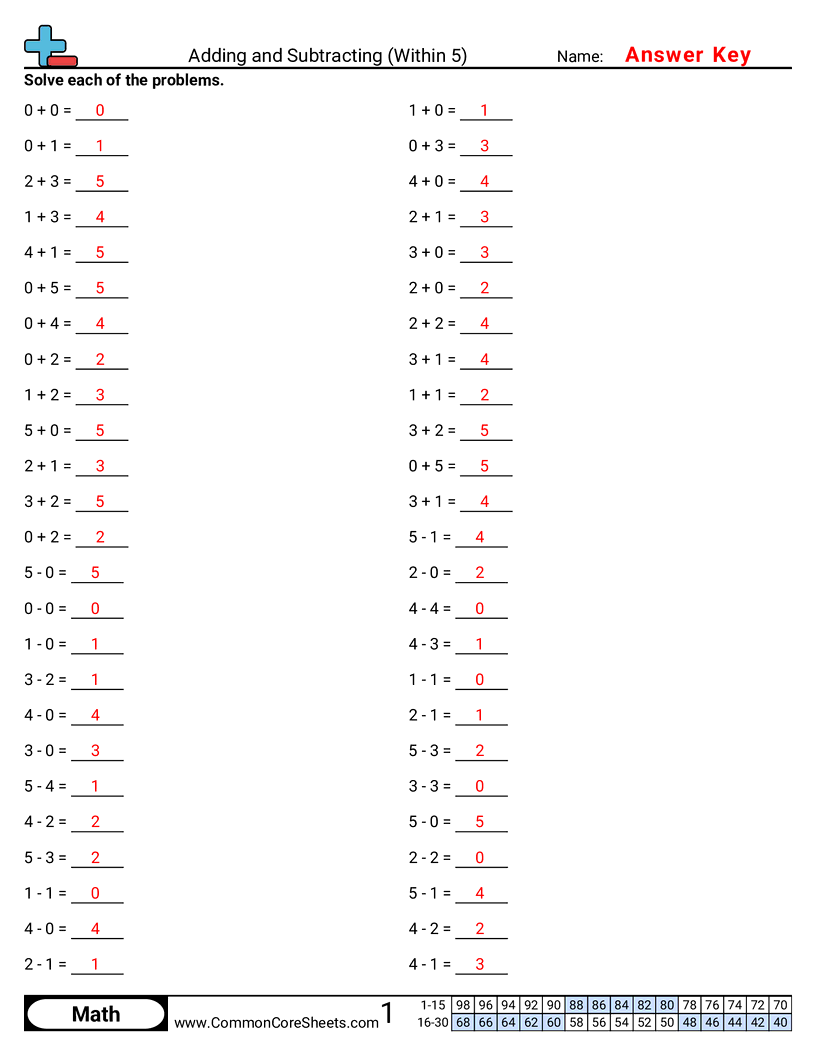
Add two small numbers and find the total up to 5. Recognize and remember common addition facts that make 5 or less.
koa5
Add two small numbers to find a total up to 5. Subtract within 5 to find how many are left. Solve mixed addition and subtraction facts and choose the correct operation. Answer basic facts quickly using mental math.
1nbt5
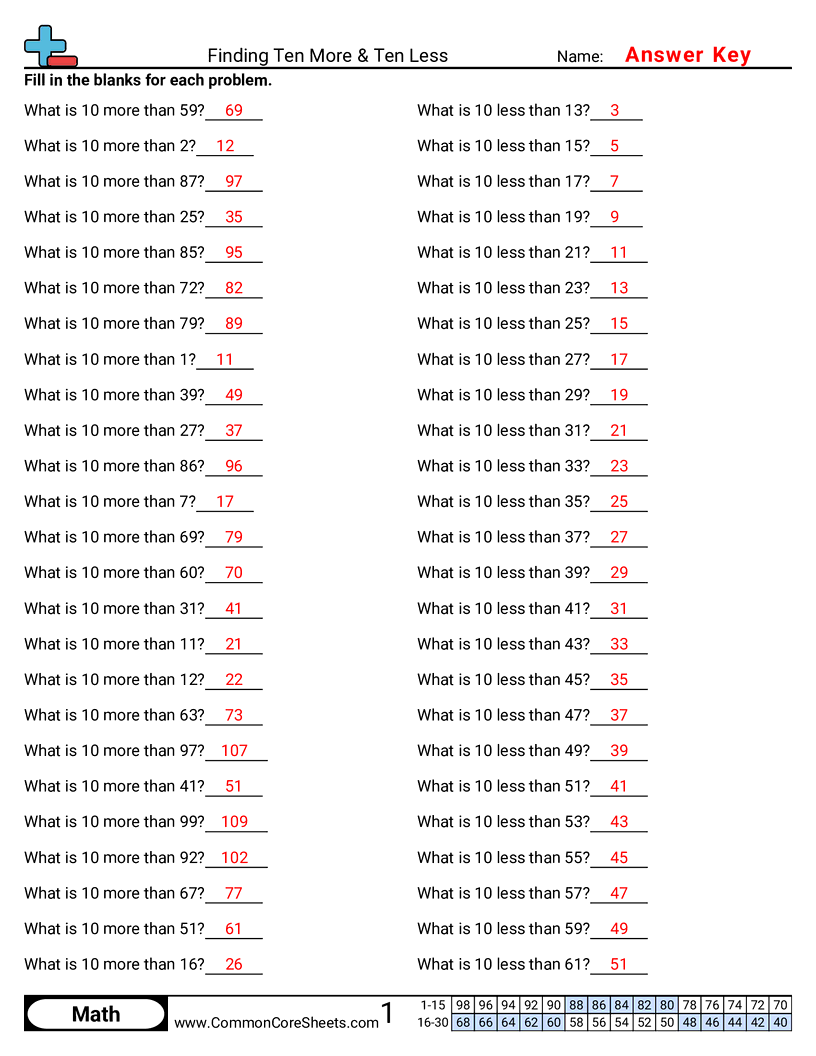
Find ten more or ten less than a two-digit number. Use place value to see how changing the tens digit changes the number.
1oa6
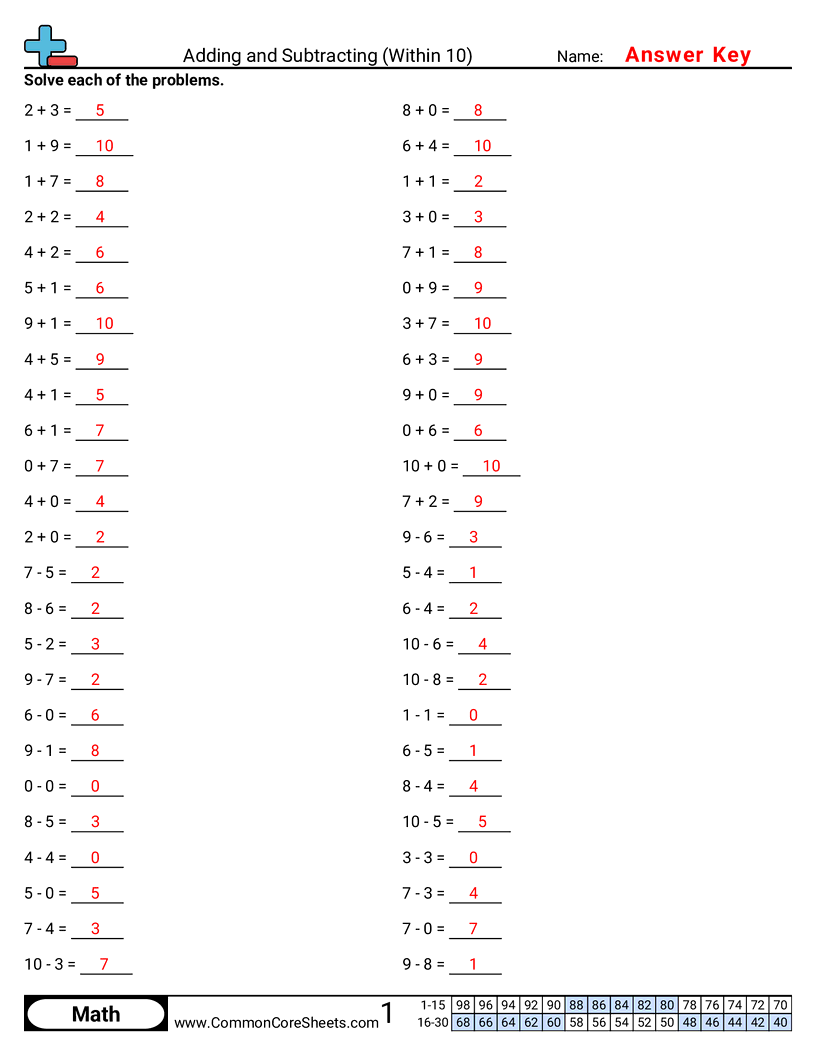
Add two numbers where the total is 10 or less. Subtract one number from another when the answer stays within 10. Switch between addition and subtraction and choose the right operation for each problem. Build speed and accuracy with basic math facts up to 10.
1oa6
Add two numbers with sums up to 20. Subtract a number from another number and find the difference up to 20. Build speed and accuracy with basic addition and subtraction facts.
2nbt8
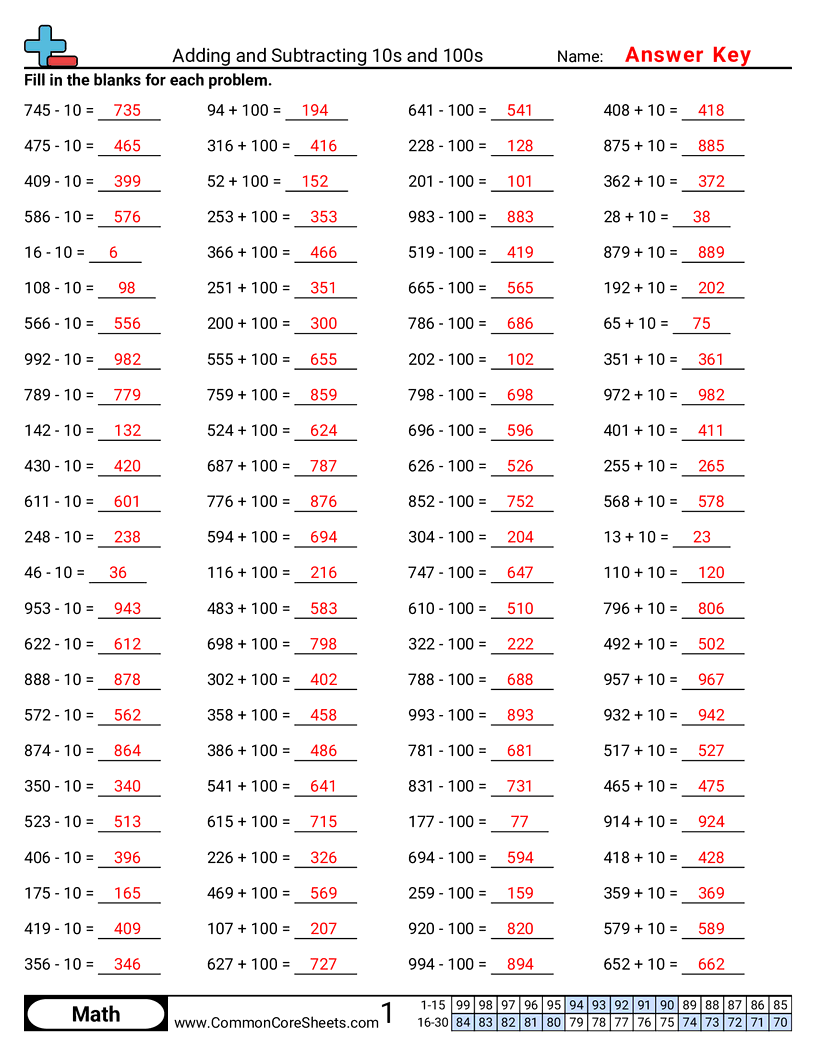
Find 10 more or 10 less than a number by changing the tens digit. Find 100 more or 100 less than a number by changing the hundreds digit. Use place value to keep the ones digit the same when adding or subtracting tens and hundreds. Do quick mental math with three-digit numbers without writing out long addition or subtraction.
1oa6 2oa2
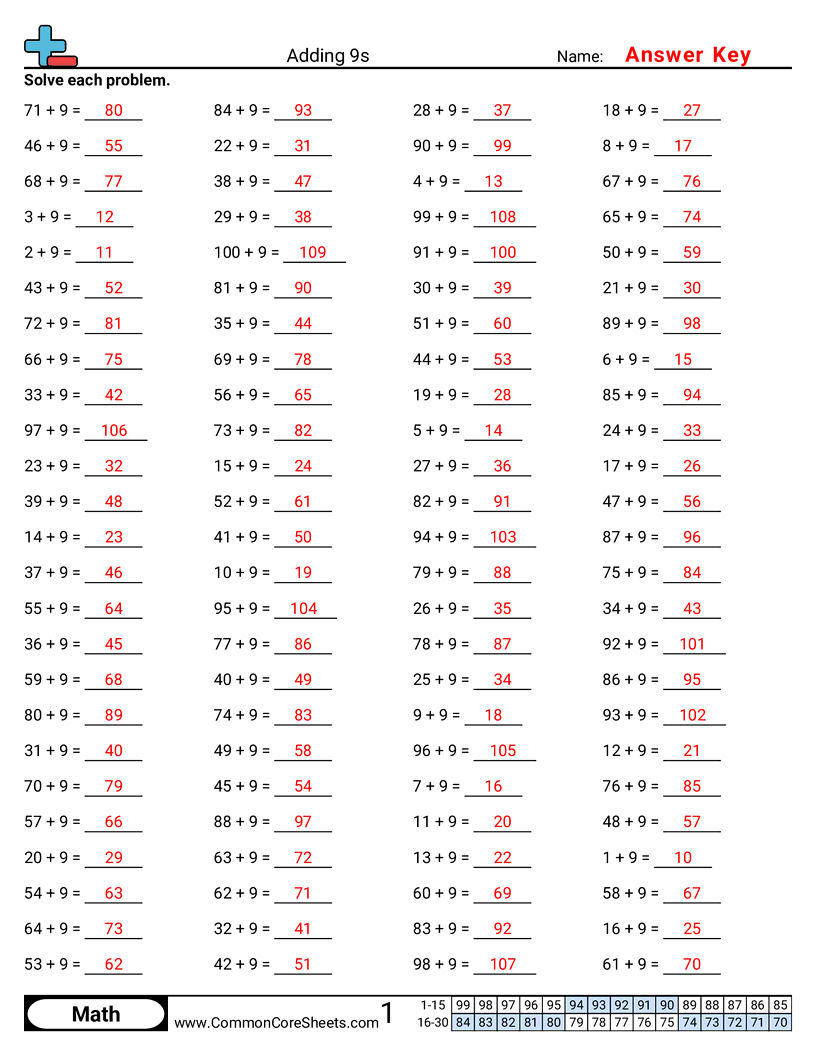
Practice quickly adding 9 to a number. Use a mental math trick for +9, like add 10 then subtract 1. Build speed and accuracy with basic addition facts involving 9. Recognize patterns when numbers increase by 9.
2nbt5
Find the number you need to add to reach the next multiple of 10. Use the ones digit to quickly figure out how far a number is from the nearest ten. Build speed and accuracy with mental addition facts that make a ten.
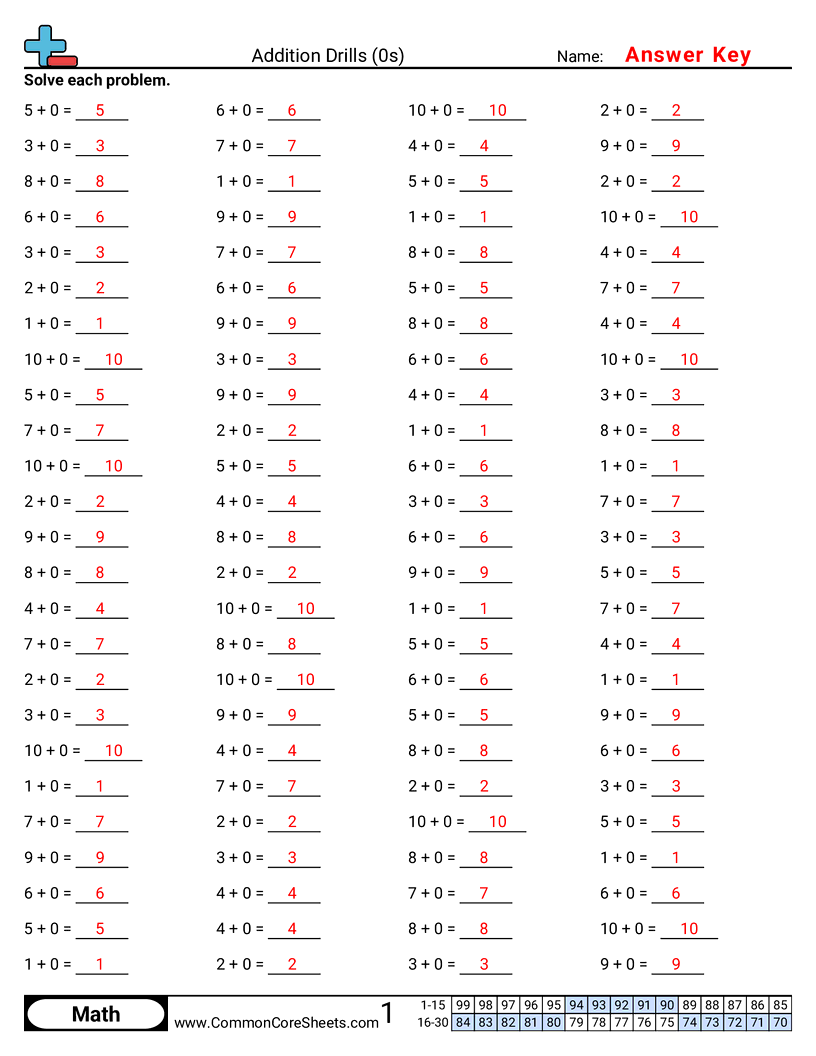
Add 0 to a number and see that the number stays the same. Recognize patterns in sums when one addend is always 0.
1oa6
Practice adding 1 to another number to find the total. Get faster at basic addition facts with 1. Recognize that adding 1 makes the number go up by one.
1oa6
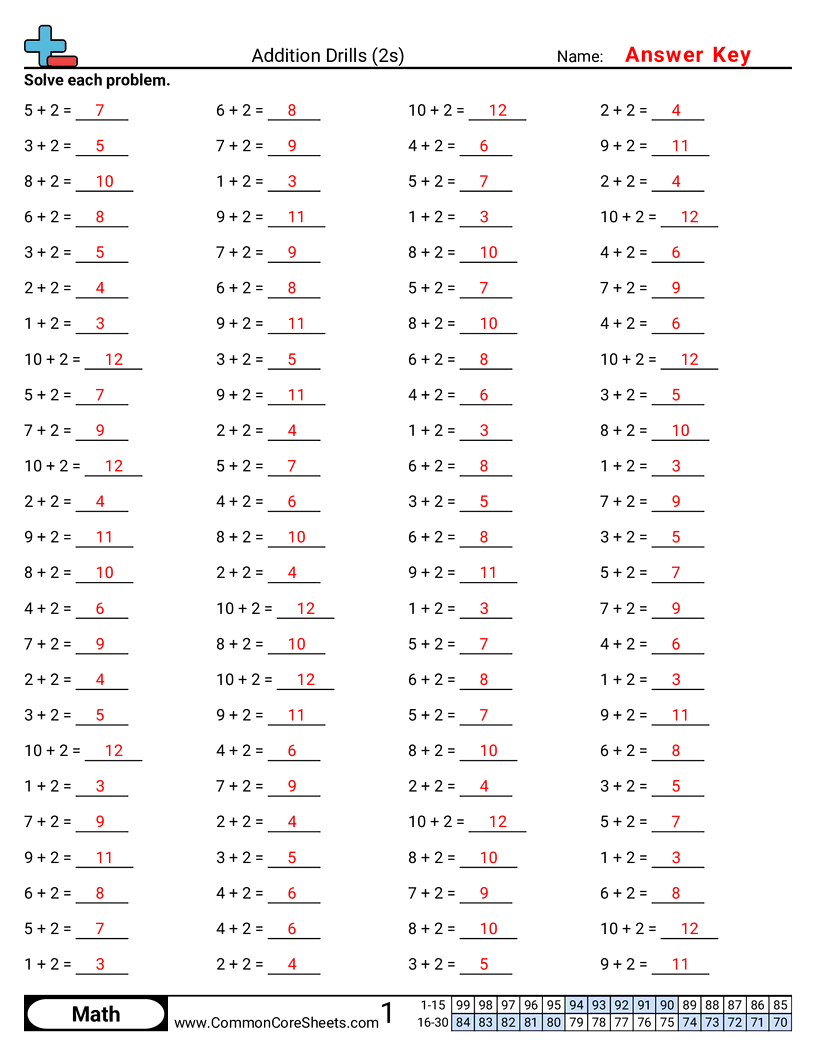
Add 2 to a number from 1 to 10 to find the total. Memorize and recall the +2 addition facts quickly. Build speed and accuracy with basic addition facts.
1oa6
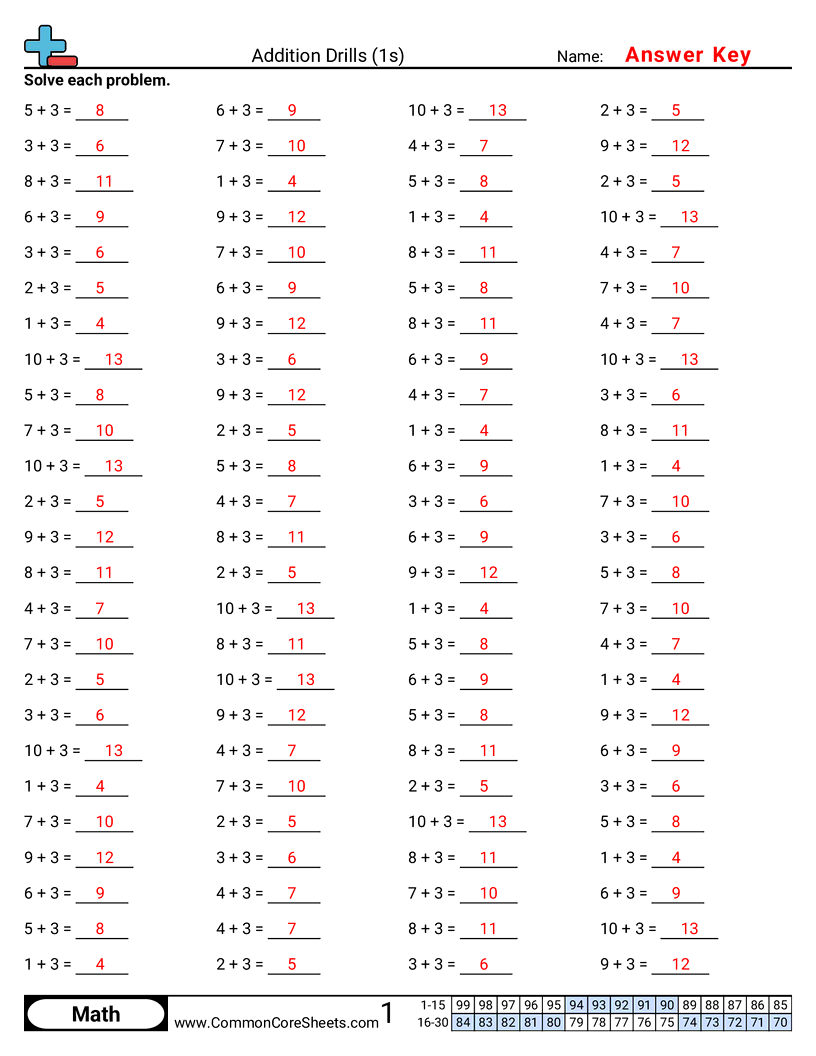
Get quick at adding 3 to another number. Build confidence with basic addition facts that include 3.
2oa2
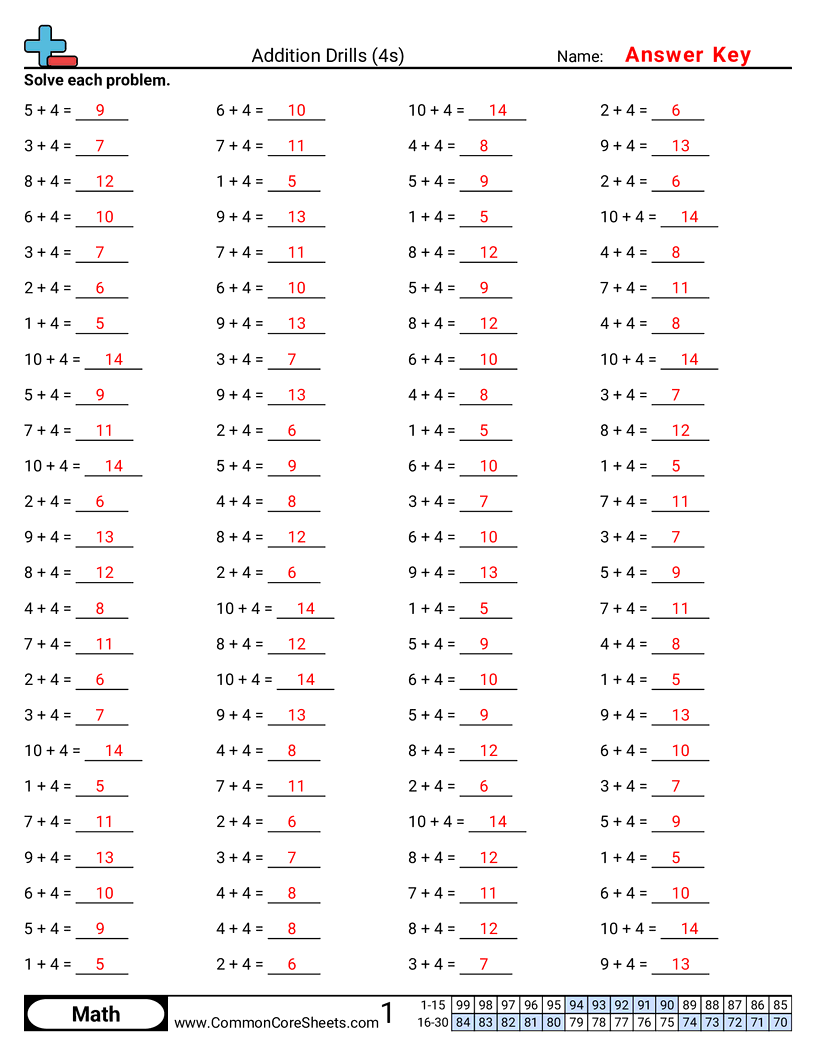
Practice adding 4 to numbers from 1 to 10. Memorize and recall the addition facts in the 4s family quickly. Build speed and accuracy with simple mental addition.
2oa2
Practice adding 5 to another number to find the total quickly. Memorize and recall the addition facts for 5 + 1 through 5 + 10. Build speed and accuracy with simple addition without using fingers or a calculator.
1oa6
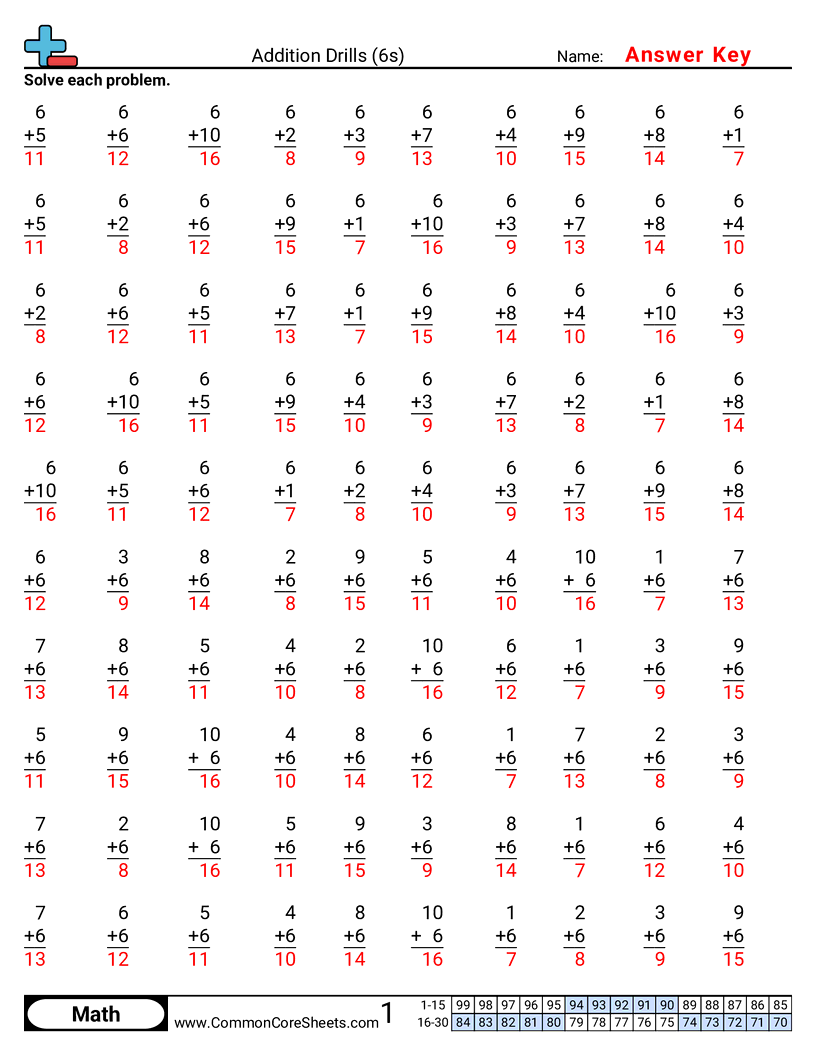
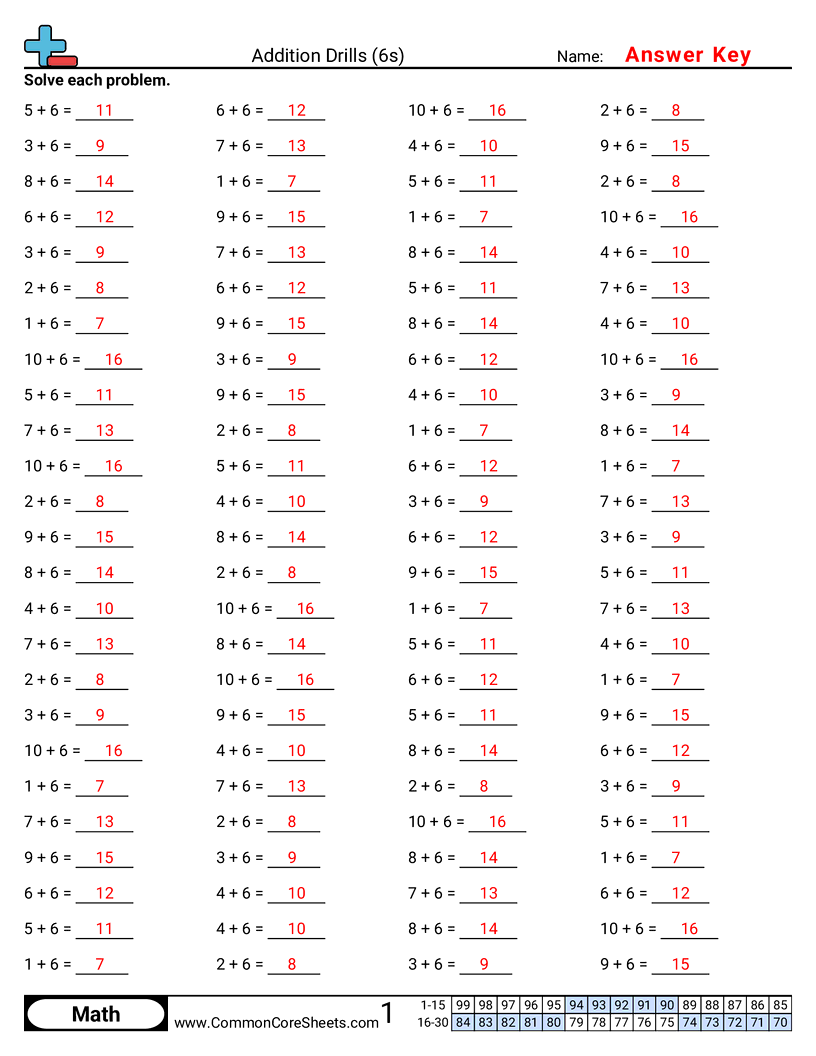
Practice adding 6 to a number from 1 to 10. Learn the addition facts in the 6s family so they come quickly from memory. Build speed and accuracy when solving simple addition problems in your head.
2oa2
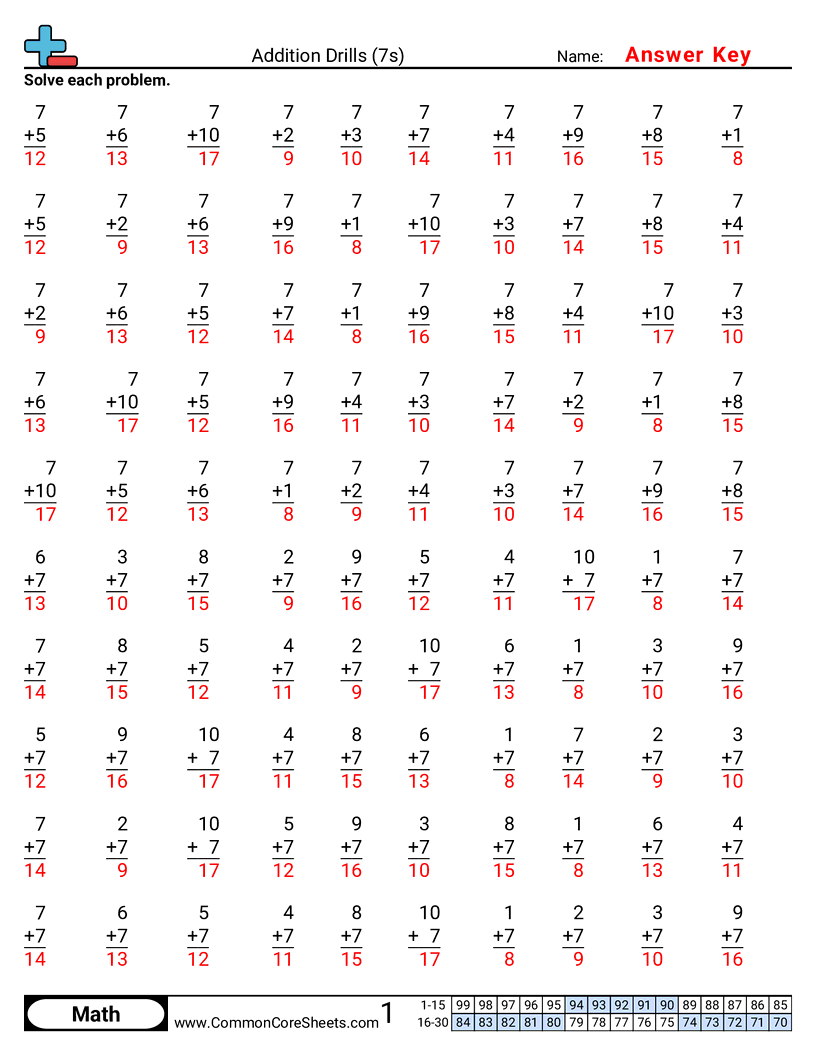
Practice adding 7 to numbers from 1 to 10 quickly and accurately. Memorize and recall the basic addition facts that start with 7. Build speed with mental math when one addend is 7.
2oa2
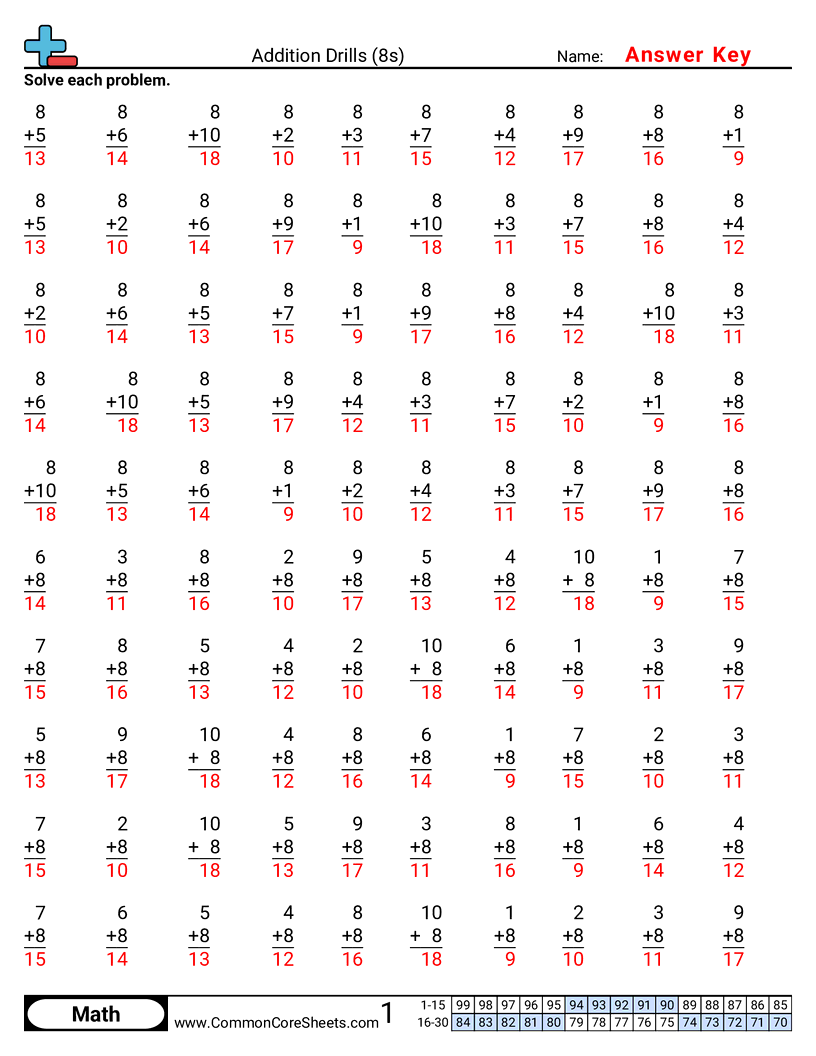
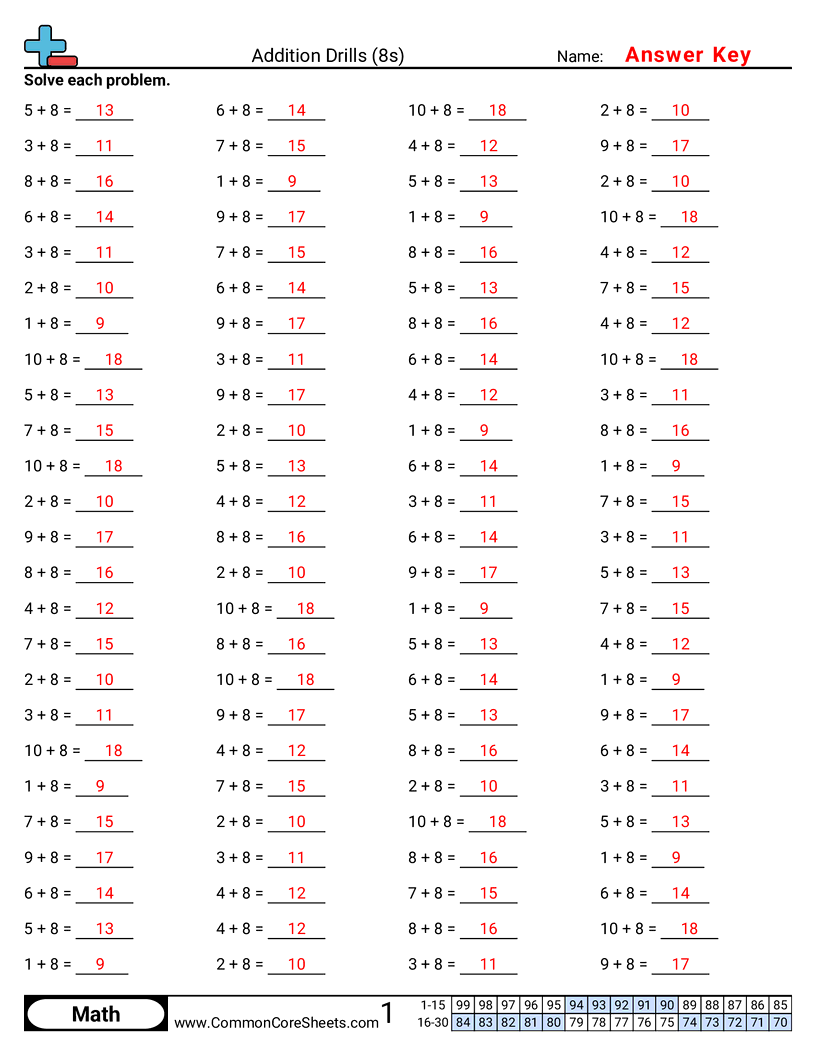
Practice adding 8 to a number from 1 to 10. Learn the addition facts in the 8s family so they come to mind quickly. Build speed and accuracy with simple addition without using fingers or a calculator.
2oa2
Practice adding 9 to a number from 1 to 10. Get faster at 9s addition facts without using fingers or a calculator. Use a quick strategy like “add 10, then subtract 1” to solve 9s facts.
1oa6
Use the pattern that adding 10 makes the ones digit stay the same while the tens digit increases by 1. Practice doing these sums in your head without counting one by one.
2oa2
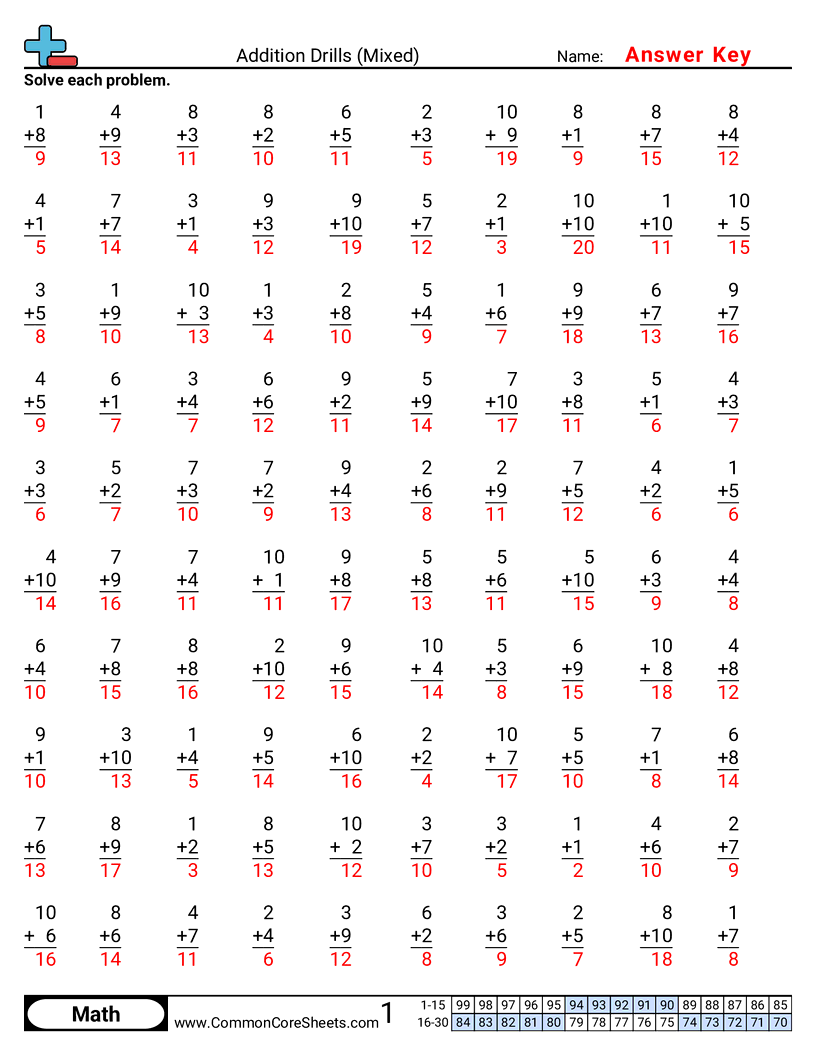
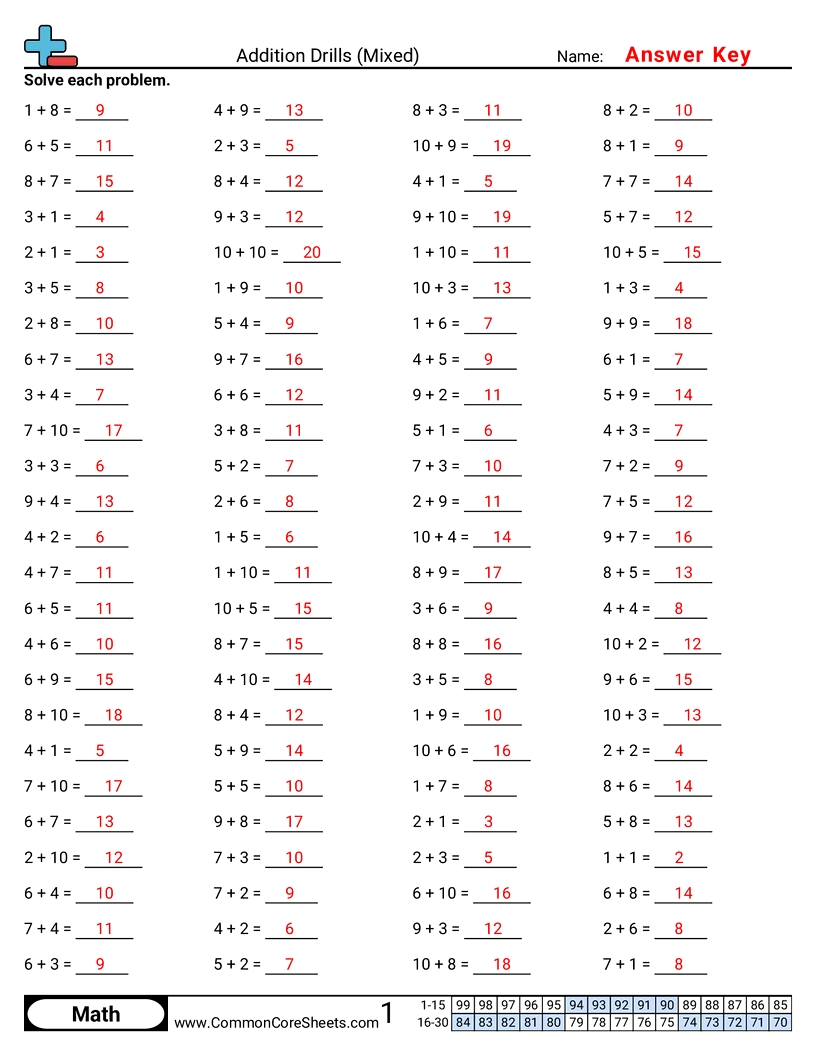
Add two numbers from 1 to 10 quickly and accurately. Recall basic addition facts without counting on fingers. Build speed and confidence with mixed addition facts.
1oa6
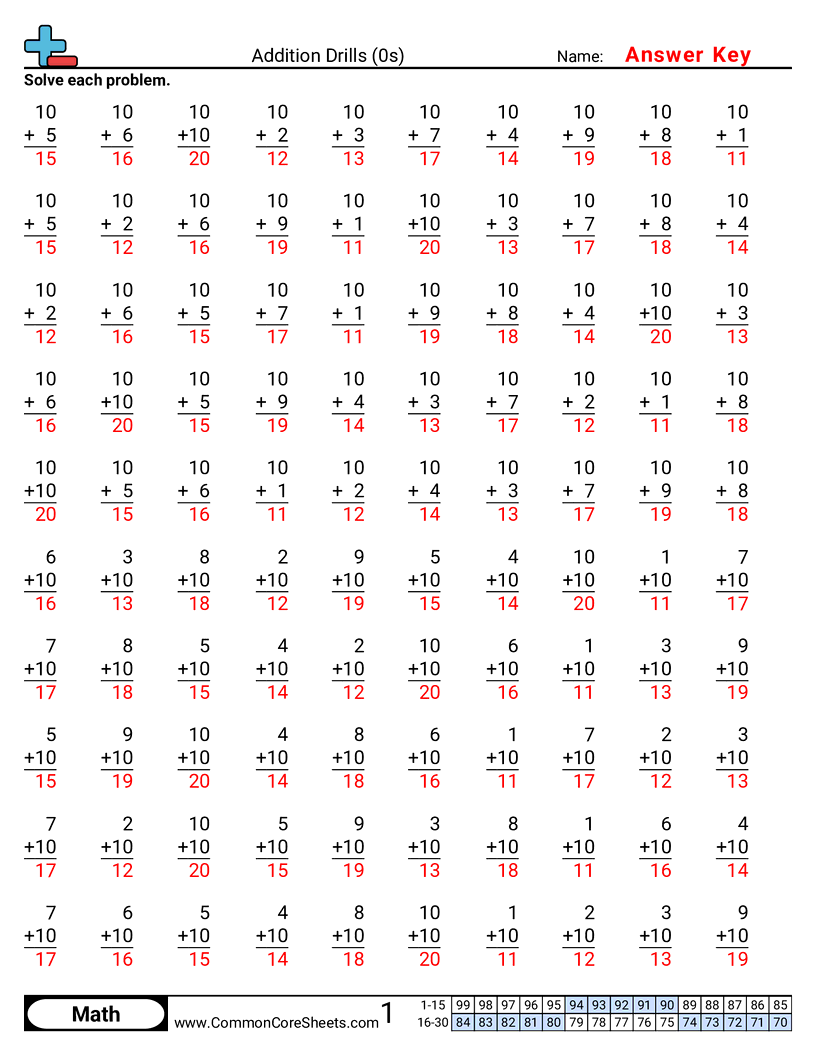
Practice adding 0 to a number and seeing that the number stays the same. Build speed and confidence with basic addition facts that include 0.
1oa6
Practice adding 1 to a number from 1 to 10. Get faster at basic addition facts that include +1. Notice the pattern that adding 1 makes the number go up by one. Build confidence doing simple mental math without counting on fingers.
1oa6
Add 2 to numbers from 1 to 10 quickly and accurately. Build confidence with basic addition facts so answers come to mind without counting.
2oa2
Add 3 to another number quickly and correctly. Recognize and remember the addition facts for 3 (like 3+7 and 3+9).
2oa2
Add 4 to numbers from 1 to 10 quickly and correctly. Build speed and confidence with mental math for simple addition.
2oa2
Memorize and recall the “5 plus” addition facts without counting. Build speed and accuracy with simple addition in your head.
2oa2
Add 6 to a number from 1 to 10 quickly and correctly. Memorize and recall the addition facts for the 6s. Build speed and confidence with mental math when adding a small number to 6.
2oa2
Add 7 to a number from 1 to 10 quickly and accurately. Memorize the addition facts for 7 (like 7+6 and 7+9). Use mental math to find sums without counting one by one.
2oa2
Add 8 to a number quickly and accurately. Recall the addition facts for 8 + 1 through 8 + 10 from memory. Use mental math to find sums when one addend is 8.
2oa2
Practice adding 9 to a number from 1 to 10. Use mental math to add 9 by thinking “add 10, then take 1 away.” Build confidence with quick, accurate addition without counting on fingers.
1oa6
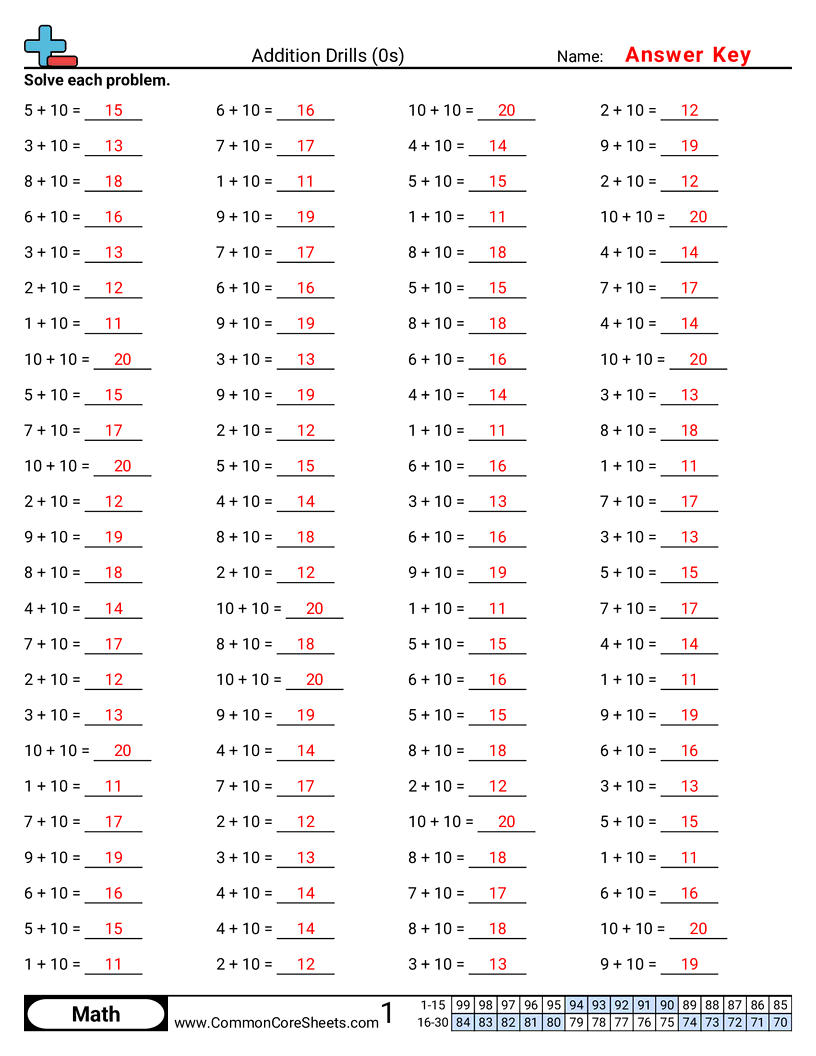
Add 10 to a number from 1 to 10 to find the total. Use the pattern that adding 10 makes the number 10 more to solve problems quickly.
2oa2
Add two numbers from 1 to 10 quickly and accurately. Recall basic addition facts without counting on fingers.
1oa8
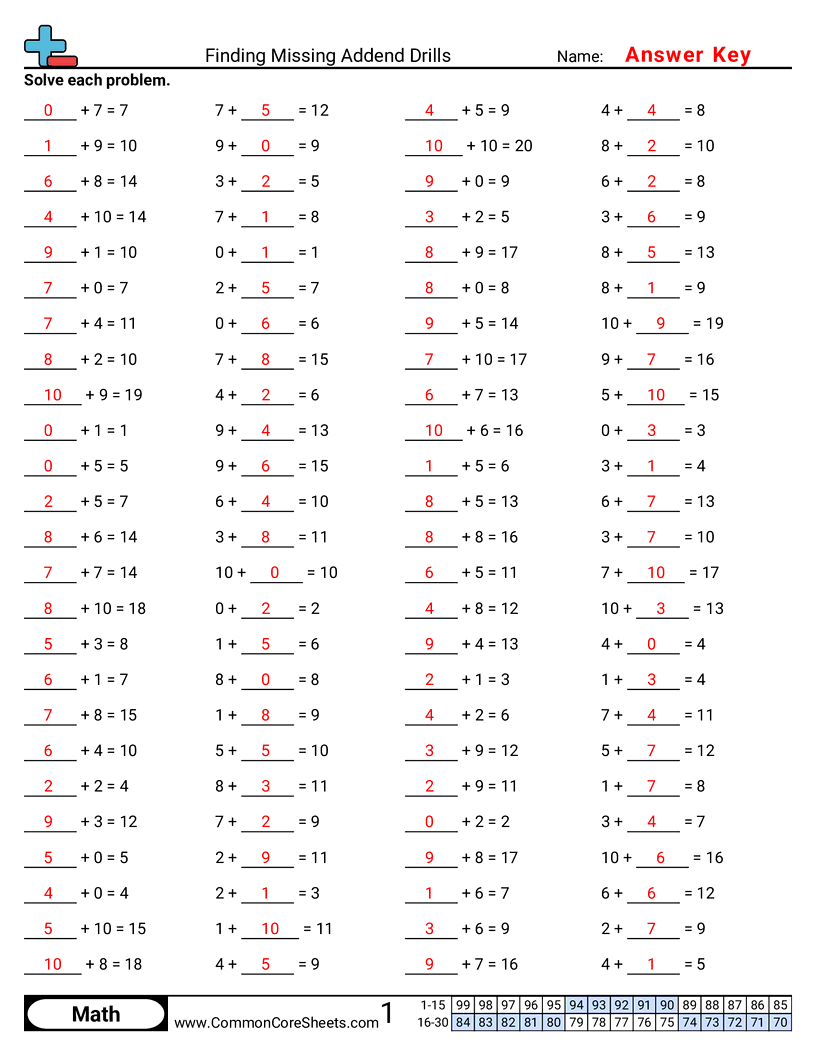
Find the missing number that makes an addition sentence true. Use what you know about addition facts to solve for an unknown addend quickly. Read and solve equations with a blank or box in different positions. Build speed and accuracy with mental math when one part of the sum is missing.
1oa6
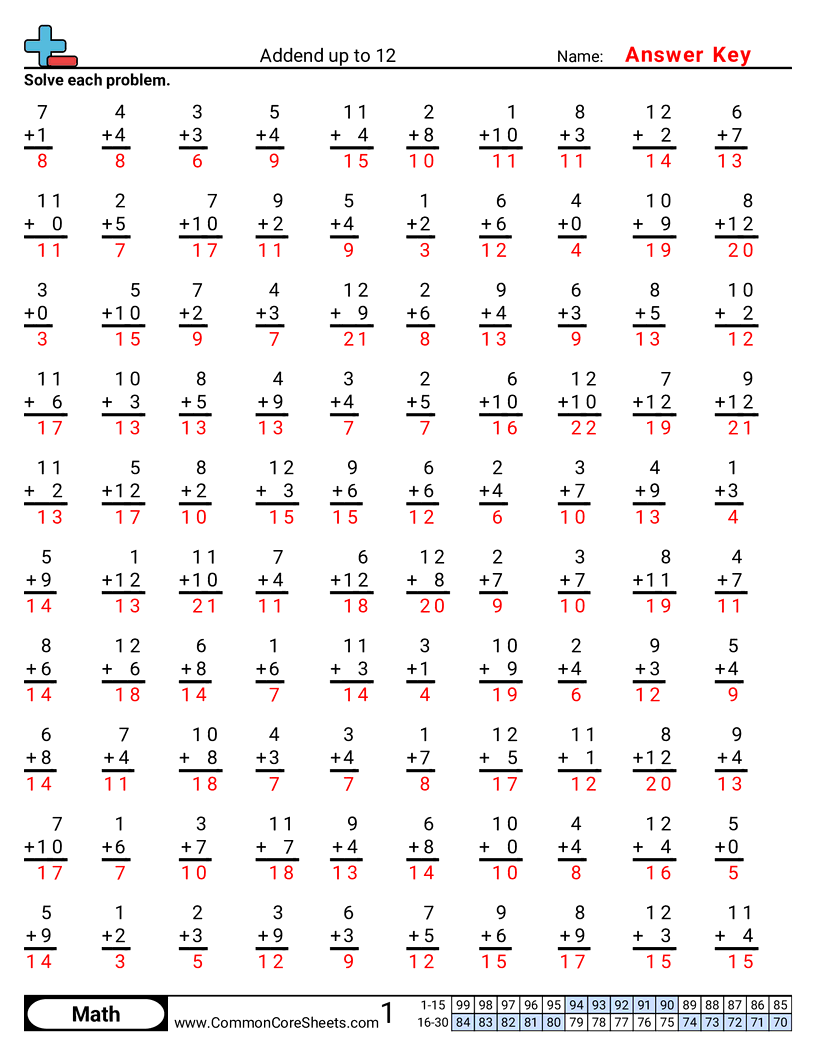
Add two numbers when one addend is 12 or less. Build speed and accuracy with basic addition facts up to 12.
About these worksheets
Time drill worksheets help students practice adding and subtracting hours and minutes on a 12-hour clock. Problem sets cover adding hours, adding in 15-minute increments, subtracting hours, and subtracting in 15-minute increments. Each worksheet contains 50 problems for building speed with time calculations.
3md1
Add a number of hours to a starting time on a 12-hour clock. Count forward by hours and keep the time label correct (AM or PM). Handle sums that pass 12 o’clock and wrap around to the next hour correctly. Read and write times using hour-only clock notation (like 7:00).
3md1
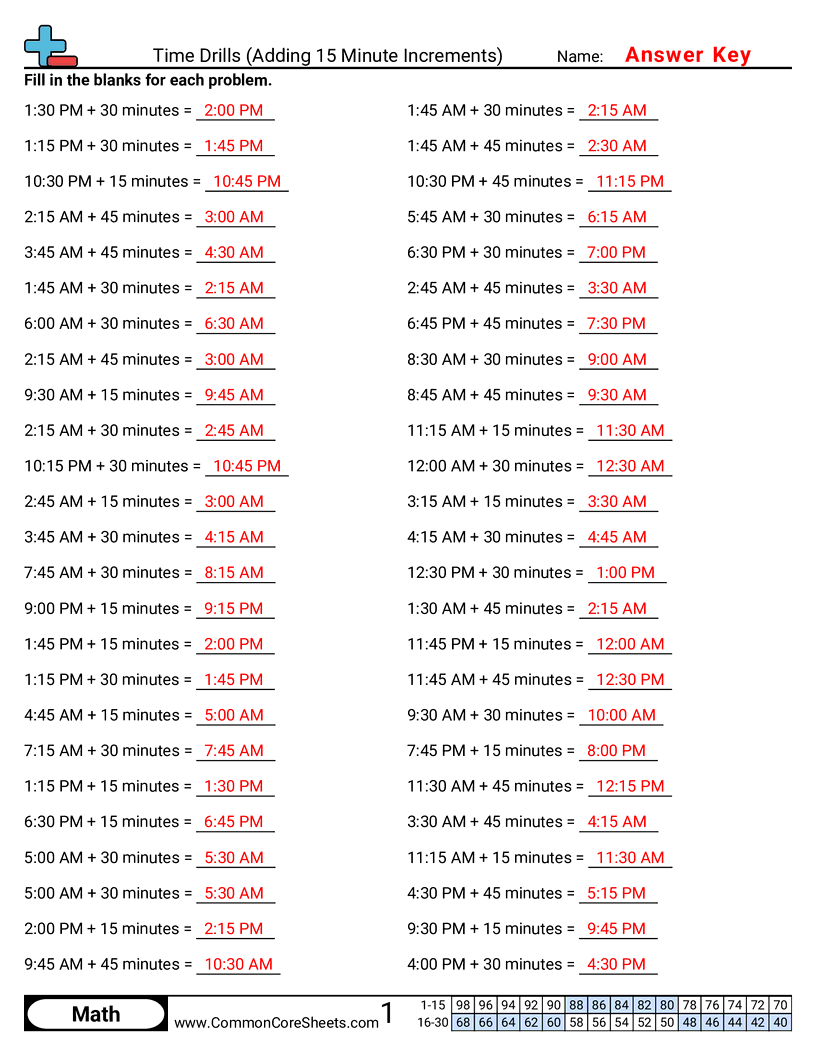
Add minutes in 15-minute steps to find a new time. Count forward by quarters of an hour (15, 30, 45, 60) without losing track. Handle totals that pass 60 minutes and understand that 60 minutes makes 1 hour. Read and work with times shown in minutes, including a.m. and p.m.
About these worksheets
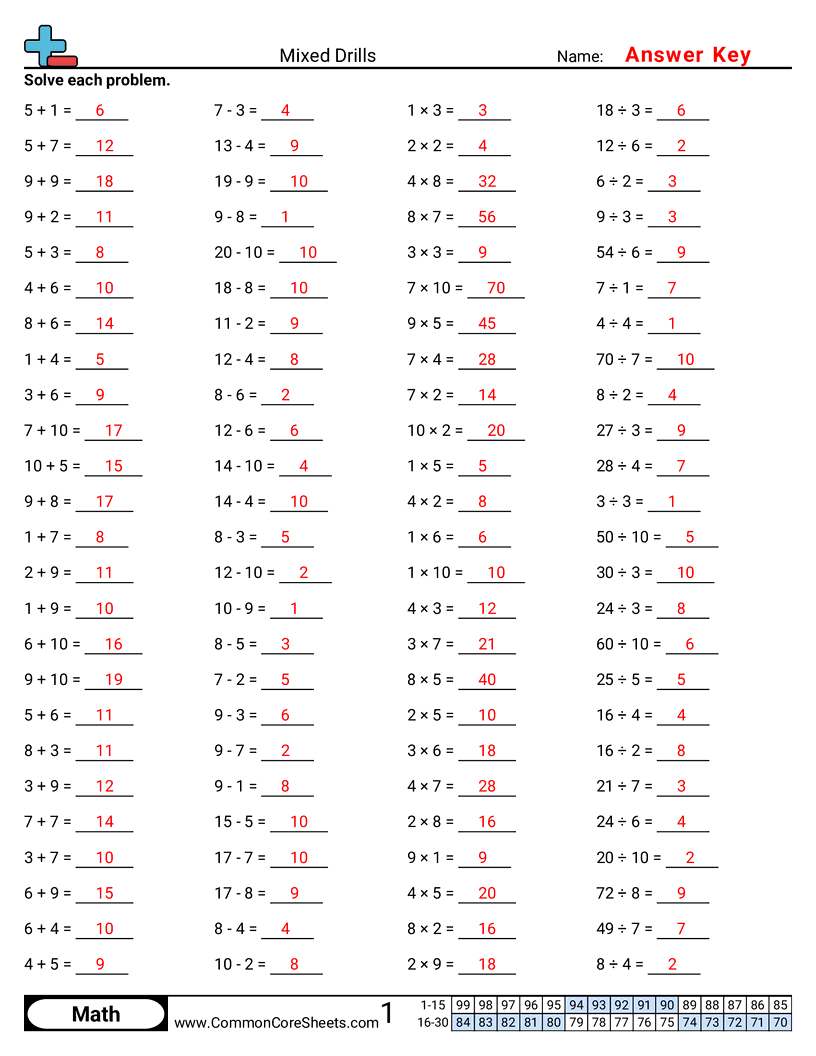
Mixed drill worksheets combine multiple operations in a single practice set. Students solve 100 problems covering addition, subtraction, multiplication, and division facts, building fluency in choosing the right operation and computing quickly. Additional practice includes finding ten more and ten less within 100.
1oa6 3oa7
Practice quickly solving basic addition facts. Get faster at choosing the right operation when problems are mixed. Build accuracy when doing mental math without a calculator. Improve fluency by working through random fact problems without a pattern.
1nbt5
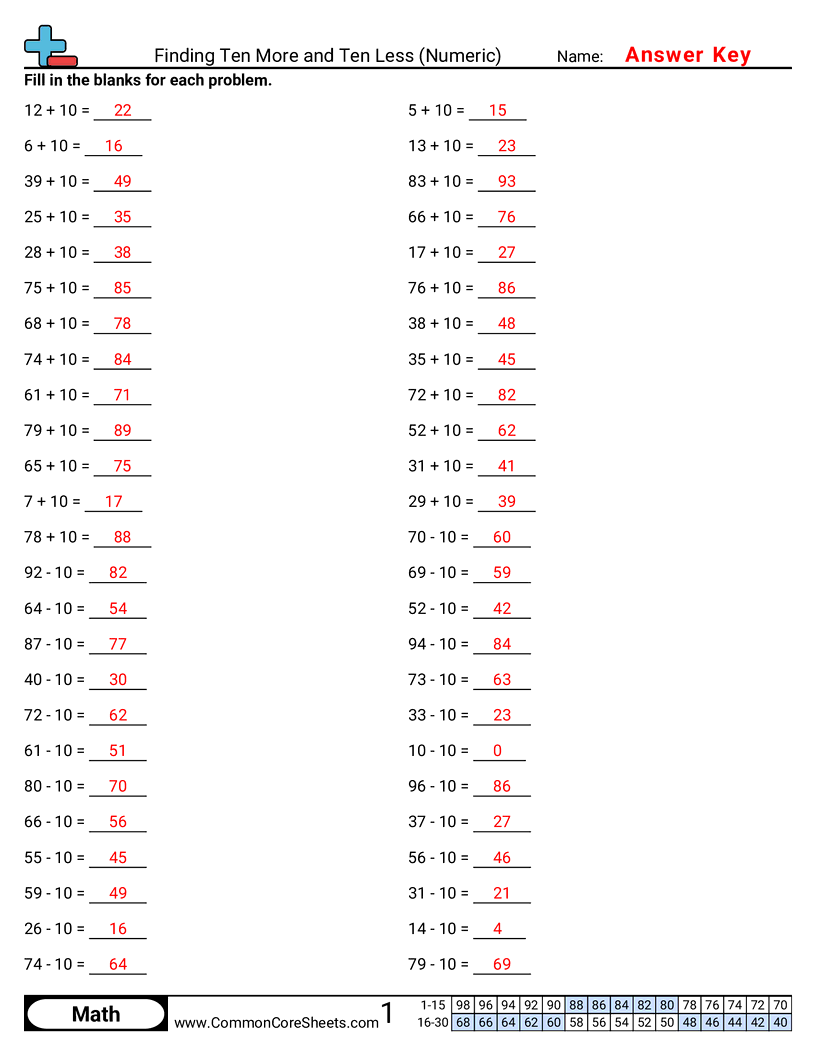
Find the number that is 10 more than a given number. Find the number that is 10 less than a given number. Use place value to see how adding or subtracting 10 changes the tens digit while the ones digit stays the same. Work quickly and accurately with numbers up to 100 by spotting the +10 and -10 pattern.
Playwire Advertisement