Probability Worksheets
Free probability worksheets with answer key. No login or account needed. From spinners to dice and even word problems, we've got you covered. A grading column and quick grade scale make grading a breeze, and modified pages help with lower level learners or when just introducing a topic. Great for teachers or for homeschool.


About these worksheets
These worksheets introduce basic probability concepts through hands-on scenarios. Students determine the likelihood of selecting specific items from a set, identify most and least probable outcomes, and calculate probability using spinners, dice, and object arrays. Activities build an intuitive understanding of chance and likelihood.
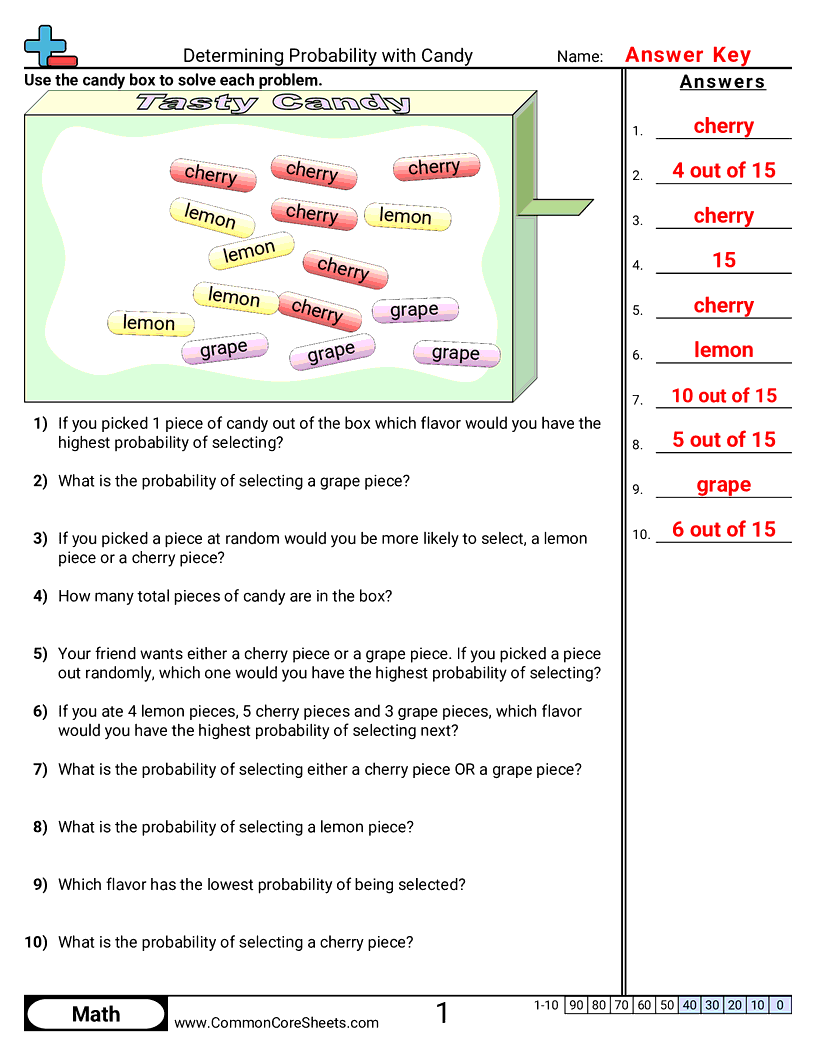

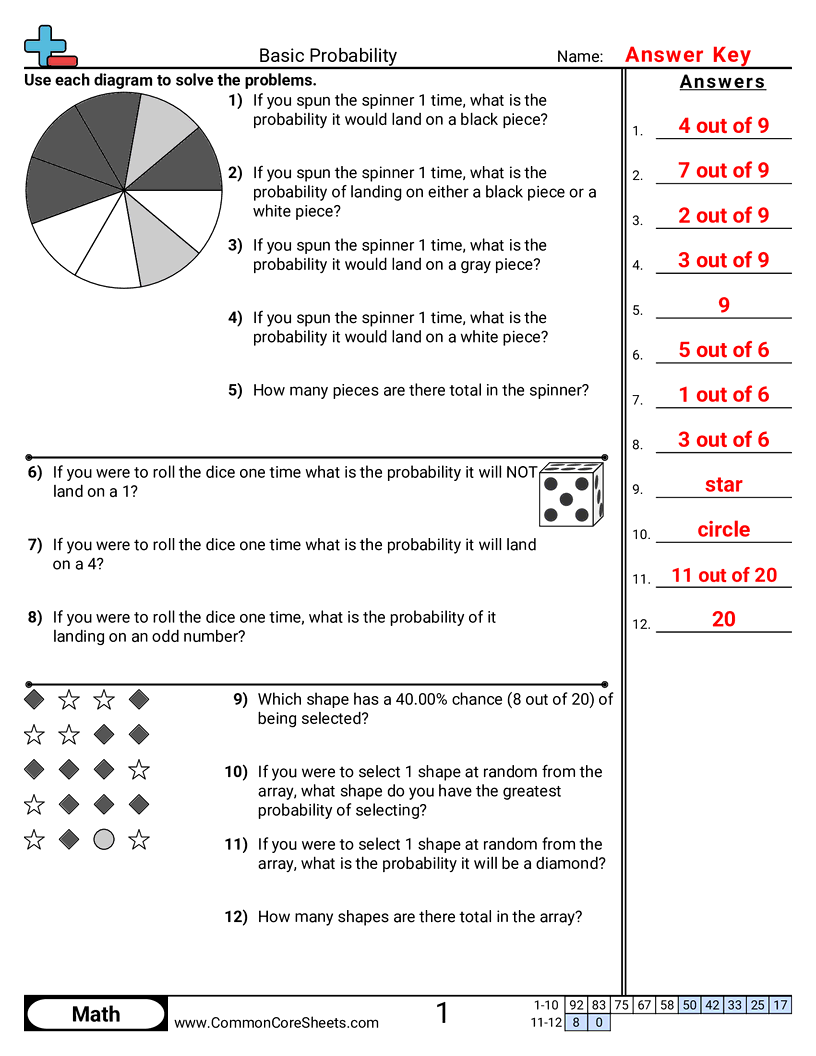


Basic Probability

- Find the probability of an event by counting favorable outcomes out of all possible outcomes.
- Read a spinner or die and list the possible outcomes in the sample space.
- Compare which event is more likely, less likely, or equally likely based on the numbers of outcomes.
- Use pictures or arrays of objects to calculate the chance of picking a certain item at random.


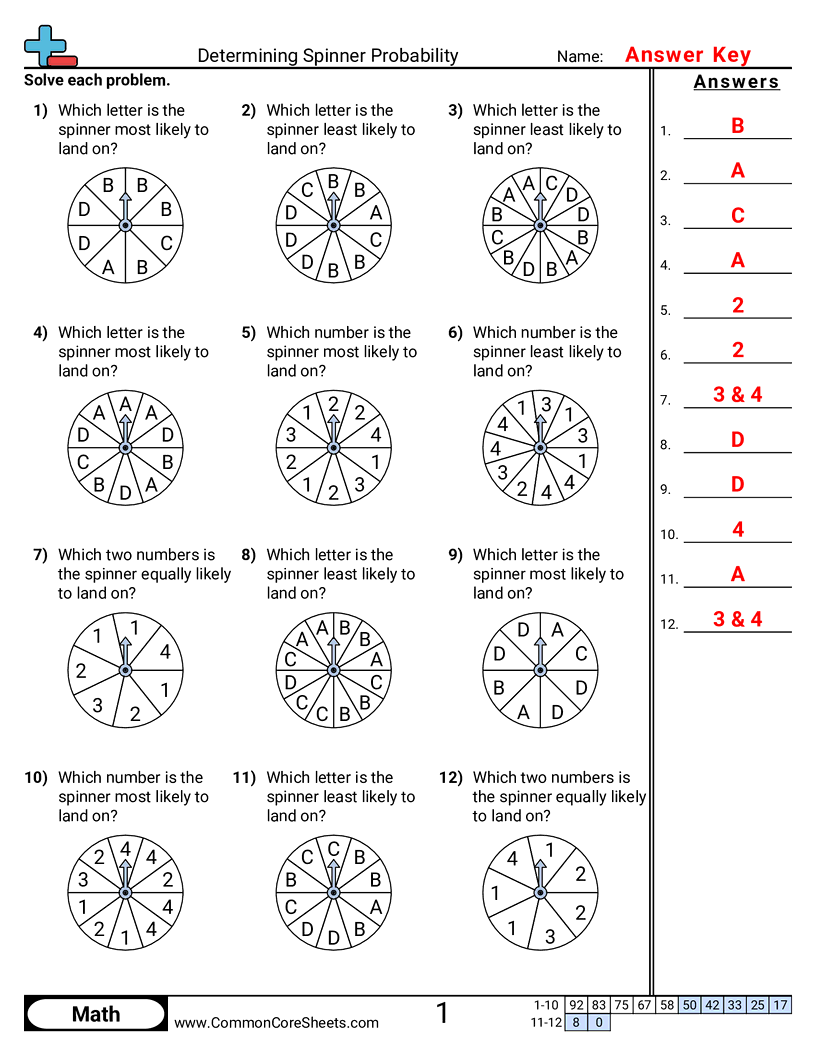
Determining Spinner Probability
- Look at a spinner and decide which value is most likely to be landed on.
- Look at a spinner and decide which value is least likely to be landed on.
- Tell when two or more outcomes are equally likely by comparing the sizes or counts of sections.
- Match probability words like most likely, least likely, and equally likely to what the spinner shows.

Describing Probability from Impossible to Certain (Word Problems)
- Describe the likelihood of an event using the words impossible, unlikely, equally likely, likely, and certain.
- Compare the number of favorable outcomes to the total outcomes to judge likelihood.
- Recognize events with probability 0 (impossible) and 1 (certain).
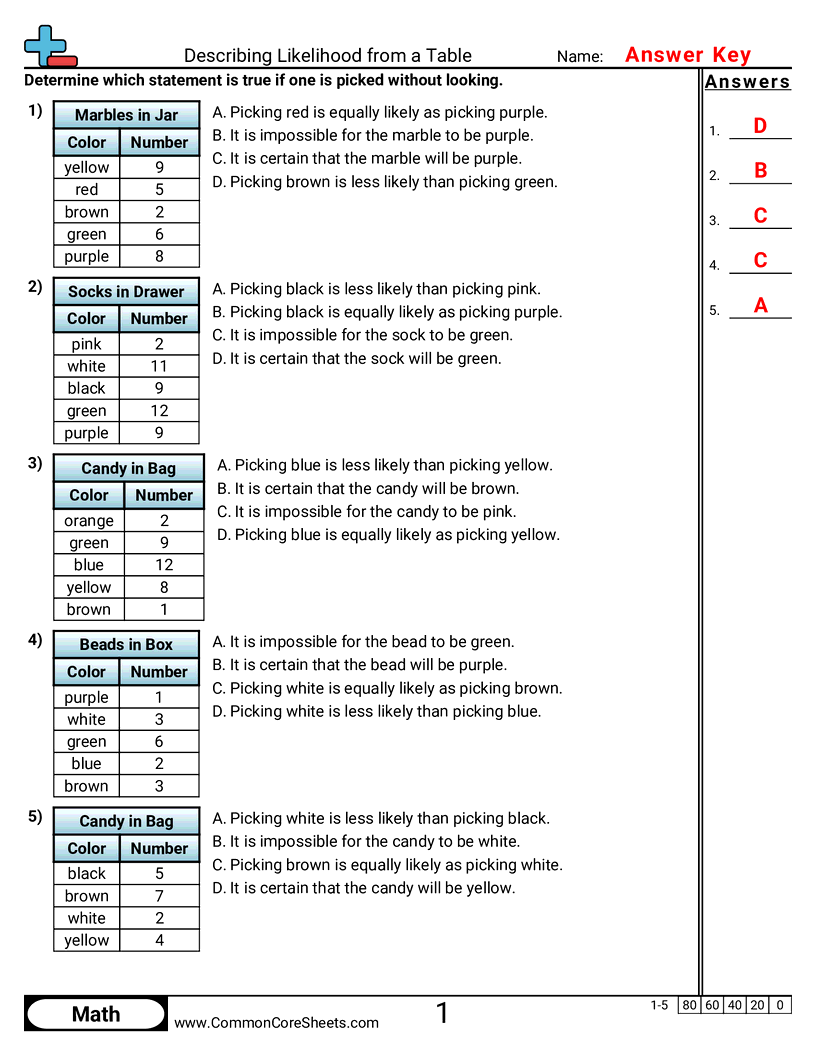
Describing Likelihood from a Table
- Decide whether an outcome is certain, impossible, equally likely, more likely or less likely
- Recognize that a color not listed in the table is impossible to pick
- Compare two counts to judge which outcome is more likely
- Judge whether a likelihood statement is true rather than simply naming a chance
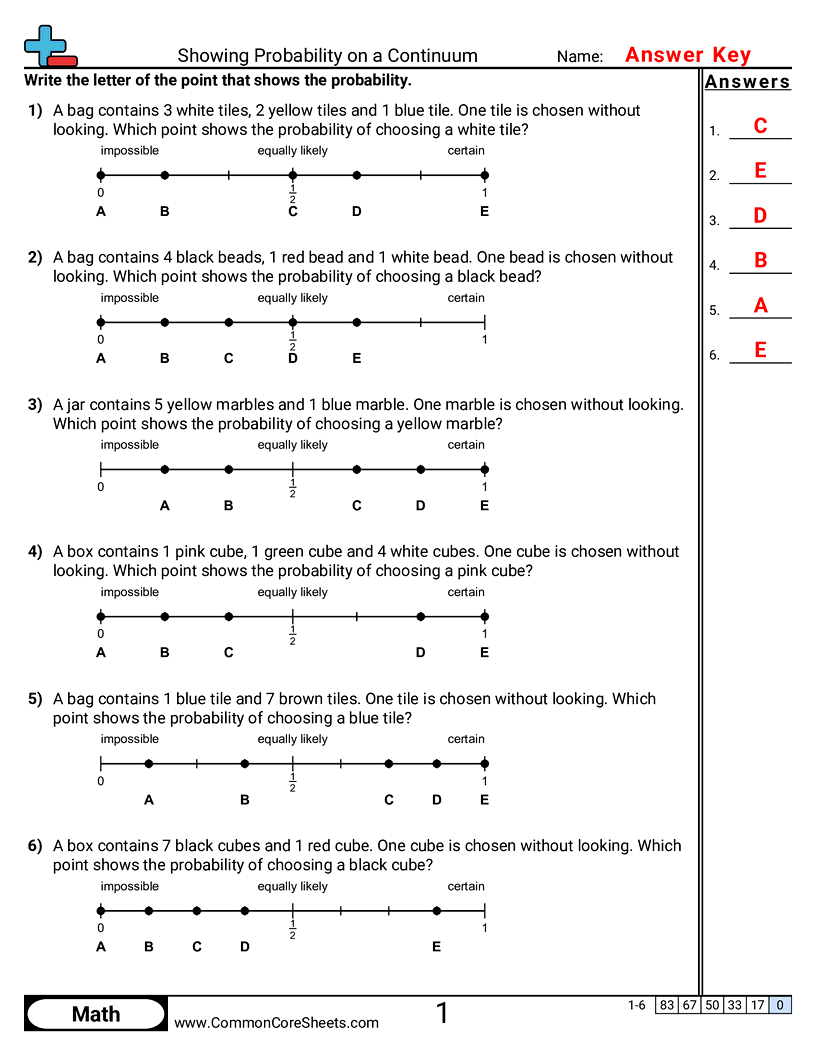
Showing Probability on a Continuum
- Write a probability as a fraction of the whole.
- Place a probability on a line from impossible to certain.
- Recognize that impossible is zero and certain is one.

Describing the Probability of a Spin
- Read a probability from a picture of a spinner.
- Decide which sections satisfy a condition before counting them.
- Describe a probability using the five likelihood words.

Matching an Experiment to a Probability Word
- Test several events against one likelihood word.
- Work out a probability from a coin, a number cube, a spinner or a bag.
- Tell certain from likely and impossible from unlikely.
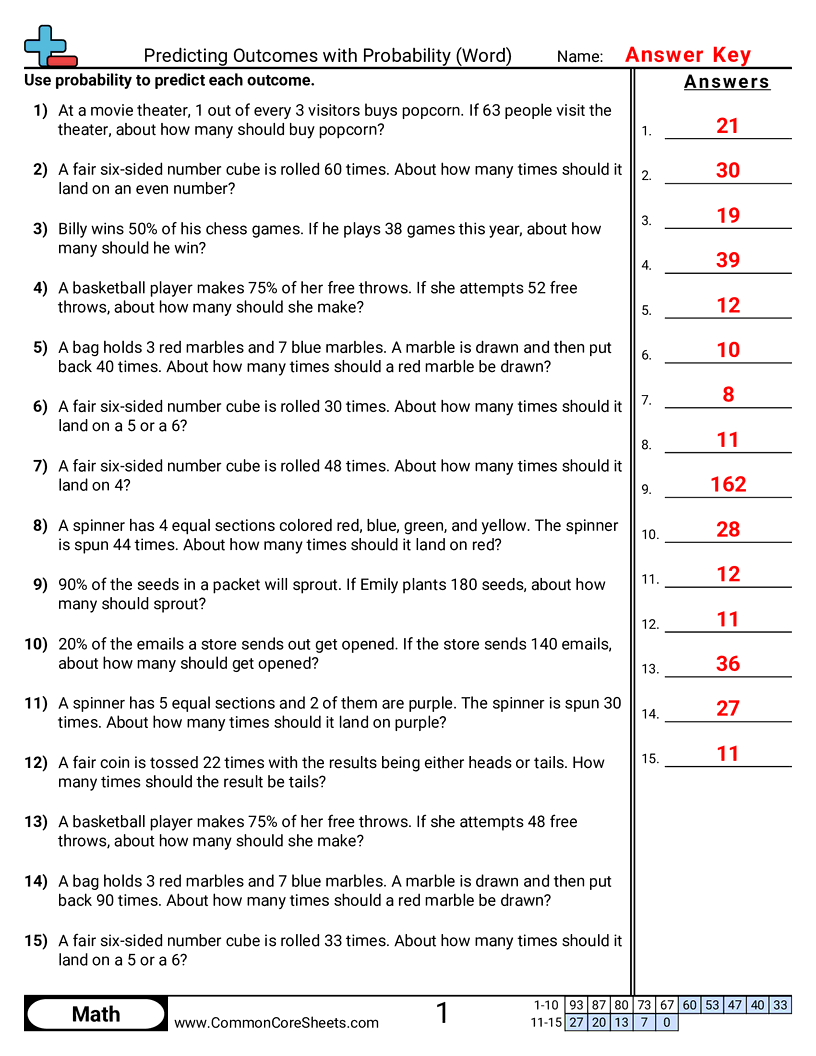
Predicting Outcomes from Theoretical Probability (Word Problems)
- Predict how many times an outcome should occur from its theoretical probability.
- Multiply the number of trials by the probability of the event.
- Work with probabilities given as fractions, ratios, and percents.
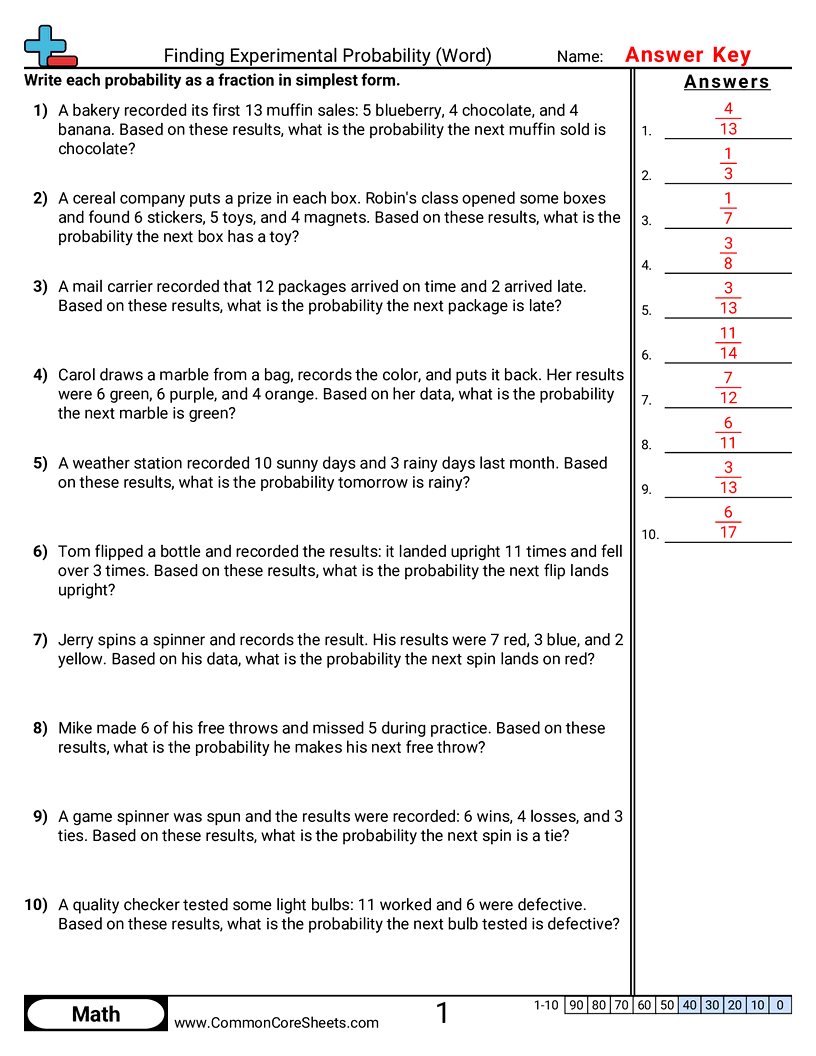
Finding Experimental Probability from Recorded Results (Word Problems)
- Calculate experimental probability from recorded results.
- Write probabilities as fractions in simplest form.
- Use experimental results to predict future outcomes when actual probabilities are unknown.

Expected and Actual Results
- Work out an expected number of results from a known probability.
- Count results recorded as tally marks.
- Put the expected number and the actual number side by side.

Comparing Results with the Known Probability
- Work out how many times an outcome should happen.
- Read how many times it actually happened.
- Say whether the results came out above or below the known probability.
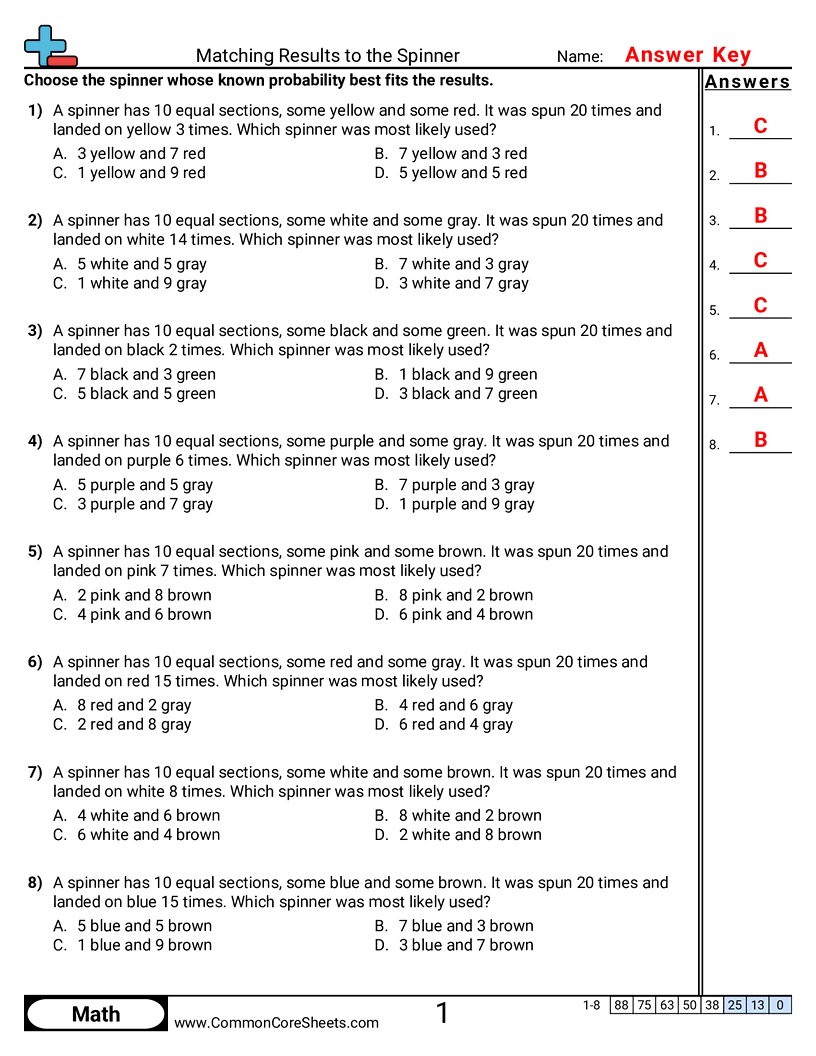
Matching Results to the Spinner
- Work out the expected results for several known probabilities.
- Compare a set of results with each one.
- Choose the probability the results fit best.
About these worksheets
Students learn to count the number of possible combinations that can be made from a set of choices. Using organized lists and systematic counting strategies, these worksheets develop combinatorial thinking and logical reasoning skills.

Identifying Combination Amounts
- Count how many different pairs or groups can be made from a set of choices.
- Use organized lists or tables to make sure every combination is counted once.
- Tell the difference between combinations (order doesn’t matter) and different orders of the same items.
- Add up the number of possibilities from different groups to find a total number of combinations.

Reading a Tree Diagram for Possible Choices
- Trace a branch of a tree diagram from the top down to a single outcome
- Recognize that two items can both appear in a diagram and still never occur together
- Decide whether a given pairing belongs to the sample space
- Tell possible outcomes from impossible ones when both use items that are shown

Finding the Sample Space of Two Spinners
- Decide whether a given pair of results is possible on two spinners
- Judge an event described by a property, such as an odd number, as well as one naming exact values
- Recognize that a value missing from a spinner makes any event using it impossible
- Select every event that belongs to the sample space, not only one