Money Worksheets
Make money math meaningful with free money worksheets on counting coins and bills, determining how much change is owed, ordering money amounts, converting between forms, and adding and subtracting money. Determining change - the money skill students use most in daily life - gets the deepest coverage. Every worksheet prints as a PDF with an answer key and works as a digital assignment too, with no login or account needed. Modified pages give developing learners fewer problems per page, and the built-in grading column with quick grade scale makes checking fast. Best suited for 1st through 4th grade classrooms, life-skills instruction, and homeschool.
More about these worksheets ▾ Show less ▴
×
About these worksheets
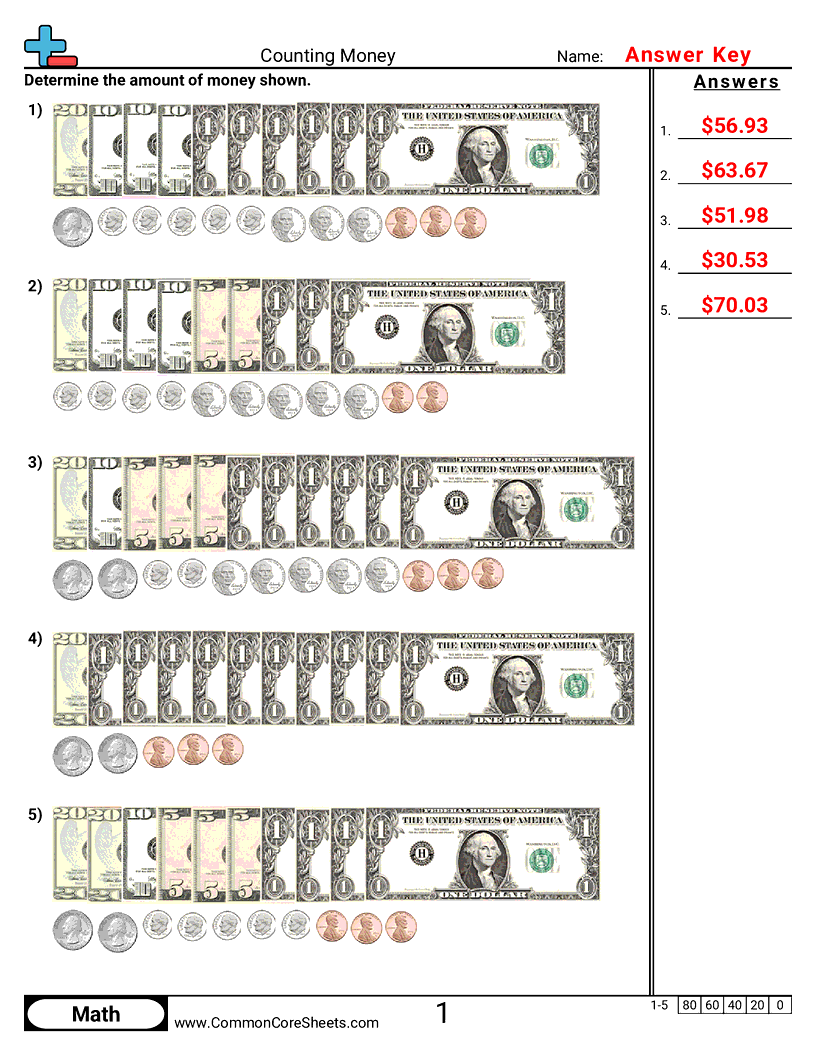
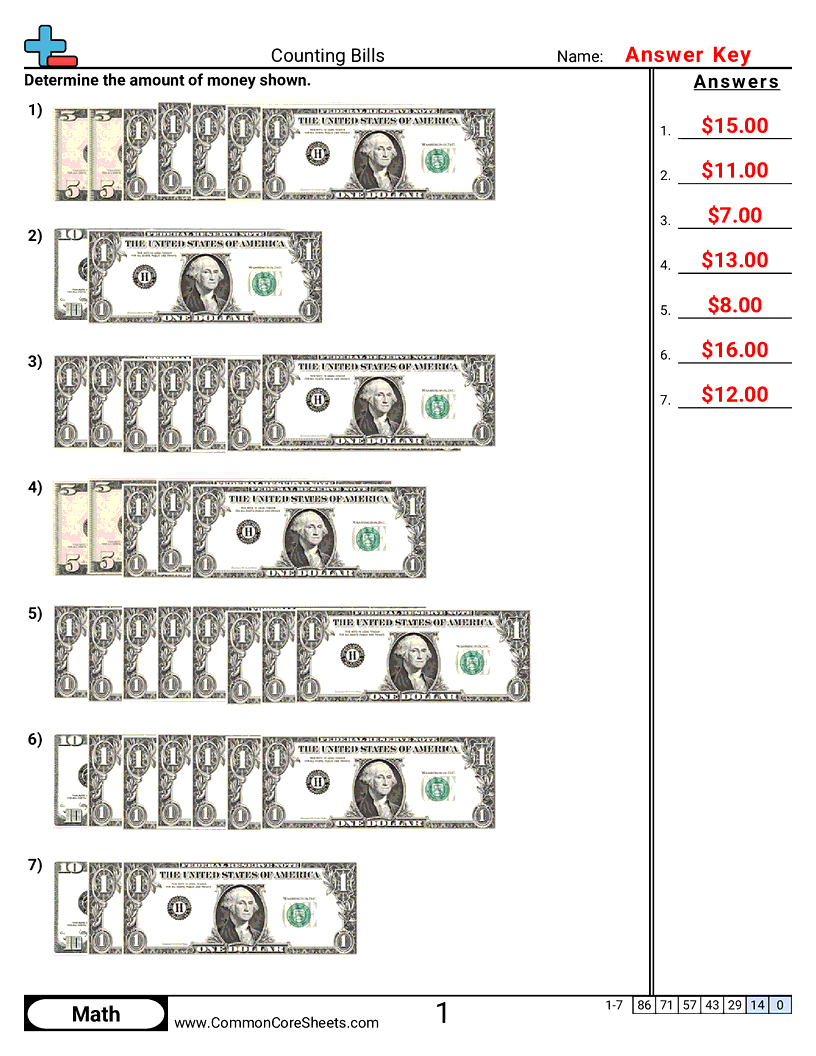
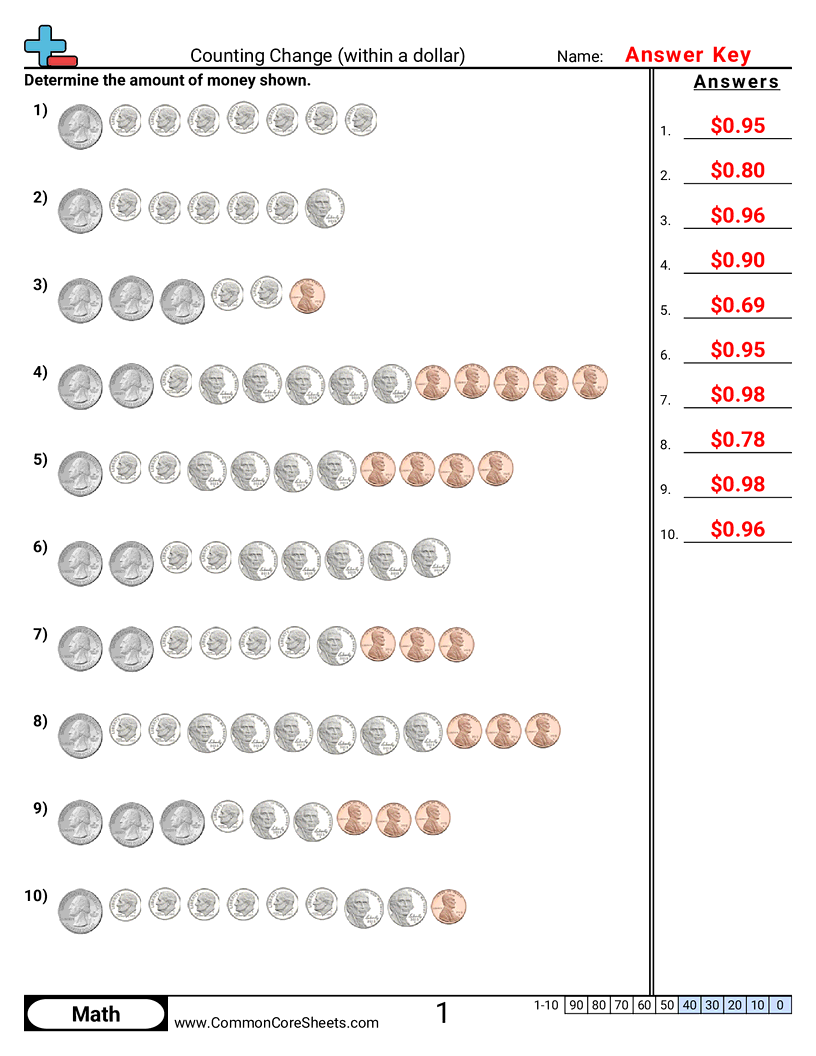
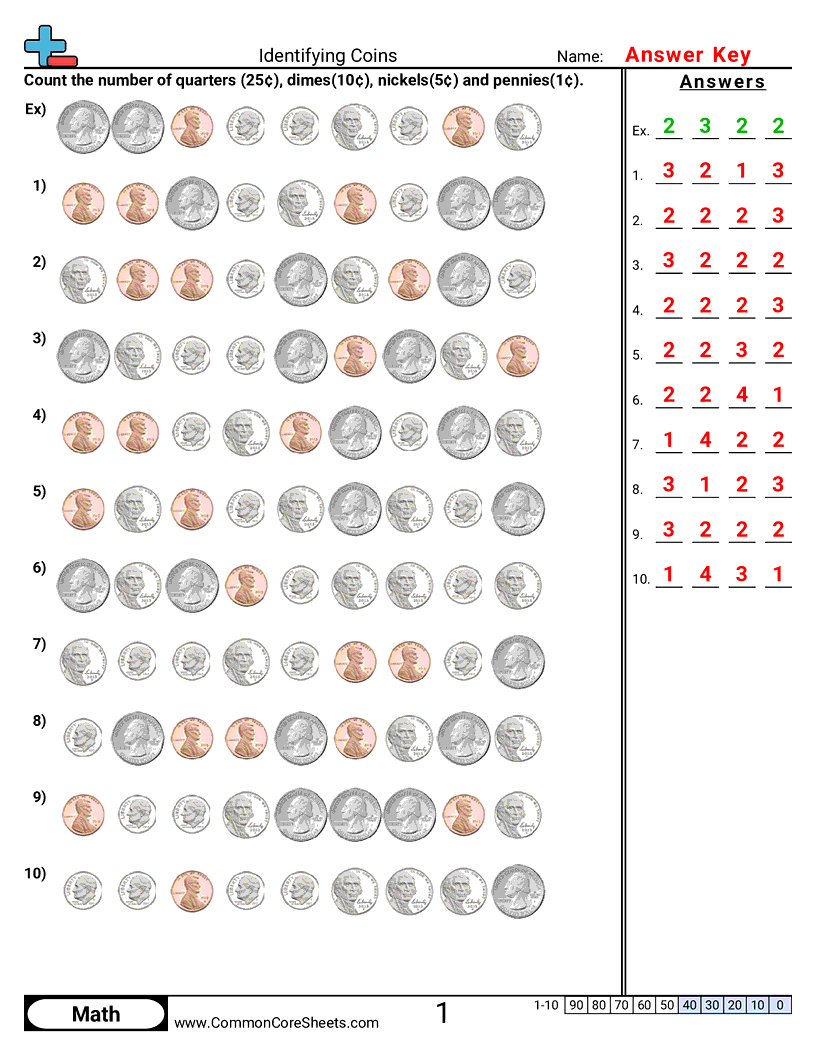
These worksheets help students learn to count and identify money. Activities include counting mixed coins and bills, counting dollar bills up to twenty dollars, counting change within a dollar using quarters, dimes, nickels, and pennies, and identifying coins by appearance and name. Designed for early elementary students.
2md8
Count mixed coins and bills to find how much money there is altogether. Add dollar and cent amounts correctly using decimals. Combine different groups of money and write the total in standard money form (like $3.45). Recognize the value of common coins and bills and use them to make a total.
2md8
Count groups of dollar bills to find the total amount of money. Add the values of different bill types (ones, fives, tens, twenties) to get one total. Use skip-counting by 1s, 5s, 10s, and 20s to count money faster. Read and write the total in dollars using the $ sign.
2md8
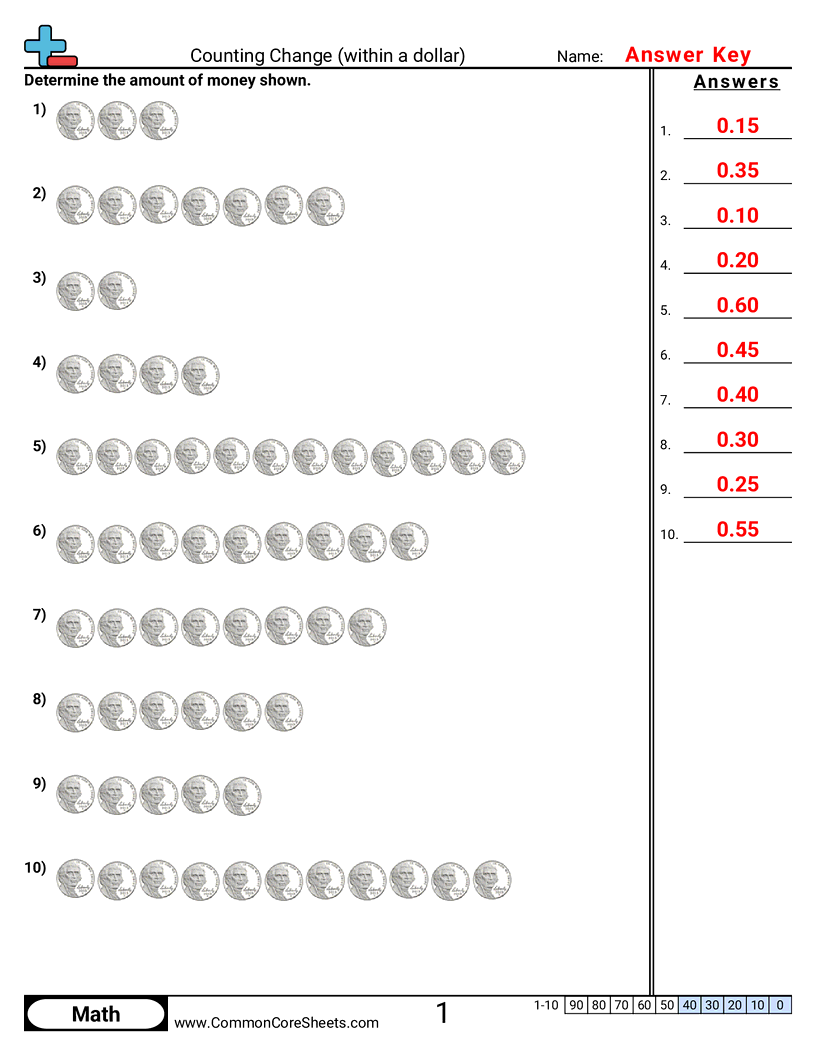
Count the total value of a group of quarters, dimes, nickels, and pennies. Skip-count by 25s, 10s, and 5s, then add on pennies to finish the total. Check that the total is under a dollar and write it in cents.
2md8
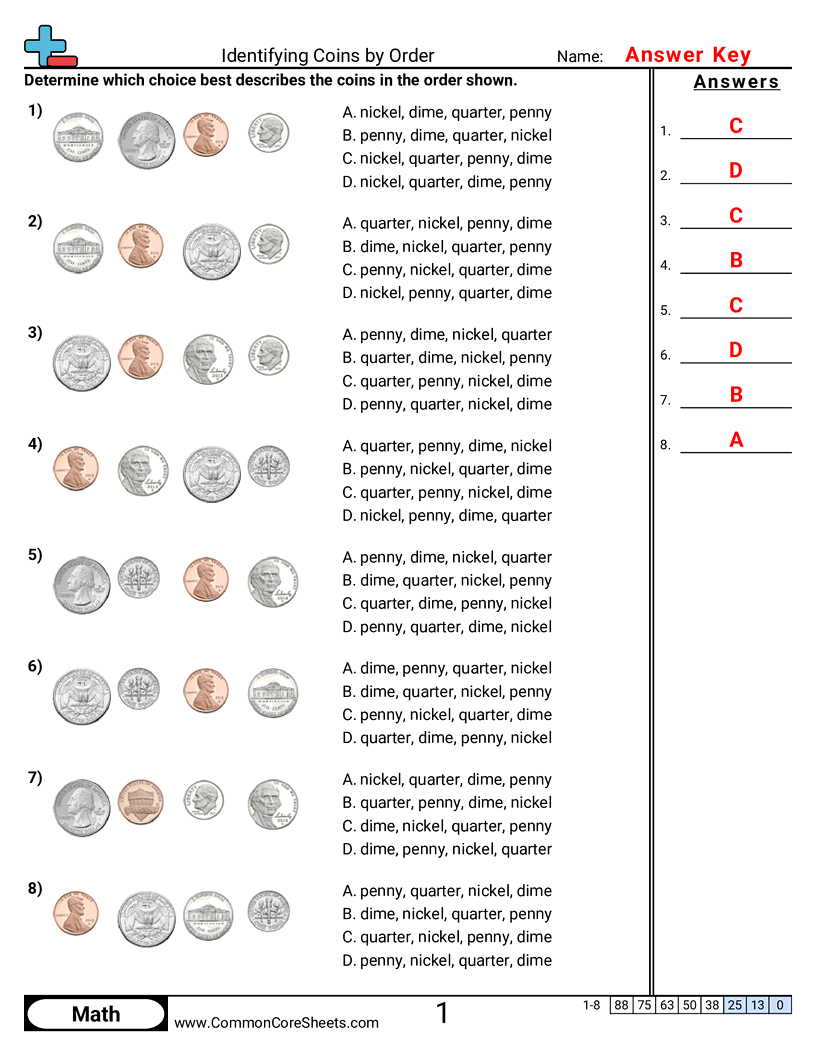
Recognize pennies, nickels, dimes, and quarters by what they look like.
2md8
Recognize and name common U.S. coins (penny, nickel, dime, quarter).
2md8
Learn to recognize a penny, nickel, dime, and quarter by name. Match a picture of a coin to the correct coin word. Notice key features on coins (like size and edge ridges) to tell similar coins apart. Use the correct coin names when talking about money.
Count the total value of a group of coins using quarters, dimes, nickels, and pennies. Add coin values to find a total amount in cents up to $1.00. Trade coins in your head (like 5 pennies for a nickel or 2 nickels for a dime) to make counting easier. Write the total amount using the correct cents and dollar notation.
2md8
Figure out how much money you have after adding the next coin in a pattern. Skip-count by coin values to find the next amount in a money sequence. Recognize how different coins change the total by 1, 5, 10, or 25 cents.
2md8
Add up the value of coins and bills to find a total amount Compare a money total to the price of an item Decide whether you have enough money to buy something Understand the value of pennies, nickels, dimes, quarters, and dollars
2md8
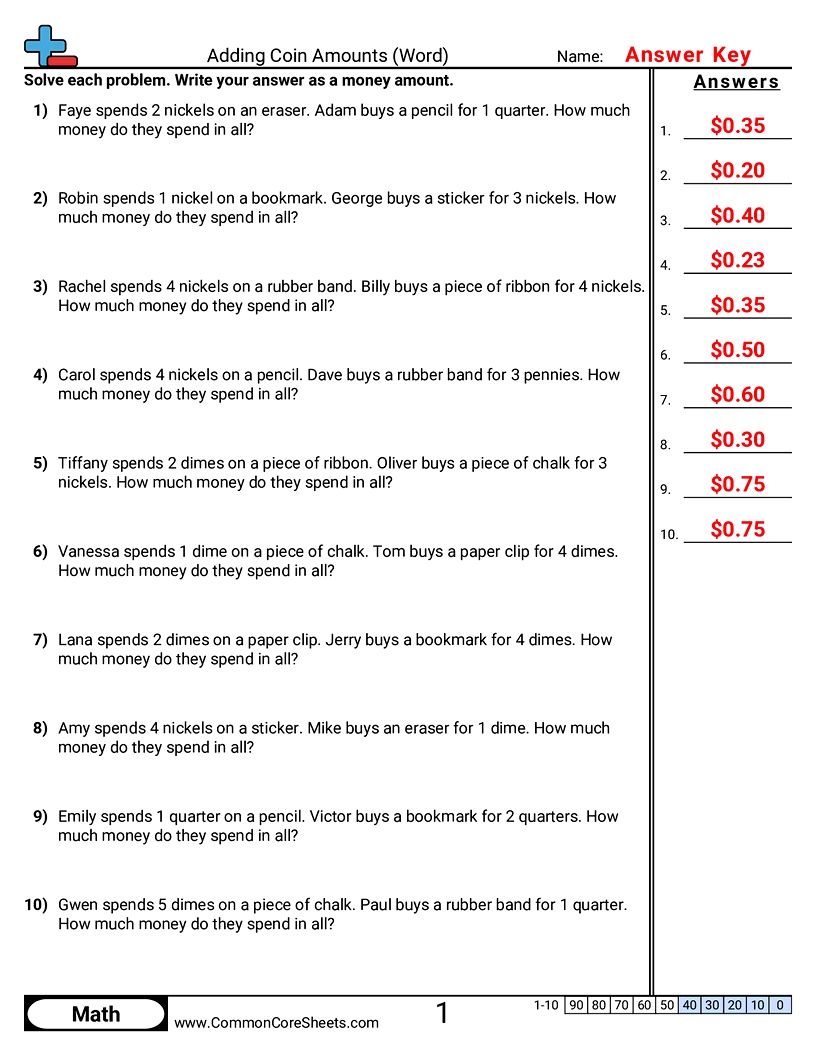
Practice adding the value of different coins together Learn to solve money word problems by finding a total Practice writing money amounts using dollar and cent symbols Recognize the value of pennies, nickels, dimes, and quarters
2md8
Practice subtracting amounts of money shown in cents Read a word problem and figure out what to subtract Find how much change or money is left after spending Work with quarters, dimes, nickels, and pennies in problems
2md8
Count and add the values of different dollar bills Write an addition number sentence for a group of bills Find the total dollar amount of mixed bills Recognize the values of $1, $5, $10, and $20 bills
2md8
Subtract a price from the amount handed over to find the change Know the value of a quarter, dime and half dollar without being told Read a word problem and decide what to subtract Work with money amounts under one dollar written with the cent sign
2md8
Find the value of a group of one, five, ten and twenty dollar bills Subtract a whole dollar amount from a money total Work in two steps: total the bills first, then take an amount away Write a money answer using the dollar sign and two decimal places
4md2
Add a whole dollar amount to an amount that includes cents Subtract a whole dollar amount from an amount that includes cents Notice that moving whole dollars leaves the cents unchanged Decide from the wording of the problem whether to add or subtract
About these worksheets
Students practice making change and working with money in real-world scenarios. Worksheets cover determining the fewest coins for an amount, calculating change from purchases with one or multiple items, reading receipts, deciding what can be purchased with remaining money, drawing coins, identifying change from visual payment, and comparing coin values. Aligned with fourth grade standards.
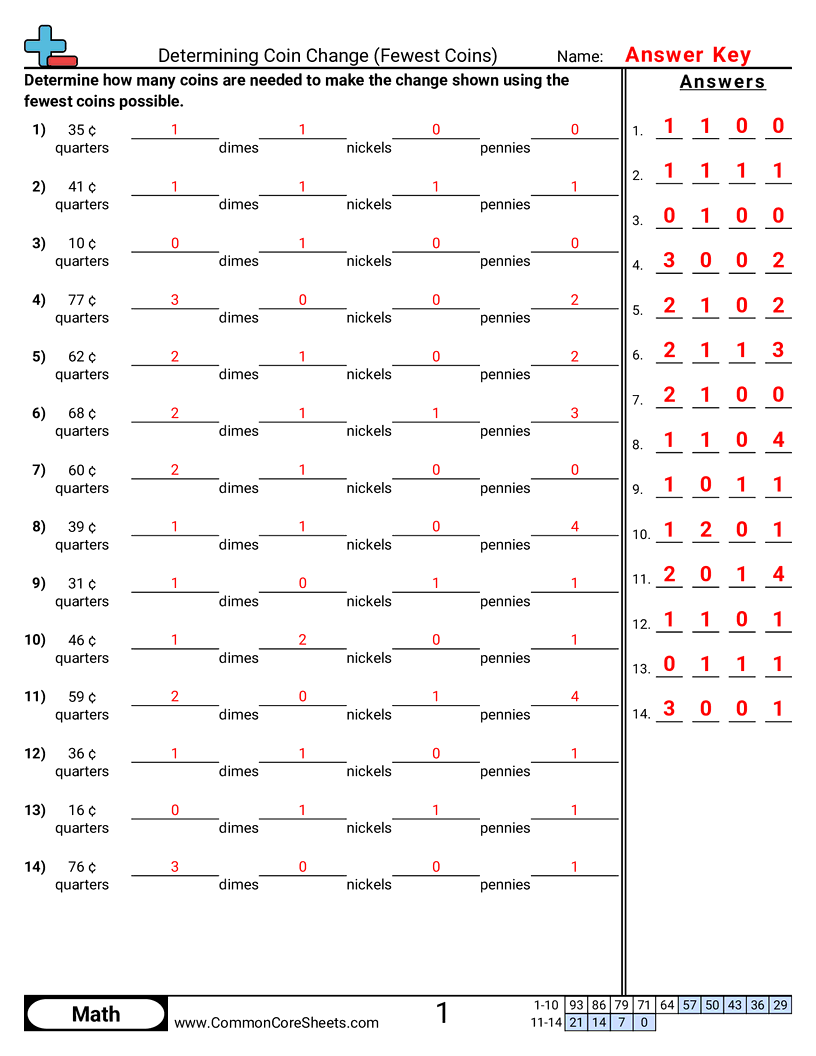
Figure out which coins add up to a given amount of cents. Choose the fewest coins possible to make the exact amount. Practice using coin values (pennies, nickels, dimes, quarters) to build totals. Compare different coin combinations and pick the most efficient one.
2md8
Make a given amount using the fewest coins possible. Recognize a quarter, dime, nickel and penny by sight. Take the largest coin that fits first, then work down to pennies.
4md2
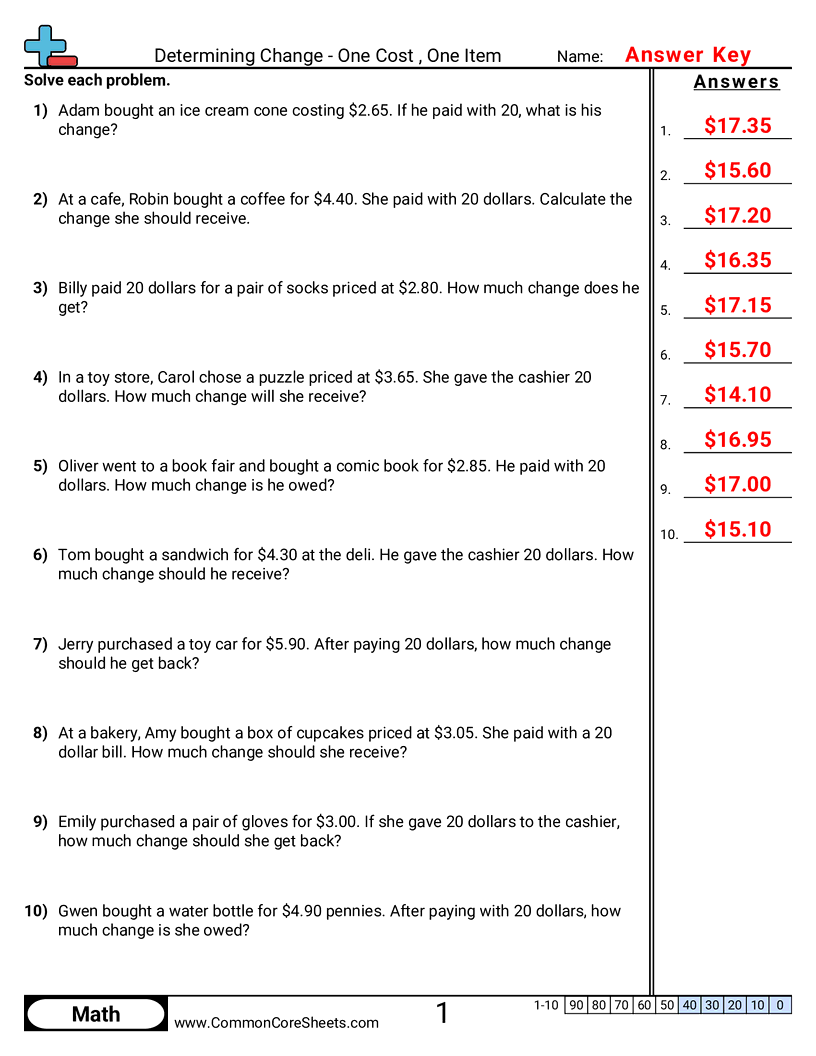
Find how much change you should get back after buying one item. Subtract a price from the amount paid using dollars and cents. Line up decimal points correctly when subtracting money amounts. Read a simple receipt-style word problem and pick the numbers to subtract.
4md2
Read a word problem about buying one item and paying with cash. Multiply to find the total cost when you buy more than one of the same item. Subtract the total cost from the amount paid to find the change.
4md2
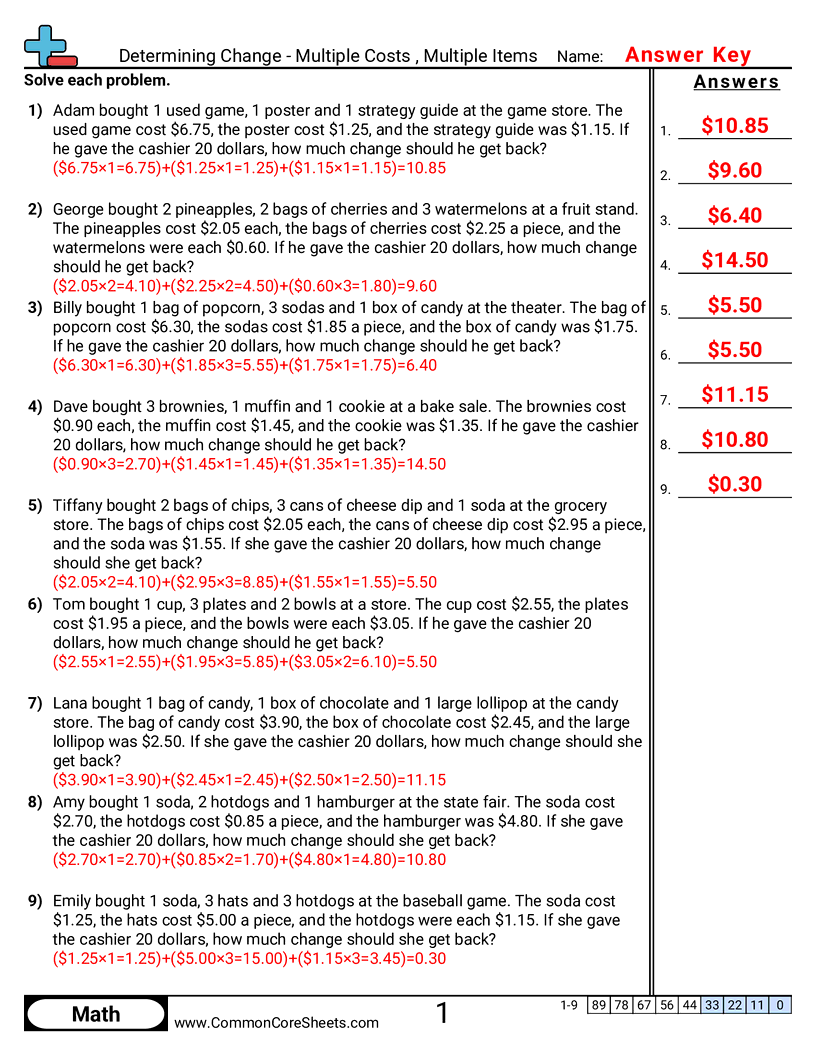
Add the prices of several different items to find the total cost. Multiply a price by a quantity when more than one of the same item is bought. Subtract the total cost from the amount paid to figure out the change. Read money word problems and pick the right steps to solve them. Work with decimal amounts in dollars and cents accurately.
4md2
Find the cost of an item from the amount paid and the change received. Subtract one money amount from another. Recognize that payment minus change gives the cost.
4md2
Find how much was handed over from the cost and the change received. Add two money amounts to find a payment. Recognize that cost plus change gives the amount paid.
4md2
Read a receipt to find the total cost of the items. Subtract the total cost from the amount paid to figure out the change. Work with dollars and cents correctly when subtracting money amounts. Match the change amount to what you should get back after paying with cash.
4md2
Subtract a purchase price from the money you have to find how much change is left. Compare prices to decide which item is the most expensive you can afford with a set amount of money. Work with dollars and cents together and keep the decimal in the right place when subtracting. Read money amounts in a shopping-style problem and pick the correct operation to solve it.
Match a money amount in cents to a set of coins by drawing the right coins. Practice adding coin values (pennies, nickels, dimes, quarters) to make a total within $1.00. Get faster at recognizing how much common coins are worth without counting by ones every time. Use different coin combinations to represent the same amount.
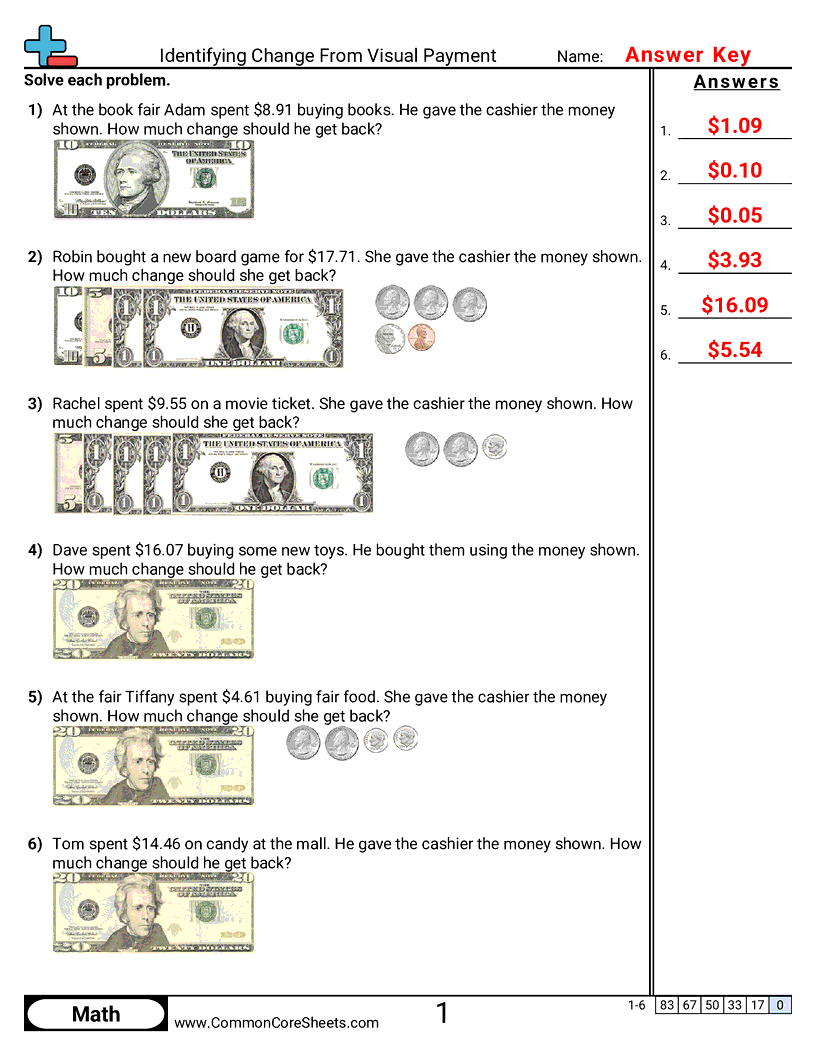
Read a picture of coins and bills to figure out how much money was paid. Subtract the cost from the amount paid to find the correct change. Work with dollars and cents written as decimals when doing money subtraction.
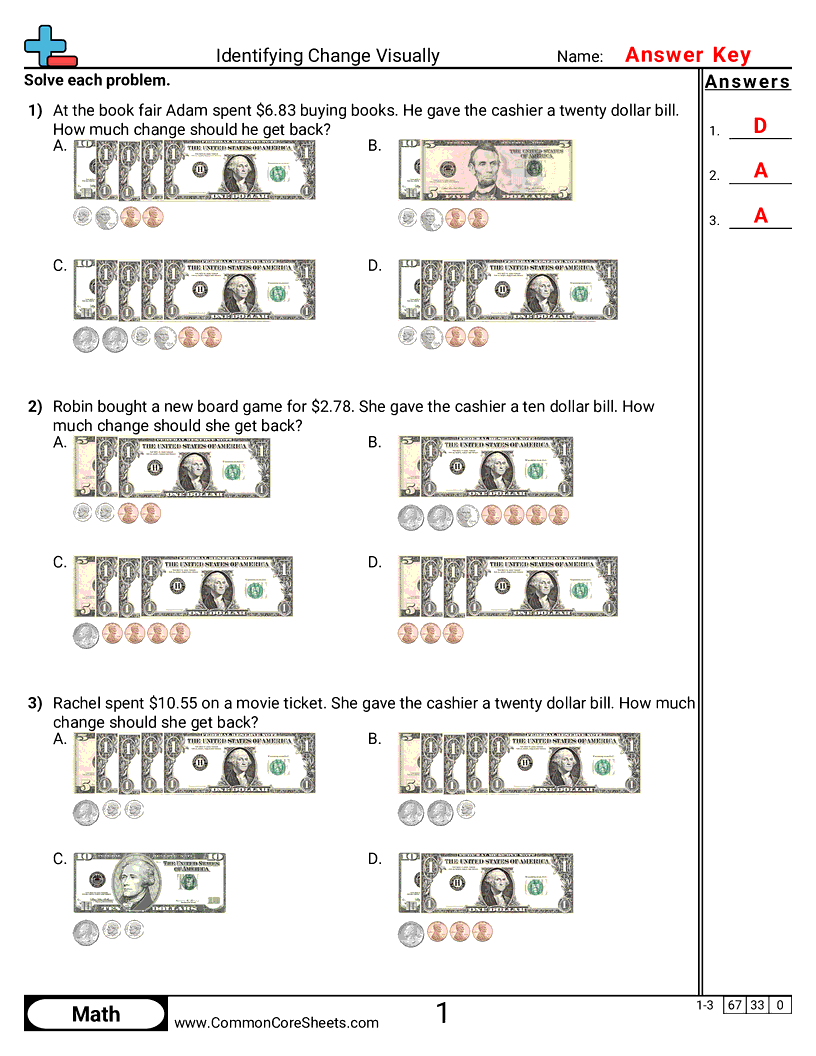
Figure out how much change you should get back after paying with a $10 or $20 bill. Read a price and a payment amount and subtract to find the difference. Use pictures of bills and coins to match the correct change amount. Recognize common bills and coins and their values when making change.
2md8
Figure out how much a group of coins is worth in cents. Recognize that different coin combinations can have the same value. Compare two sets of coins to see which is worth more or if they are equal.
Practice figuring out how much change you get back from $1.00 Break an amount of change into the fewest number of quarters, dimes, nickels, and pennies Solve money word problems by subtracting a price from a dollar
About these worksheets
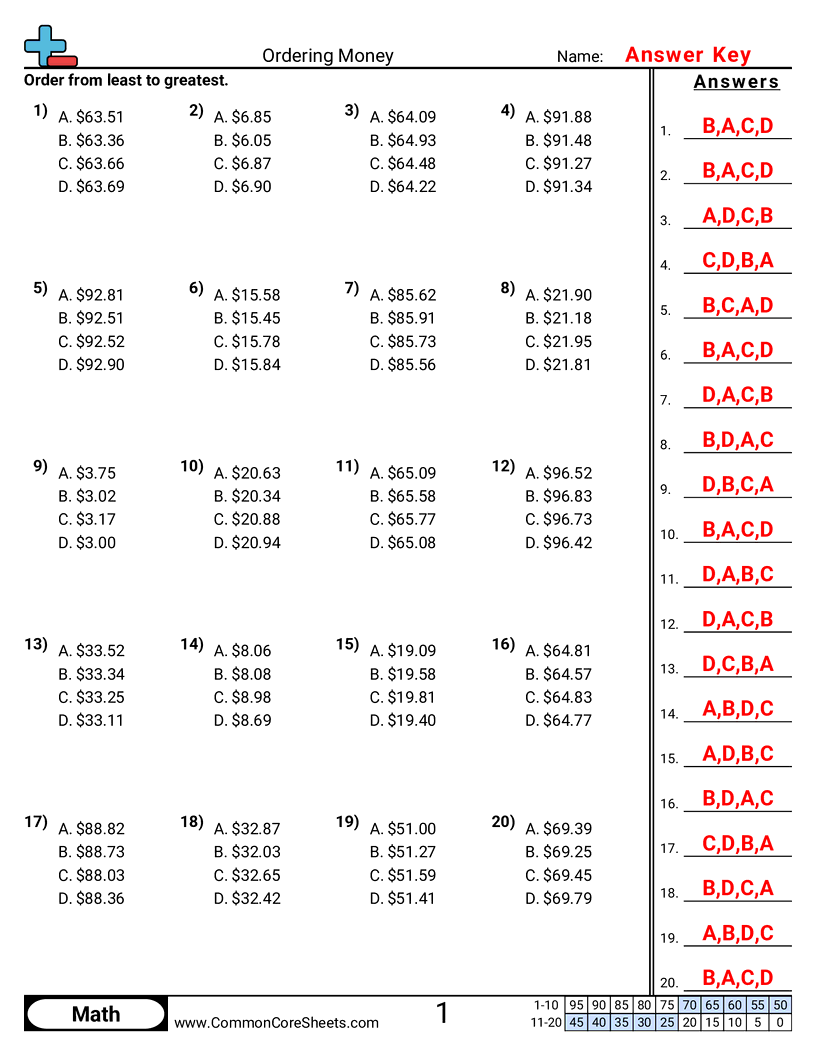
These worksheets develop the ability to order money amounts from least to greatest and greatest to least. Students compare amounts with the same dollar value but different cents, as well as amounts with different dollar and cent values. Aligned with fourth grade comparison standards.
4nf7
Compare money amounts that have the same number of dollars but different cents. Put prices in order from least to greatest or greatest to least by looking at the cents. Use place value to decide which amount is larger when the dollars match.
4nf7
Compare two money amounts written with dollars and cents to see which is greater or less. Put several prices in order from least to greatest or greatest to least. Read and understand money written as decimals (like $3.45) and match it to dollars and cents. Use place value in decimals to compare amounts correctly, even when both the dollars and cents are different.
About these worksheets
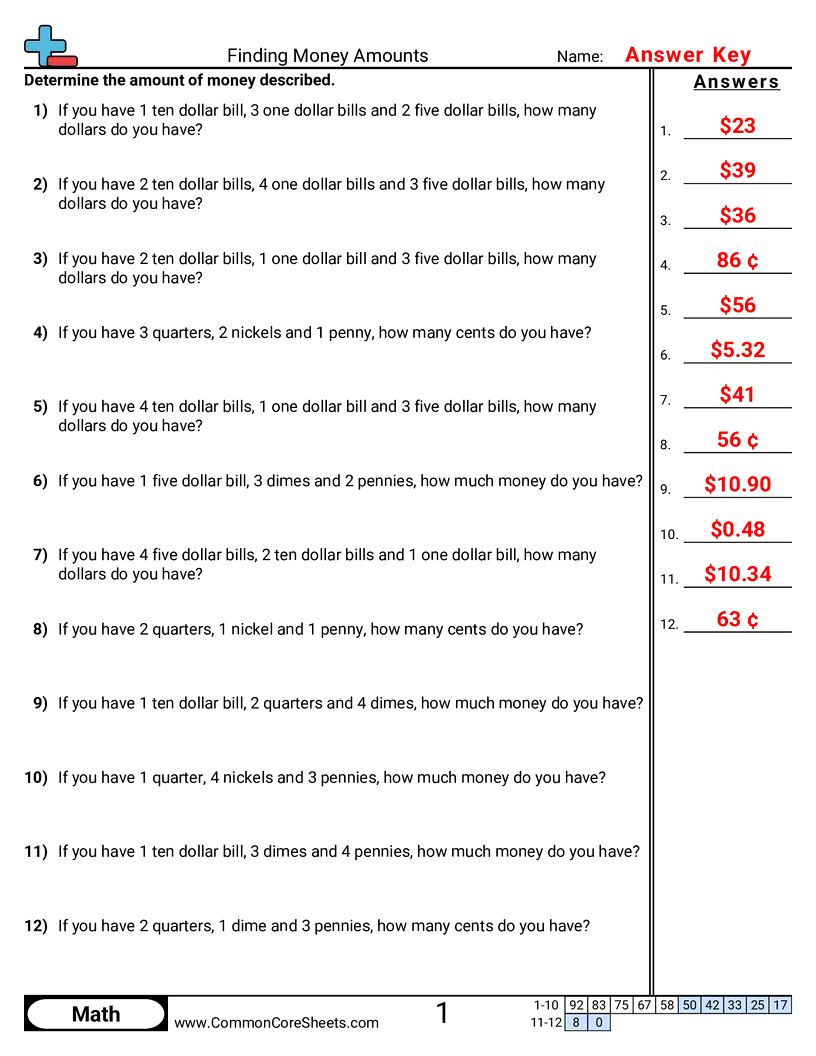
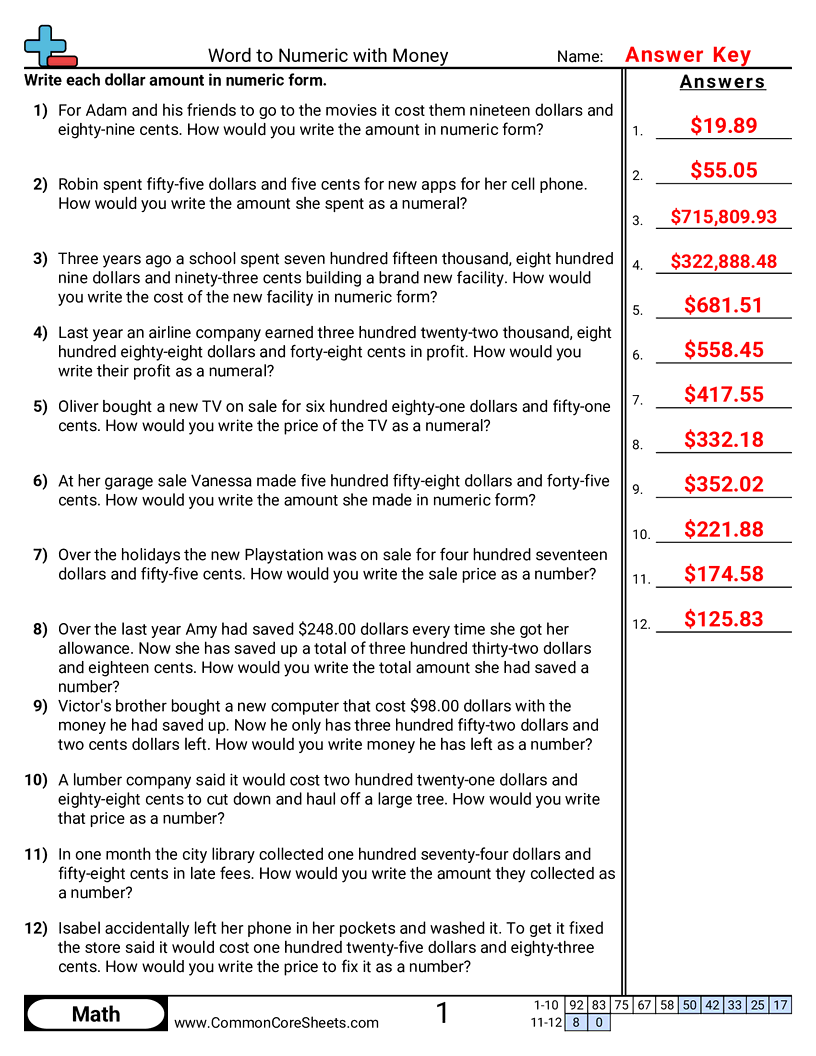
Students practice converting money amounts between different forms. Activities include finding dollar and cent values from descriptions of coins and bills, and converting money amounts written in words to numeric form with correct decimal notation. Aligned with second and fourth grade standards.
2md8
Figure out the total value of a group of coins and bills. Read money amounts written without a dollar sign and decimal point and say how much they are worth. Add money amounts in dollars and cents to find a total. Keep dollars and cents lined up correctly when combining amounts.
4md2
Turn a money amount written in words into the correct number using a decimal point. Write dollars and cents correctly using the $ sign and two digits for cents. Use place value to match the words for dollars and cents to the right digits.
About these worksheets
These worksheets provide practice adding money amounts using the vertical column method. Students line up decimal points and regroup when cents add up to a dollar or more, building accuracy with dollar-and-cent arithmetic.
4md2
Add dollar-and-cent amounts correctly by lining up the decimal points. Use the standard column method to add money amounts. Regroup when the cents add to 100 or more and carry to the dollars. Read and write money amounts with two decimal places while adding.
5nbt7
Choose the amount closest to the answer without calculating exactly. Estimate change from a bill. Estimate a total or a difference in price.
Money worksheets by grade
2nd Grade Money Worksheets (16 worksheets) 4th Grade Money Worksheets (12 worksheets)
Playwire Advertisement