×Description:
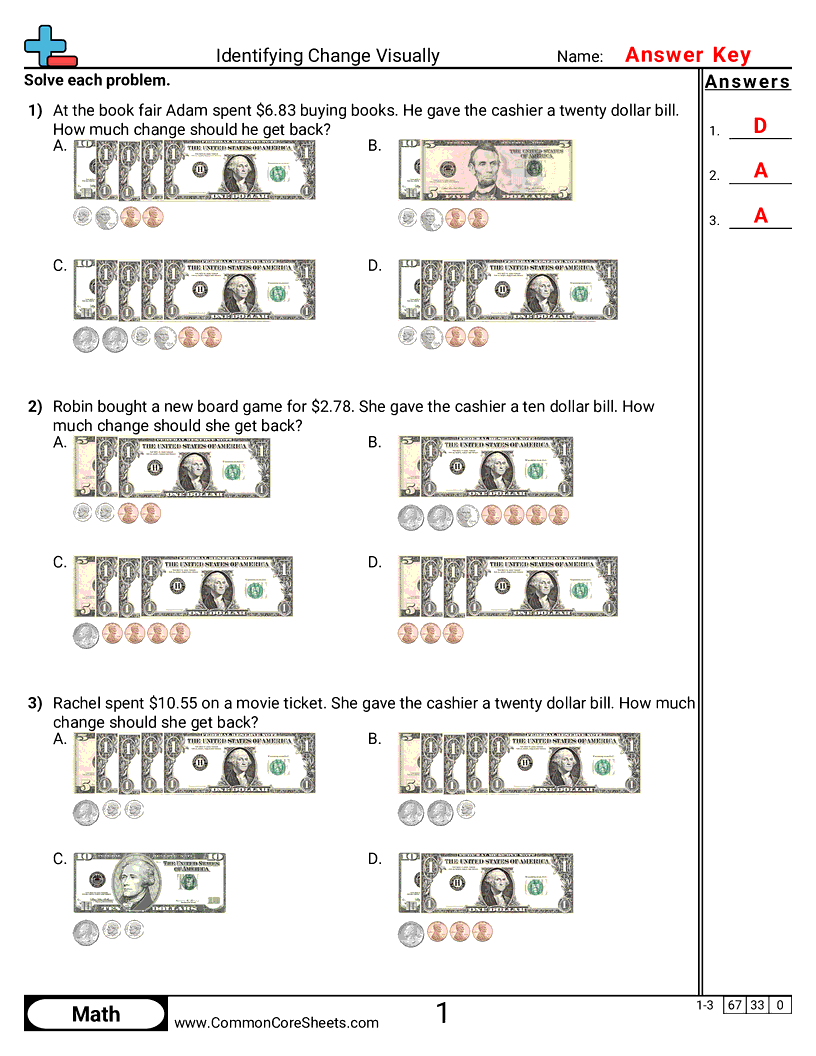
"This worksheet is designed to teach children the concept of identifying change in math visually, using real-world examples. It contains three problems that depict scenarios at a fair, a book fair, and a mall. These exercises can be customized and converted into flashcards. It's also suitable for distance learning, making it a versatile teaching resource for understanding financial transactions."
×Student Goals: Problem-Solving SkillsStudents will gain an understanding of how to effectively approach and solve problems. They will be able to process the given information, identify the question, and use appropriate mathematics operations to find the solution. The specific focus will be on subtracting amounts, which is directly applicable to understanding change in real life transactions.Financial LiteracyLearners will develop basic financial literacy, a vital life skill. By understanding and calculating change for transactions, students will be better prepared for real world situations involving purchases. They will grasp the concept of making payments larger than the cost of a purchase and learn to calculate the change they should receive back.Numerical ProficiencyBy walking through these math problems, students will make progress in their ability to conduct numerical operations, specifically subtraction. They will also further their understanding of decimals, which plays a vital role in managing money and conducting financial transactions. Consequently, learners will be able to handle complex practical math problems with more confidence.Relevance to Real-World ScenariosStudents will learn to apply mathematical concepts to real-world scenarios, in this case, the actual situation of a monetary transaction. This helps to reinforce the relevance and utility of what they are learning, thereby nurturing an appreciation for the practical applications of mathematics.Analytical ThinkingCompleting the worksheet will necessitate the use of analytical thinking skills as learners are not merely applying a formula but also interpreting a narrative problem. This requirement fosters their ability to understand and dissect problems presented in a text-rich format, improving their comprehension capabilities.