Value & Place Value Worksheets
Build true number sense with nearly 50 free place value worksheets. Students identify the value of digits, work with place value blocks and number lines, place commas in large numbers, balance equations, and use value mats to break numbers apart. Hands-on visual models run throughout the collection. Every worksheet prints as a PDF with an answer key and can be used online - no login or account required. Modified pages lighten the load for students who need it, while the grading column and quick grade scale speed up checking. From kindergartners counting tens and ones to 5th graders working with larger numbers, these place value worksheets cover the full progression.
More about these worksheets ▾ Show less ▴
×
About these worksheets
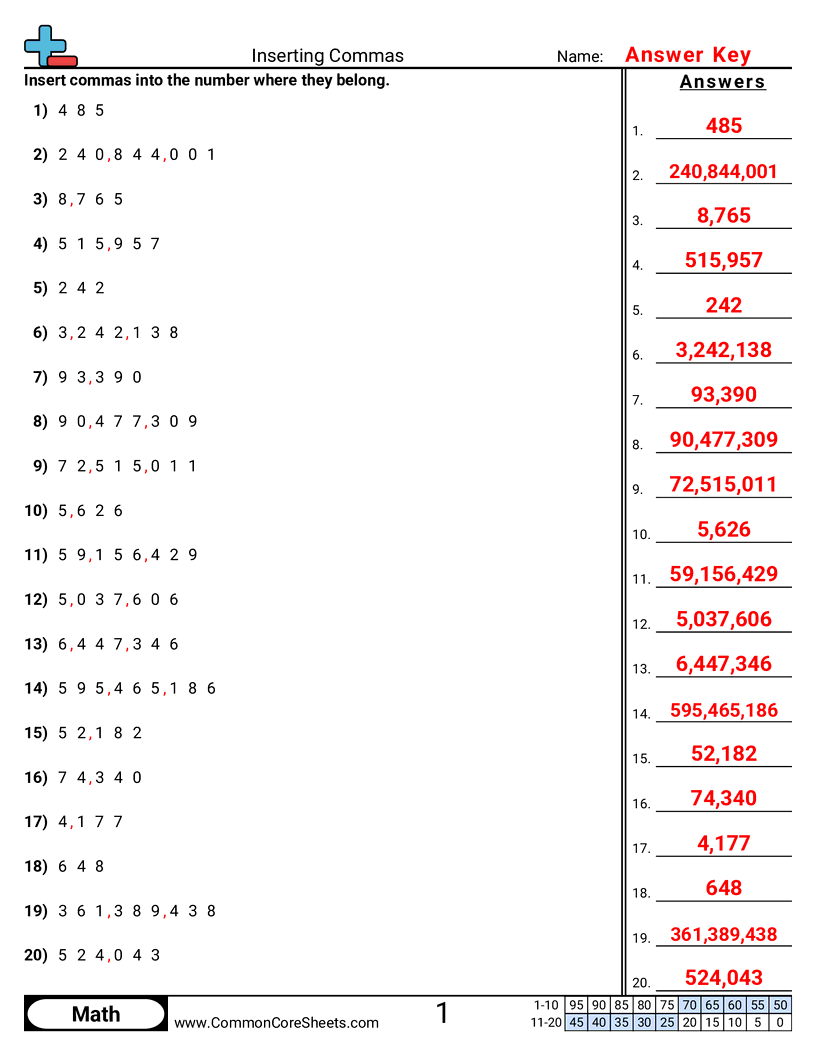
These worksheets provide practice inserting commas into large numbers to make them easier to read. Students learn to group digits in sets of three from right to left, building the number formatting skills needed for working with large values.
4nbt2
Practice adding commas to large numbers so they are easier to read. Learn to group digits in sets of three from the right to find where commas go. Tell the difference between thousands, millions, and billions by looking at comma groups. Rewrite numbers in a standard, readable format without changing their value.
About these worksheets
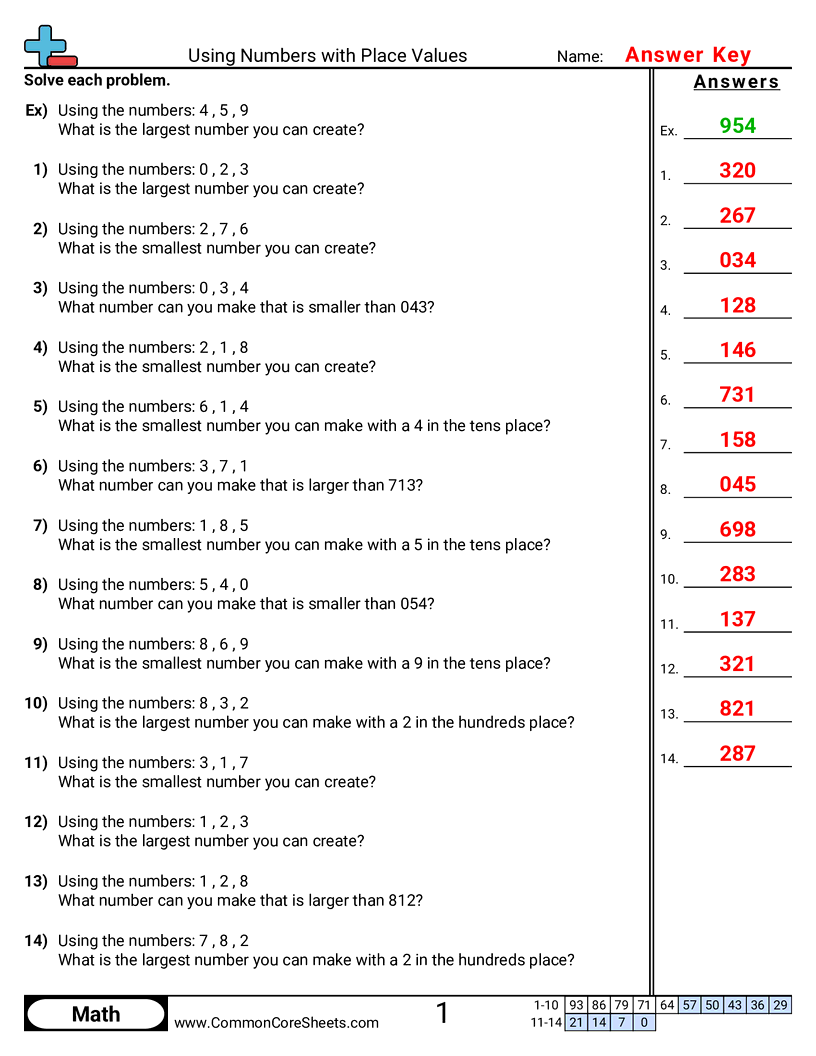
These worksheets cover place value concepts from kindergarten through fifth grade. Activities include visual place value with base-ten blocks for numbers under 20, using place value to multiply and divide by powers of ten, examining digit values and how they change with position, identifying value and place value of digits in large numbers, marking values on number lines, organizing numbers by place value, converting between standard and expanded forms, and working with place values greater than ten. Resources align with Common Core standards across multiple grade levels.
knbt1
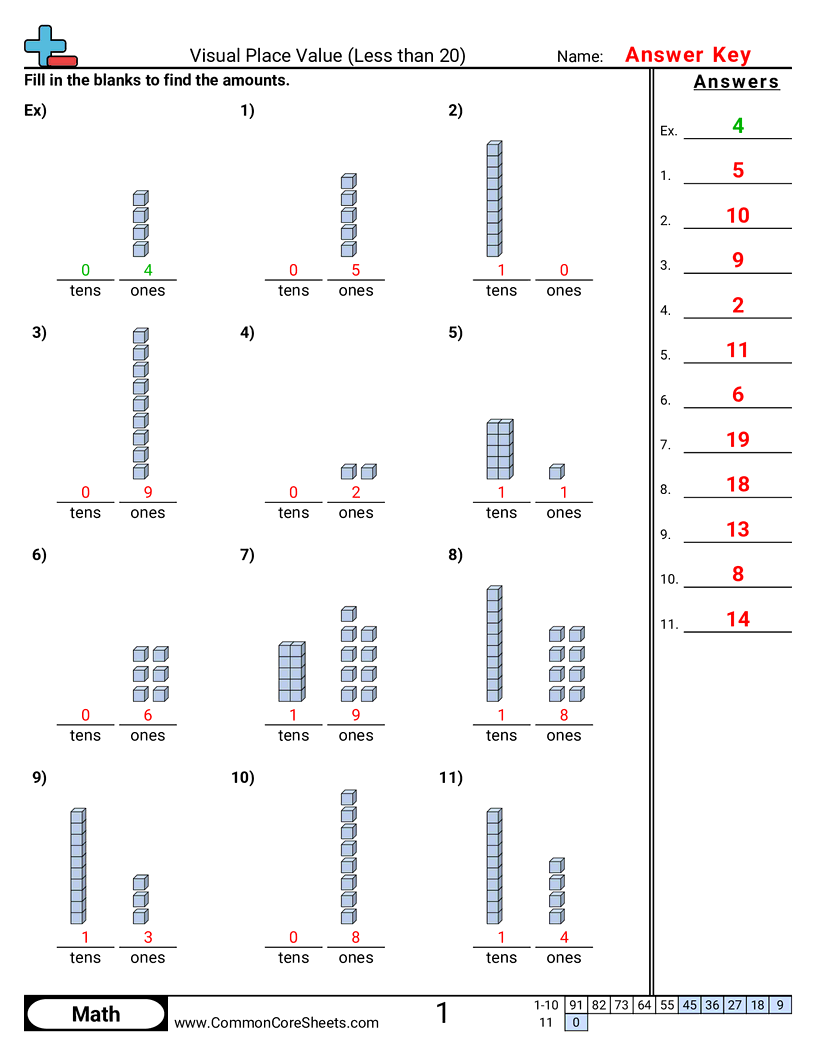
Look at a picture of blocks and tell what number it shows. Tell how many tens and how many ones are in a number under 20. Match teen numbers to the idea of one ten plus some ones. Write the number that goes with a visual model of tens and ones.
4nbt1
Multiply a whole number by 10, 100, or 1,000 by shifting digits to the left. Divide a whole number by 10, 100, or 1,000 by shifting digits to the right.
5nbt1
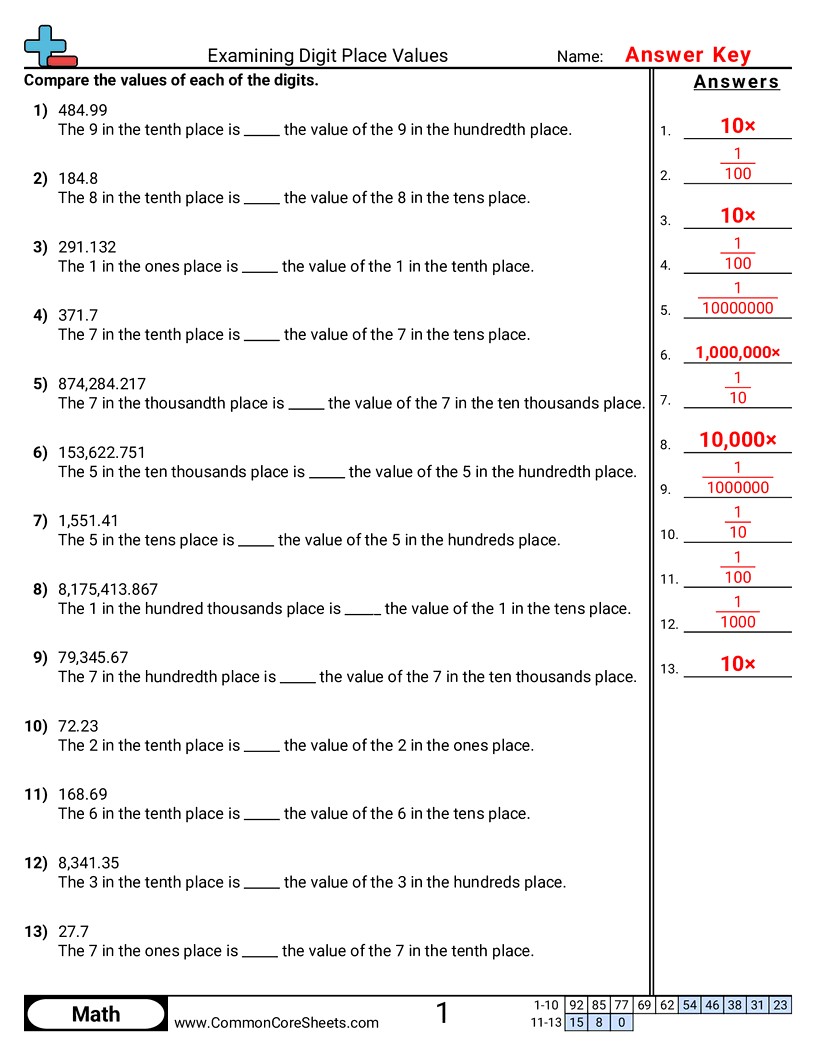
Practice comparing the value of the same digit in two different place-value positions within a number Figure out how many times greater or smaller a digit's value is when it moves to a different place Express the relationship between two place values as a multiplication (like 10×) or a fraction (like 1/100) Work with place values that span both whole numbers and decimals
4nbt1
Identify the value of a digit based on its place in a whole number. Explain how multiplying or dividing by 10 changes a number’s digits and their values.
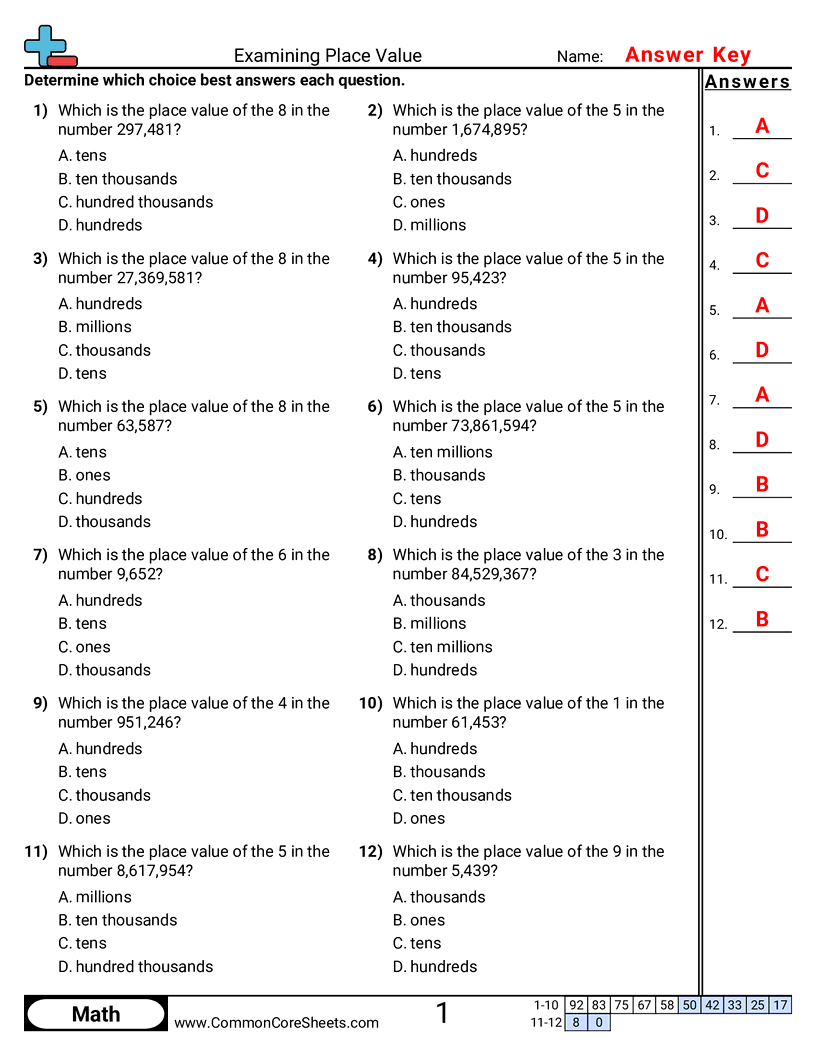
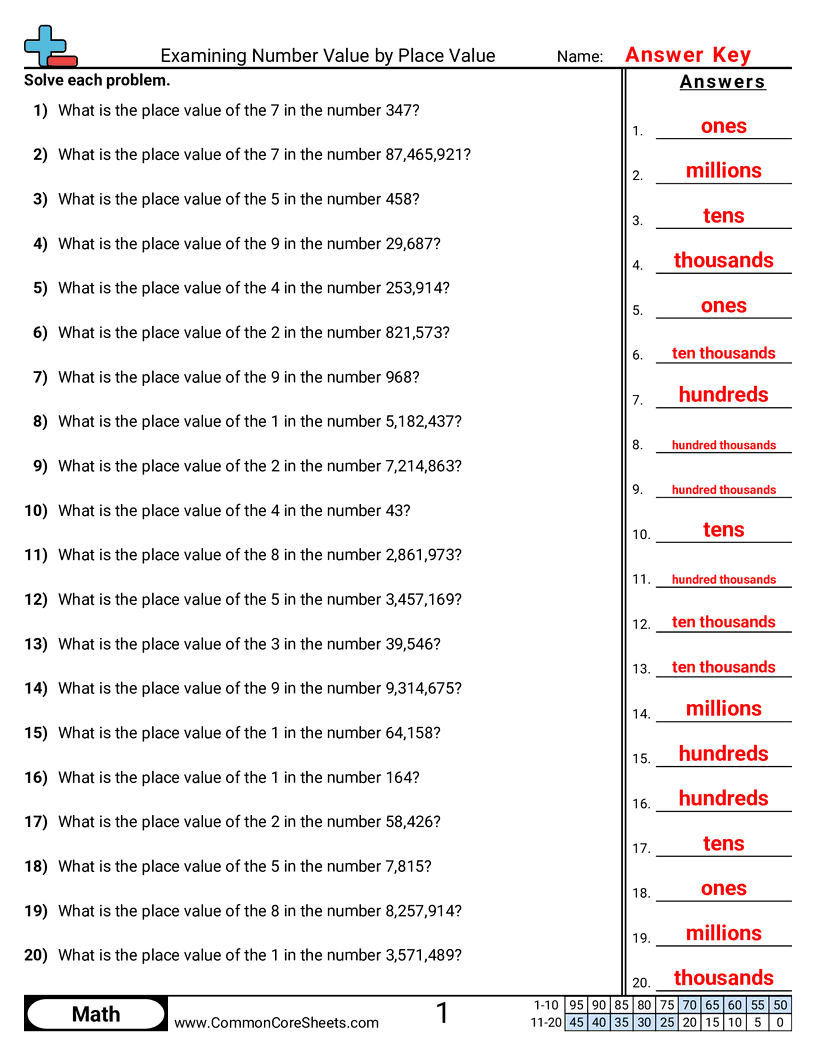
Practice identifying which place value a specific digit is in (ones, tens, hundreds, thousands, etc.) Find which digit sits in a given place value within a number Work with numbers of different sizes, from two digits up to eight digits
Identify the value of a digit based on its place in a number. Use place value to decide which digit is in the ones, tens, hundreds, thousands, or millions place.
4nbt1
Find what a specific digit is worth based on where it sits in a number. Name the place of a digit (ones, tens, hundreds, thousands, and beyond). Use place value to tell which digits make the biggest and smallest parts of a number.
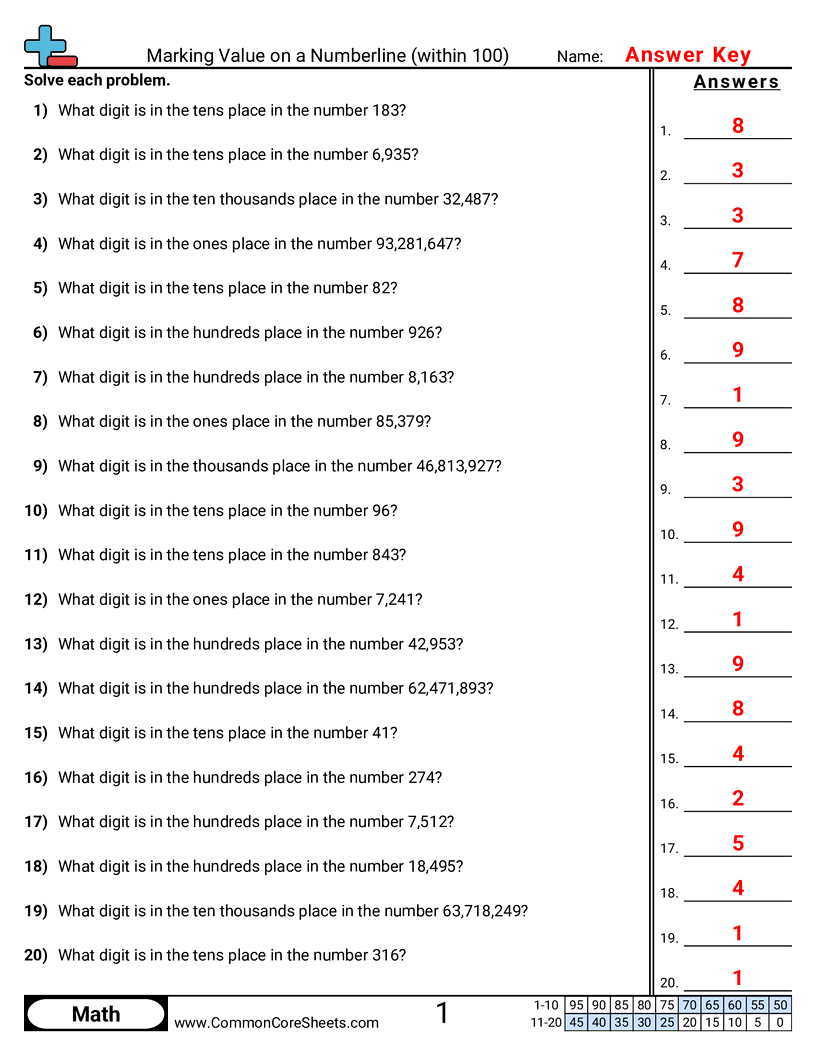
Practice finding which digit is in a specific place value (ones, tens, hundreds, thousands, or ten thousands) Read numbers of different sizes — from two digits up to eight digits — and pick out the right digit Understand that a digit's position in a number tells you its place value
Use place value to put three numbers in order from least to greatest or greatest to least. Compare three numbers by looking at the highest place first and deciding which is bigger.
4nbt1
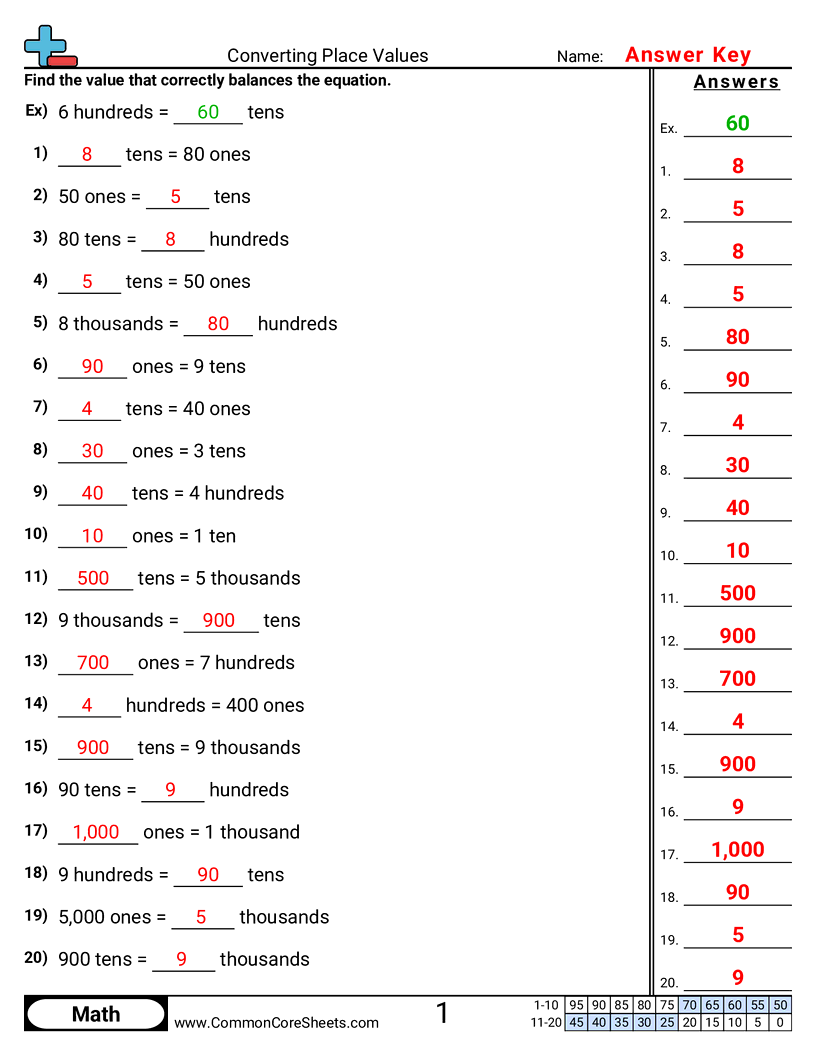
Practice breaking a number into its place value parts and writing it in expanded form. Practice turning expanded form back into a standard number. Practice renaming a number by trading between place values (like 1 ten = 10 ones) without changing the total. Practice using place value to make both sides of an equation equal.
4nbt1
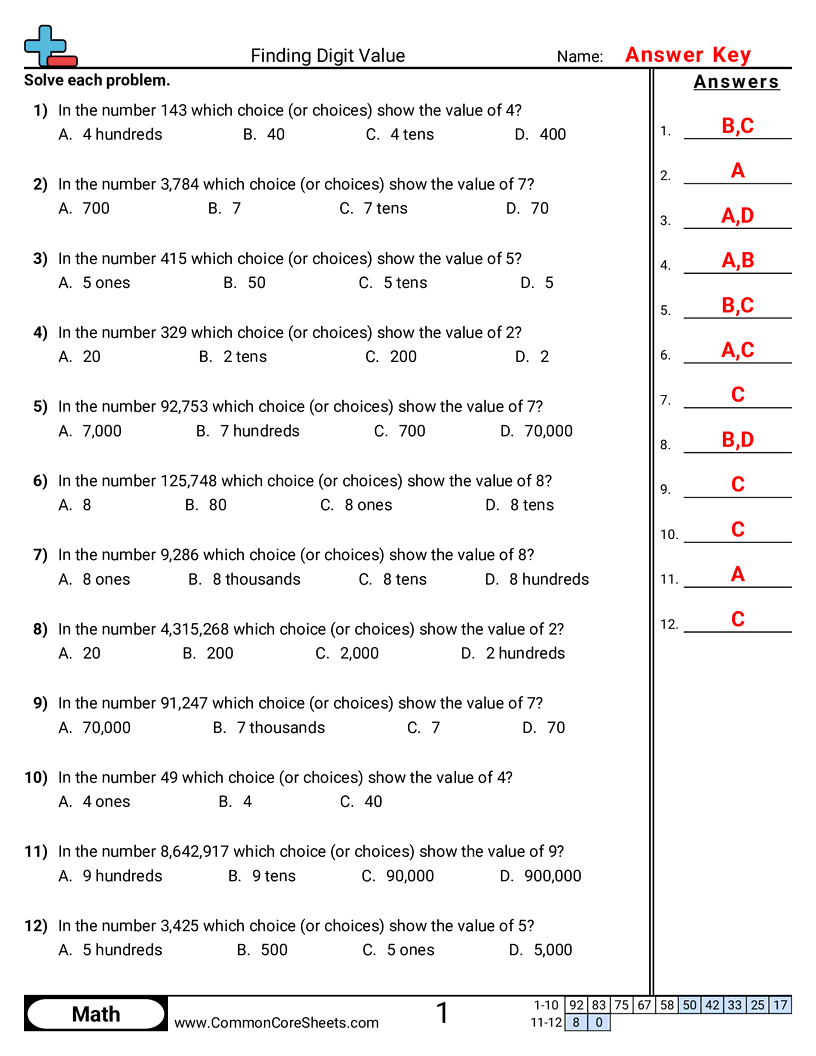
Find what a digit is really worth based on where it sits in a number. Match a digit to its place name (ones, tens, hundreds, thousands, millions). Read a multi-digit number and pick out the value of a specific digit. Tell the difference between a digit’s face value and its place value.
4nbt1
Find the value of a digit by looking at its place in the number. Tell the difference between a digit and the value it represents in a number. Write the value of a digit in standard form (like 300 or 40) based on its position.
4nbt1
ractice finding the total value of a number when some place-value columns hold a number bigger than 9 Regroup values that spill over into the next place (like 46 tens becoming 4 hundreds and 6 tens) Work with numbers of different sizes, from hundreds up to ten thousands
4nbt1
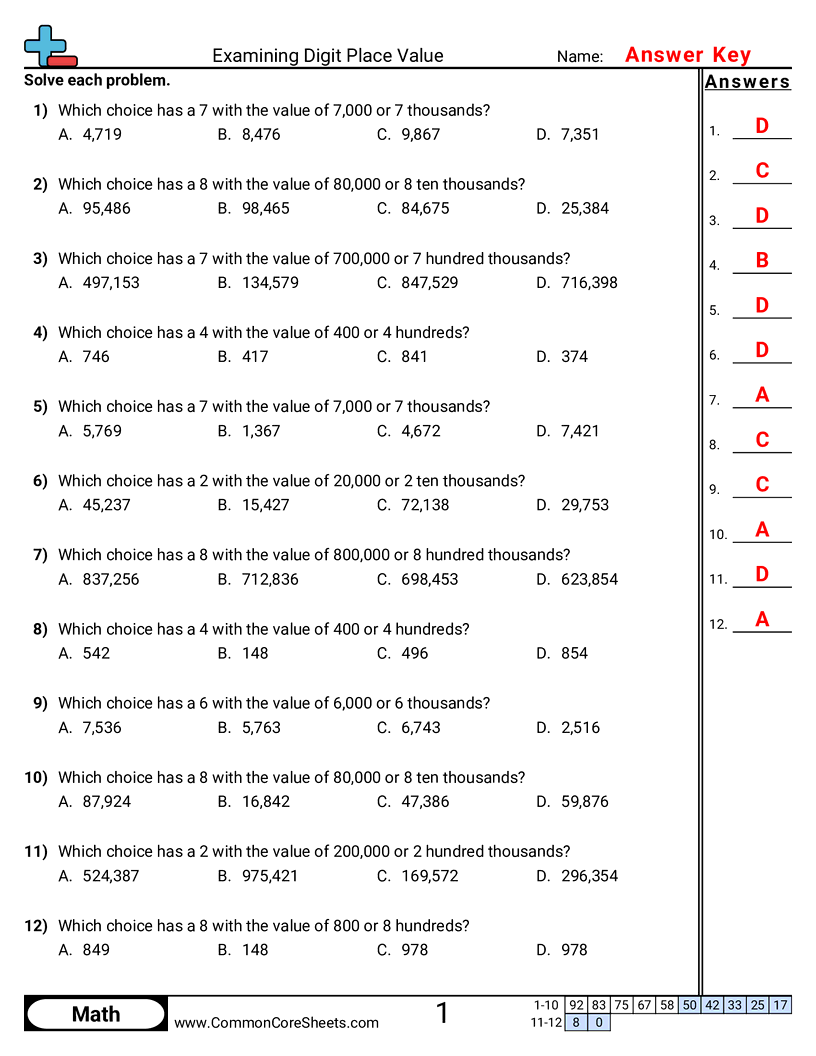
Find the value of a specific digit in a number (like knowing the 7 in 3,742 means 700). Use place value names to explain what each digit stands for in a whole number. Compare digits in different places to see how the same digit can mean different amounts.
Read numbers written out in words and understand their value Add 1,000 to a given number in your head Recognize how the thousands digit changes when adding 1,000 Practice place value with numbers up to the thousands
4nbt2
Compare whole numbers under 100,000 using place value. Work through a number place by place instead of judging it by length. Recognize that a question may have more than one correct answer.
4nbt2
Compare two multi-digit numbers to see which is bigger Use the greater than, less than, and equal signs correctly Line up numbers by place value to compare them Tell when two numbers are equal
4nbt2
Find the greatest whole number less than a given number up to 1,000,000. Find the least whole number greater than a given number up to 1,000,000. Subtract one across several zeros, as in 400,000 to 399,999.
4nbt2
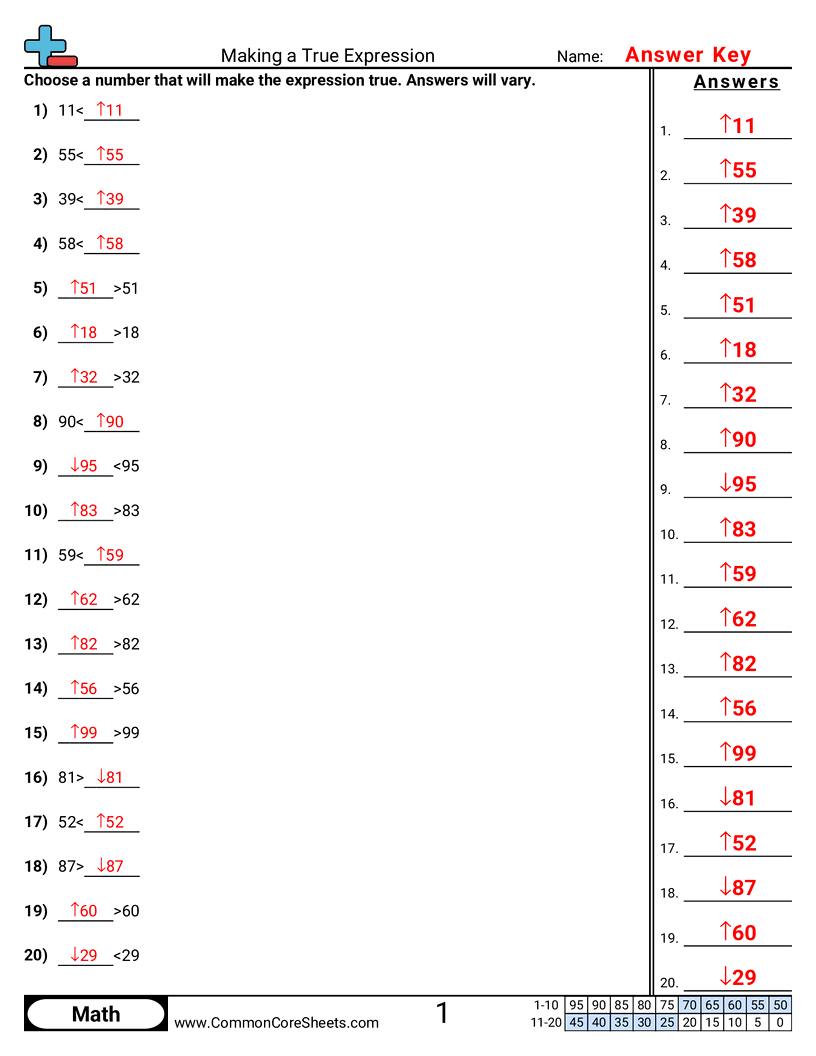
Choose a number that makes a comparison sentence true Use place value to compare numbers that share their leading digits Notice whether the blank sits on the left or the right of the symbol Compare whole numbers up to 100,000
About these worksheets
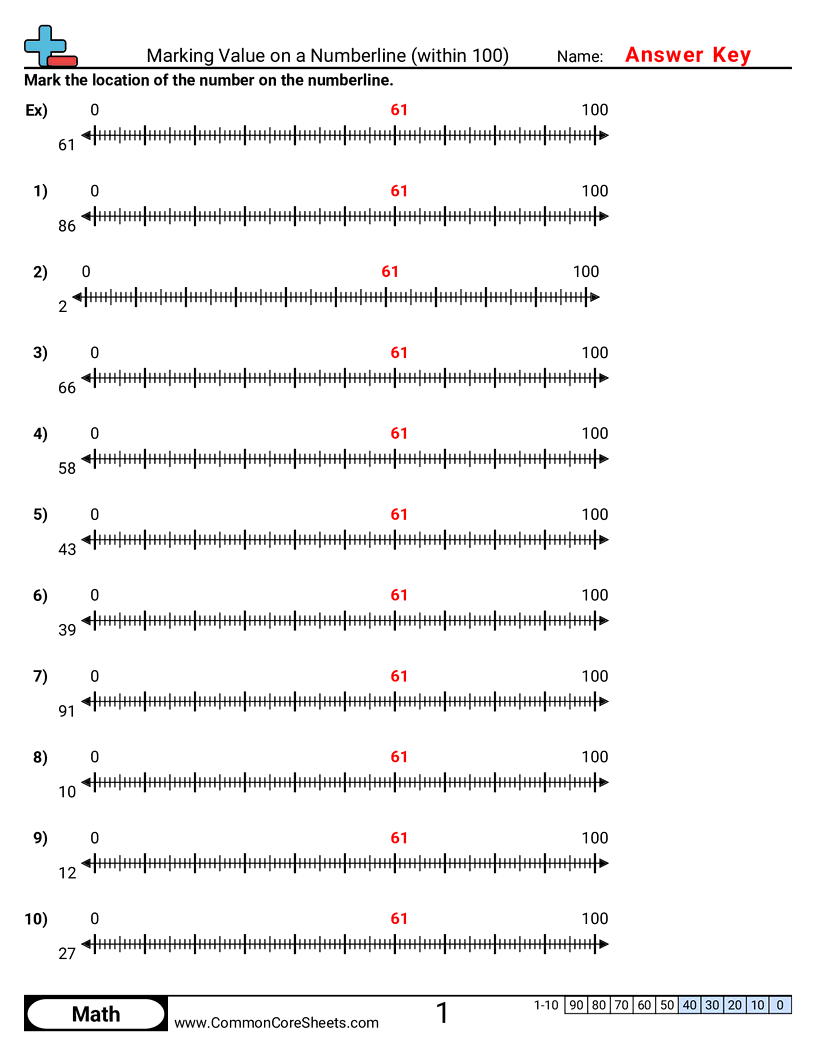
Students work with number lines and place value mats to build number sense. Worksheets include filling in missing values on number lines, reading place value mats, interpreting non-traditional number lines that don't start at zero, and marking values on open number lines within 20 and within 100. Aligned with second grade and general number sense standards.
2md6
Read a number line and figure out what each tick mark is worth.
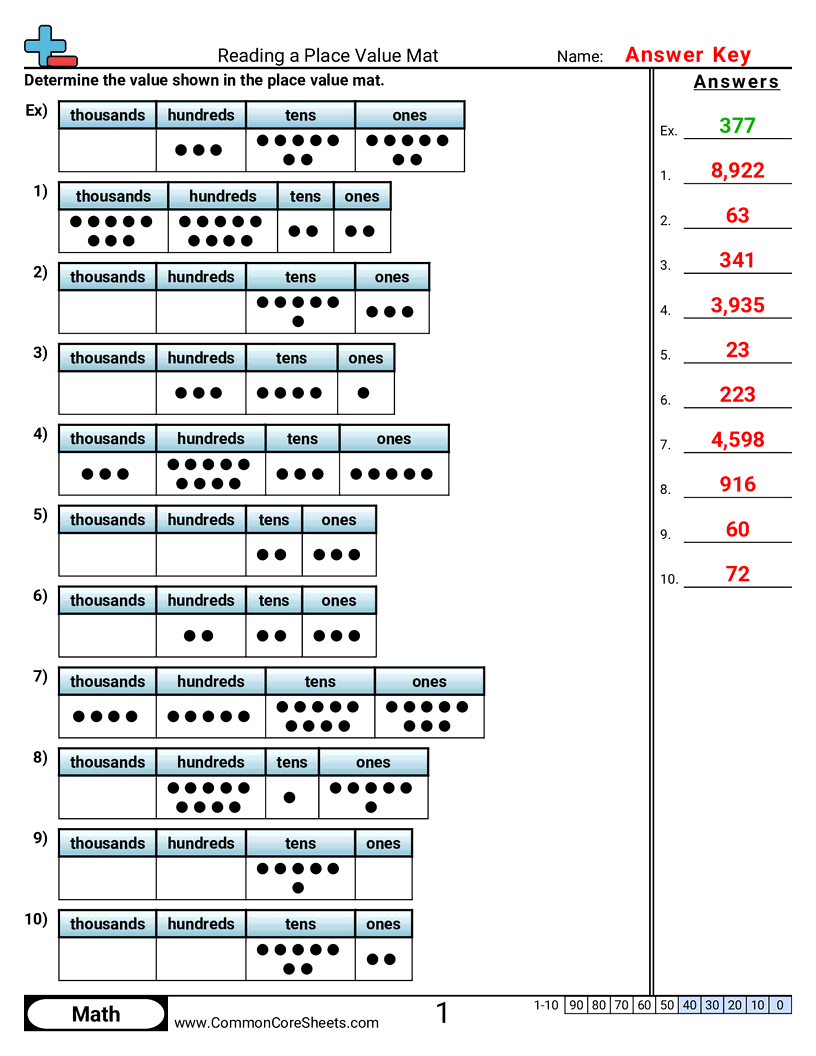
Read a place value mat and say what number it shows. Match each digit to its correct place (ones, tens, hundreds, thousands). Tell the value of a digit based on where it is on the mat (like 7 tens means 70). Write the number from the mat in standard form using the correct digit order.
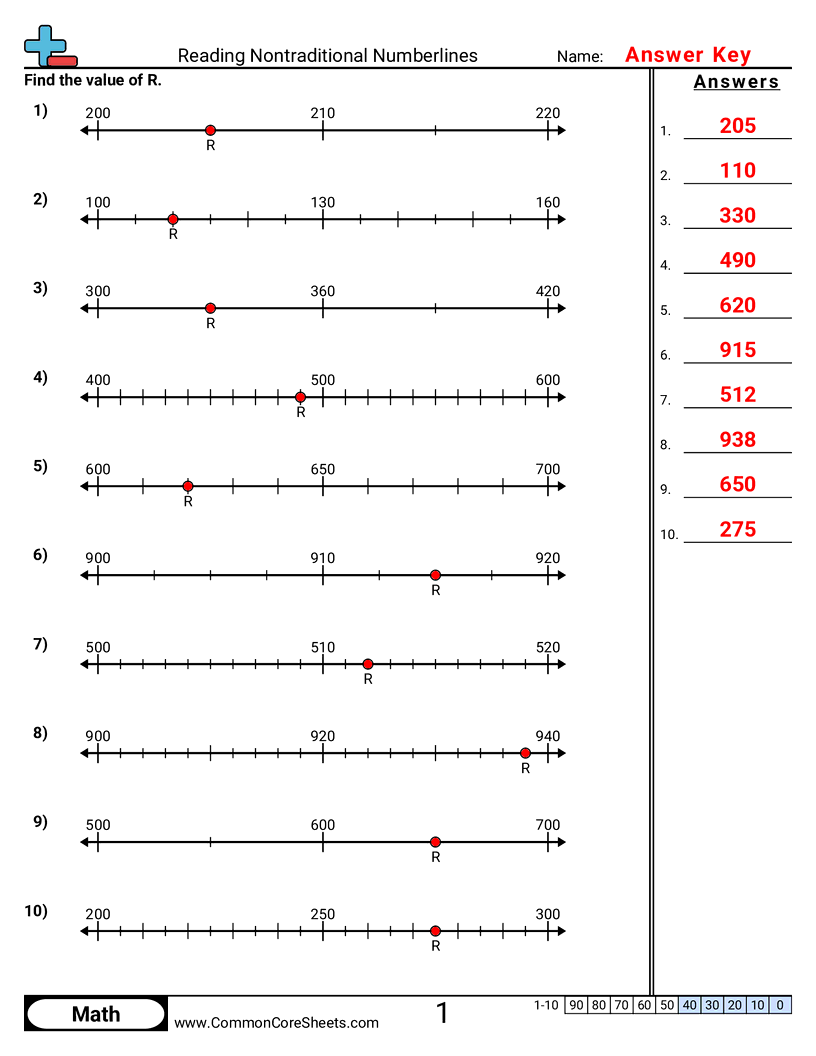
Figure out what number each tick mark stands for when the number line doesn’t start at 0. Use the spacing between tick marks to find the interval and count by that amount. Use jumps on the number line to count forward or backward to a target number.
2md6
Practice finding where a number belongs on an open number line from 0 to 20. Use the tick marks to count forward and figure out the value of a point. Read a number line and write the number that matches a marked location.
2md6
Find where a given number belongs on a number line from 0 to 100. Use the tick marks and the scale to count by 1s or 10s to locate a number. Figure out which two labeled numbers a value falls between on an open number line. Place a point at the correct spot even when only some numbers on the line are shown.
4nbt1
Practice finding missing place-value entries when some columns can hold numbers greater than 9 Figure out what value is needed in a blank column so that all the parts add up to the given number Understand that a number can be broken down into non-standard place-value combinations (like 12 tens instead of 1 hundred and 2 tens)
About these worksheets
These worksheets introduce equation concepts and algebraic thinking. Activities include filling in missing numbers to make true expressions, understanding the meaning of the equals sign, writing algebraic expressions with variables, rewriting word sentences as numeric equations, and identifying true and false equations within 20. Resources span first through sixth grade standards.
1nbt3
Fill in a missing number to make an equation true.
1oa7
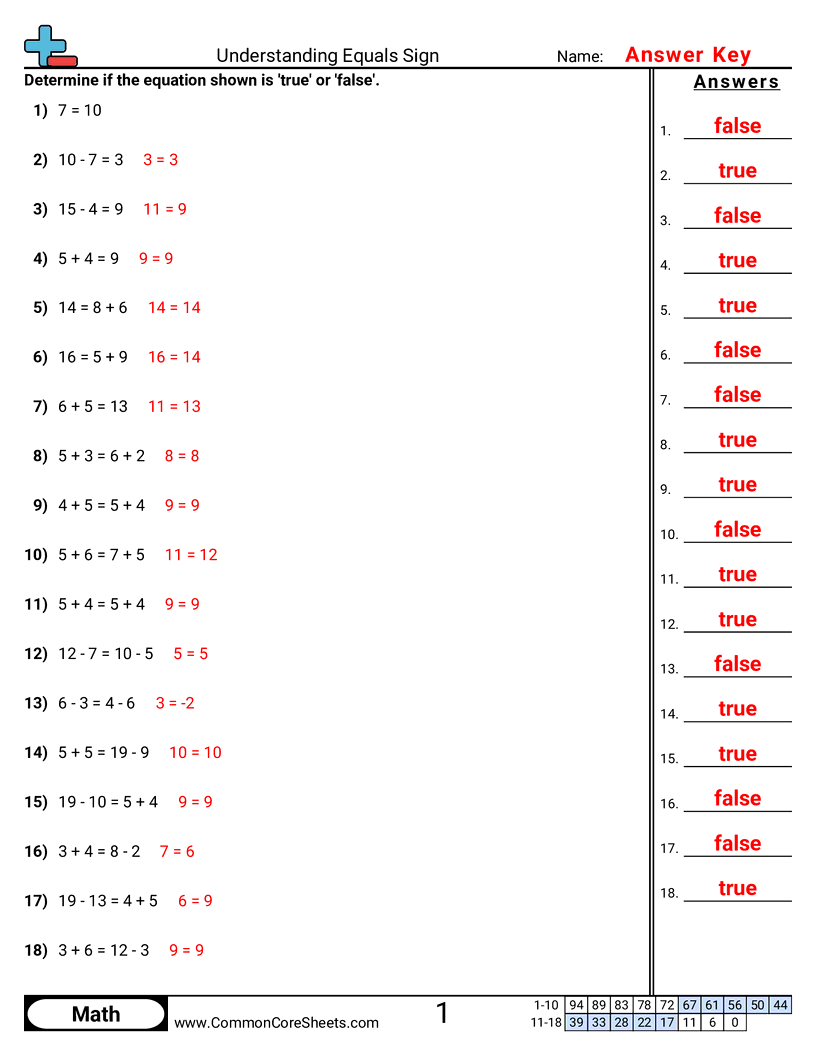
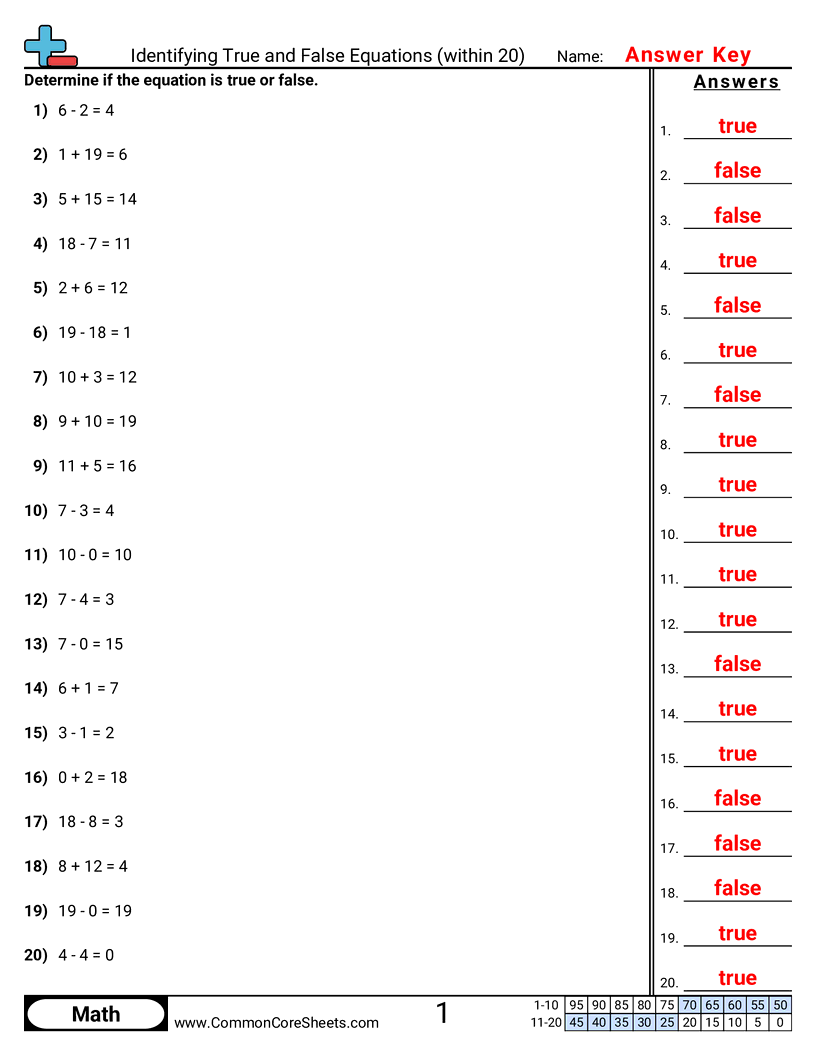
Understand that the equals sign means both sides have the same value. Decide whether an equation is true or false by comparing the left side and the right side. Solve simple addition or subtraction expressions to check if two sides match.
4oa1
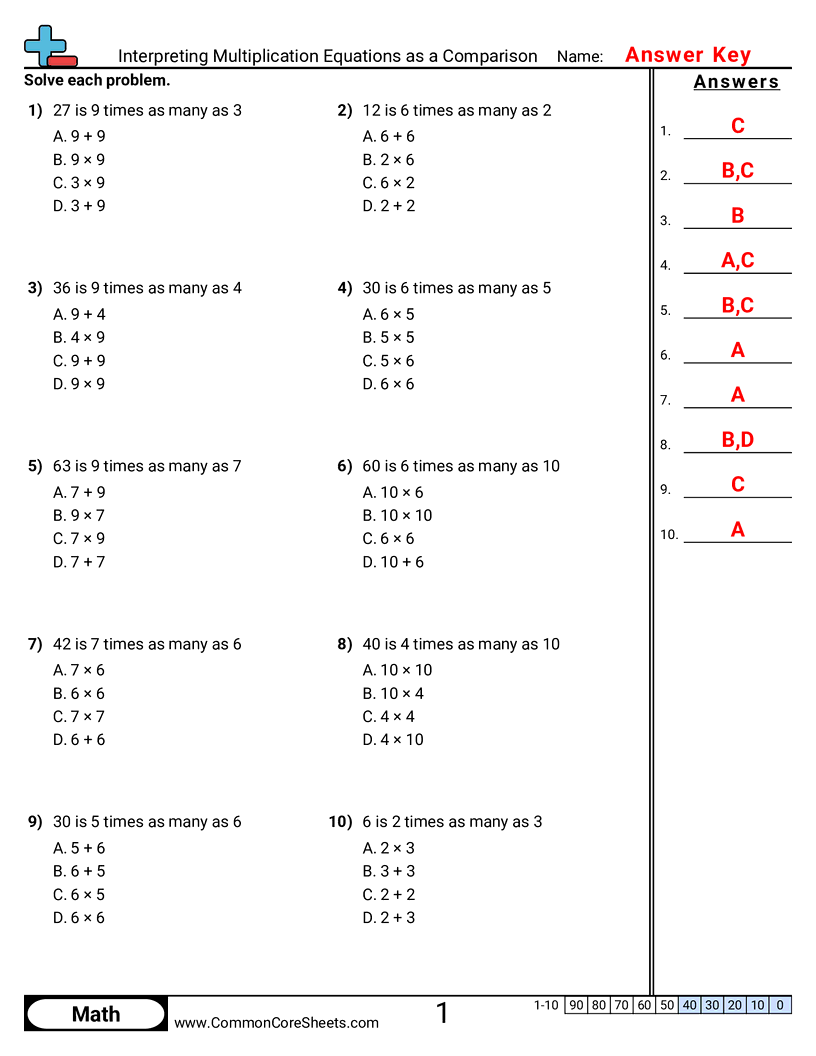
Read a multiplication equation as a comparison, like "3 times as many." Match an equation to a sentence that correctly describes the comparison.
5oa2
Rewrite a worded number sentence using numerals and math symbols.
6ee2a
Match a short phrase to the correct algebraic expression using a variable. Translate words like plus, minus, times, and divided by into the right math symbols.
1oa7
Decide whether an addition or subtraction equation is true or false. Solve simple addition and subtraction facts within 20 to check an equation. Understand that the equals sign means both sides of an equation have the same value.
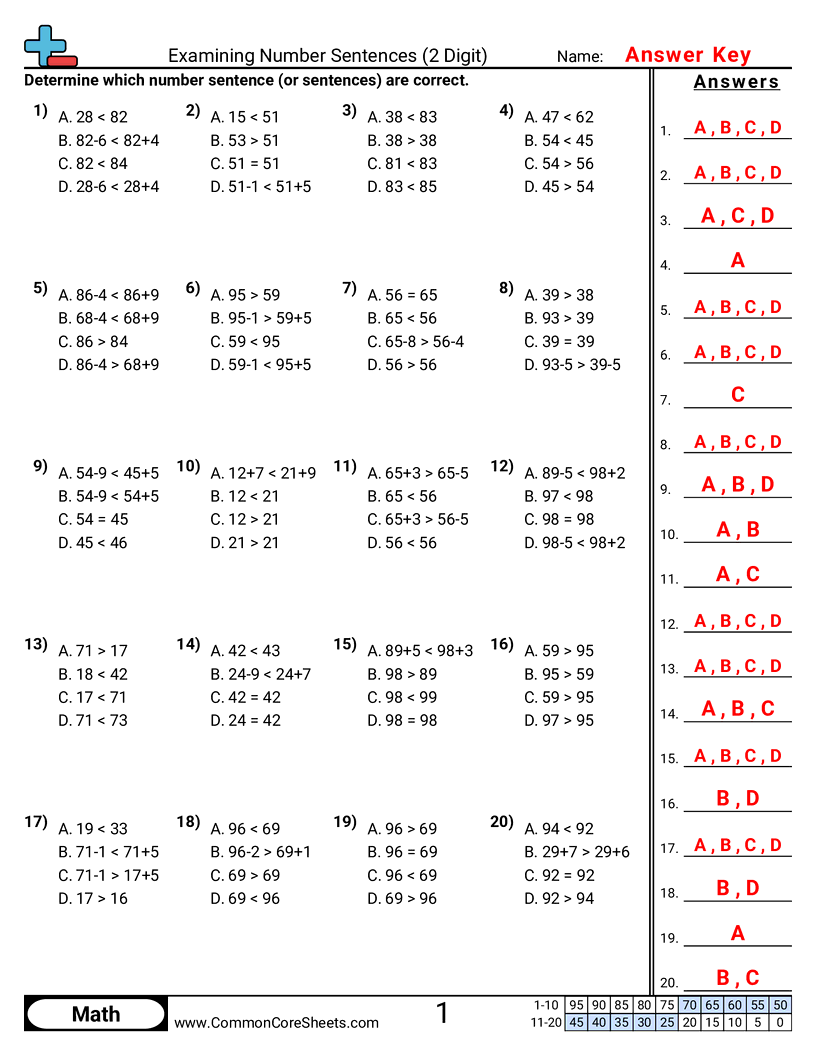
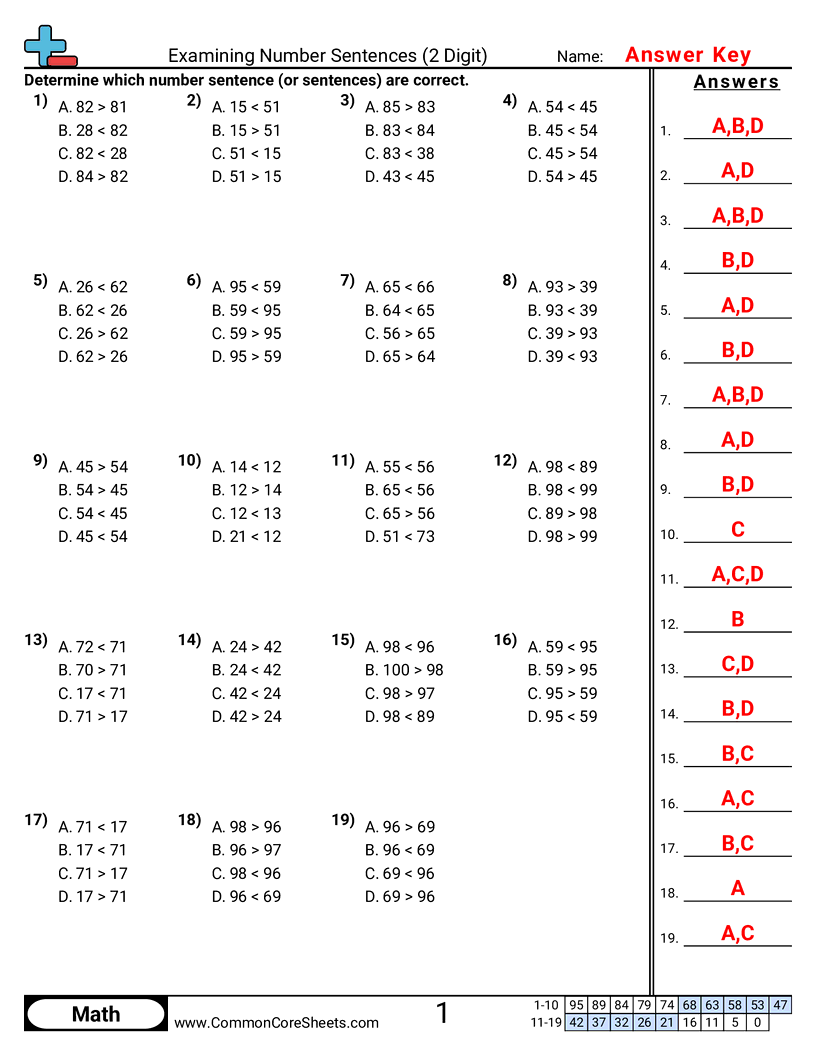
Practice deciding if comparison statements with two-digit numbers are true or false using >, <, and = Simplify expressions with addition or subtraction on one or both sides before comparing Choose all the correct answers when more than one number sentence is true
3oa4
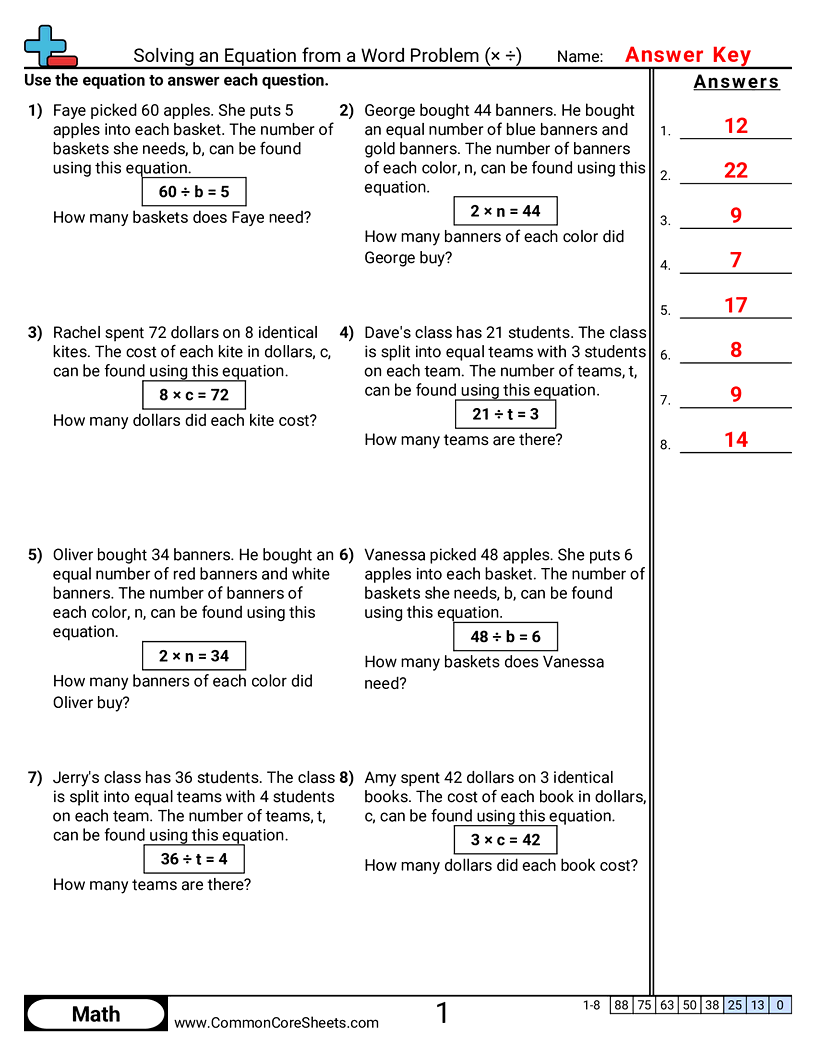
Find the value of a letter in a multiplication or division equation Read an equation that has already been written for a word problem Understand that a letter stands for one unknown number Use the relationship between multiplication and division to solve for the unknown
4oa3
Find the value of a letter in an addition or subtraction equation Read an equation that has already been written for a word problem Understand that a letter stands for one unknown number Solve for an unknown that is not alone on one side of the equal sign
3oa4
Find the value of a letter in an addition, subtraction or multiplication equation Read an equation that has already been written for a word problem Understand that a letter stands for one unknown number Check that the answer makes sense against the numbers in the story
4oa3
Find the value of a letter that makes a given equation true. Work with all four operations in one set of problems. Read an equation that has the unknown inside it rather than alone on one side.
4oa3
Find the value of a letter that makes a given equation true. Work with addition equations where the unknown sits inside the equation. Check an answer by putting it back into the equation.
4oa3
Find the value of a letter that makes a given equation true. Work with subtraction equations where the unknown sits inside the equation. Check an answer by putting it back into the equation.
3oa4 4oa3
Find the value of a letter that makes a given equation true. Work with multiplication equations where the unknown sits inside the equation. Check an answer by putting it back into the equation.
3oa4 4oa3
Find the value of a letter that makes a given equation true. Work with division equations where the unknown sits inside the equation. Check an answer by putting it back into the equation.
About these worksheets
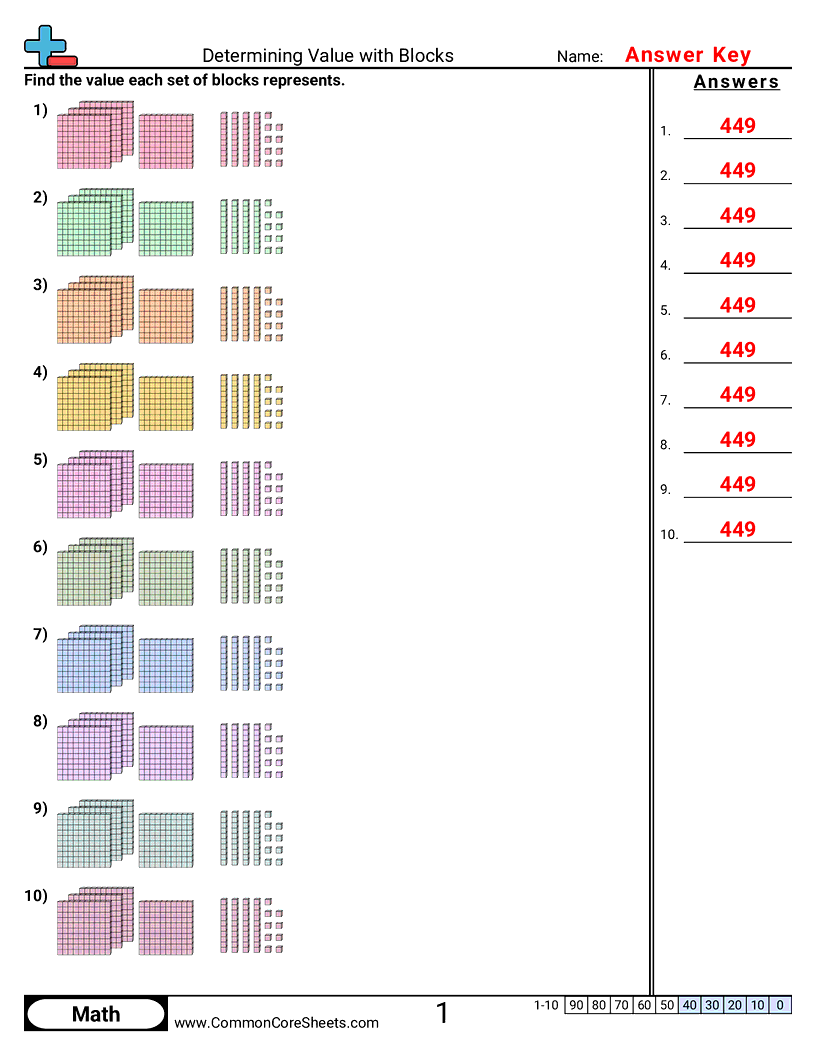
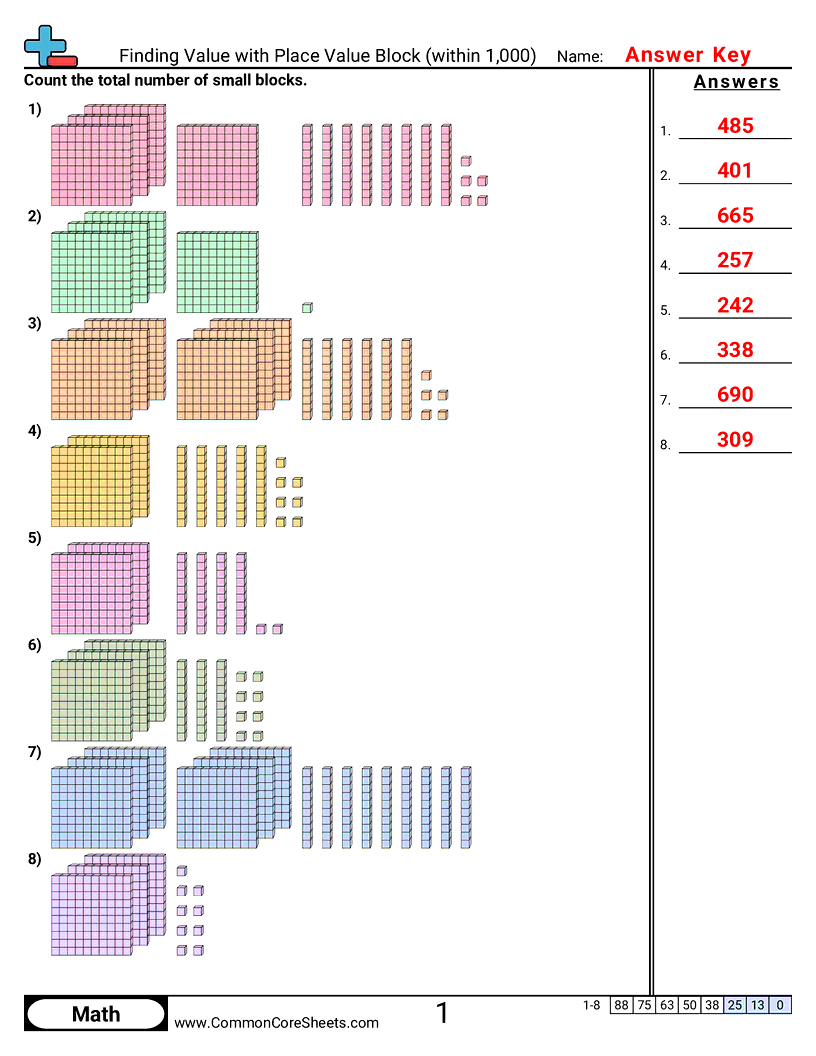
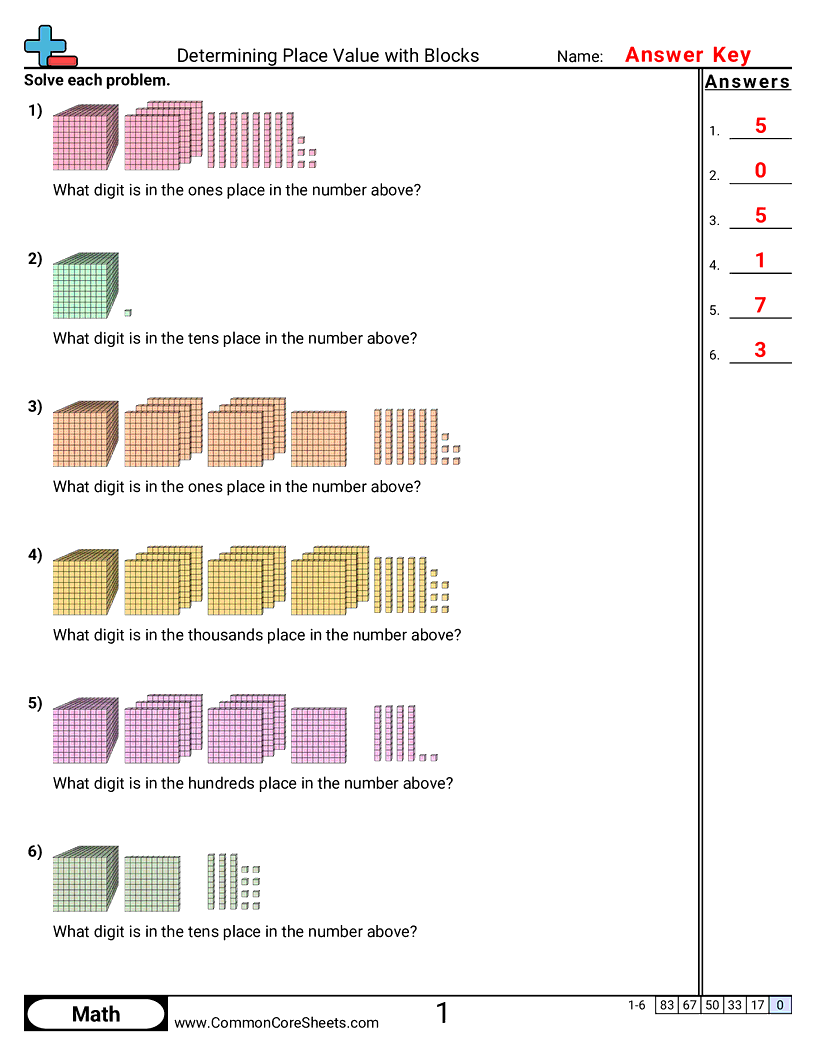
Students use base-ten blocks to build understanding of place value. Worksheets progress from identifying values with tens and ones blocks, to working with hundreds blocks, creating and identifying groups of 100, and determining values shown by blocks up to 1,000 and beyond. These concrete visual models make abstract place value concepts tangible for first and second graders.
1nbt2c
Read base-ten blocks and tell what number they show using tens and ones. Count tens and ones separately and combine them to make the total value. Match a block model to the correct written number (like 34) and say how many tens and ones it has. Explain the value of a number by describing it as tens and ones (like 34 is 3 tens and 4 ones).
2nbt1a
Read base-ten block pictures and tell how many hundreds, tens, and ones they show. Break a number into hundreds, tens, and ones to explain what each digit means. Count groups of 100s, 10s, and 1s without counting every single block one by one.
2nbt1a
Count by tens to find how many items are in a set of ten-bundles. Use groups of ten to make and recognize 100 as 10 tens.
2nbt1b
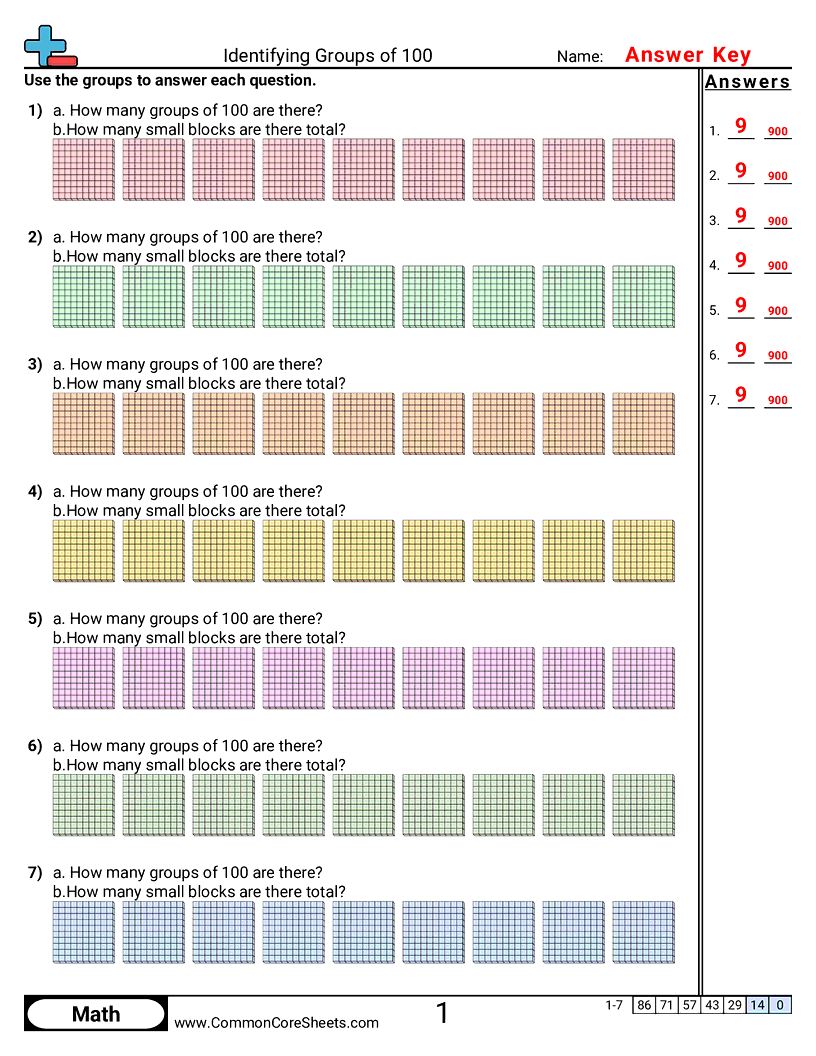
Recognize when a picture or set of objects shows groups of 100. Count how many hundreds are shown by counting the groups. Tell the value of the groups using hundreds (like 3 groups of 100 is 300). Connect groups of 100 to the hundreds place in a number.
Read base-ten blocks and figure out the number they show. Connect each block to its place value (ones, tens, hundreds, thousands). Write the value of a model as a standard number using digits.
Read base-ten blocks and tell what number they show (up to 1,000). Write the number shown by blocks using digits in the correct places. Add the values of the blocks together to find the total.
Read base-ten blocks and tell what number they show. Name the value of a digit by looking at its place (ones, tens, hundreds, thousands). Match a block model to the correct written number. Explain how many ones, tens, hundreds, and thousands are in a number.
About these worksheets
These worksheets develop number comparison and identification skills across grade levels. Activities include finding more and less, comparing two- and three-digit numbers and numbers within one million using inequality symbols, identifying even and odd numbers visually, creating even equations, building numbers from place value descriptions, using place value for multiplication and division, identifying integers, comparing relative size with addition and subtraction, and evaluating number sentences. Resources span first through fourth grade and beyond.
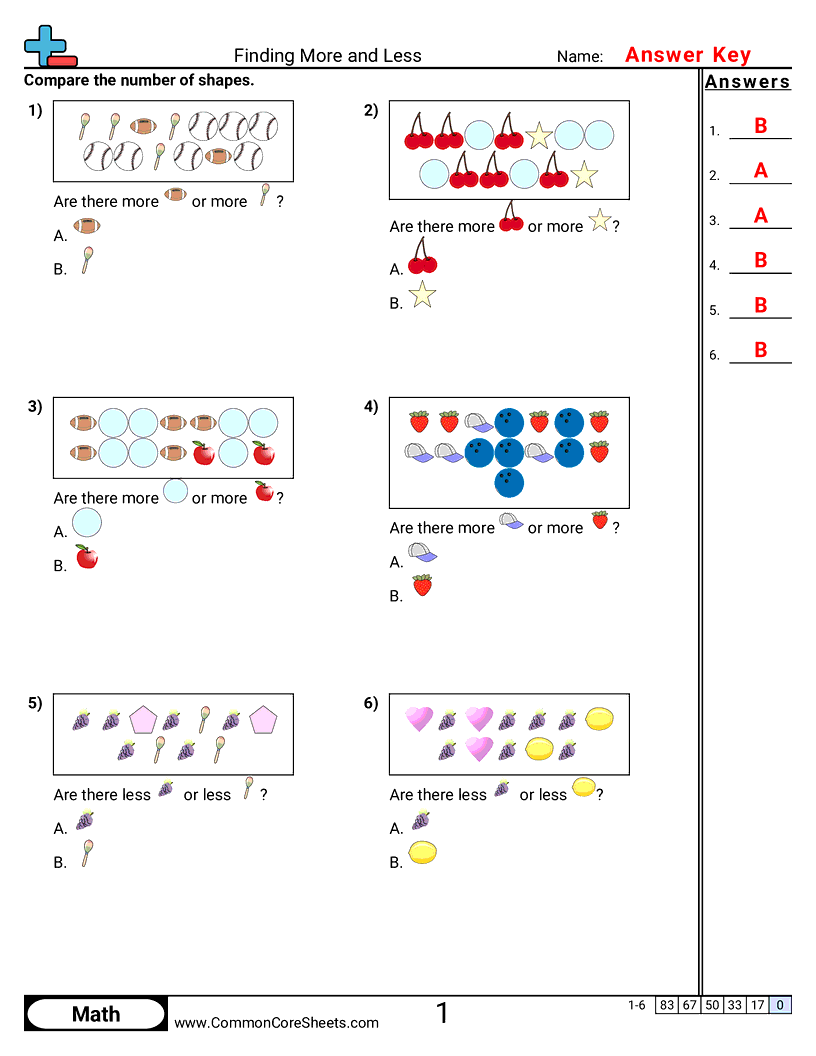
1md4
Look at a few objects and decide which group has more or less.
1nbt3
Compare two two-digit numbers and decide which one is greater, less, or equal. Use the symbols >, <, and = to show how two numbers relate. Look at the tens digit first (and then the ones digit if needed) to compare numbers quickly.
2oa3
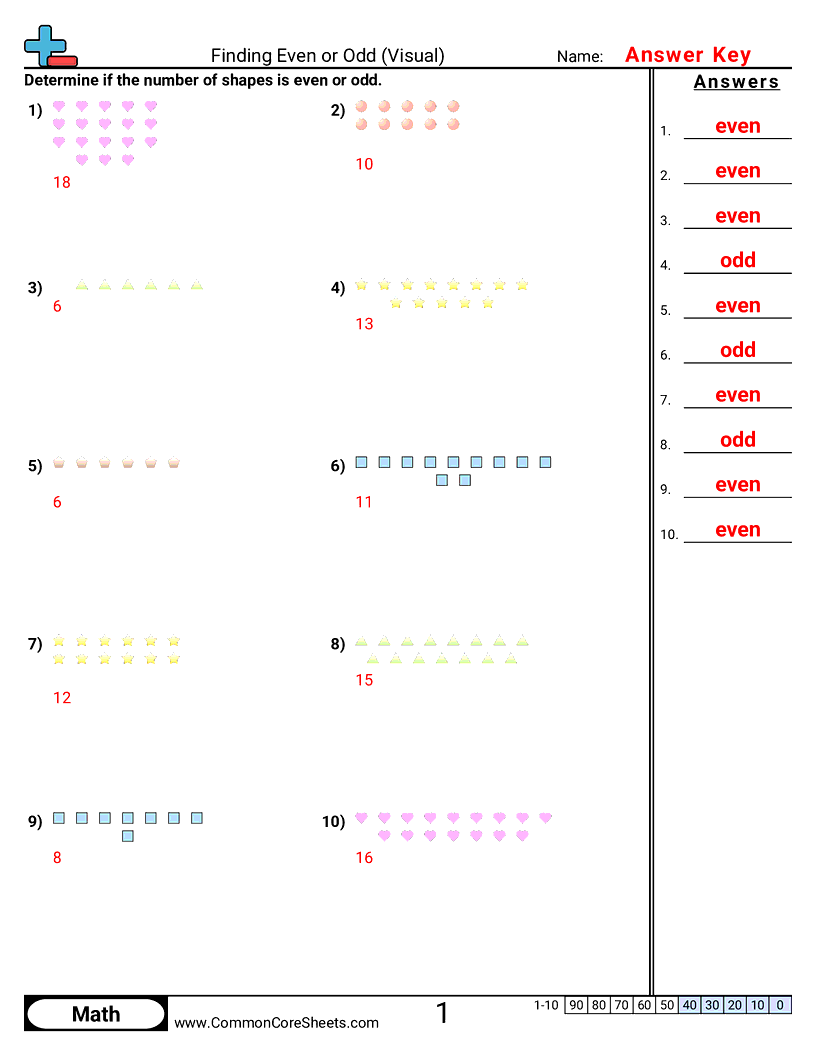
Count a group of shapes and decide if the total is even or odd. Use pairing to see if every shape can be matched with a partner with none left over. Explain even and odd using simple words like "pairs" and "one left." Recognize that even numbers can be split into two equal groups and odd numbers cannot.
2oa3
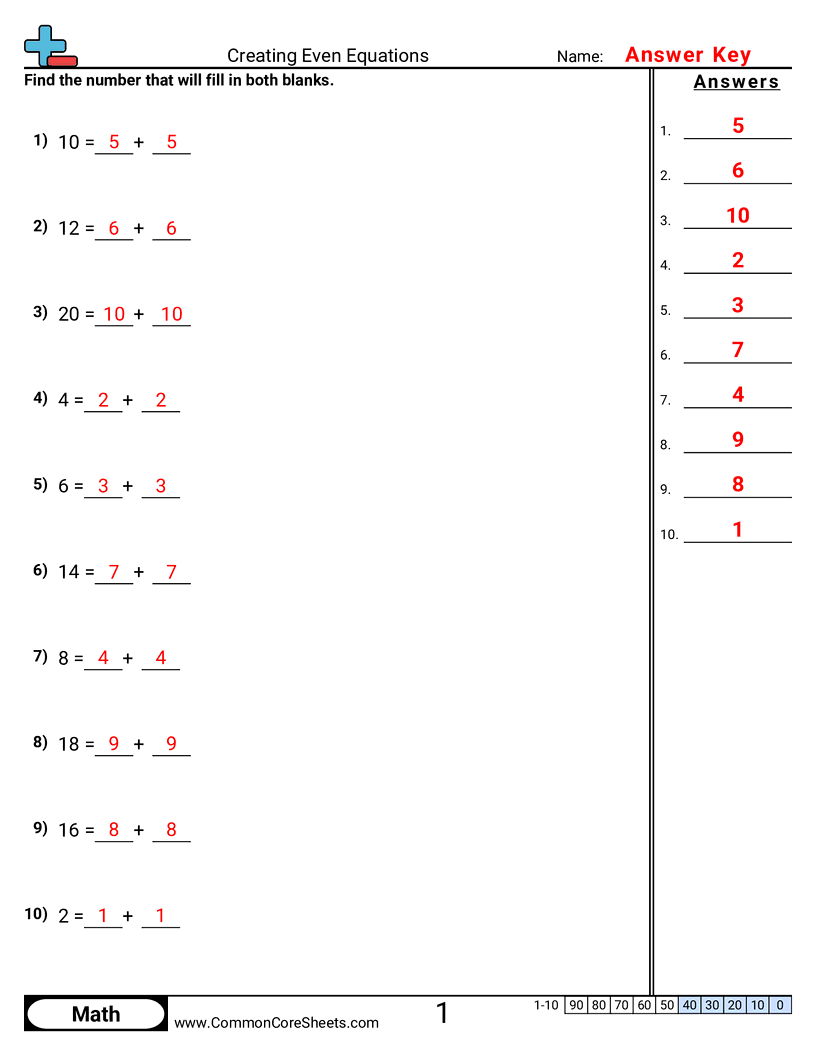
Practice making addition equations that add up to an even number.
2nbt4
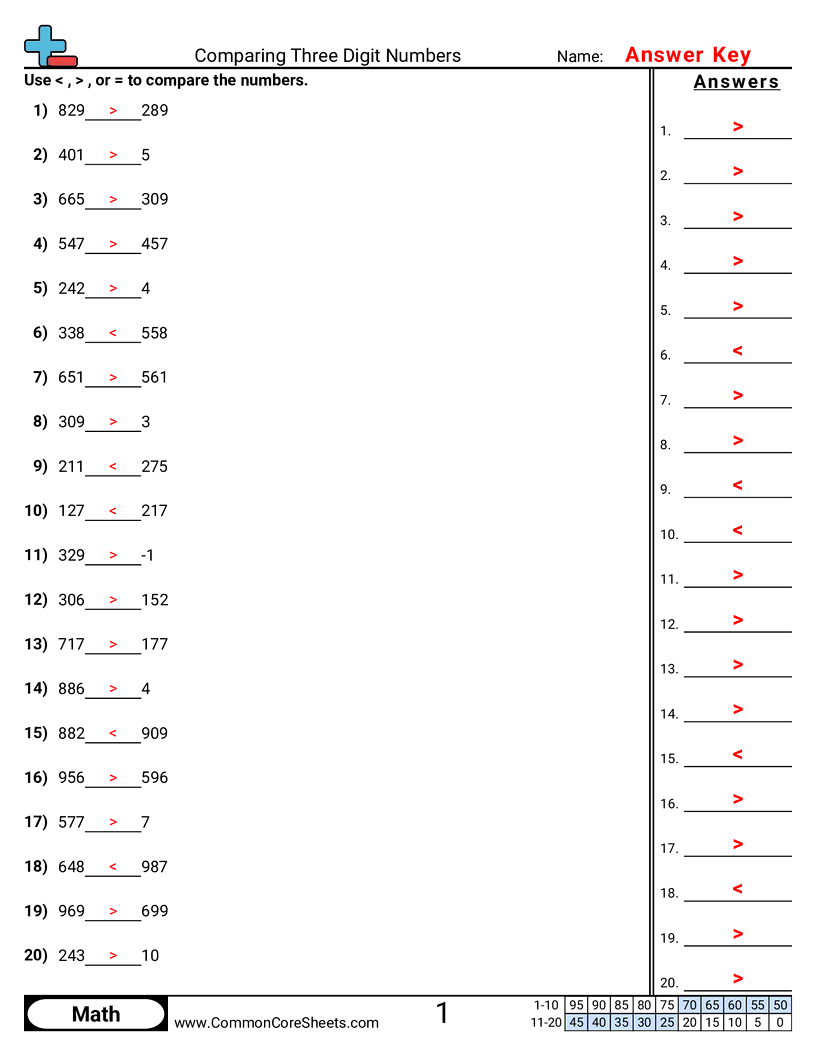
Compare two three-digit numbers and decide which one is greater, less, or equal. Use the hundreds, tens, and ones digits to explain why one number is bigger than another. Read and use the symbols >, <, and = correctly when comparing numbers.
2nbt1a
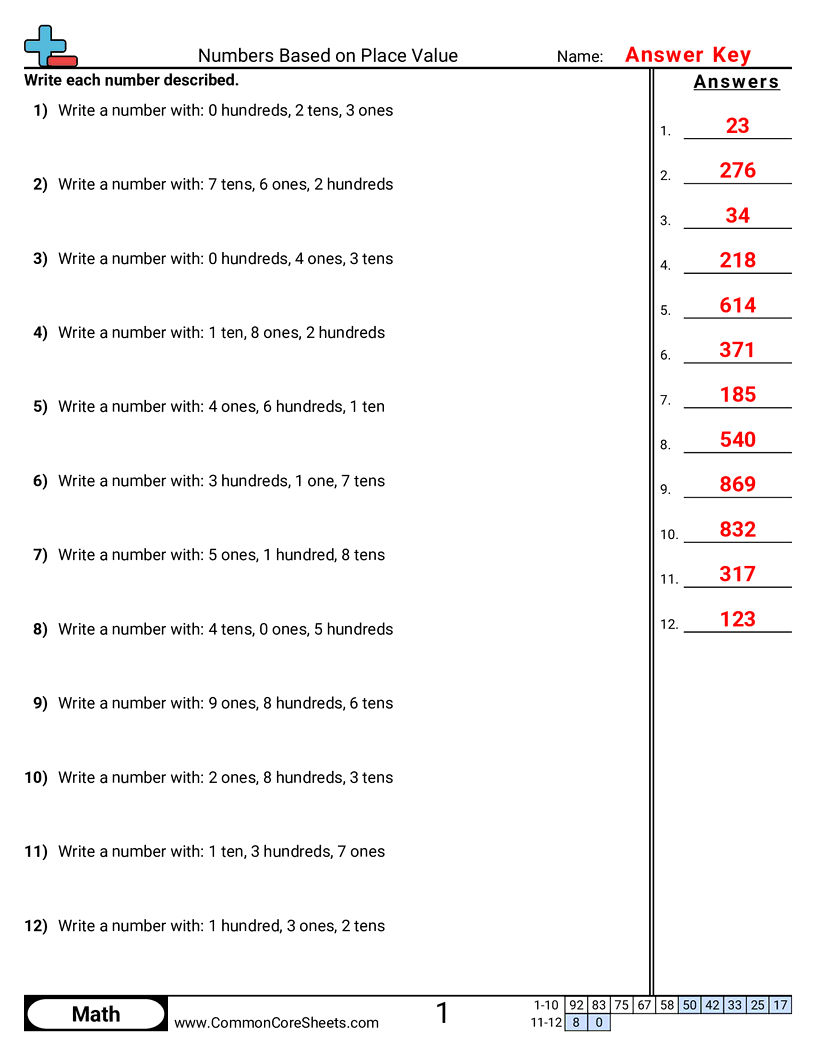
Use hundreds, tens, and ones to build a 3-digit number. Read a place-value description and write the number in standard form.
4nbt2
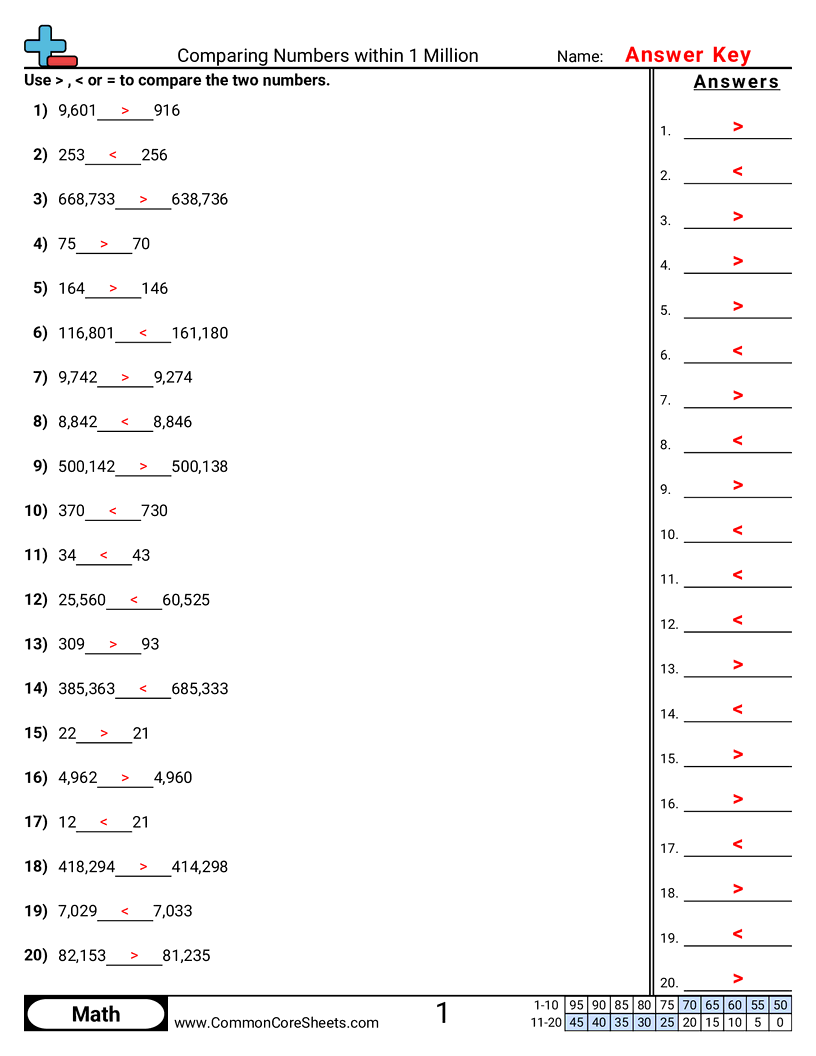
Compare two large numbers and decide which one is greater, less, or equal. Use place value (hundred-thousands, ten-thousands, thousands, etc.) to explain why one number is bigger than another. Use the symbols >, <, and = correctly when comparing numbers.
4nbt2
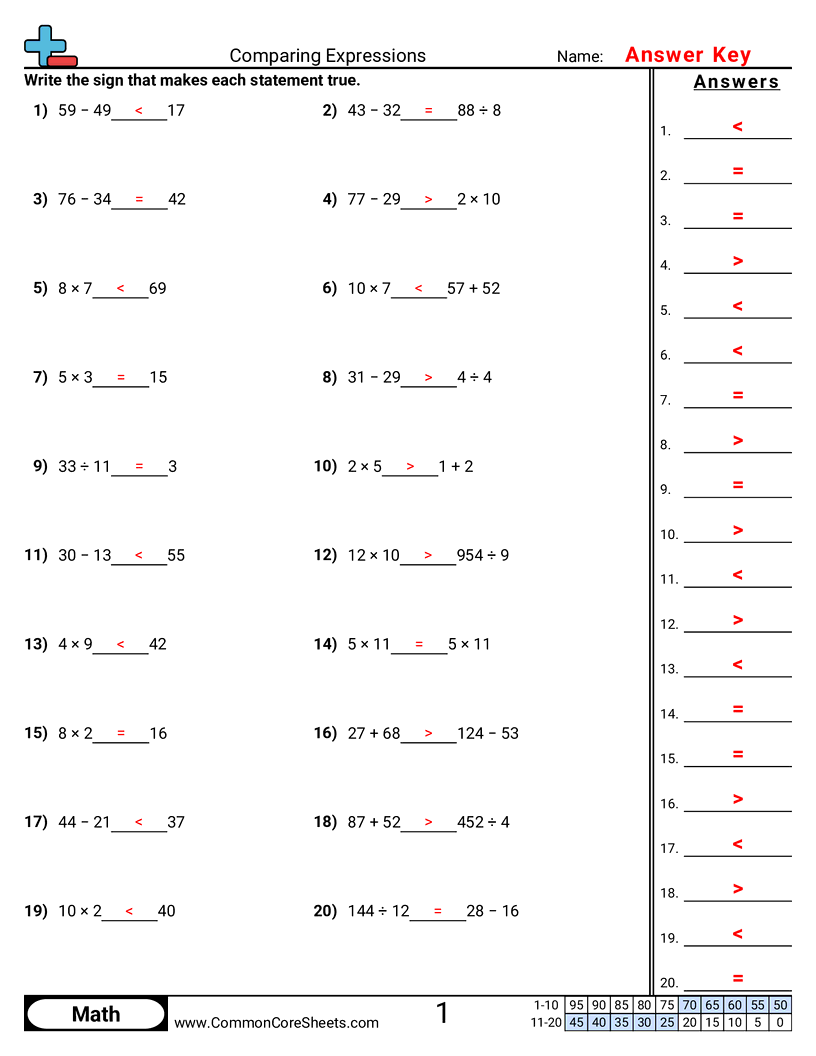
Work out the value of an expression before comparing it. Choose the sign that makes a statement true. Recognize when two different expressions have the same value.
4nbt2
Work out the value of a addition expression before comparing it. Choose the sign that makes a statement true. Recognize when two expressions have the same value.
4nbt2
Work out the value of a subtraction expression before comparing it. Choose the sign that makes a statement true. Recognize when two expressions have the same value.
4nbt2
Work out the value of a multiplication expression before comparing it. Choose the sign that makes a statement true. Recognize when two expressions have the same value.
4nbt2
Work out the value of a division expression before comparing it. Choose the sign that makes a statement true. Recognize when two expressions have the same value.
4nbt1
Multiply a whole number by 10, 100, or 1,000 by shifting digits to the left. Divide a whole number by 10, 100, or 1,000 by shifting digits to the right.
6ns6c
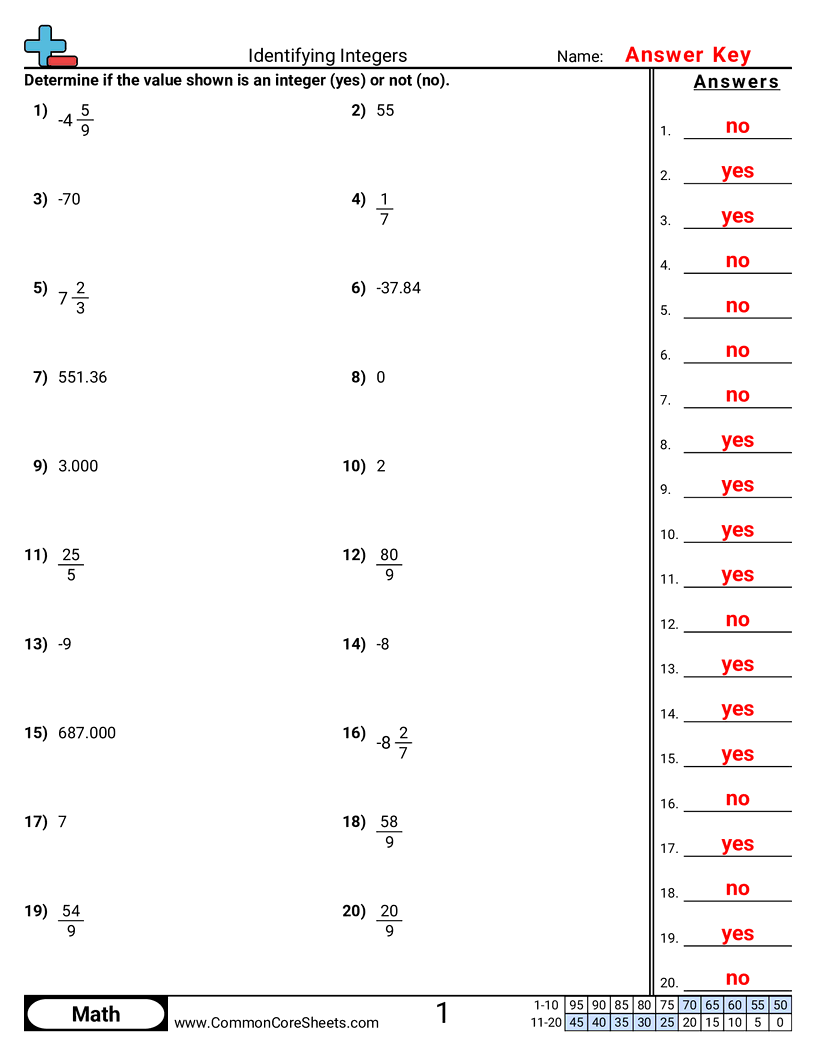
Decide whether a number is an integer or not. Recognize that integers include negative numbers, zero, and positive whole numbers. Tell the difference between integers and numbers with decimals or fractions.
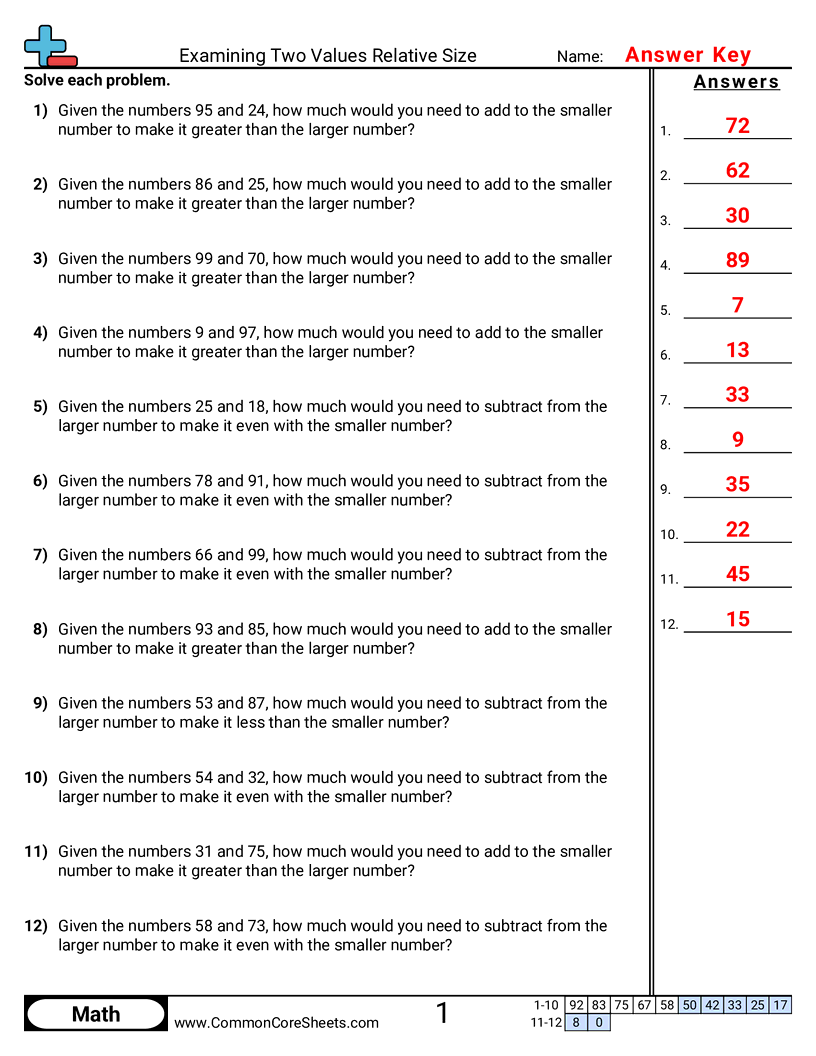
Practice finding the difference between two numbers by figuring out how much to add or subtract Read carefully to understand whether the problem is asking to add to the smaller number or subtract from the larger number Determine which of two numbers is larger and which is smaller before solving
Practice deciding if a greater than (>) or less than (<) statement with two-digit numbers is true or false Compare two-digit numbers by looking at the tens digit first, then the ones digit Choose all the correct answers when more than one comparison statement is true
1nbt3
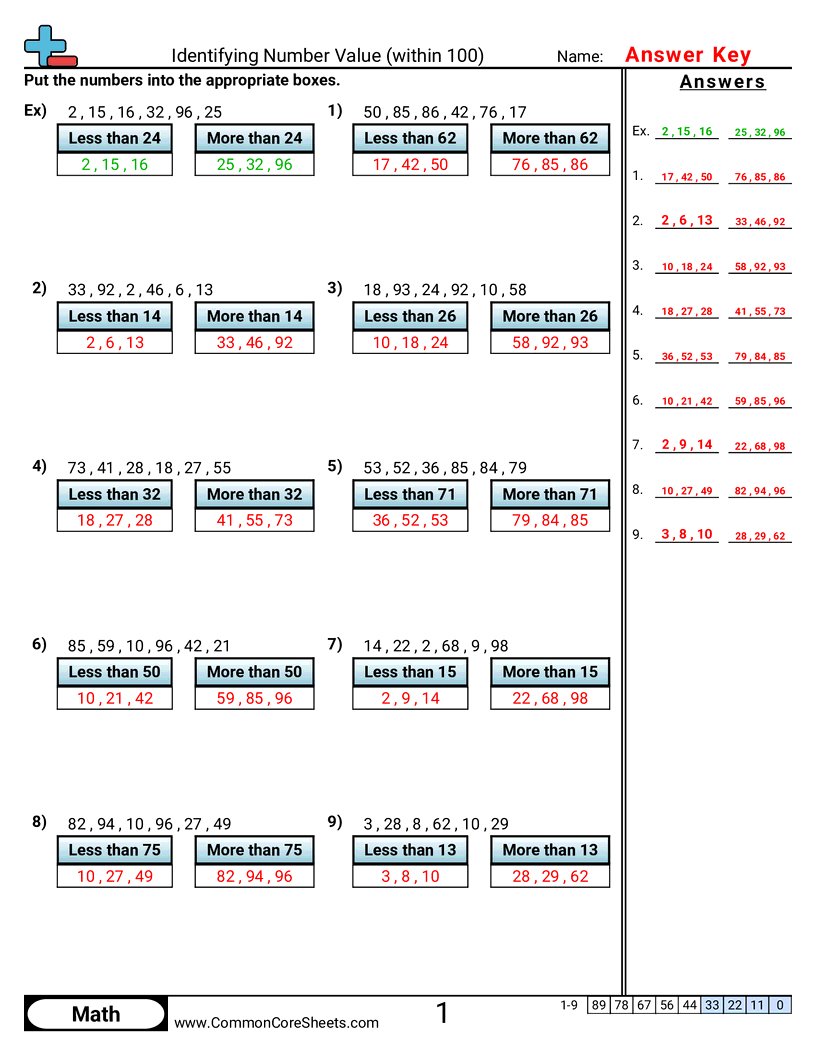
Read and interpret two-digit numbers so you can place them in the correct comparison group.
2nbt4
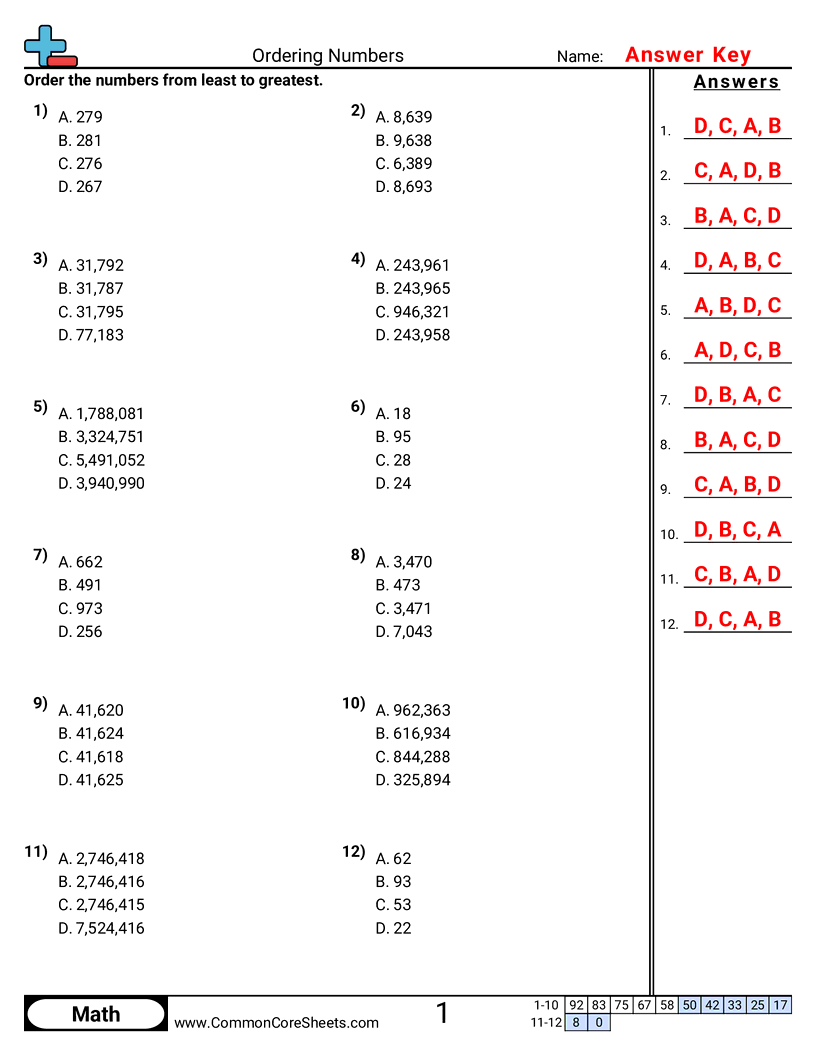
Use the hundreds, tens, and ones digits to explain why one number is bigger than another. Put several three-digit numbers in order from least to greatest or greatest to least.
Value & Place Value worksheets by grade
Playwire Advertisement