Decimal Worksheets
Understand decimals from place value to operations with over 40 free decimal worksheets. Students start by locating decimals on a number line and determining decimal value, then progress to comparing and ordering decimals, adding and subtracting decimals, and multiplying and dividing decimals. Every worksheet is a printable PDF with an answer key in multiple versions - no login or account required - and most are also available as digital assignments. Modified versions help learners who need a lighter problem load, and the grading column with quick grade scale keeps scoring simple. These decimal worksheets work best for 4th through 6th grade, and pair naturally with the fraction and place value collections.
More about these worksheets ▾ Show less ▴
×
About these worksheets
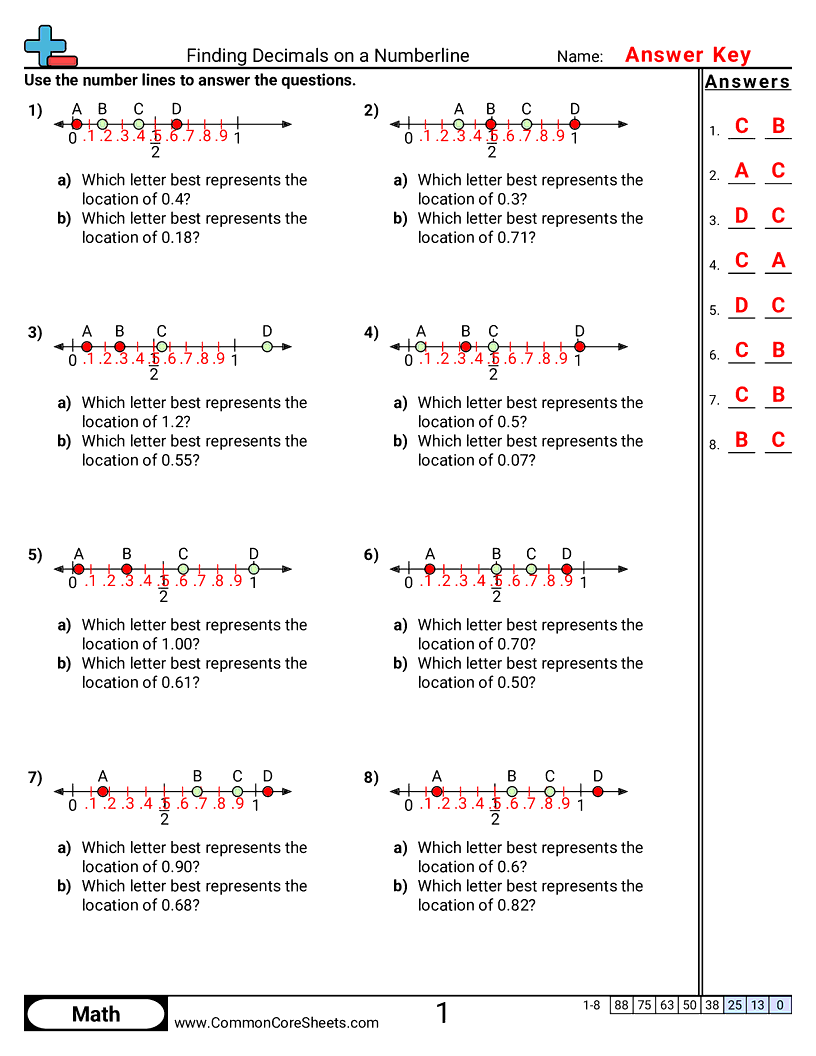
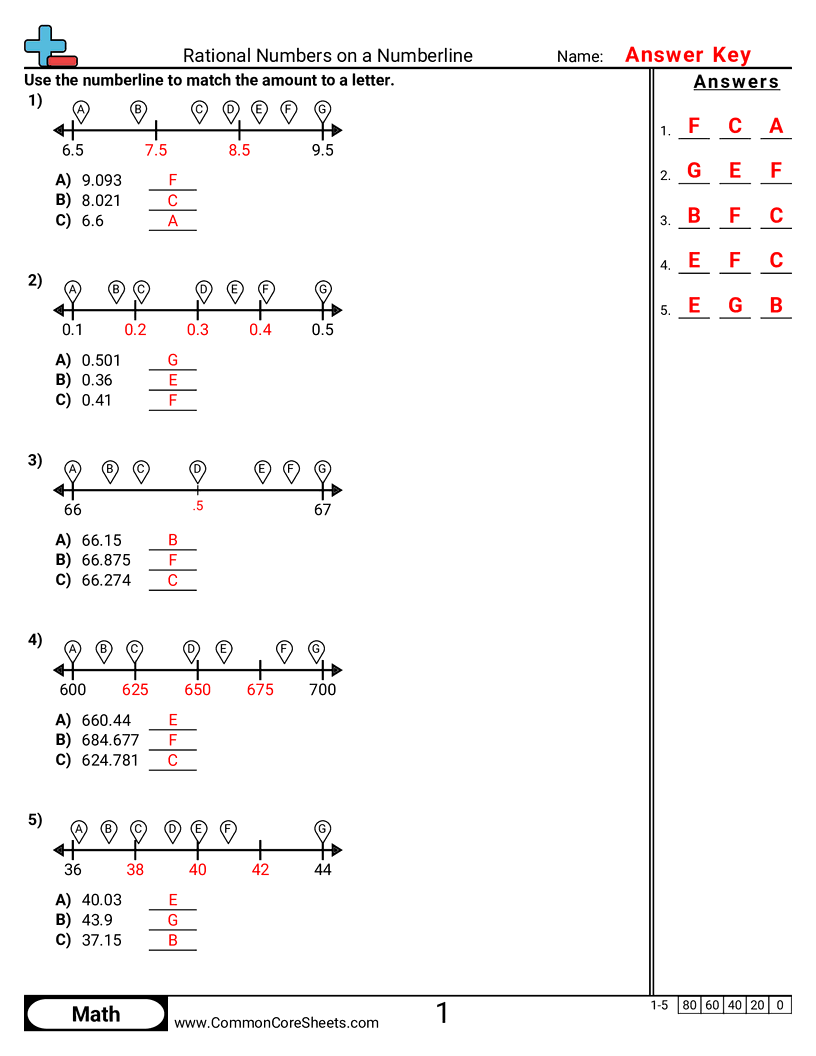
These worksheets develop students' understanding of where decimals fall on a number line. Activities include locating decimals between whole numbers, determining whether a decimal is less than, equal to, or greater than one-half, and using number lines to express decimal expansions. Suitable for fourth through eighth grade.
4nf6
Use the whole numbers on a number line to figure out which interval a decimal belongs in. Count equal tick marks on a number line to place a decimal at the correct point.
4nf6
Decide whether a decimal number is less than, equal to, or greater than one-half (0.5). Use place value to compare decimals by looking at tenths and hundredths. Recognize different ways to write one-half, like 0.5 and 0.50, and compare other decimals to it.
8ns2
Practice reading a number line that is divided into equal parts and understanding what each tick mark means. Learn to locate a decimal on a number line by using the interval between two whole numbers.
4md2
Practice placing decimals in the correct spot on a number line
5nbt3b
Find a decimal on a number line. Find a fraction or mixed number on the same line. See that a point is a decimal and a fraction at once.
About these worksheets
Students explore the meaning and value of decimal digits through a variety of activities. Worksheets cover identifying the value of underlined digits, recognizing repeating and terminating decimals, reading visual models of tenths and hundredths, interpreting place value blocks, and converting between decimals and percents. These resources span fifth through seventh grade standards.
5nbt1
Find the value of an underlined digit in a decimal number. Use place value to tell how much a digit is worth (like tens, ones, tenths, or hundredths).
7ns2d
Convert a fraction into a decimal that repeats. Spot the repeating pattern in a decimal and write it using a bar (overline) notation.
7ns2d
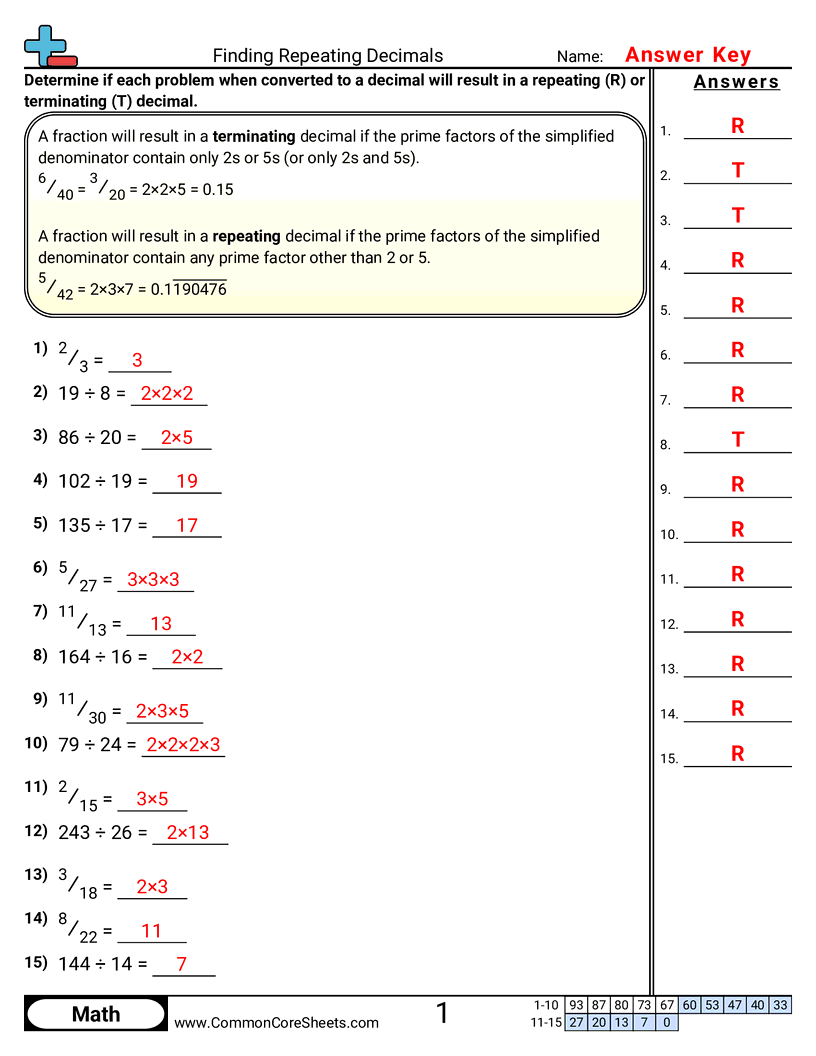
Decide whether a fraction will turn into a terminating decimal or a repeating decimal. Use long division to see if the decimal ends or starts cycling. Spot when a remainder repeats and understand that this creates a repeating pattern in the decimal.
4nf6
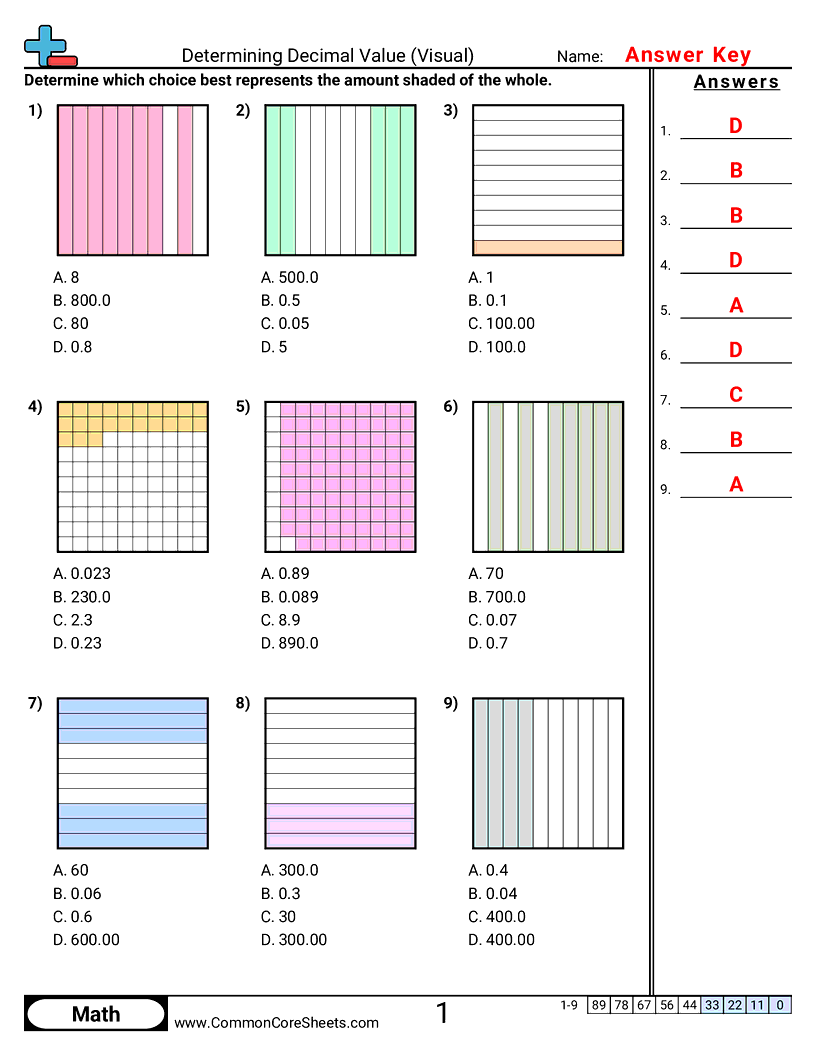
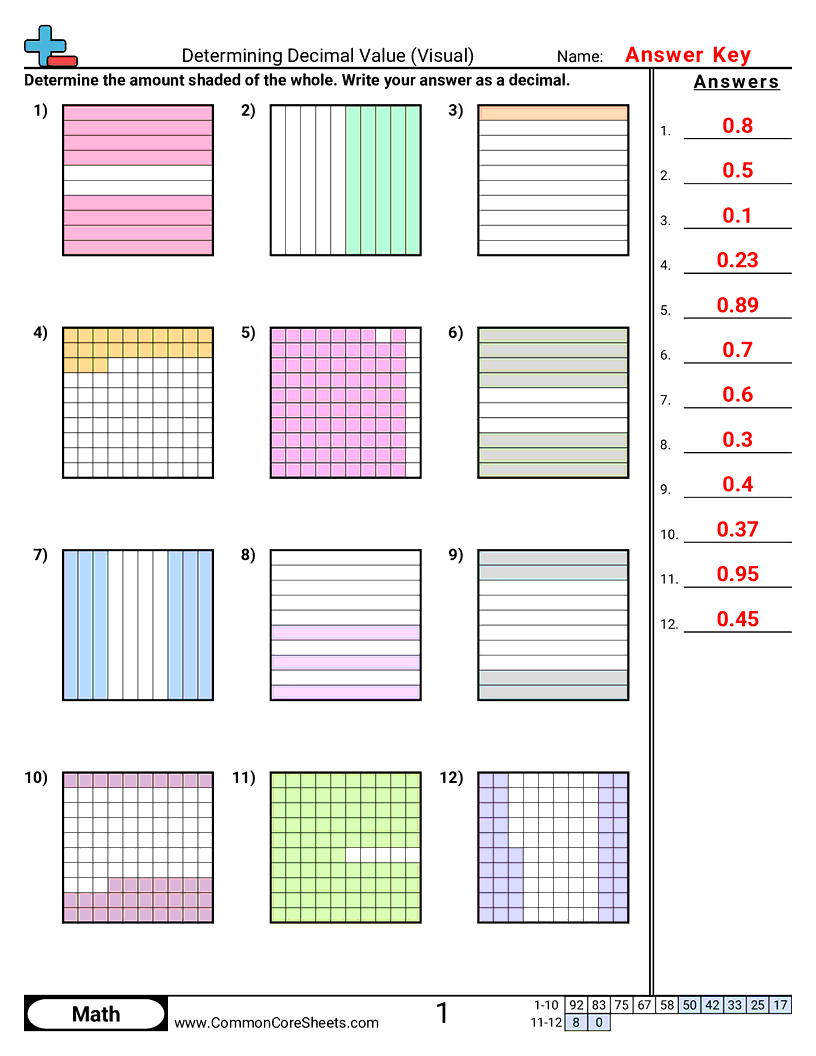
Read a shaded picture model and tell what decimal it represents. Connect tenths and hundredths to how much of a whole is shaded. Use place value to decide whether the decimal should have one or two digits after the decimal point. Choose the matching decimal from several answer choices by comparing the model to the numbers.
4nf6
Read a shaded picture model and tell what decimal it represents. Connect tenths and hundredths to how much of a whole is shaded. Use place value to write the decimal correctly with the decimal point in the right spot.
4nf5
Read base-ten blocks and decide what decimal number they show. Match each block piece to its place value (ones, tenths, hundredths, thousandths). Write the number in standard decimal form using the correct digits and decimal point.
6rp3c
Practice turning a decimal less than 1 into a percent. Learn to multiply a decimal by 100 to find the percent. Get comfortable moving the decimal point two places to the right when converting to percent. Write the final answer correctly using the percent sign (%)
6rp3c
Convert a percent to a decimal by dividing by 100. Move the decimal point two places to the left when changing a percent into a decimal. Write the decimal in correct place value form (tenths, hundredths, thousandths). Recognize that percents under 100% turn into decimals less than 1.
5nbt3a
Work out what each base ten block is worth once one of them is named the whole Write the value of a set of blocks as a fraction Use a denominator of tenths, hundredths or thousandths depending on the smallest block shown See how the same block changes value when a different block is the whole
5nbt3a
Read a decimal fraction off a 10 by 10 grid. Write the same amount as a fraction and as a decimal. Recognize that hundredths on a grid and a decimal are the same number.
5nbt3a
Read a length in meters as a decimal. See a mark as tenths and hundredths at the same time. Connect centimeters to hundredths of a meter.
5nbt3a
Shade a 10 by 10 grid to show a decimal. Turn tenths and hundredths into a number of squares. Represent a decimal with a model.
5nbt3a
Write the same amount as tenths and as hundredths. See that one tenth is ten hundredths. Recognize ten tenths as one whole.
Use place value and mental math to find 0.1, 0.01, or 0.001 more or less than a decimal number. Identify which decimal digit changes when adding or subtracting tenths, hundredths, or thousandths. Solve problems with decimals without written computation.
Find 0.1, 0.01 or 0.001 more than a number. Find 0.1, 0.01 or 0.001 less than a number. Regroup across a place value using mental math.
Name the change between two decimals. Identify which place value changed. Tell an increase from a decrease.
Count on by 0.1, 0.01 or 0.001. Count back by 0.1, 0.01 or 0.001. Continue a decimal pattern across a place value.
5nbt7
Add 0.1, 0.01 or 0.001 to a number. Subtract 0.1, 0.01 or 0.001 from a number. Work with decimals that have different numbers of places.
About these worksheets
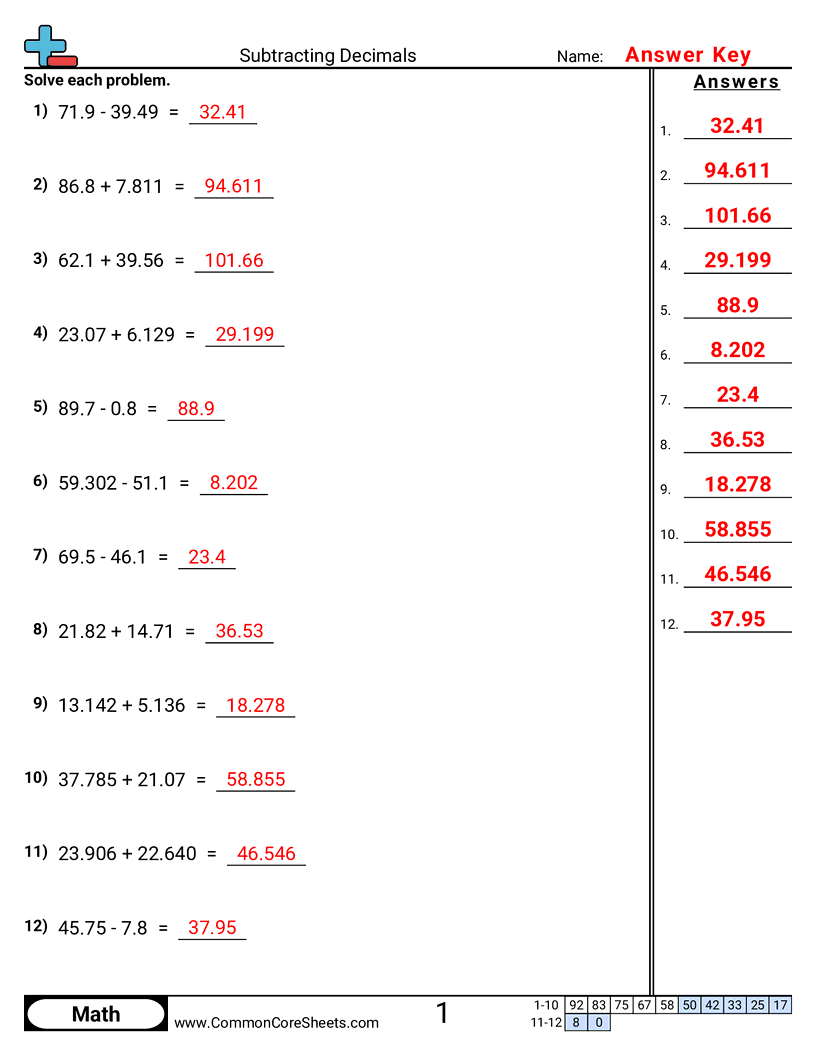
These worksheets provide practice adding and subtracting decimal numbers. Activities include vertical and horizontal computation, using number lines and helper grids to visualize operations, and adding multiple decimal addends. Students learn to line up decimal points by place value and regroup when needed. Aligned with fifth grade standards.
5nbt7
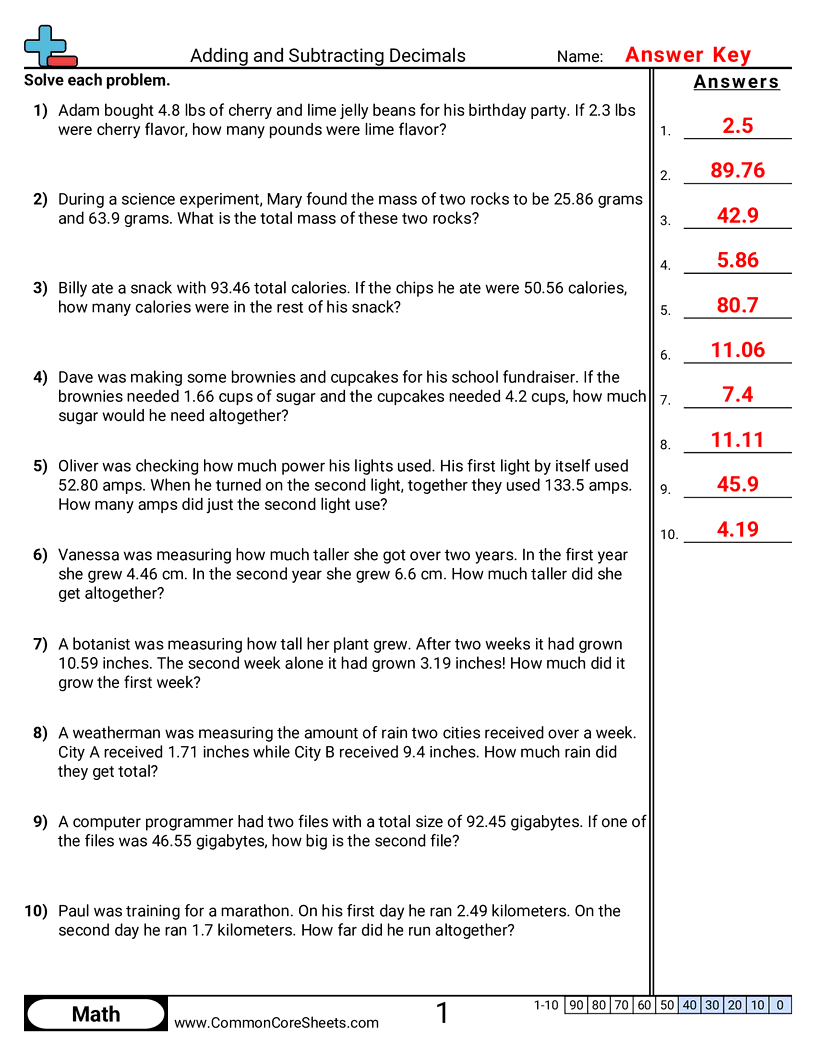
Add decimals to find a total when numbers include tenths and hundredths. Subtract decimals to find how much more or how much is left. Line up decimal points so each place value stays in the right column. Read word problems and decide whether to add or subtract to solve them. Write the answer with the decimal in the correct place.
5nbt7
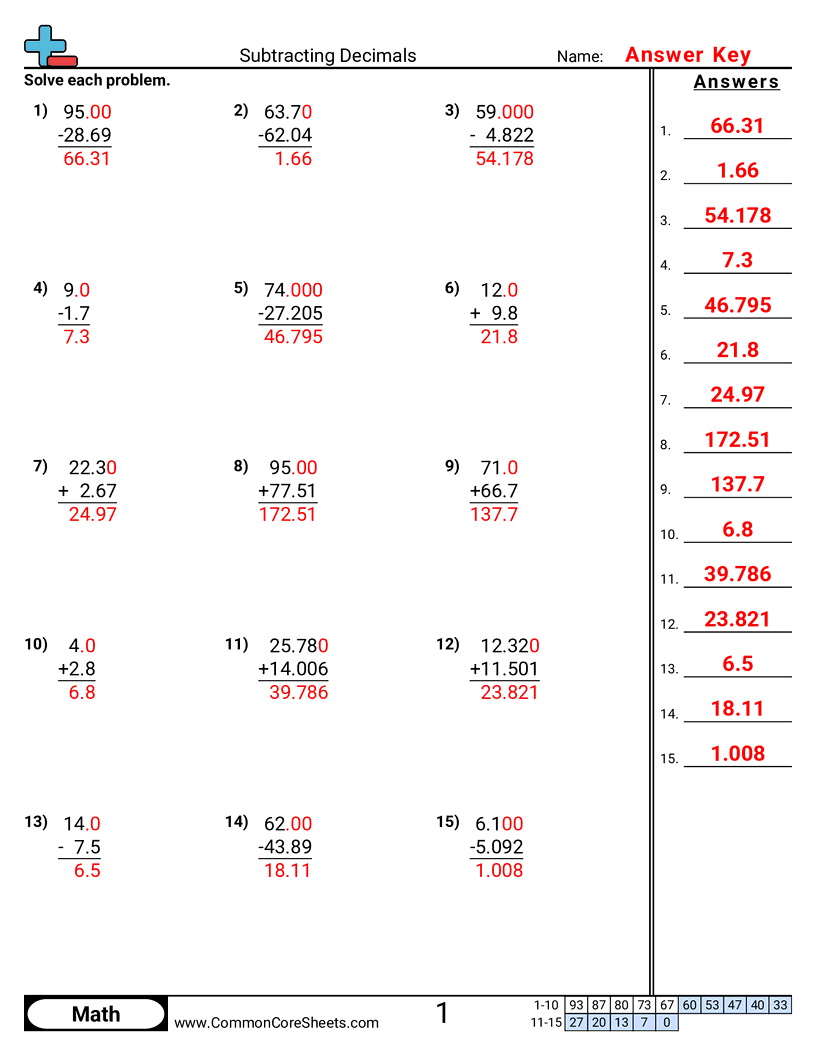
Add decimals accurately, including when you need to regroup (carry). Subtract decimals accurately, including when you need to regroup (borrow). Keep track of place value (ones, tenths, hundredths, thousandths) to write the correct sum or difference.
5nbt7
Line up decimals by place value before adding or subtracting. Add decimals accurately, including when you need to regroup. Subtract decimals accurately, including when you need to borrow. Keep track of the decimal point in the answer.
5nbt7
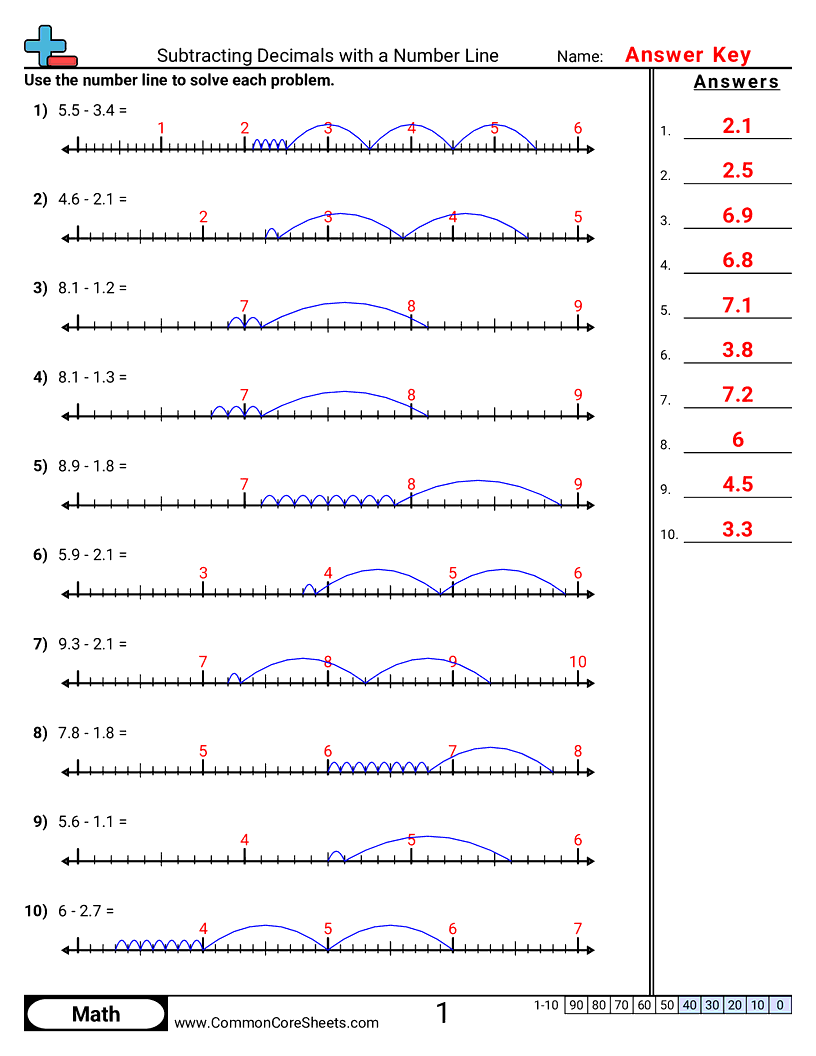
Use a number line to subtract one decimal from another by jumping backward the right amount. Read and place decimals on a number line so you can start and end at the correct points. Break a decimal subtraction into smaller steps (like tenths and hundredths) to keep track of each jump. Find the difference between two decimals and write the answer with the decimal point in the right place.
5nbt7
Add two decimal numbers by starting at the first number and making jumps on a number line. Use tenths marks to keep track of how far each jump moves. Read and write the decimal you land on as the sum.
5nbt7
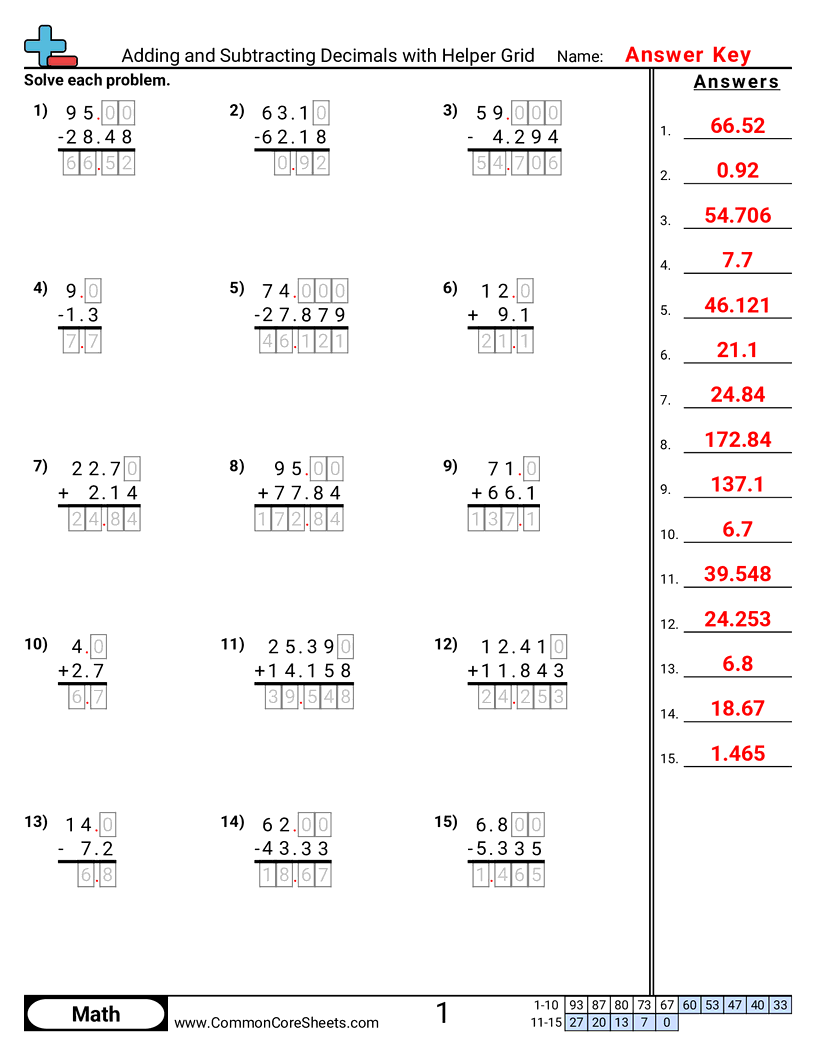
Line up decimals by place value using a helper grid so the digits match up correctly. Add decimals accurately, including when you need to regroup. Subtract decimals accurately, including when you need to regroup. Keep the decimal point in the right place when writing the final answer.
5nbt7
Add several decimal numbers to find one total. Line up decimal points so each place value is added in the right column. Regroup when the digits in a column add to 10 or more. Keep track of tenths and hundredths so the decimal ends up in the correct spot in the sum.
5nbt7
Round decimals to the nearest whole number Estimate a sum of several decimals Judge whether a total is reasonable Read amounts out of a table
5nbt7
Estimate a sum or difference of decimals. Choose the amount closest to an answer. Judge the size of a decimal answer without calculating.
Read decimal values from a table. Decide which rows a question is about. Find a total, a difference or a multiple.
About these worksheets
Students practice multiplying and dividing with decimal numbers using a range of methods. Worksheets cover placing the decimal point correctly in products and quotients, multiplying and dividing by powers of ten, estimating decimal products, using visual area models, and performing all four operations with decimals. Topics extend through sixth grade standards.
5nbt7
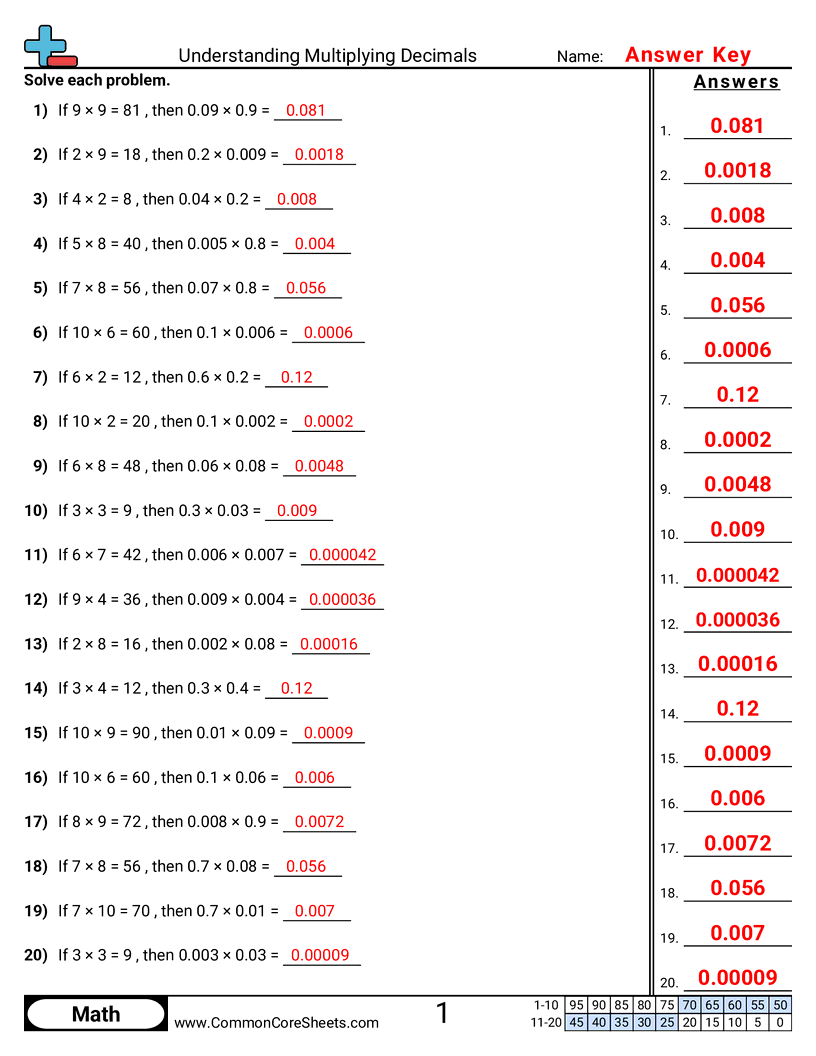
Place the decimal point correctly in a multiplication problem with decimals. Count decimal places in the factors to decide how many decimal places the product should have. Multiply the numbers as whole numbers first, then put the decimal back in the right spot.
5nbt2
Multiply two decimal numbers to find the product. Place the decimal point correctly in the answer. Use place value to understand how multiplying by tenths and hundredths changes a number. Multiply decimals by multiplying as whole numbers first, then adjusting for the decimal places.
5nbt2
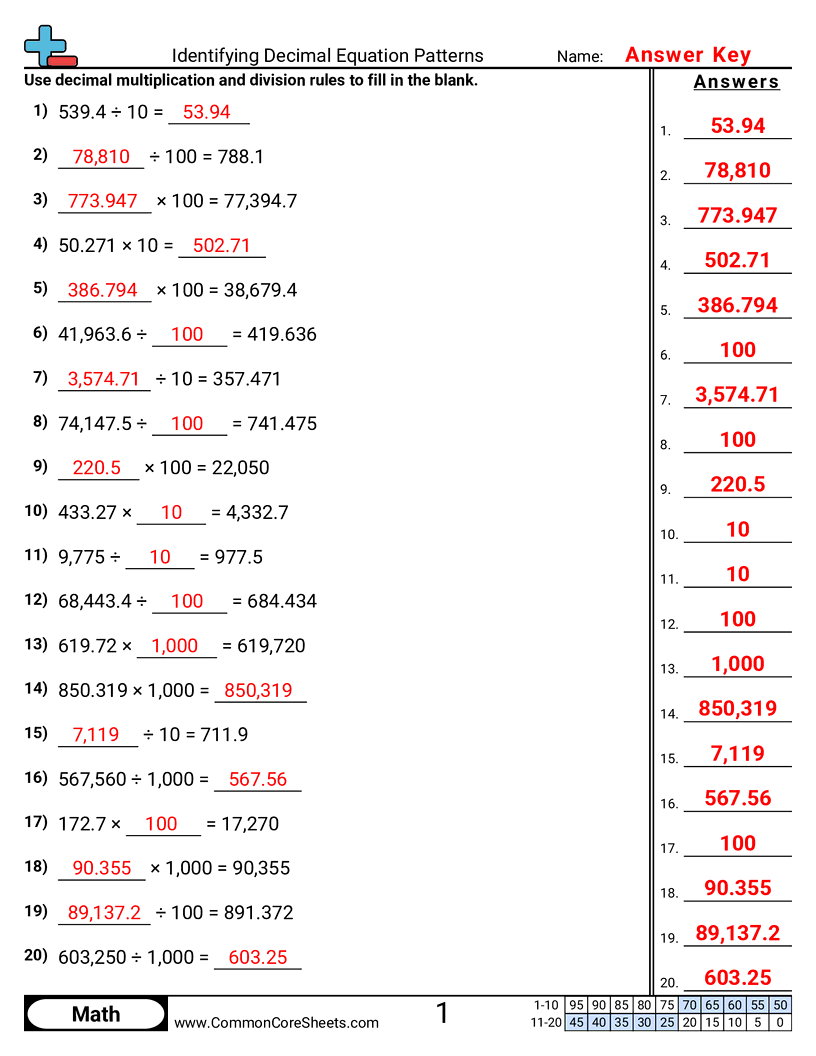
Multiply decimals by 10, 100, and 1,000 by moving the decimal point the right number of places. Divide decimals by 10, 100, and 1,000 by moving the decimal point the right number of places. Use exponents like 10^2 and 10^3 to recognize how many places to shift the decimal. Write answers with the decimal point and any needed zeros in the correct place.
5nbt2
Multiply decimals by 10, 100, and 1,000 by shifting the decimal point the right way. Divide decimals by 10, 100, and 1,000 by shifting the decimal point the right way. Spot patterns in how the digits and decimal point change when you multiply or divide by powers of 10.
5nbt7
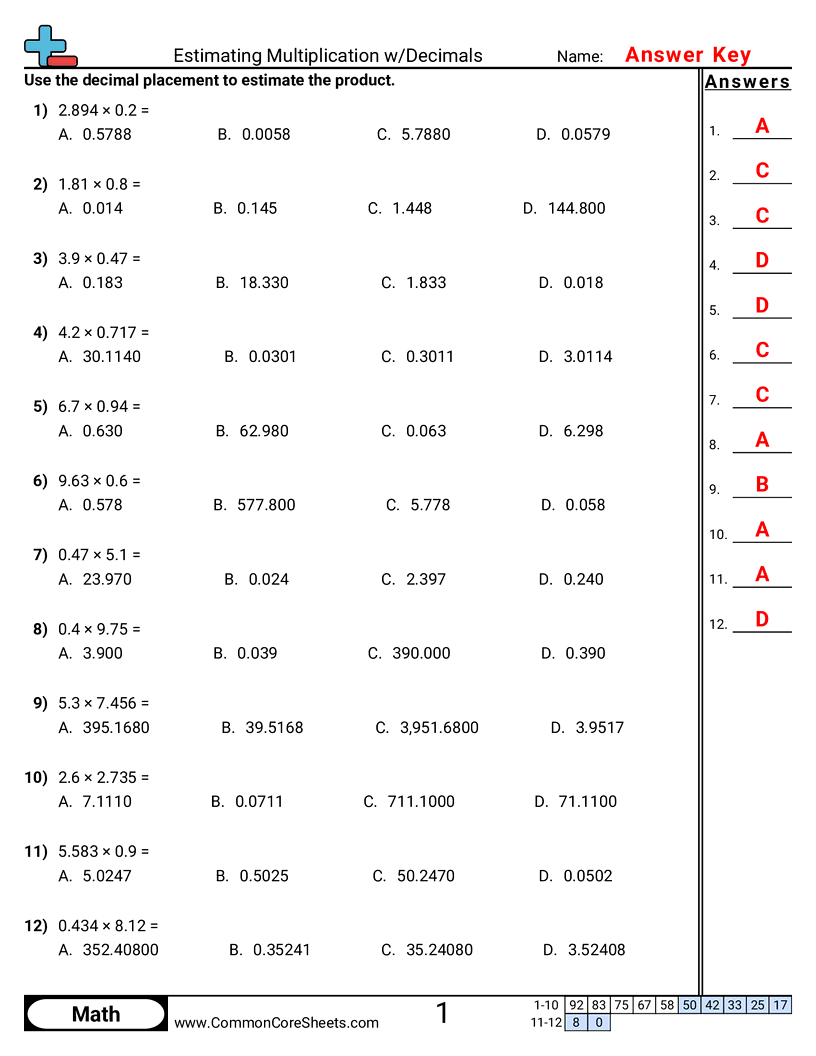
Practice rounding decimals to make easier numbers to multiply in your head. Estimate the product of a decimal and a whole number using friendly numbers. Estimate the product of two decimals by rounding to tenths or whole numbers.
5nbt7
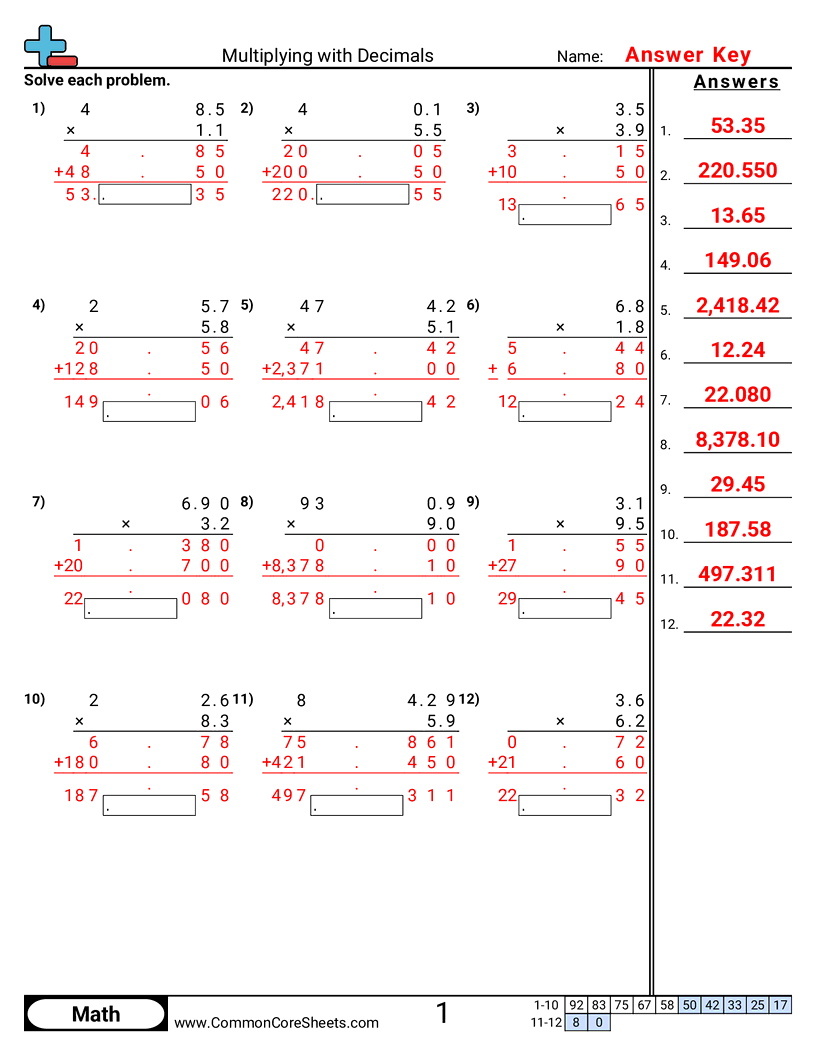
Multiply decimals using the regular multiplication steps you use for whole numbers. Place the decimal point in the product by counting decimal places in the factors. Keep digits lined up correctly in vertical (column) multiplication. Handle carrying when multiplying multi-digit numbers that include decimals.
5nbt7
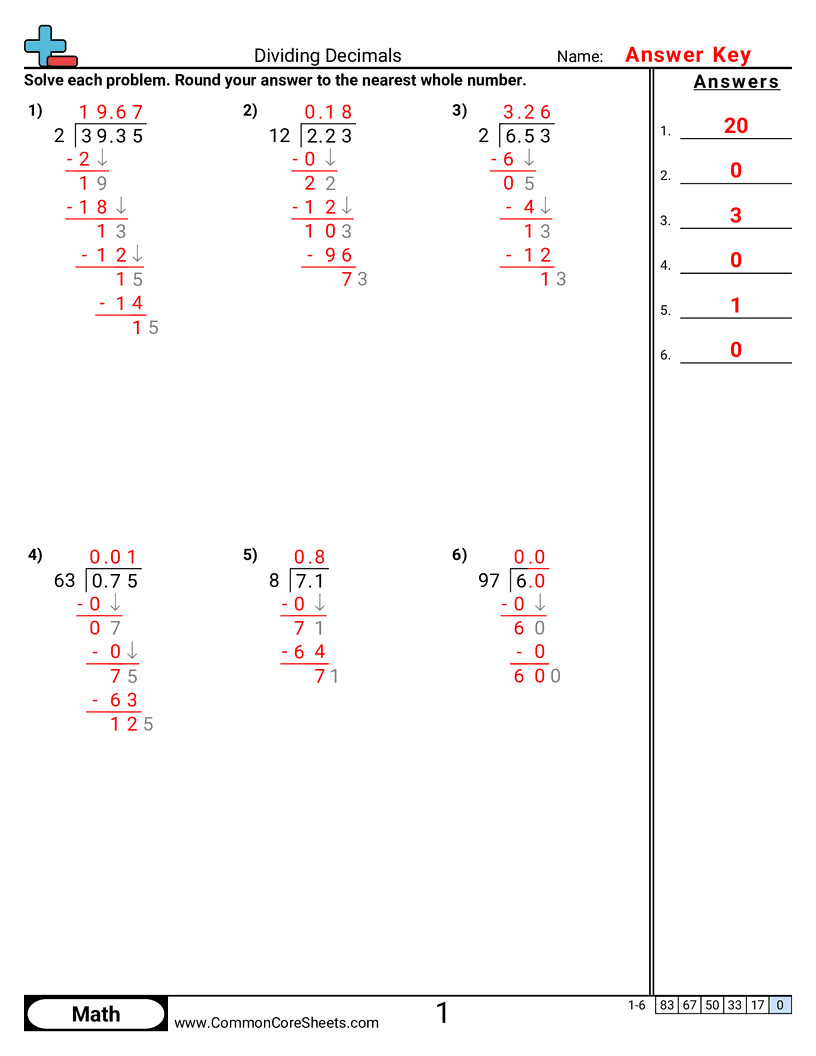
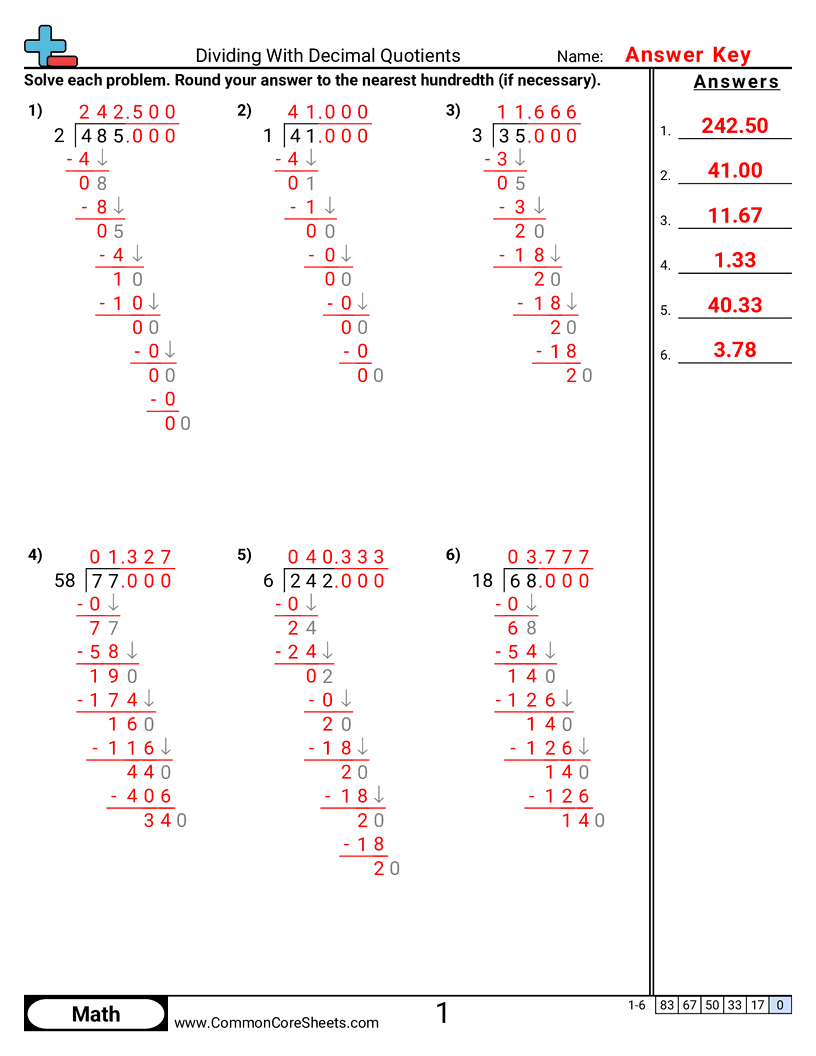
Move the decimal point to turn the divisor into a whole number before dividing. Use long division to place the decimal point correctly in the quotient. Keep dividing past the decimal to get an exact answer or a decimal answer.
5nbt7
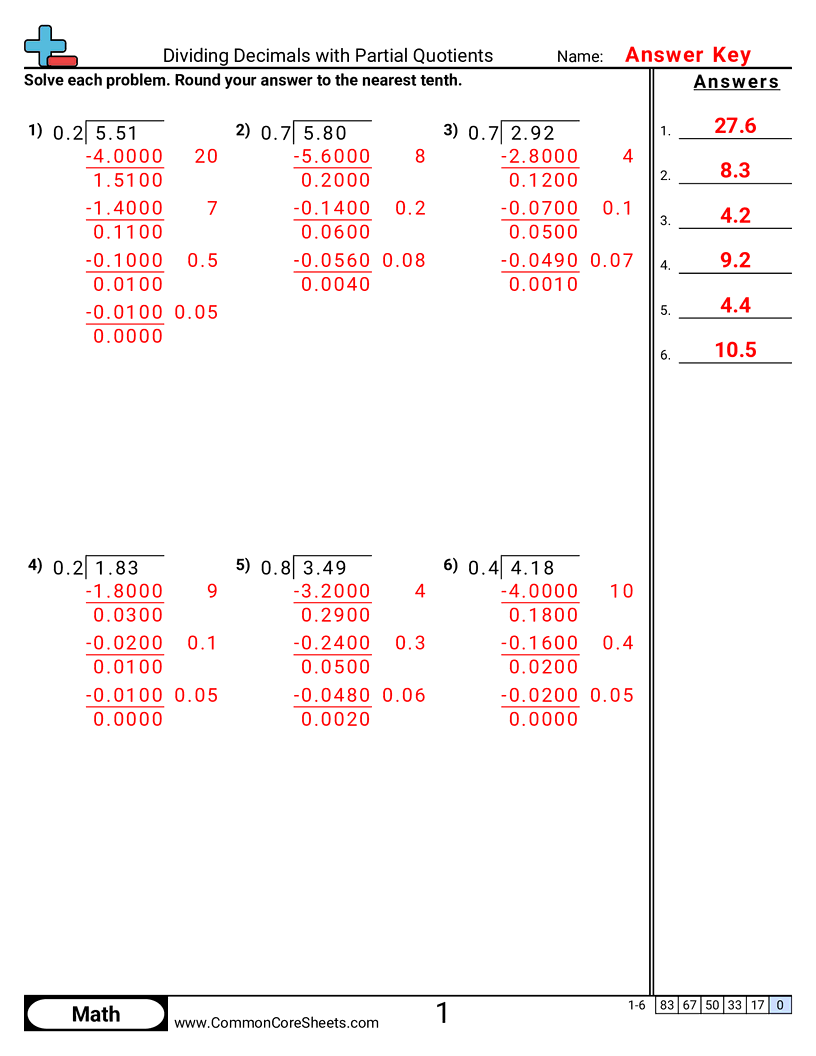
Divide decimals by decimals using the partial quotients (chunking) method. Break a division problem into easier steps by subtracting groups of the divisor and keeping a running total of the quotient. Place the decimal correctly in the quotient based on the values in the dividend and divisor. Multiply to find helpful chunks of the divisor (like 10× or 0.1×) that fit into the dividend.
5nbt7
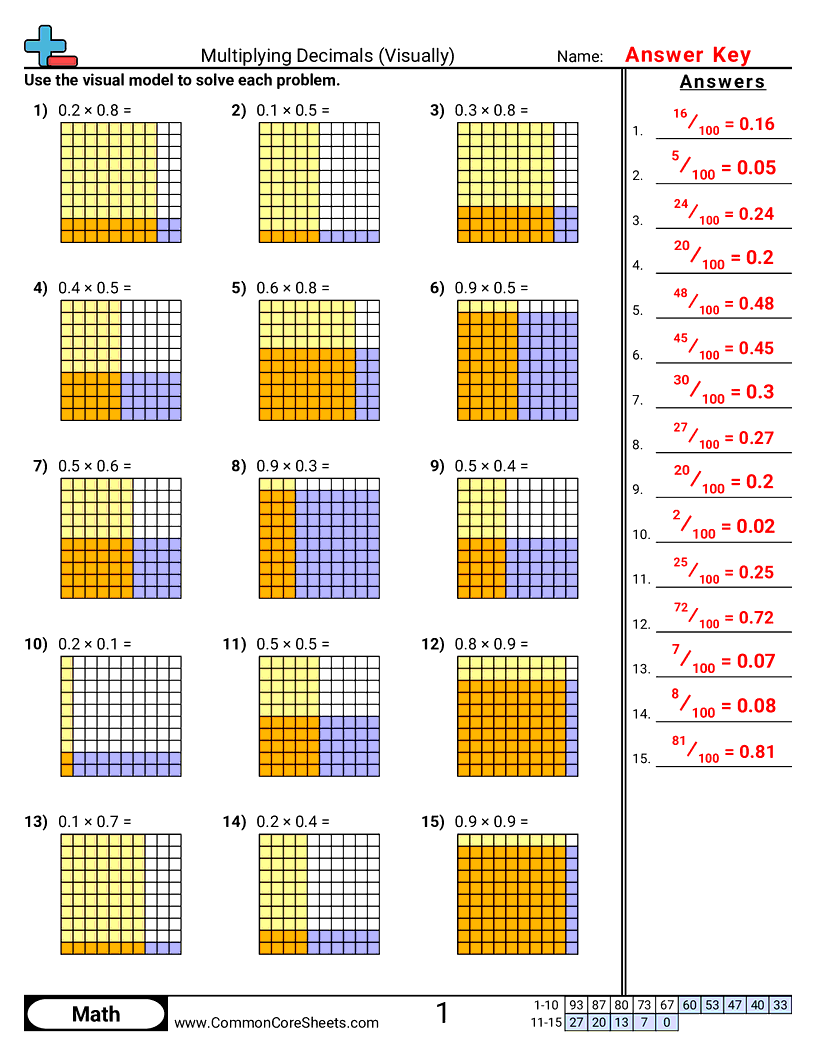
Multiply two decimals to find the product. Use an area model (grid) to show what a decimal multiplication problem means.
5nbt7
Multiply a whole number by a decimal to find the product. Use a grid or area model to show what the multiplication means.
5nbt2
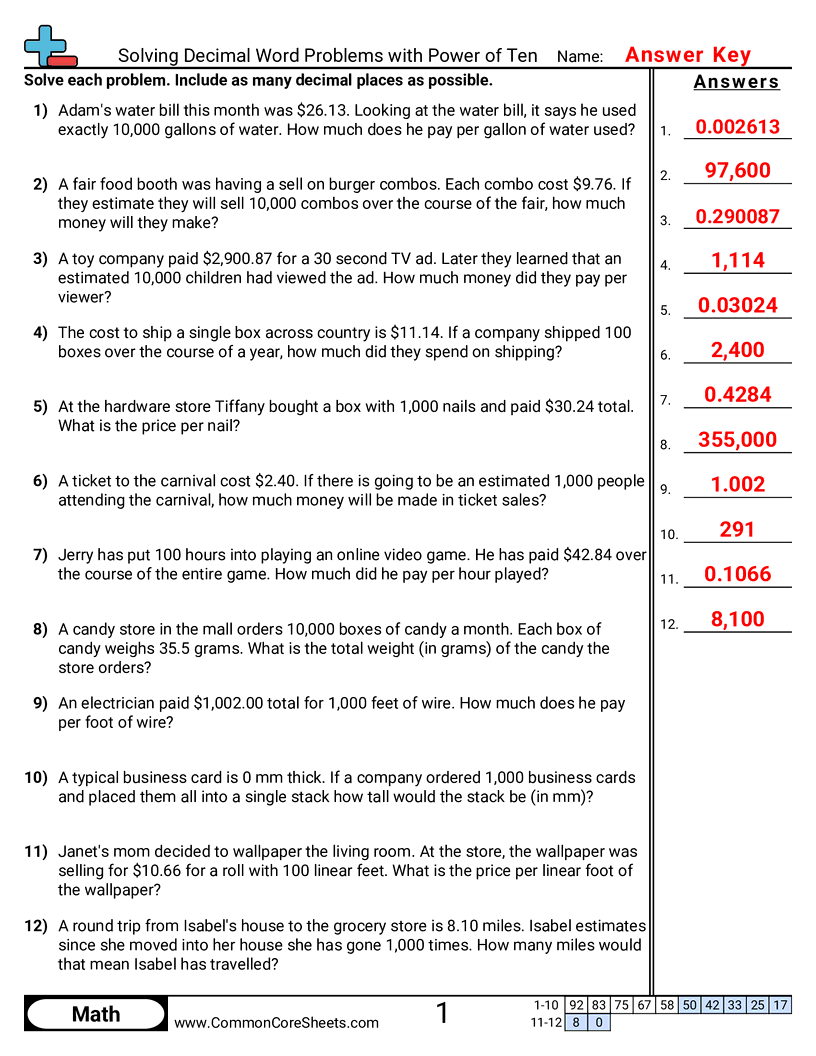
Multiply decimals by 10, 100, and 1,000 by shifting the digits to the left. Divide decimals by 10, 100, and 1,000 by shifting the digits to the right. Read a word problem and decide whether it needs multiplying or dividing by a power of ten.
6ns3
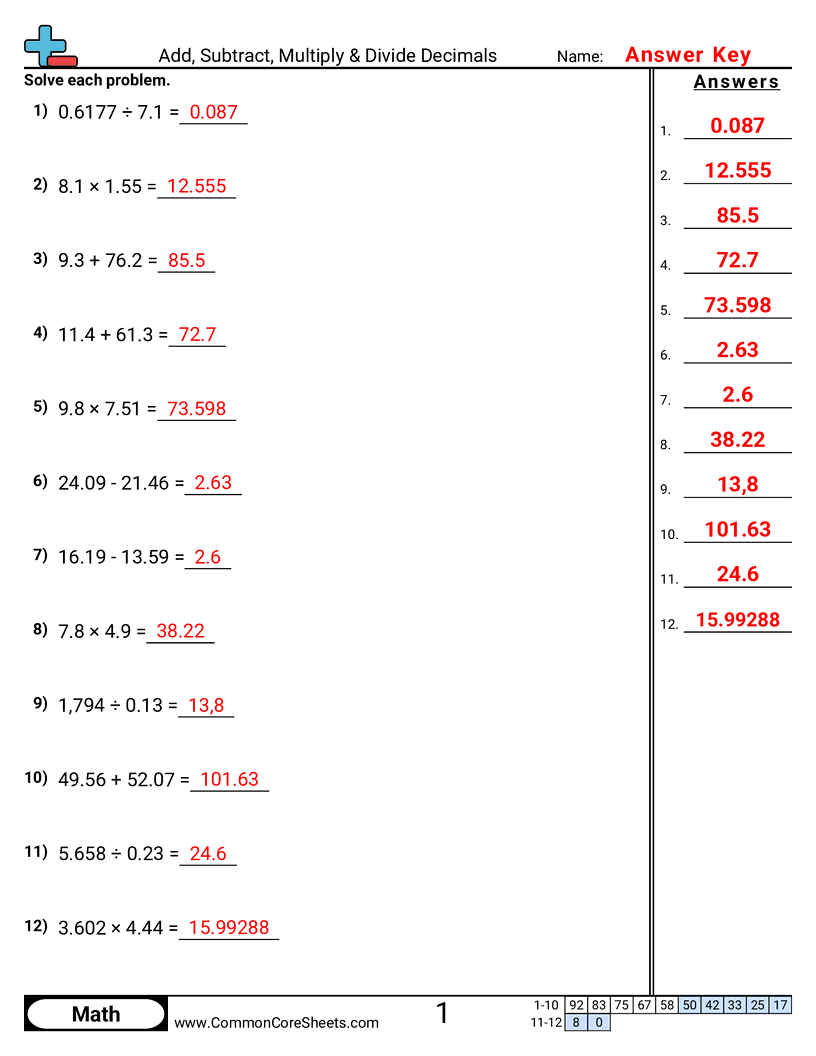
Add decimals correctly by lining up the decimal points. Subtract decimals and handle borrowing when needed. Multiply decimals and place the decimal in the product. Divide decimals and write the quotient with the decimal in the right spot. Read and write decimals in tenths, hundredths, and thousandths to keep place value straight.
5nbt7
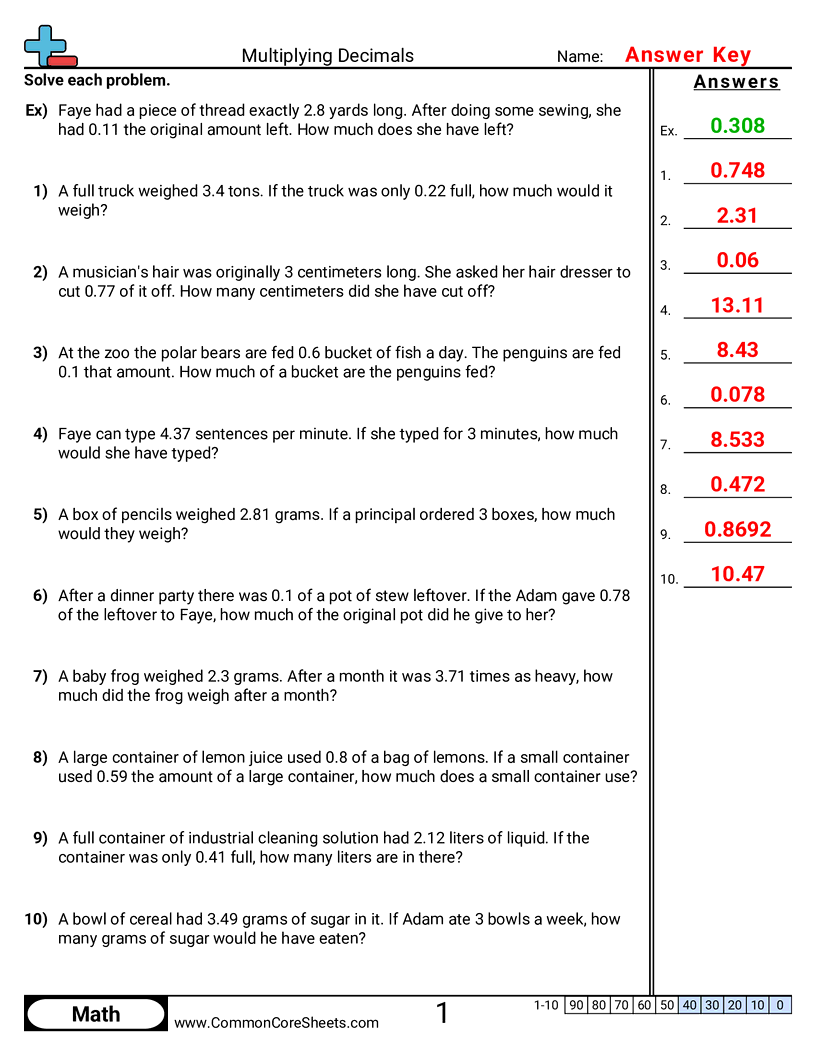
Solve word problems by multiplying decimals to find a total, cost, or amount. Translate a real-life situation into a multiplication equation with decimals. Multiply decimals accurately and place the decimal point correctly in the product.
6ns3
Divide one whole number by another and write the answer as a decimal. Use long division to keep dividing past the ones place when the division doesn’t come out evenly. Place the decimal point in the quotient correctly when you bring down zeros. Handle remainders by turning them into decimal digits.
5nbt7 6ns3
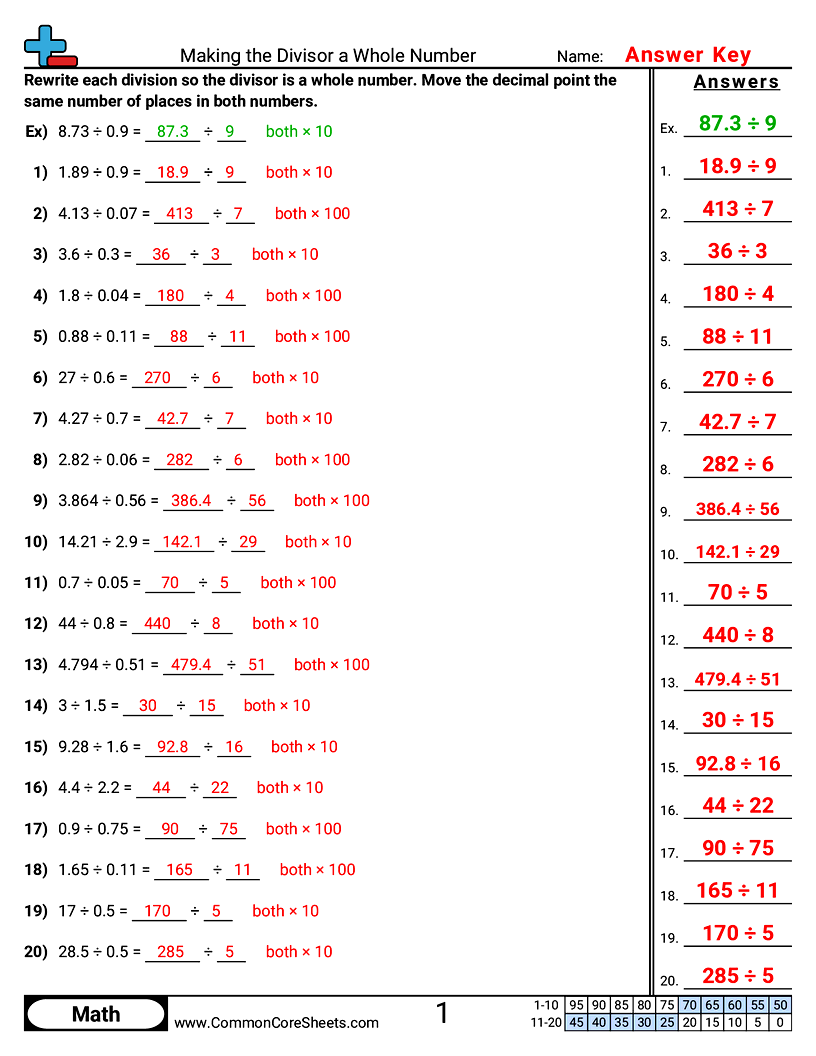
Make a decimal divisor a whole number by multiplying by 10 or 100 Move the decimal point the same number of places in the dividend Add zeros to the dividend when it runs out of decimal places
6ns3
Divide one whole number by another and write the answer as a decimal. Use long division to keep dividing past the ones place when the division doesn’t come out evenly. Place the decimal point in the quotient correctly when you bring down zeros. Handle remainders by turning them into decimal digits.
About these worksheets
These worksheets help students compare decimal numbers using place value reasoning. Activities include determining which decimal is greatest or least, writing number sentences with inequality symbols, and comparing decimals to the hundredths and thousandths places. Aligned with fourth and fifth grade standards.
4nf7
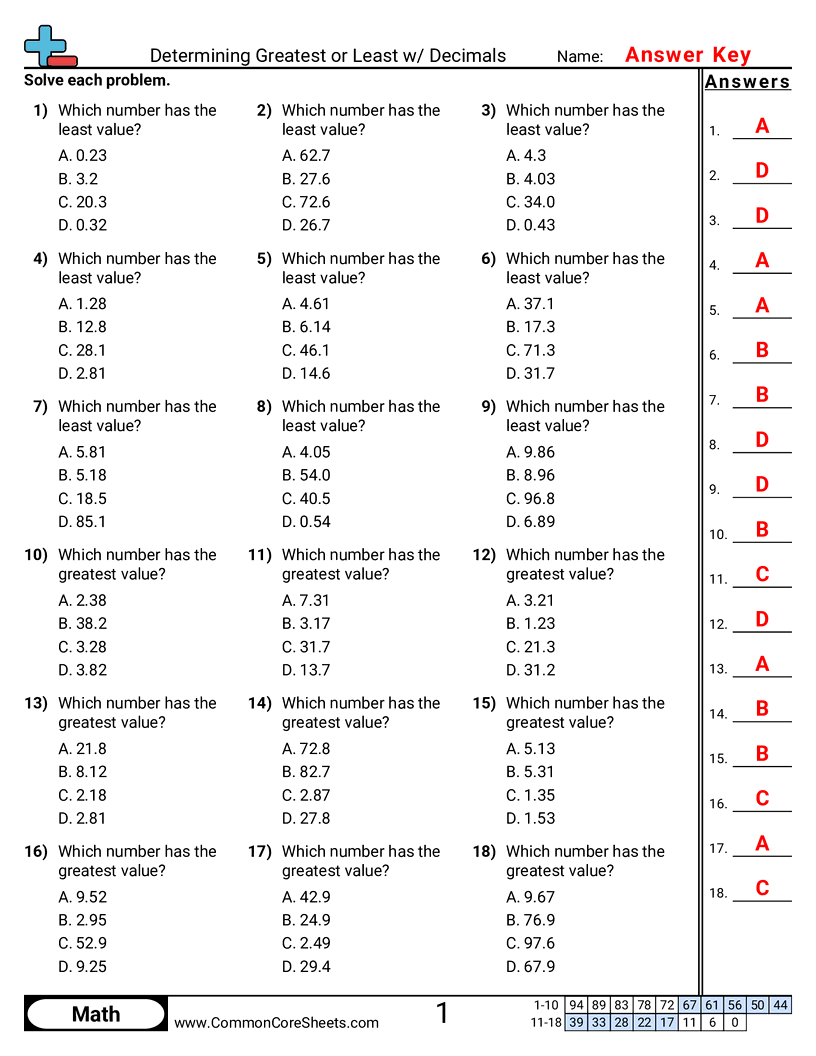
Compare two decimals and decide which one is greater or less. Use place value to compare decimals by looking at tenths, hundredths, and thousandths. Line up decimal points to make fair comparisons between numbers.
4nf7
Compare two decimal numbers and decide which one is greater, less, or equal. Use place value (ones, tenths, hundredths) to explain why one decimal is bigger than another. Notice that decimals with different numbers of digits can still be compared by lining up the decimal points.
4nf7
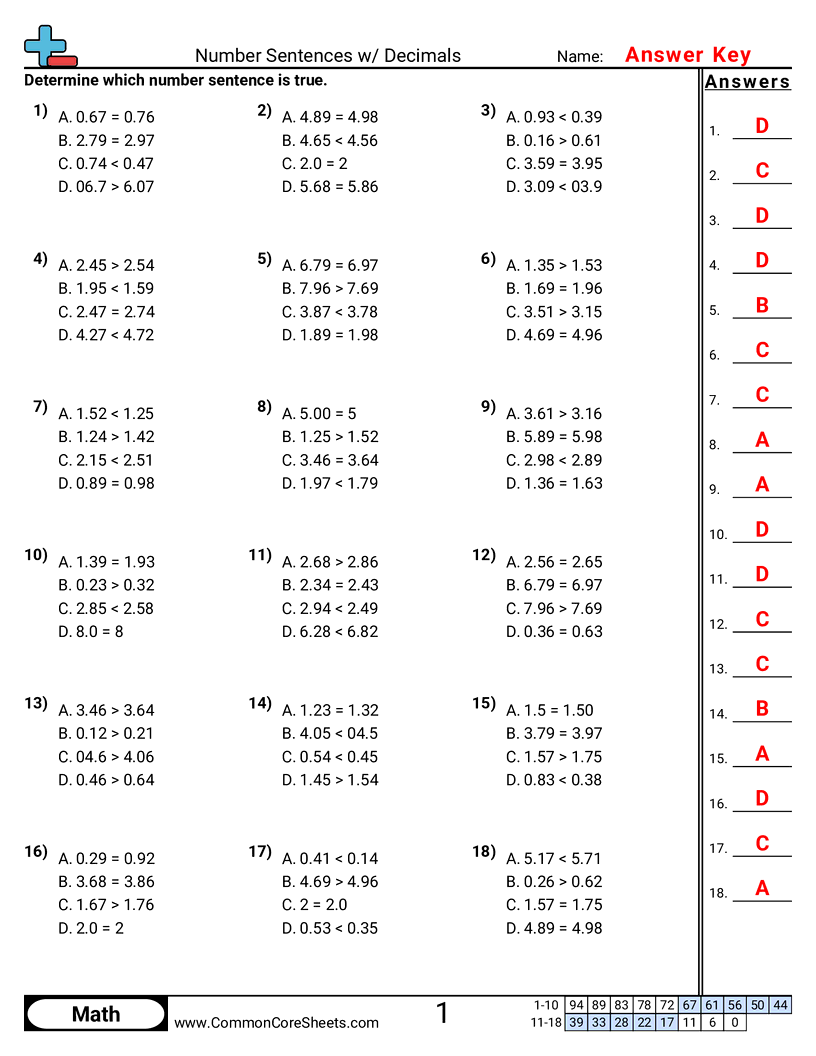
Compare two decimals to see which one is greater, less, or if they are equal. Use place value (ones, tenths, hundredths) to decide which decimal is bigger. Line up decimal points and add zeros when needed so two decimals are easy to compare. Choose the correct symbol (<, >, or =) to show the comparison.
5nbt3b
Compare two decimal numbers up to the thousandths place and decide which one is larger or smaller. Use place value to compare decimals by checking digits from left to right (ones, tenths, hundredths, thousandths). Line up decimal points so the place values match before comparing. Choose the correct symbol (<, >, or =) to show the comparison.
5nbt3b
Order a list that mixes decimals and fractions. Compare a fraction against a decimal. Order mixed numbers alongside decimals.
5nbt3b
Compare a mixed number against a decimal. Recognize when a fraction and a decimal are equal. Convert between forms to compare.
About these worksheets
Students practice finding the missing decimal that adds to exactly one whole. These worksheets reinforce the relationship between decimal complements and strengthen subtraction skills with decimals less than one.
5nbt7
Add decimal numbers that make a total of 1.0. Subtract a decimal from 1.0 to find the missing amount.
About these worksheets
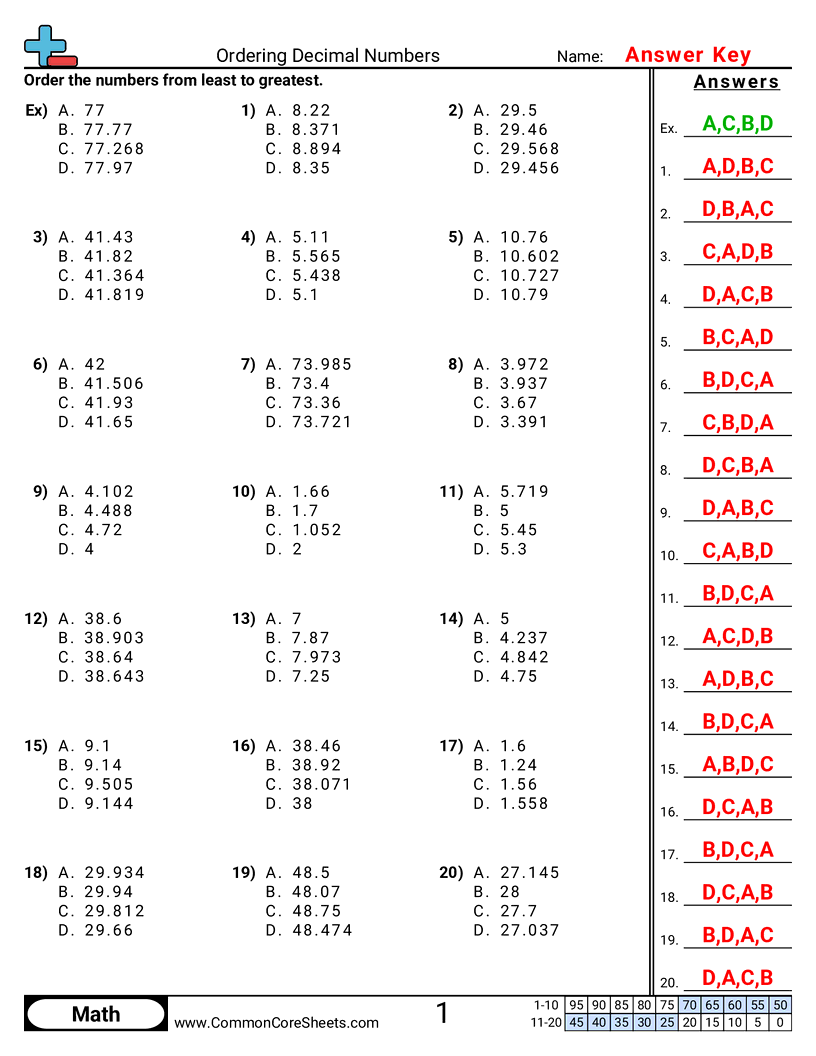
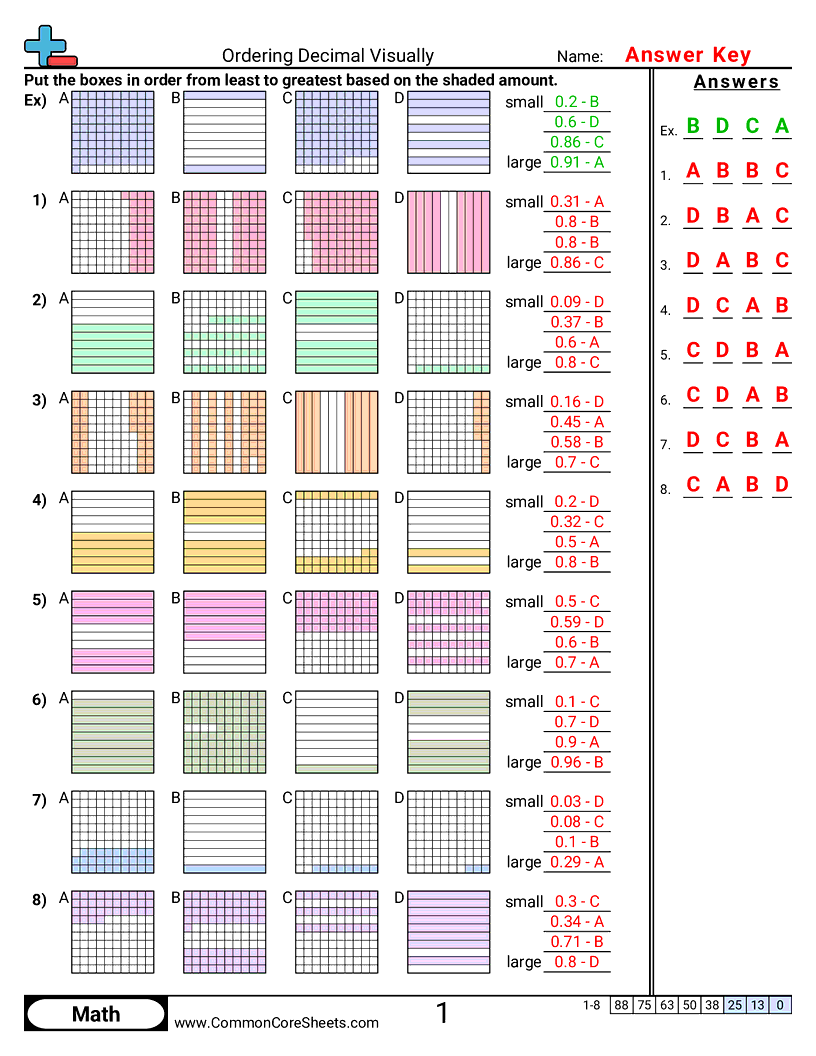
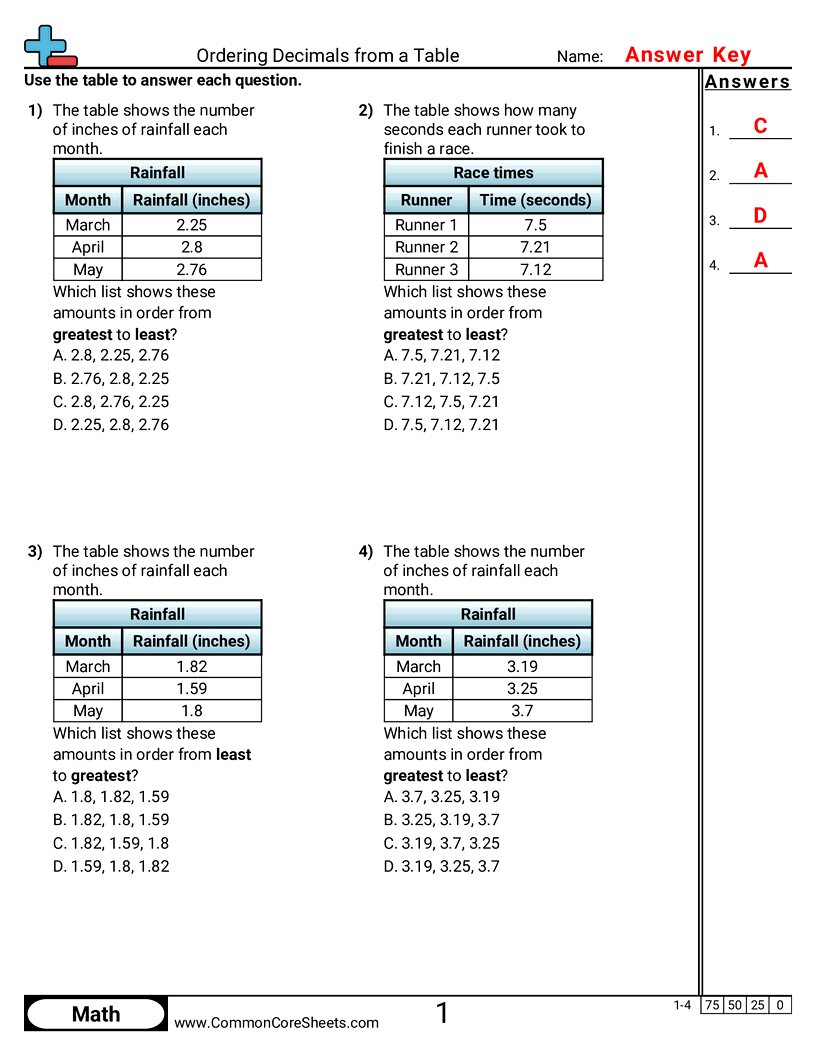
These worksheets build skills in ordering decimal numbers from least to greatest and greatest to least. Students compare decimals to the hundredths place using place value reasoning, work with visual models of tenths and hundredths, and practice arranging sets of decimals in correct order. Aligned with fourth and fifth grade standards.
4nf7
Put decimal numbers in order from least to greatest or greatest to least. Compare two decimals and decide which one is larger or smaller. Use place value (ones, tenths, hundredths) to tell decimals apart. Line up decimal points to compare numbers correctly, including numbers with zeros.
4nf7
Compare decimals to the hundredths place to decide which is greater or less. Put a set of decimals in order from least to greatest or greatest to least. Use place value (ones, tenths, hundredths) to explain why one decimal comes before another. Notice that trailing zeros don’t change a decimal’s value (like 2.5 and 2.50) when ordering numbers.
5nbt3b
Practice putting decimal numbers in order from least to greatest or greatest to least. Learn to compare decimals by lining up the decimal points and matching place values. Use zeros to make decimals the same length so they are easier to compare. Check which decimal is larger by looking at tenths, hundredths, and thousandths in order.
4nf7
Use visual models (like shaded grids or number lines) to see how big a decimal is. Compare two decimals and decide which one is greater or less. Put a set of decimals in order from least to greatest or greatest to least.
4nf7
Compare decimals to figure out which is larger or smaller Put a set of decimals in order from least to greatest Put a set of decimals in order from greatest to least Read decimal values from a table to answer the question Line up decimals by place value to compare them accurately
Decimal worksheets by grade
4th Grade Decimal Worksheets (13 worksheets) 5th Grade Decimal Worksheets (35 worksheets) 6th Grade Decimal Worksheets (6 worksheets) 7th Grade Decimal Worksheets (2 worksheets) 8th Grade Decimal Worksheets (1 worksheet)
Advertisement