Determining Decimal Value Worksheets
This section provides comprehensive worksheets helping students master decimal concepts and place value understanding. Through varied activities including digit identification, visual interpretation with blocks and shaded models, and decimal-percent conversions, students build foundational skills. Perfect for grades 5-7 with problems ranging from basic place value recognition to working with repeating decimals.
More about these worksheets ▾ Show less ▴
×
Determining Decimal Value
About these worksheets
Students explore the meaning and value of decimal digits through a variety of activities. Worksheets cover identifying the value of underlined digits, recognizing repeating and terminating decimals, reading visual models of tenths and hundredths, interpreting place value blocks, and converting between decimals and percents. These resources span fifth through seventh grade standards.
5nbt1
Find the value of an underlined digit in a decimal number. Use place value to tell how much a digit is worth (like tens, ones, tenths, or hundredths).
7ns2d
Convert a fraction into a decimal that repeats. Spot the repeating pattern in a decimal and write it using a bar (overline) notation.
7ns2d
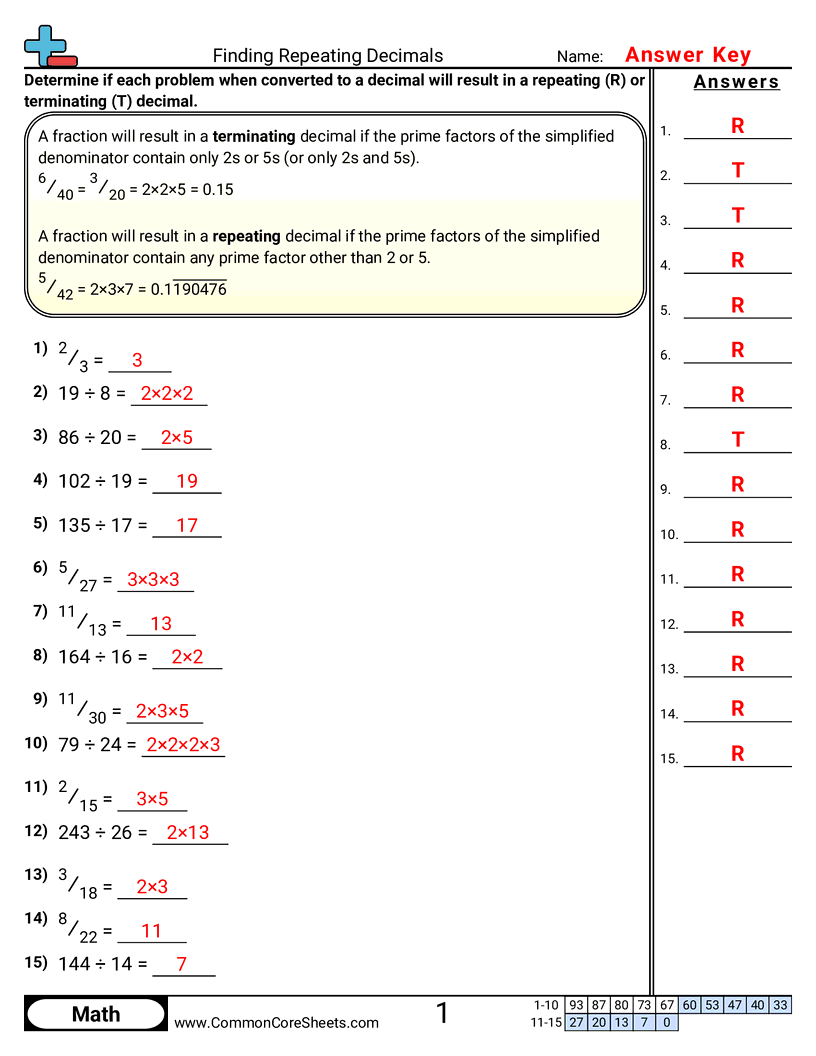
Decide whether a fraction will turn into a terminating decimal or a repeating decimal. Use long division to see if the decimal ends or starts cycling. Spot when a remainder repeats and understand that this creates a repeating pattern in the decimal.
4nf6
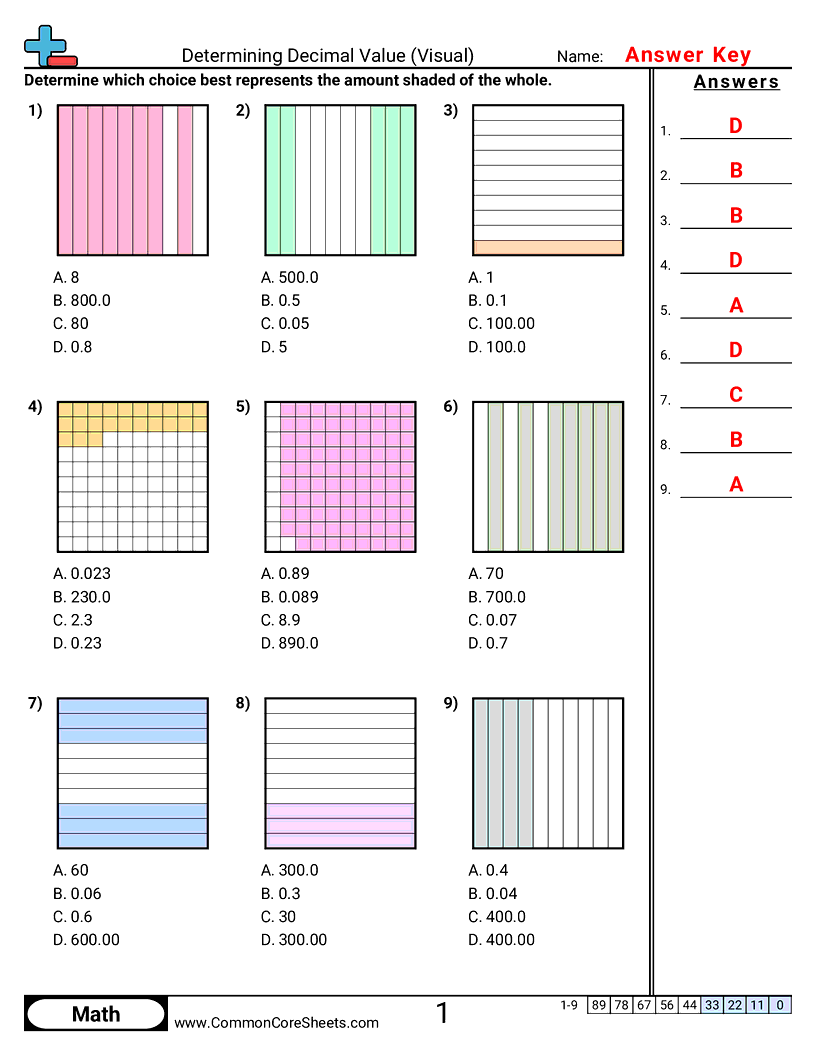
Read a shaded picture model and tell what decimal it represents. Connect tenths and hundredths to how much of a whole is shaded. Use place value to decide whether the decimal should have one or two digits after the decimal point. Choose the matching decimal from several answer choices by comparing the model to the numbers.
4nf6
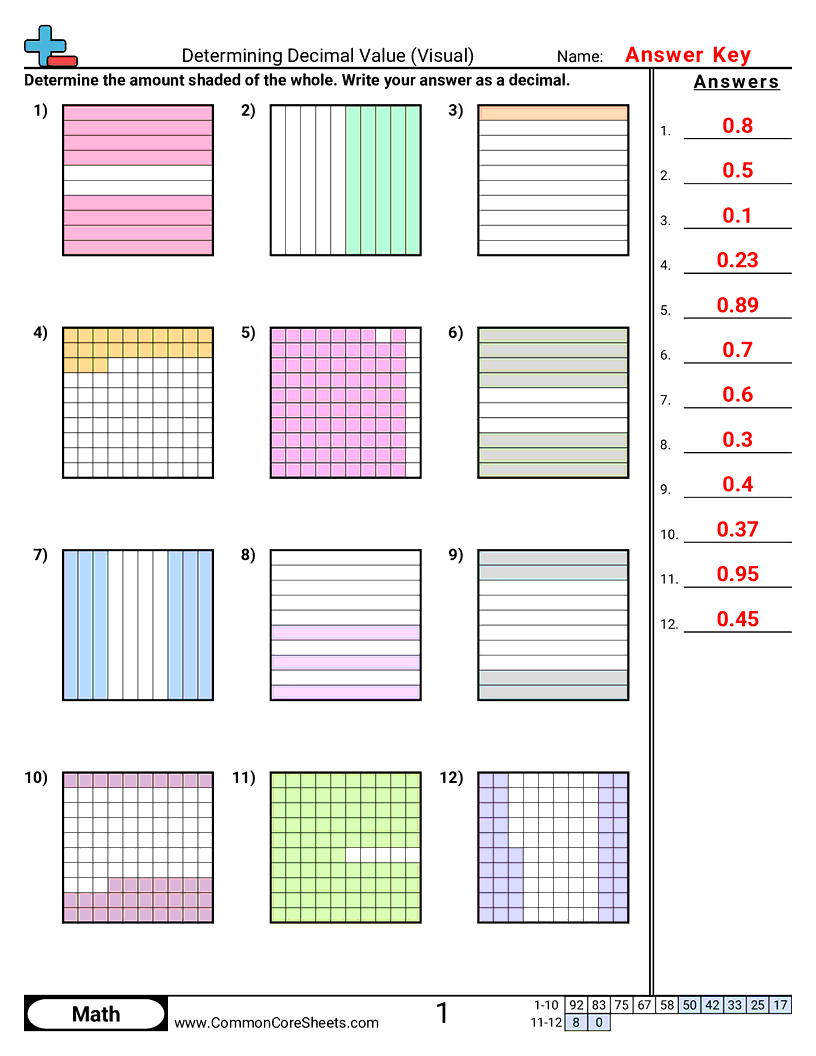
Read a shaded picture model and tell what decimal it represents. Connect tenths and hundredths to how much of a whole is shaded. Use place value to write the decimal correctly with the decimal point in the right spot.
4nf5
Read base-ten blocks and decide what decimal number they show. Match each block piece to its place value (ones, tenths, hundredths, thousandths). Write the number in standard decimal form using the correct digits and decimal point.
6rp3c
Practice turning a decimal less than 1 into a percent. Learn to multiply a decimal by 100 to find the percent. Get comfortable moving the decimal point two places to the right when converting to percent. Write the final answer correctly using the percent sign (%)
6rp3c
Convert a percent to a decimal by dividing by 100. Move the decimal point two places to the left when changing a percent into a decimal. Write the decimal in correct place value form (tenths, hundredths, thousandths). Recognize that percents under 100% turn into decimals less than 1.
5nbt3a
Work out what each base ten block is worth once one of them is named the whole Write the value of a set of blocks as a fraction Use a denominator of tenths, hundredths or thousandths depending on the smallest block shown See how the same block changes value when a different block is the whole
5nbt3a
Read a decimal fraction off a 10 by 10 grid. Write the same amount as a fraction and as a decimal. Recognize that hundredths on a grid and a decimal are the same number.
5nbt3a
Read a length in meters as a decimal. See a mark as tenths and hundredths at the same time. Connect centimeters to hundredths of a meter.
5nbt3a
Shade a 10 by 10 grid to show a decimal. Turn tenths and hundredths into a number of squares. Represent a decimal with a model.
5nbt3a
Write the same amount as tenths and as hundredths. See that one tenth is ten hundredths. Recognize ten tenths as one whole.
Use place value and mental math to find 0.1, 0.01, or 0.001 more or less than a decimal number. Identify which decimal digit changes when adding or subtracting tenths, hundredths, or thousandths. Solve problems with decimals without written computation.
Find 0.1, 0.01 or 0.001 more than a number. Find 0.1, 0.01 or 0.001 less than a number. Regroup across a place value using mental math.
Name the change between two decimals. Identify which place value changed. Tell an increase from a decrease.
Count on by 0.1, 0.01 or 0.001. Count back by 0.1, 0.01 or 0.001. Continue a decimal pattern across a place value.
5nbt7
Add 0.1, 0.01 or 0.001 to a number. Subtract 0.1, 0.01 or 0.001 from a number. Work with decimals that have different numbers of places.
Playwire Advertisement