Measurement Worksheets
Measure up with free measurement worksheets covering both American (customary) and metric units. Students practice measuring, converting inches to feet, ounces to pounds, and centimeters to meters, and comparing measurements across systems with worksheets that mix American and metric units. General measurement pages introduce the concept of using tools and units. Every worksheet is a printable PDF with an answer key and works as a digital assignment - no login or account needed. Modified pages support learners who need fewer problems, and the grading column with quick grade scale keeps grading quick. A strong match for 2nd through 5th grade measurement units and homeschool math.
More about these worksheets ▾ Show less ▴
×
About these worksheets
These worksheets introduce basic measurement concepts for early learners. Students compare the lengths of objects to determine which is longest or shortest and use non-standard units to measure objects by lining up equal-sized units end to end. Aligned with first grade measurement standards.
1md1
Compare three objects and decide which one is longest and which one is shortest. Put three objects in order from shortest to longest by looking at their lengths. Use words like longer, shorter, and same length to describe how objects compare. Pay attention to where each object starts and ends so the comparison is fair.
1md2
Measure the length of an object by lining up equal-size units end to end with no gaps or overlaps. Count the units to tell how long each object is. Use the same unit each time so measurements can be compared fairly.
4md1
Decide which of two lengths is longer or shorter when the units differ. Convert to a common unit before comparing. Recognize that the larger number is not always the longer length.
4md1
Decide which of two lengths is longer or shorter when the units differ. Convert to a common unit before comparing. Recognize that the larger number is not always the longer length.
2md1
Choose whether a centimeter ruler, a meter stick or a measuring tape best fits an object. Judge roughly how long an object is before deciding how to measure it. Explain why a tool can be too short, or longer than it needs to be, for a given object.
2md1
Decide whether an object is best measured in centimeters or in meters. Connect a unit to a real object of about that size. Recognize that centimeters suit small objects and meters suit large ones.
2md1
Measure the length of an object with a centimeter ruler. Line the end of an object up with zero before reading the other end. Read a length to the nearest whole centimeter.
2md1
Choose whether an inch ruler, a yardstick or a measuring tape best fits an object. Judge roughly how long an object is before deciding how to measure it. Explain why a tool can be too short, or longer than it needs to be, for a given object.
2md1 2md3
Decide whether an object is best measured in inches, feet or yards. Connect a unit to a real object of about that size. Recognize that yards are used for fields and long distances, feet for rooms and furniture, and inches for small objects.
2md1
Measure the length of an object with an inch ruler. Line the end of an object up with zero before reading the other end. Read a length to the nearest half inch, including marks that fall between two numbers.
2md1
Measure the length of an object to the nearest quarter inch. Read a mark that is neither a whole number nor the halfway point. Find the quarter inch marks among the eighths on a ruler.
2md1
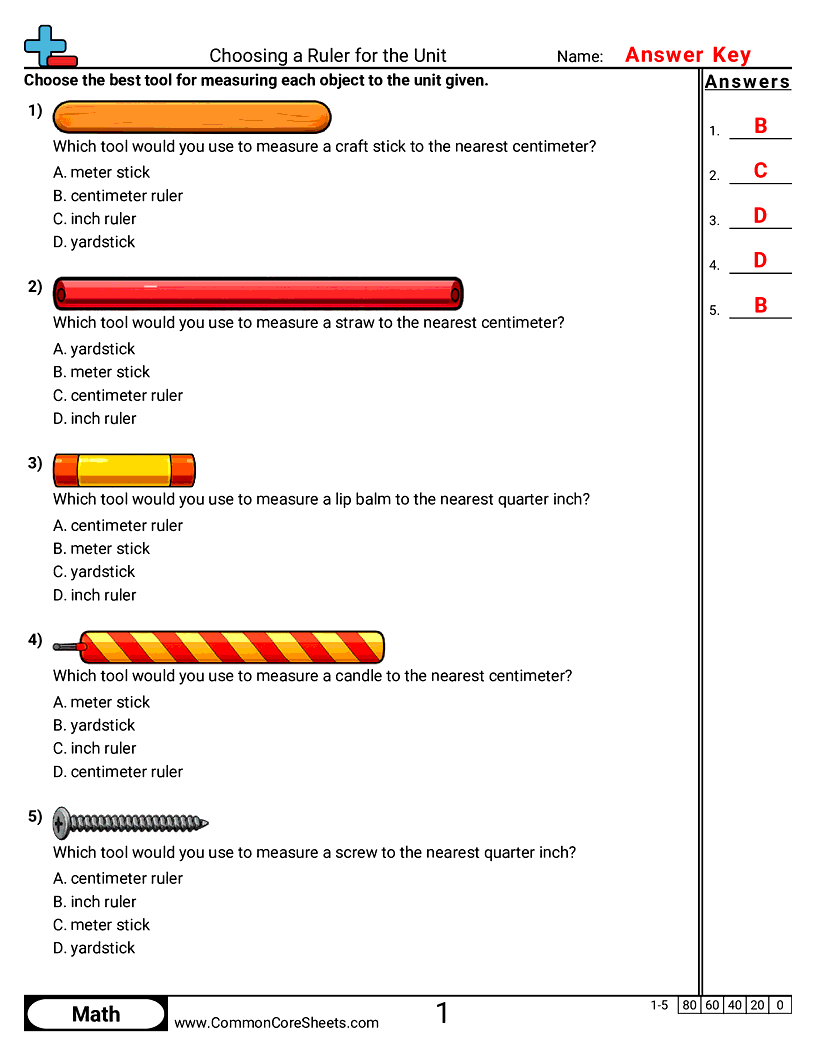
Choose a ruler that measures in the unit the question asks for. Recognize that a centimeter ruler cannot give an answer in inches. Rule out a tool that is the wrong length as well as one in the wrong unit.
2md1
Line a ruler up with the end of an object before reading it. Measure a real object to the nearest centimeter. Read a ruler that is not already positioned for you.
2md1
Line a ruler up with the end of an object before reading it. Measure a real object to the nearest half inch. Read a ruler that is not already positioned for you.
2md1
Line a ruler up with the end of an object before reading it. Measure a real object to the nearest quarter inch. Read a ruler that is not already positioned for you.
2md1
Measure an object to the nearest eighth inch. Read the smallest tick on a ruler. Write a length as a mixed number.
2md1
Measure an object to the nearest sixteenth inch. Use a real ruler on a printed object. Write a length as a mixed number.
2md1
Measure an object that does not start at zero. Find a length by subtracting two ruler readings. Read a ruler to the nearest centimeter.
About these worksheets
Students practice measuring lengths using American customary units. Worksheets include reading rulers in inches, estimating distances, choosing appropriate units, converting between inches, feet, yards, and miles, adding and subtracting measurements in feet and inches, and working with mixed unit conversions. Resources span second through fifth grade standards.
2md1
Read a metric ruler to find how long a bar is in centimeters. Write the length using the correct decimal location.
3md4
Measure the length of an object using a ruler and standard units. Write down measurements clearly so they can be compared. Make a line plot to show a set of measurements.
4md1
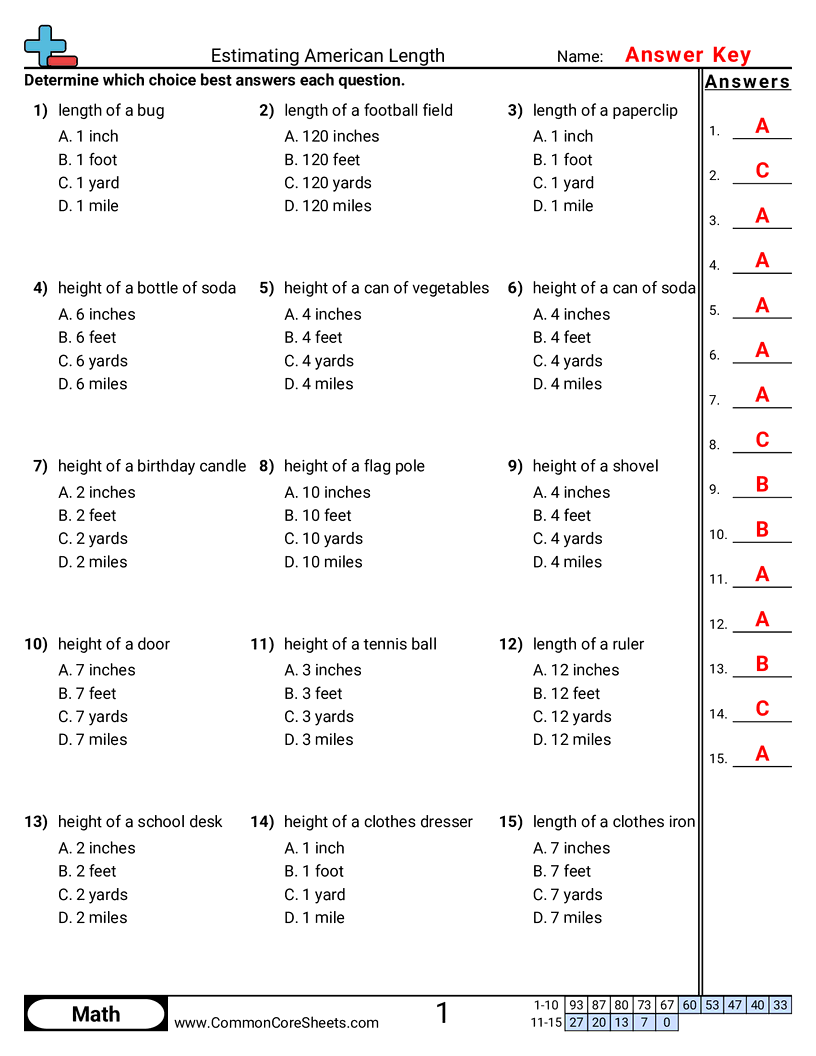
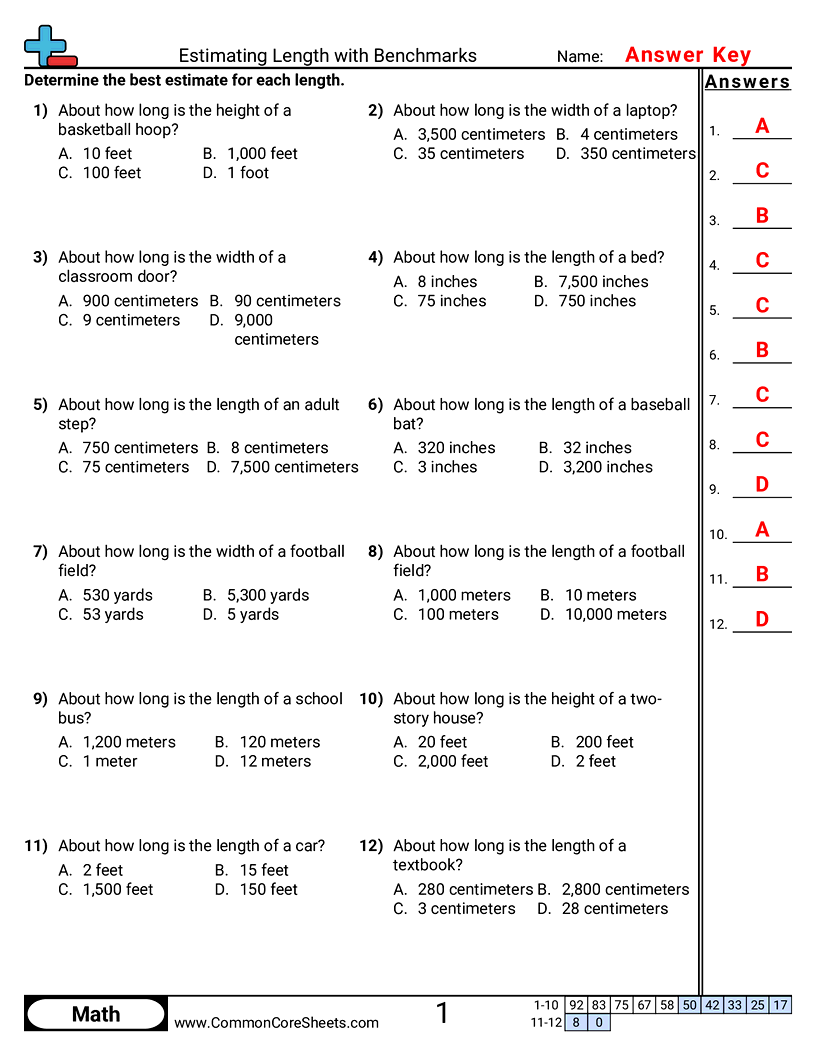
Get better at making a reasonable guess for how long an object is without measuring it. Choose the best length from a few options by comparing what you see to familiar sizes (like an inch, foot, or yard). Decide which unit makes sense for an object’s length (inches, feet, or yards). Use benchmark lengths to tell when an estimate is too short or too long.
4md1
Choose whether inches, feet, yards, or miles makes the most sense for a given distance. Use what you know about common objects and places to make a reasonable estimate of a length. Explain why one unit is more appropriate than another for measuring a specific distance.
5md1
Convert between inches, feet, yards, and miles using the right conversion facts. Multiply or divide by conversion factors to change a measurement to a different unit.
4md2
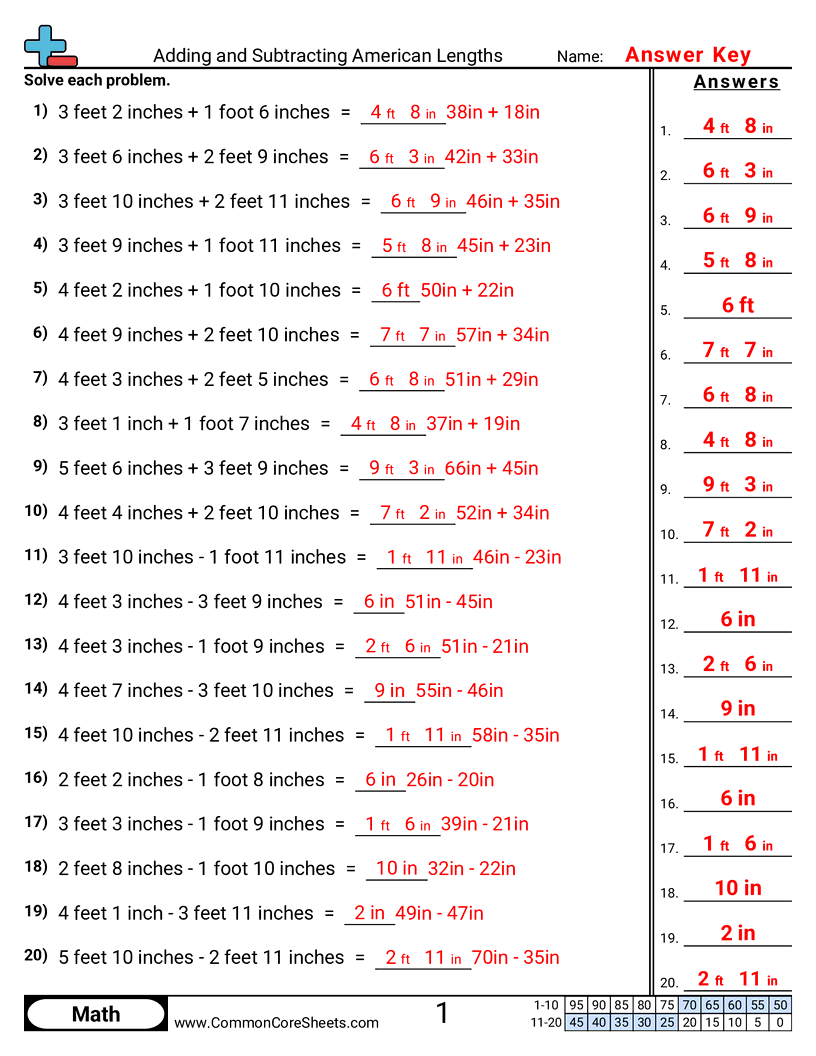
Add lengths written in feet and inches. Subtract one feet-and-inches measurement from another. Regroup between inches and feet when the inches add past 12 or when you need to borrow a foot.
4md1
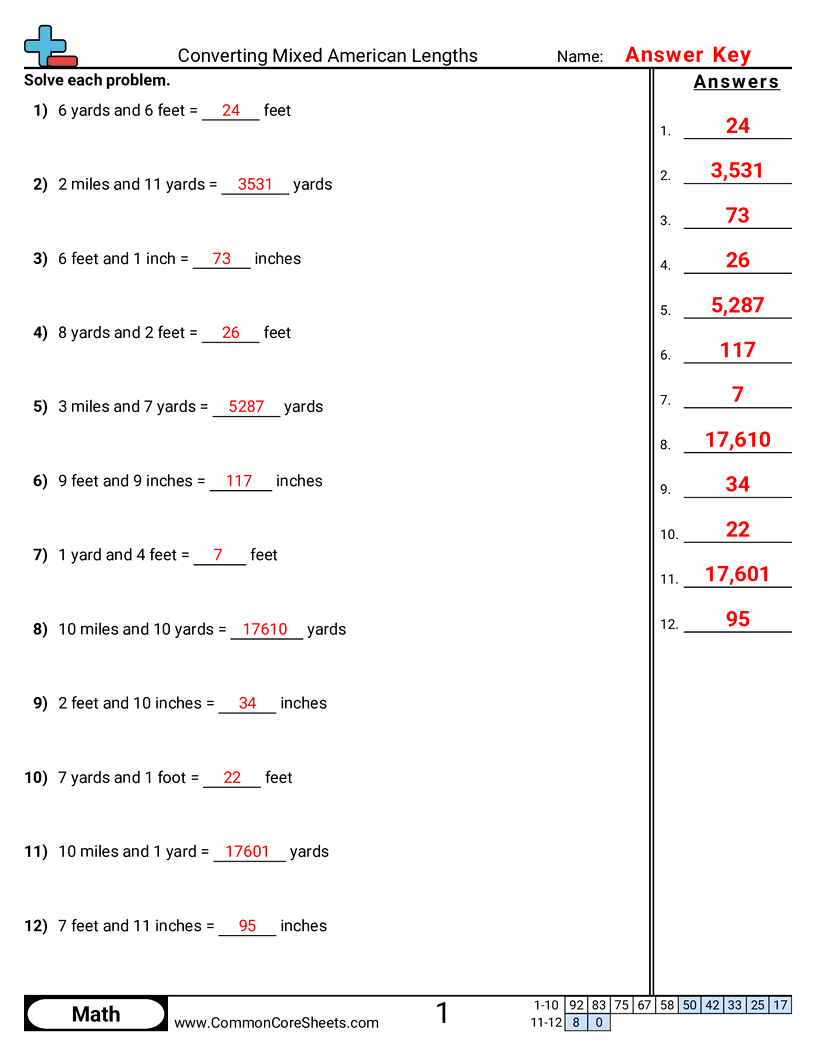
Convert a measurement written in mixed units (like feet and inches) into just the smaller unit. Use the correct conversion facts between inches, feet, yards, and miles.
3md4
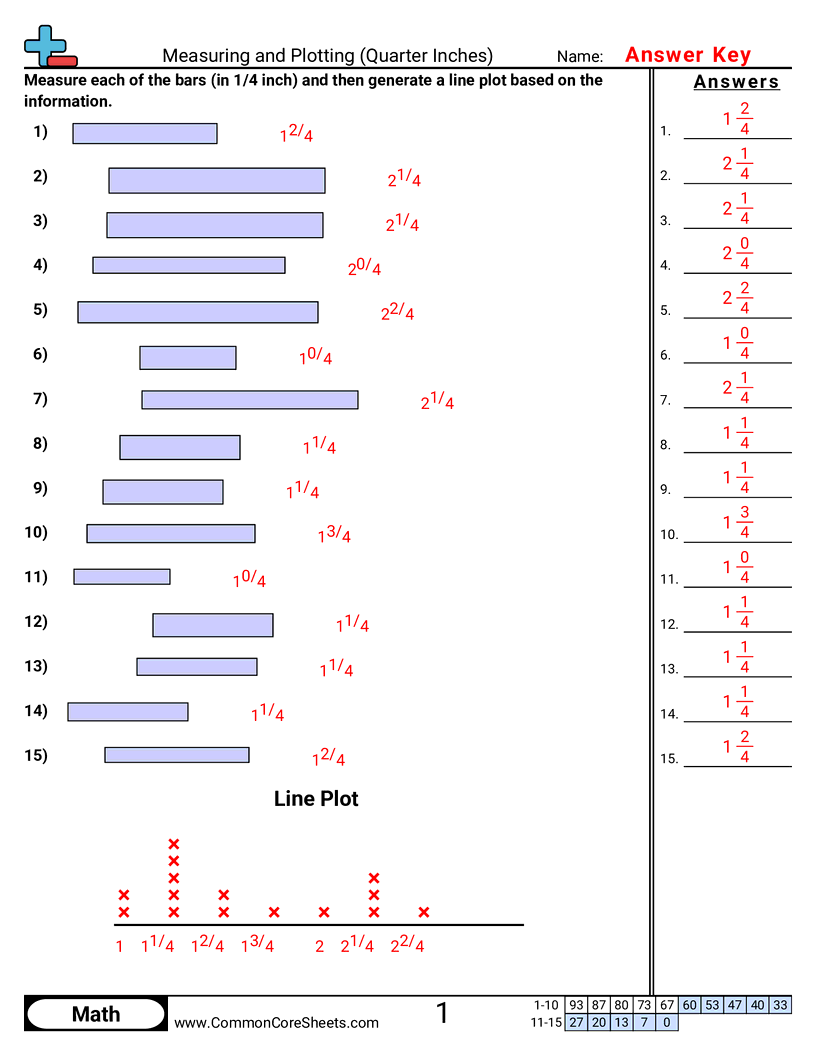
Measure the length of a bar using a ruler marked in quarter inches. Read and write measurements that include 1/4-inch parts (like 2 3/4 inches). Make a line plot and mark how many times each length shows up.
4md1
Choose the customary unit that best fits what is being measured. Tell length, weight and liquid volume apart from the situation alone. Use the largest unit that still gives a number of at least 1.
5md1
Convert between inches, feet and yards. Choose whether to multiply or divide. Use the right conversion factor.
5md1
Convert between millimeters, centimeters and meters. Decide how many places to move. Choose whether to multiply or divide.
5md1
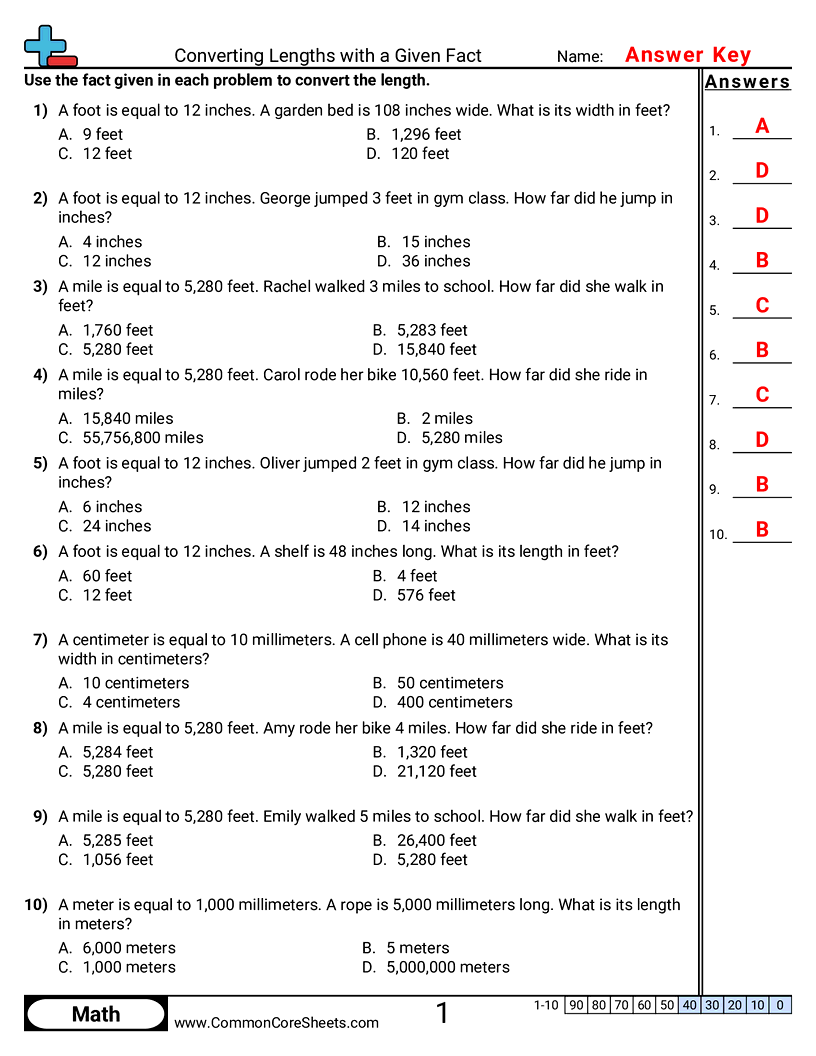
Use a conversion fact given in the problem. Decide whether to multiply or divide by it. Keep the whole problem inside one measurement system.
2md3
Estimate a length using a benchmark. Judge the order of magnitude of a measurement. Estimate in both customary and metric units.
About these worksheets
These worksheets cover metric length measurement skills. Students practice reading centimeter and millimeter rulers, estimating metric distances, choosing appropriate metric units, converting between millimeters, centimeters, meters, and kilometers, and adding and subtracting metric lengths. Aligned with fourth and fifth grade standards.
4md1
Practice reading a centimeter ruler to find the length of a bar, including half-centimeter measurements Subtract the starting point from the ending point when the bar doesn't begin at zero Measure to the nearest half centimeter using the smaller tick marks on the ruler
4md1
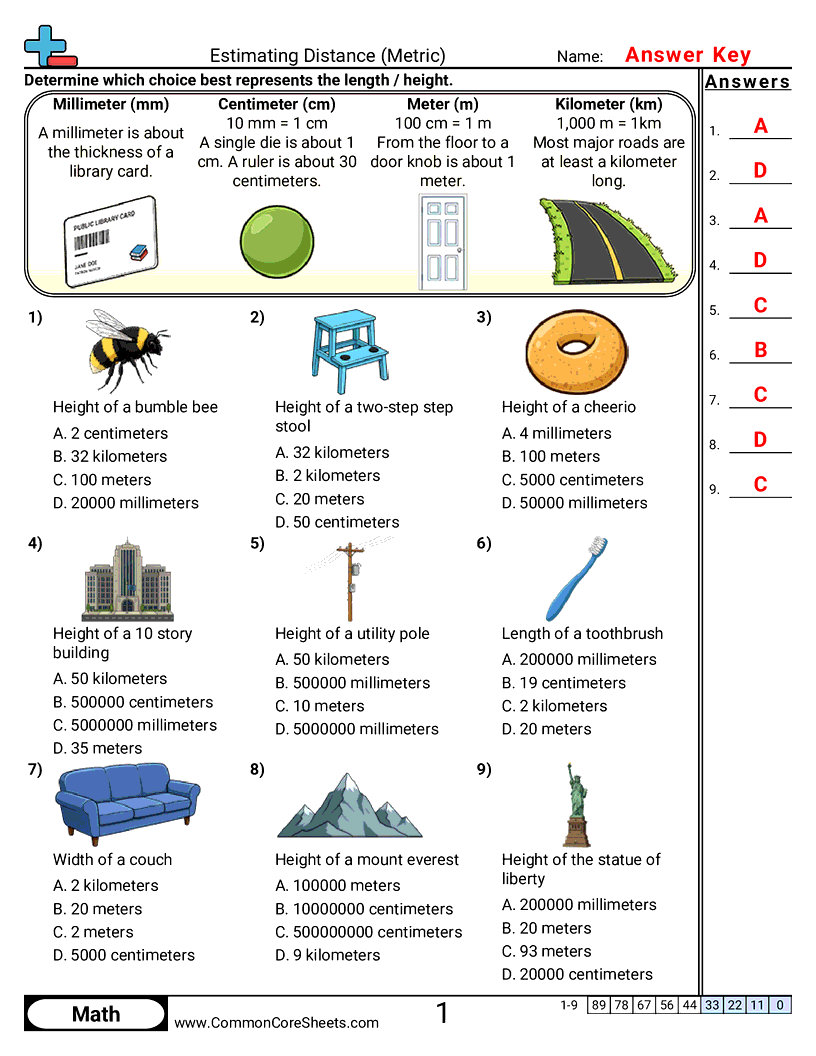
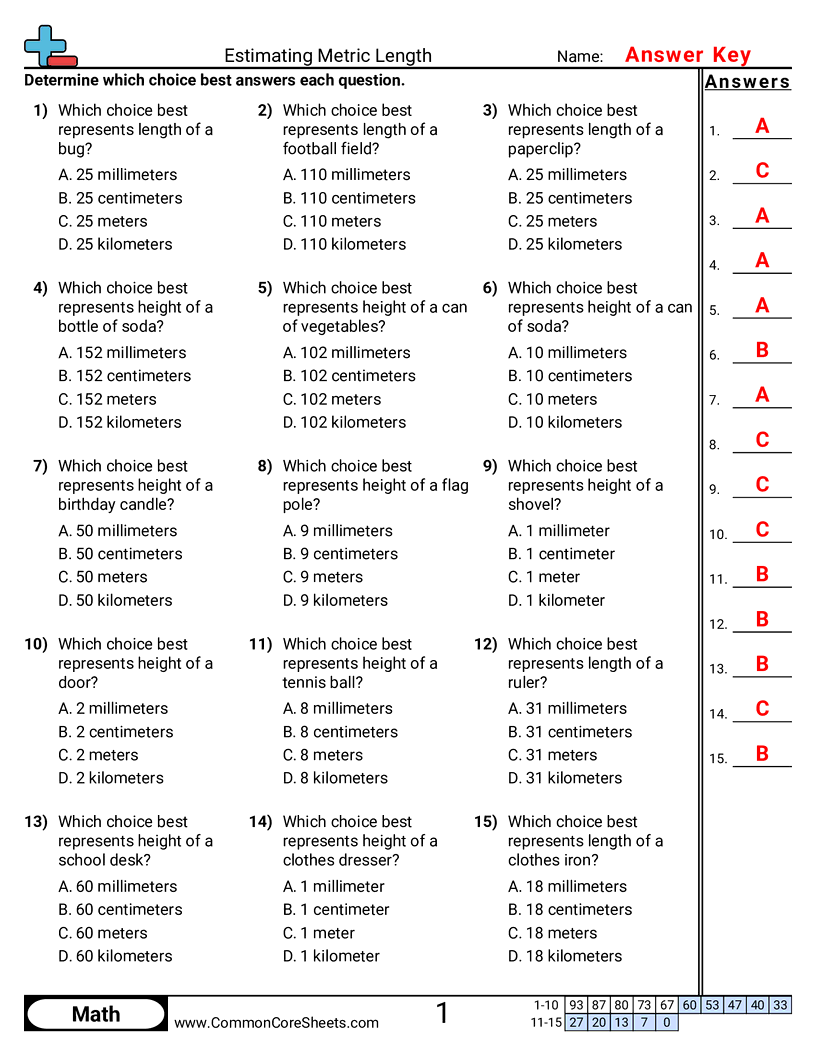
Practice making a reasonable guess about how long something is using metric units. Learn to choose the best unit for a length (millimeters, centimeters, meters, or kilometers). Compare a few possible lengths and pick the one that makes the most sense for the object shown. Use what you know about common objects to judge about how long something is without measuring.
4md1
Choose the best metric unit to describe how long something is. Tell when millimeters, centimeters, meters, or kilometers make the most sense for an item. Compare a few unit choices and pick the one that matches a reasonable real-world size. Read a short description of an object and decide which metric measurement fits.
5md1
Convert between millimeters, centimeters, meters, and kilometers. Use the metric scale to decide whether to multiply or divide when converting units.
4md2
Practice adding and subtracting decimal measurements in centimeters Convert between millimeters and centimeters (10 mm = 1 cm) before adding or subtracting mixed units Give the answer in the correct unit based on what the problem asks for (cm or mm)
4md1
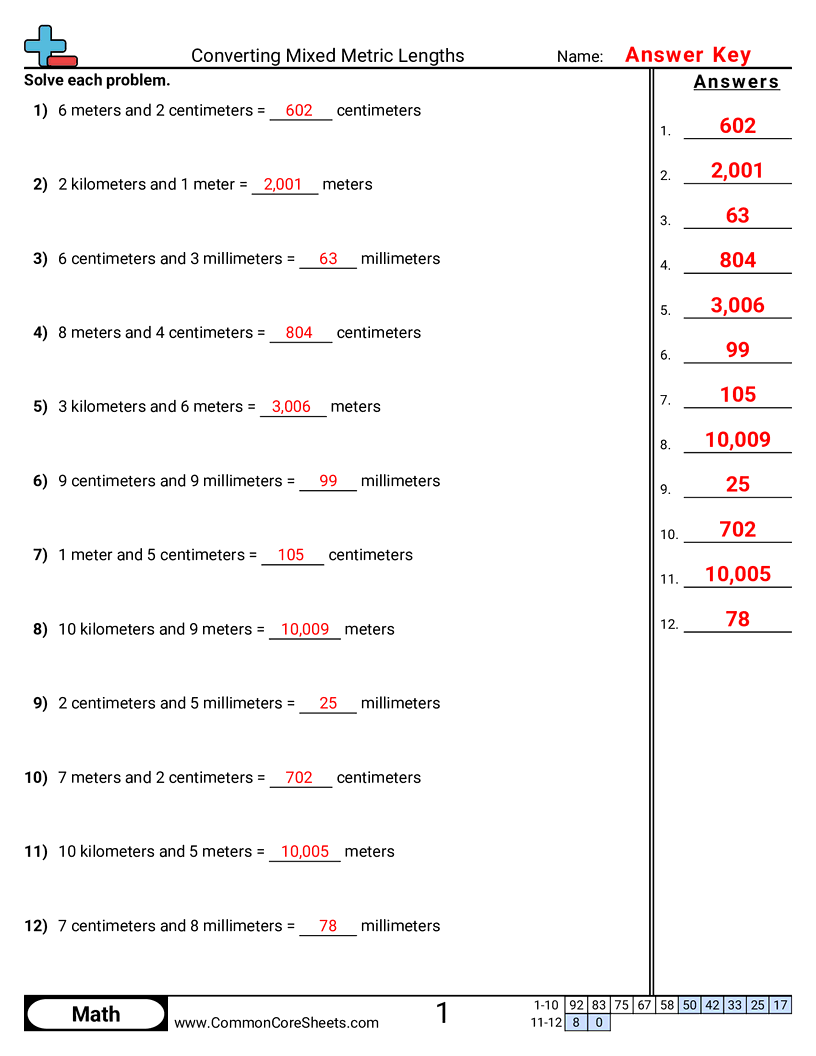
Convert a mixed metric length (like meters and centimeters) into just the smaller unit. Use the metric relationships (10, 100, 1,000) to move between kilometers, meters, centimeters, and millimeters. Combine the converted parts correctly to write one total measurement in a single unit.
4md1
Choose the metric unit that best fits what is being measured. Tell length, mass and liquid volume apart from the situation alone. Use the largest unit that still gives a number of at least 1.
About these worksheets
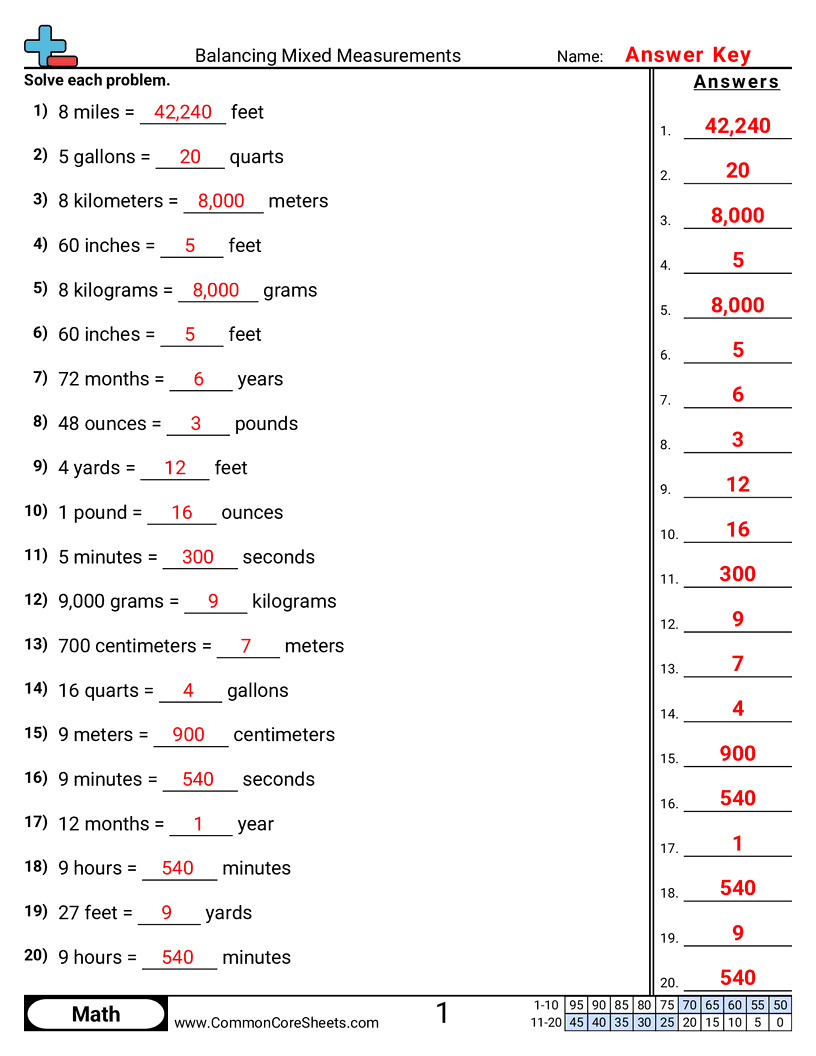
Students work with both American customary and metric measurement systems side by side. Worksheets include measuring objects in both inches and centimeters, estimating lengths using both systems, filling in conversion tables, and balancing equations with mixed units. These activities help students see the relationship between the two measurement systems. Aligned with second through fourth grade.
2md4
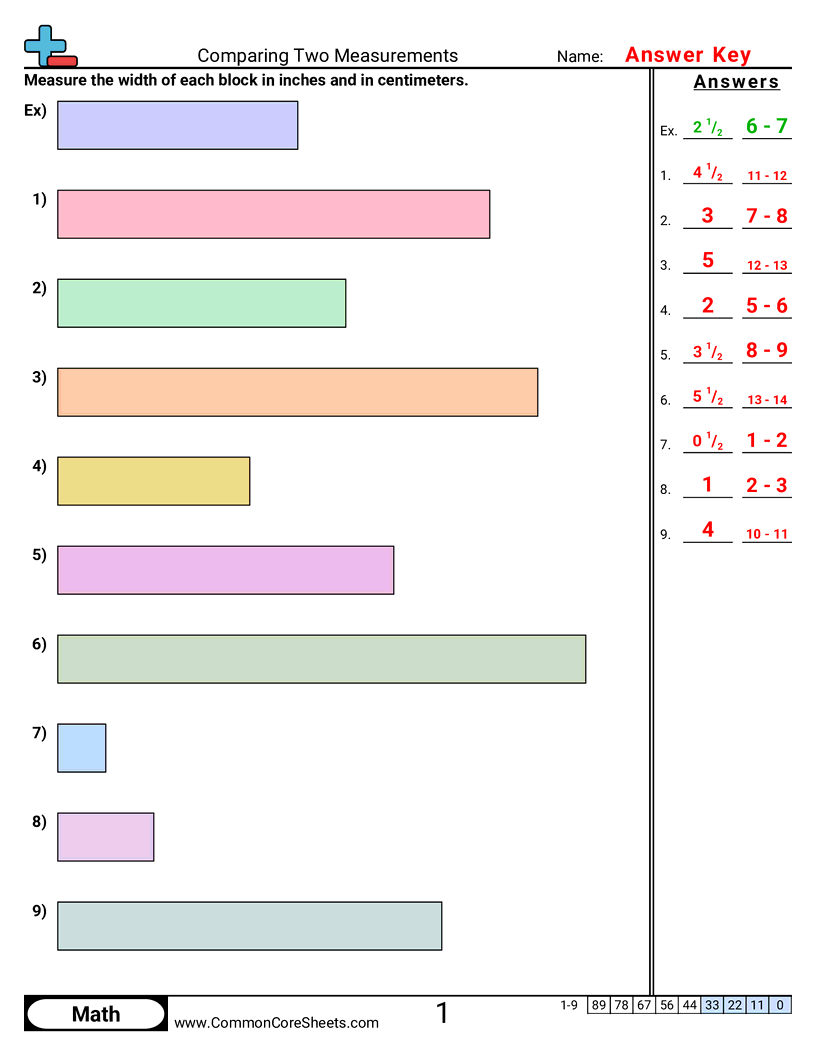
Practice measuring the same object in both inches and centimeters Read a ruler to the nearest half inch and to the nearest centimeter See that the same length gives a different number depending on the unit used
2md2
Read a ruler to find the width of an object in inches. Read a ruler to find the width of an object in centimeters. Use measurement words like wider, narrower, longer, and shorter to describe the comparison.
2md2
Measure the width and height of a block using a ruler. Read ruler marks to write measurements in inches and in centimeters. Use words like greater than and less than to describe measurement comparisons.
2md3
Choose whether inches, feet, centimeters, or meters makes the most sense for a length in a word problem. Use what you know about common objects to make a reasonable estimate of a length. Tell the difference between small lengths and longer distances so you don’t pick a unit that’s way too big or too small.
4md1
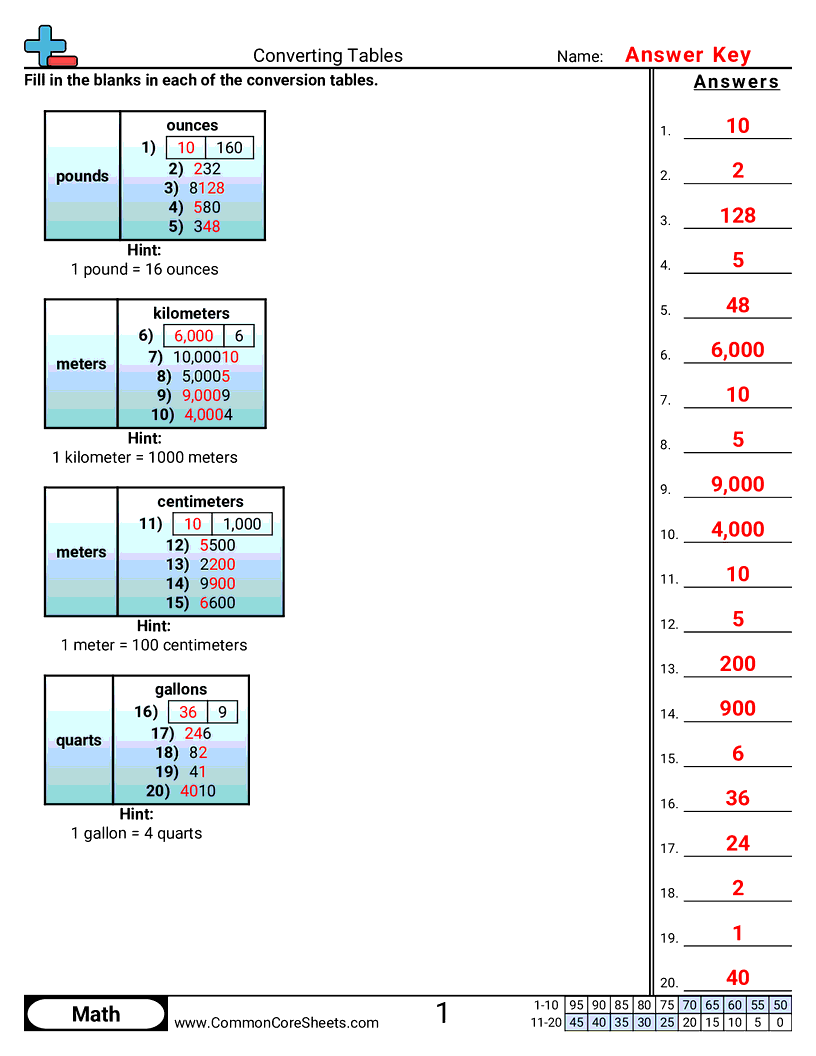
Convert between larger and smaller units of length, weight, and liquid volume. Use a conversion table to find the matching value in a different unit. Multiply or divide by a conversion factor to fill in missing measurements.
4md1
Practice balancing measurement equations by figuring out the missing amount that makes both sides equal.
4md1
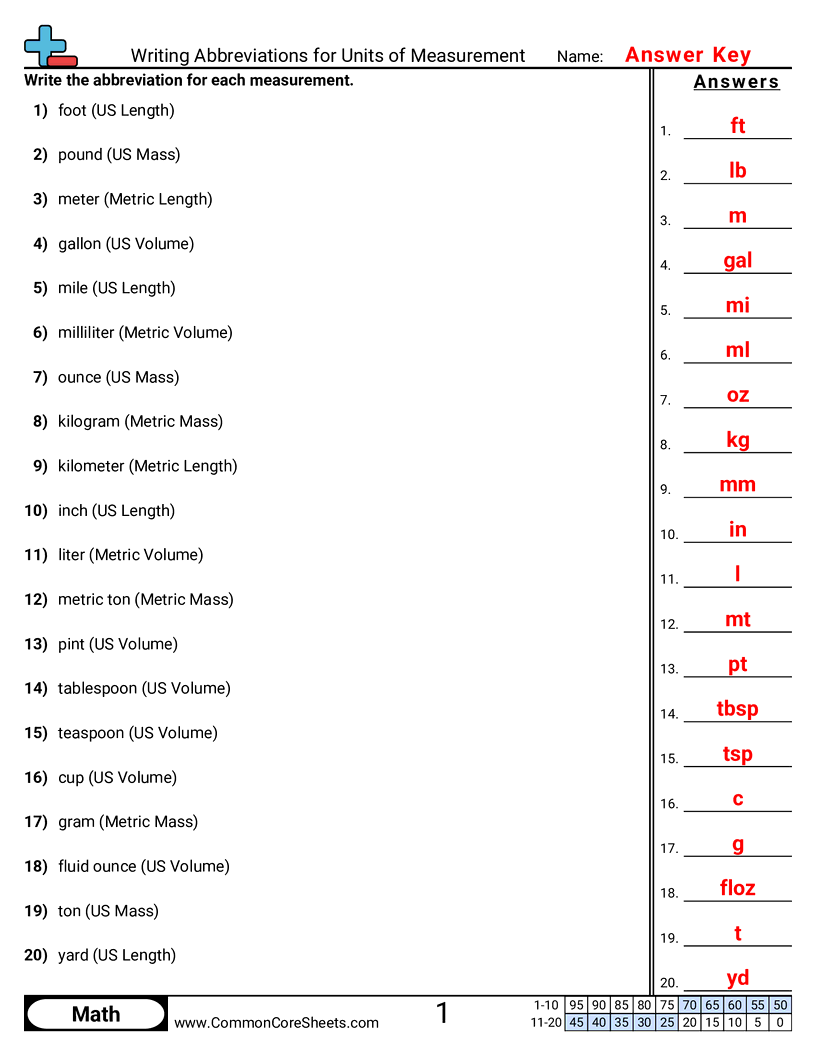
Practice writing the correct abbreviations for common U.S. customary units like inches, feet, yards, and miles. Practice writing the correct abbreviations for common weight and capacity units like ounces, pounds, cups, pints, quarts, and gallons. Practice writing the correct abbreviations for metric units like millimeters, centimeters, meters, kilometers, milliliters, and liters. Learn to match a unit name to its standard abbreviation without mixing up similar-looking abbreviations (like m vs mi or oz vs lb).
4md1
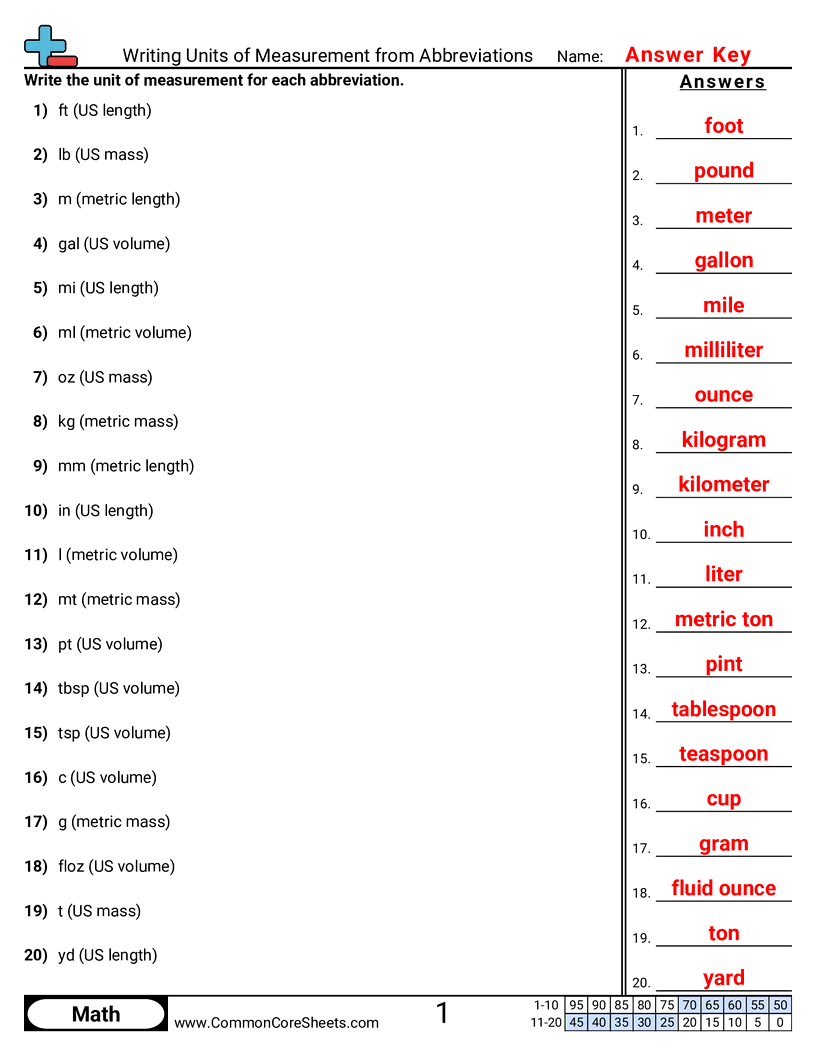
Practice reading common measurement abbreviations and writing the full unit name. Learn the correct spelling of standard and metric measurement units. Recognize similar-looking abbreviations and match each one to the right unit.
4md1
Judge whether a stated measurement is sensible for the situation. Recognize a measurement that uses the wrong unit. Recognize a measurement that uses the right unit but the wrong amount.
4md1
Choose a reasonable temperature for an everyday situation. Read a temperature against the scale it is written in. Compare Fahrenheit and Celsius values for the same situation.
Measurement worksheets by grade
Playwire Advertisement