Rocks, Fossils and Earth's Surface Worksheets
Free Earth science worksheets with answer key. No login or account needed. Students read how fossils form and what they tell us about the past, sort weathering from erosion, and decide whether each change to the land happens fast or slowly. A grading column and quick grade scale make grading a breeze. Great for teachers or for homeschool.
More about these worksheets ▾ Show less ▴
×
Identify causes and effects in a science passage Explain how a fossil can form when a plant or animal is buried quickly in mud or sand Use fossils and rock layers as evidence of what a place was like long ago
Analyze the fossils found in a column of rock layers Use the order of the layers to tell older rocks from younger ones Describe how the fossil record shows life changing and dying out over time
Explain that some changes to the land happen fast, in minutes, hours or days Explain that some changes to the land happen slowly, over many, many years Sort changes to the land as fast or slow
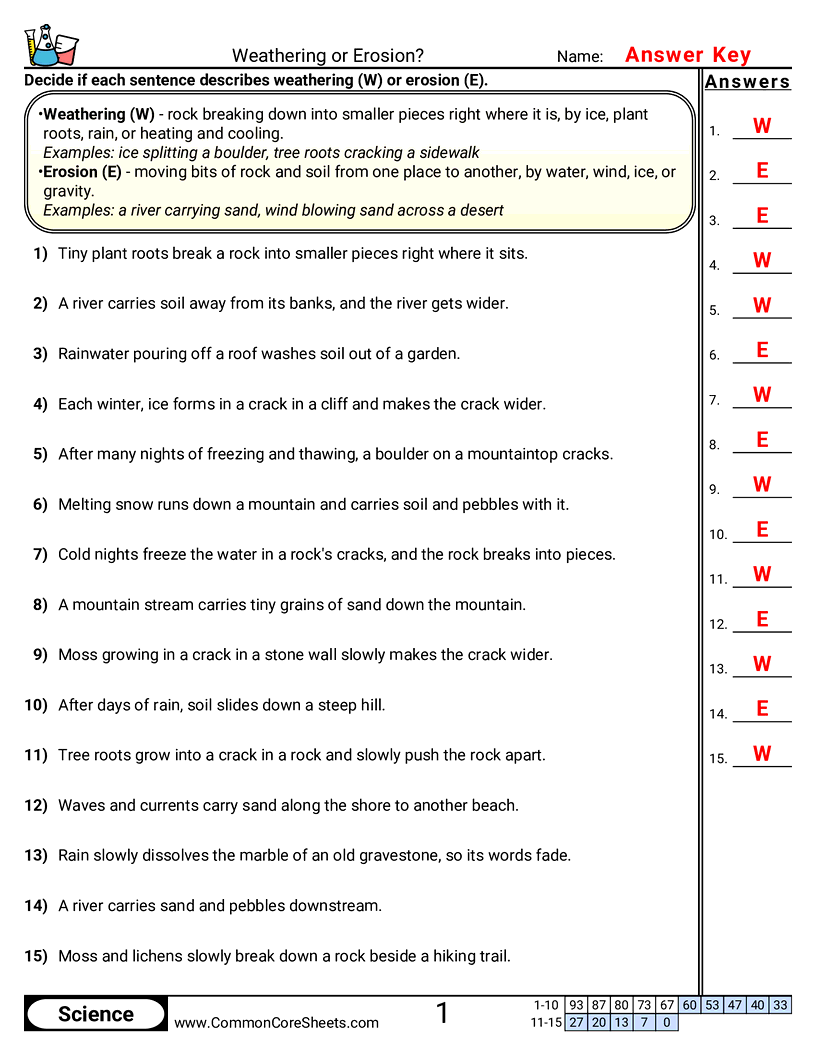
Explain that weathering breaks rock down into smaller pieces where it is Explain that erosion moves bits of rock and soil from one place to another Tell sentences about weathering from sentences about erosion
Explain that weathering breaks down or dissolves rock right where it is Explain that erosion carries rock and soil to a new place by wind, water, ice or gravity Explain that deposition happens when wind, water or ice slows down and drops sediment, building up new land Sort descriptions of changes to Earth's surface as weathering, erosion or deposition
Analyze where the same fossils are found on different continents Explain why these living things could not have crossed the oceans Use fossil evidence to support the idea that continents have moved
Determine the central idea of a science article Use a diagram of a mid-ocean ridge together with the text Explain how fossils show that continents were once joined
Explain that igneous rock forms when melted rock cools and hardens Explain that sedimentary rock forms when layers of sediment are pressed and cemented together Explain that metamorphic rock forms when heat and pressure change one rock into a new rock without melting it Sort rocks as igneous, sedimentary or metamorphic by how they formed
Explain that an earthquake is a sudden shaking of the ground that happens when rocks deep underground slip Explain that a flood happens when water overflows onto land that is usually dry Explain that a volcano is an opening in Earth's surface where melted rock, ash and gas burst out Describe ways people reduce the harm that earthquakes, floods and volcanoes can cause Sort ways to protect people as protection from an earthquake, a flood or a volcano
Analyze readings from a volcano observatory Identify the warning signs that magma is rising Explain how forecasting an eruption helps keep people safe
Determine the central idea of a science article Use a diagram of an oil trap together with the text Explain why resources are found in some places and not others
Advertisement