Ecosystems and Food Chains Worksheets
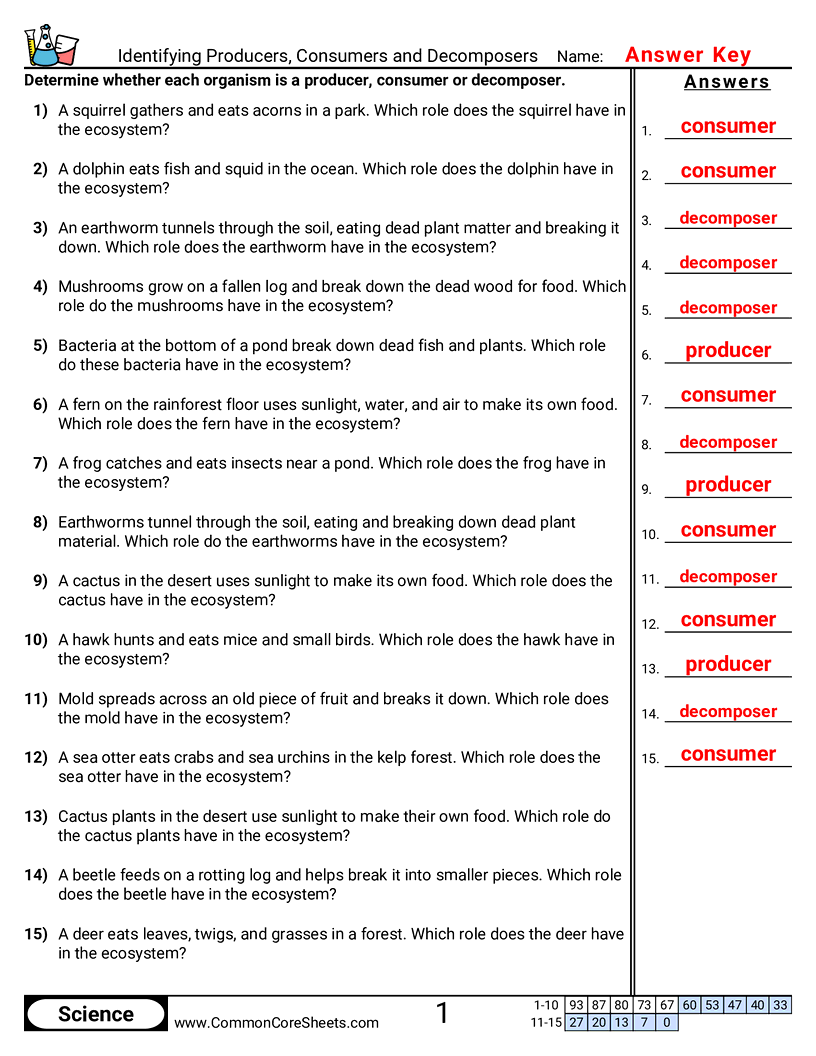
Free ecosystem and food chain worksheets with answer key. No login or account needed. Students decide whether each living thing is a producer, a consumer or a decomposer from the way it gets its food. A grading column and quick grade scale make grading a breeze. Great for teachers or for homeschool.
More about these worksheets ▾ Show less ▴
×
Classify organisms as producers, consumers, or decomposers. Use clues about how an organism gets food to determine its role. Understand how matter and energy move through an ecosystem.
Explain that an herbivore eats only plants Explain that a carnivore eats only other animals Explain that an omnivore eats both plants and animals Sort animals by everything they eat, not by one meal
Identify causes and effects in a science passage Explain that the energy in a food chain starts with the sun and moves from producers to consumers Describe how decomposers return nutrients to the soil so matter moves in a cycle
Explain that people can help the Earth by keeping the land, water, and air clean Name ways to save water and electricity and to reduce, reuse, and recycle Sort everyday actions into ones that help the Earth and ones that harm it
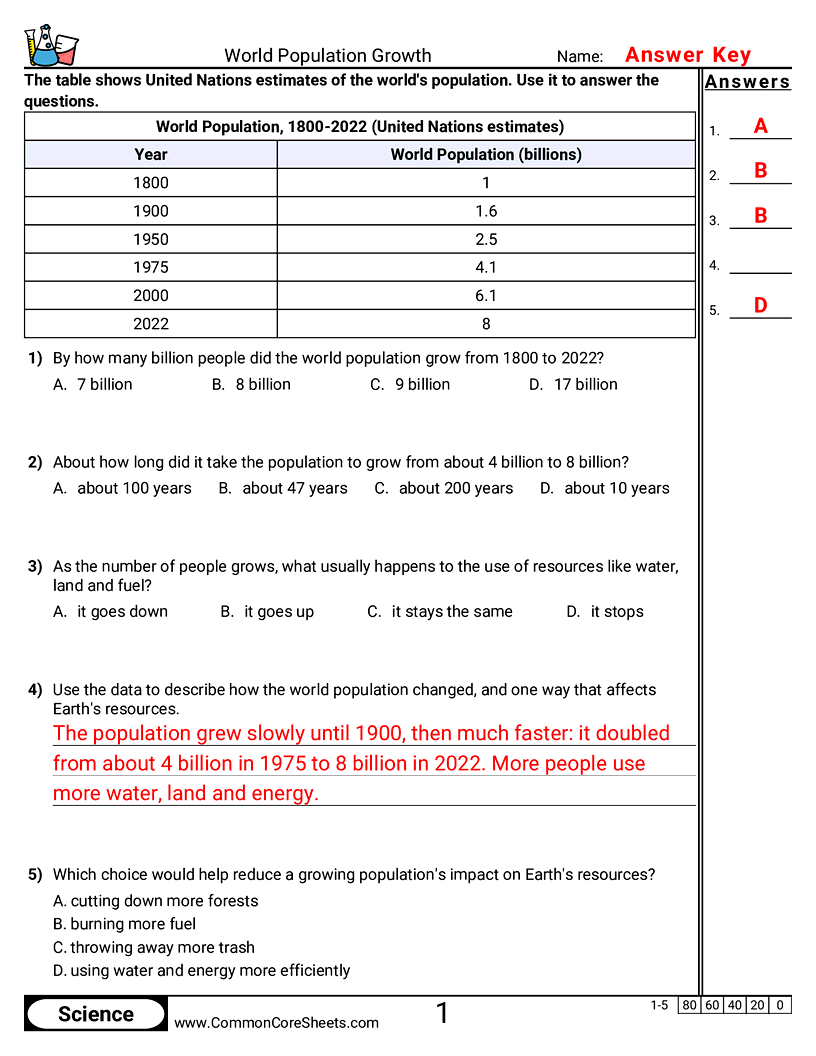
Analyze real data on world population growth Describe how fast the population grew in different periods Explain how more people using more resources affects Earth's systems
Explain that plants, animals and people can all change the place where they live Tell that plants change a place as they grow, like roots cracking a sidewalk or a vine covering a wall Tell that animals change a place to get food, water or a home, like a beaver building a dam or a mole digging tunnels Tell that people change a place to meet their needs, like building roads and houses or planting gardens Sort sentences by whether a plant, an animal or people made the change
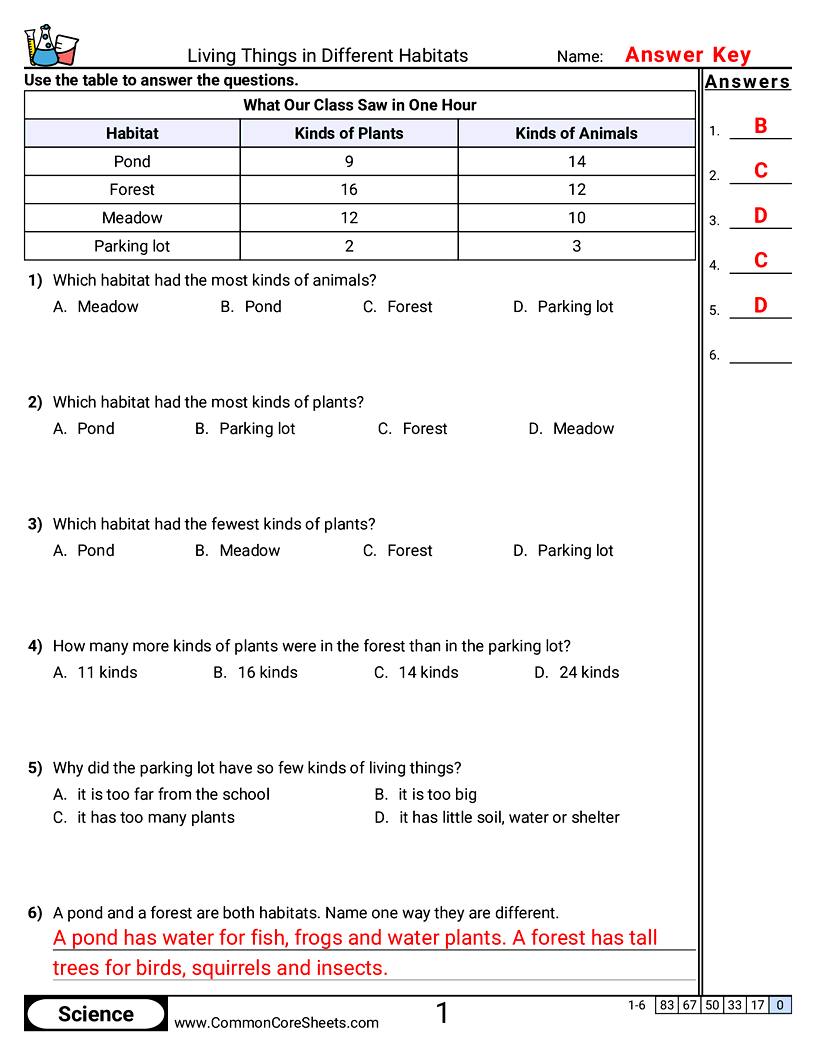
Read a table of the kinds of plants and animals seen in different habitats Compare how many kinds of living things live in each habitat Explain why some places have more kinds of living things than others
Explain that an ocean is a huge body of salty water, and that ocean plants and animals need salt water Explain that a forest is land covered with many trees, with shade and lots of rain Explain that a desert is dry land that gets very little rain and is often hot in the day Use what a plant or animal needs or does to decide whether it lives in the ocean, a forest or a desert
Trace the energy in a food back to the sun Tell which foods come straight from plants Name ways animals use the energy in food
Analyze data from a photosynthesis experiment Describe how the amount of light changes the rate of photosynthesis Explain that plants give off oxygen as they use light to make sugar
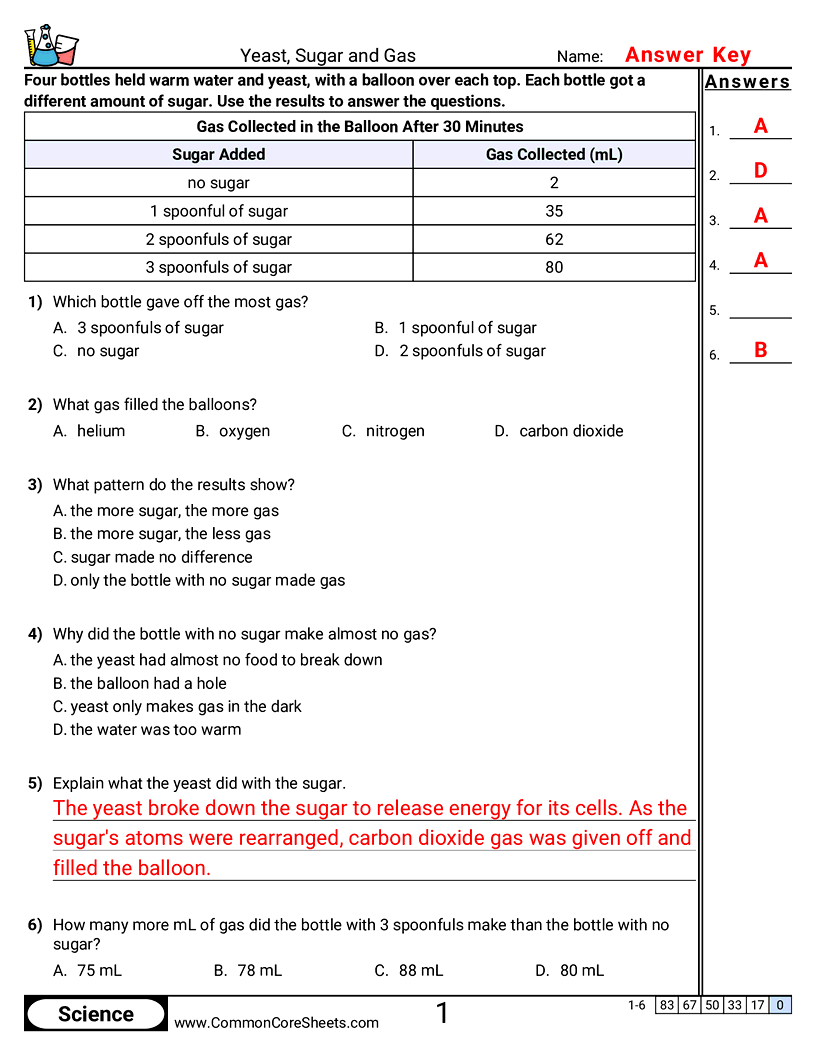
Analyze data from a yeast and sugar experiment Describe how the amount of food changed the gas given off Explain that cells break down food, rearranging its atoms to release energy
Determine the central idea of a science article Use a diagram together with the text to compare photosynthesis and cellular respiration Explain where most of a plant's mass comes from
Analyze data on a resource and the size of a population Identify a limiting factor for a population Explain how the amount of a resource affects how many organisms an ecosystem can support
Analyze data on a population after its predator is removed Describe the boom and crash of the prey population Explain how a change to one part of an ecosystem affects other parts
Explain that in mutualism both organisms benefit Explain that in commensalism one organism benefits and the other is neither helped nor harmed Explain that in parasitism one organism, the parasite, benefits by living on or in another organism, the host, and harms it Sort descriptions of interactions between organisms as mutualism, commensalism or parasitism
Advertisement