General Measurment Worksheets
Our General Measurement worksheets help first grade students master foundational measurement skills through hands-on practice. Students compare object lengths to identify longest and shortest items, then learn to measure using non-standard units by placing equal-sized objects end to end without gaps.
×
About these worksheets
These worksheets introduce basic measurement concepts for early learners. Students compare the lengths of objects to determine which is longest or shortest and use non-standard units to measure objects by lining up equal-sized units end to end. Aligned with first grade measurement standards.
1md1
Compare three objects and decide which one is longest and which one is shortest. Put three objects in order from shortest to longest by looking at their lengths. Use words like longer, shorter, and same length to describe how objects compare. Pay attention to where each object starts and ends so the comparison is fair.
1md2
Measure the length of an object by lining up equal-size units end to end with no gaps or overlaps. Count the units to tell how long each object is. Use the same unit each time so measurements can be compared fairly.
4md1
Decide which of two lengths is longer or shorter when the units differ. Convert to a common unit before comparing. Recognize that the larger number is not always the longer length.
4md1
Decide which of two lengths is longer or shorter when the units differ. Convert to a common unit before comparing. Recognize that the larger number is not always the longer length.
2md1
Choose whether a centimeter ruler, a meter stick or a measuring tape best fits an object. Judge roughly how long an object is before deciding how to measure it. Explain why a tool can be too short, or longer than it needs to be, for a given object.
2md1
Decide whether an object is best measured in centimeters or in meters. Connect a unit to a real object of about that size. Recognize that centimeters suit small objects and meters suit large ones.
2md1
Measure the length of an object with a centimeter ruler. Line the end of an object up with zero before reading the other end. Read a length to the nearest whole centimeter.
2md1
Choose whether an inch ruler, a yardstick or a measuring tape best fits an object. Judge roughly how long an object is before deciding how to measure it. Explain why a tool can be too short, or longer than it needs to be, for a given object.
2md1 2md3
Decide whether an object is best measured in inches, feet or yards. Connect a unit to a real object of about that size. Recognize that yards are used for fields and long distances, feet for rooms and furniture, and inches for small objects.
2md1
Measure the length of an object with an inch ruler. Line the end of an object up with zero before reading the other end. Read a length to the nearest half inch, including marks that fall between two numbers.
2md1
Measure the length of an object to the nearest quarter inch. Read a mark that is neither a whole number nor the halfway point. Find the quarter inch marks among the eighths on a ruler.
2md1
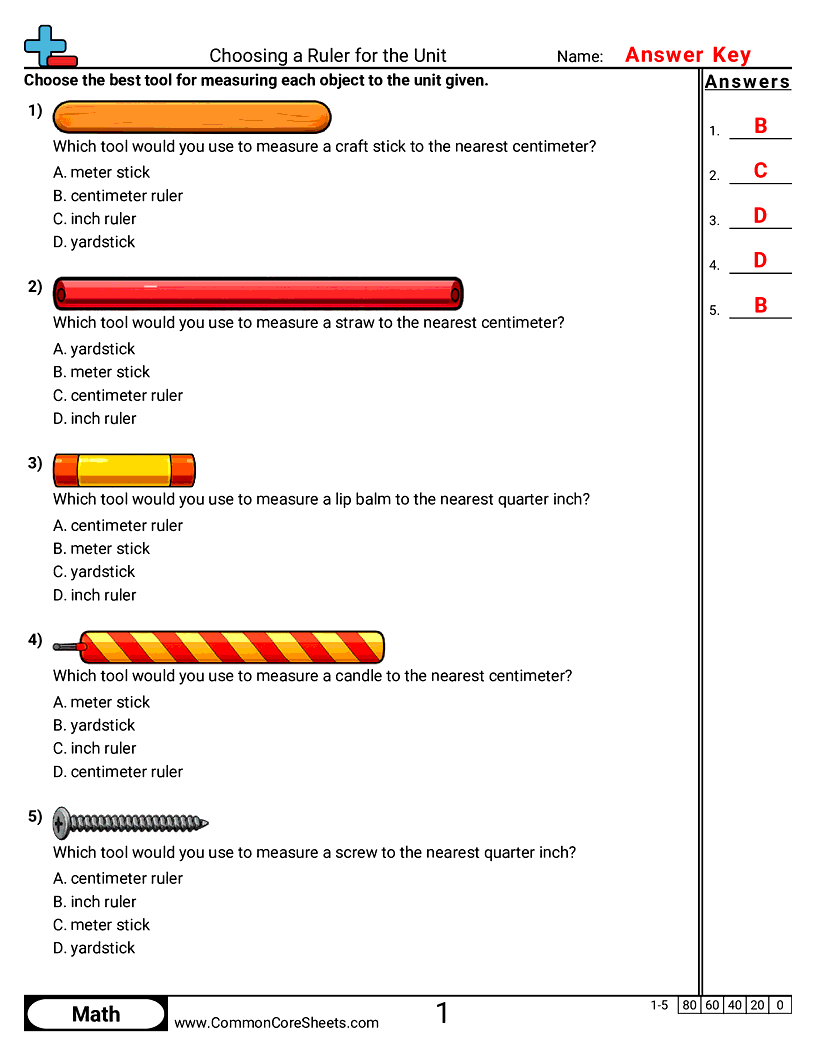
Choose a ruler that measures in the unit the question asks for. Recognize that a centimeter ruler cannot give an answer in inches. Rule out a tool that is the wrong length as well as one in the wrong unit.
2md1
Line a ruler up with the end of an object before reading it. Measure a real object to the nearest centimeter. Read a ruler that is not already positioned for you.
2md1
Line a ruler up with the end of an object before reading it. Measure a real object to the nearest half inch. Read a ruler that is not already positioned for you.
2md1
Line a ruler up with the end of an object before reading it. Measure a real object to the nearest quarter inch. Read a ruler that is not already positioned for you.
2md1
Measure an object to the nearest eighth inch. Read the smallest tick on a ruler. Write a length as a mixed number.
2md1
Measure an object to the nearest sixteenth inch. Use a real ruler on a printed object. Write a length as a mixed number.
2md1
Measure an object that does not start at zero. Find a length by subtracting two ruler readings. Read a ruler to the nearest centimeter.
Playwire Advertisement