5th Grade Fraction Worksheets
This collection of 50 free printable worksheets helps 5th graders master fraction skills including adding and subtracting fractions with different denominators, multiplying and dividing fractions, and solving fraction word problems. Students practice using visual models, number lines, and real-world applications to build fraction fluency.
More about these worksheets ▾ Show less ▴
Grade & filters: 5th Grade ▾
×
About these worksheets
These worksheets introduce the concept of fractions from the ground up. Activities include naming fractions from words and pictures, writing fractions from visual models, identifying correct fraction representations, partitioning shapes into equal parts, determining whether fractions equal zero, one-half, or one whole, examining fraction values between whole numbers, comparing relative fraction sizes, finding reciprocals, and expressing fractions in words and numbers. Resources span first through fifth grade.
5nf3
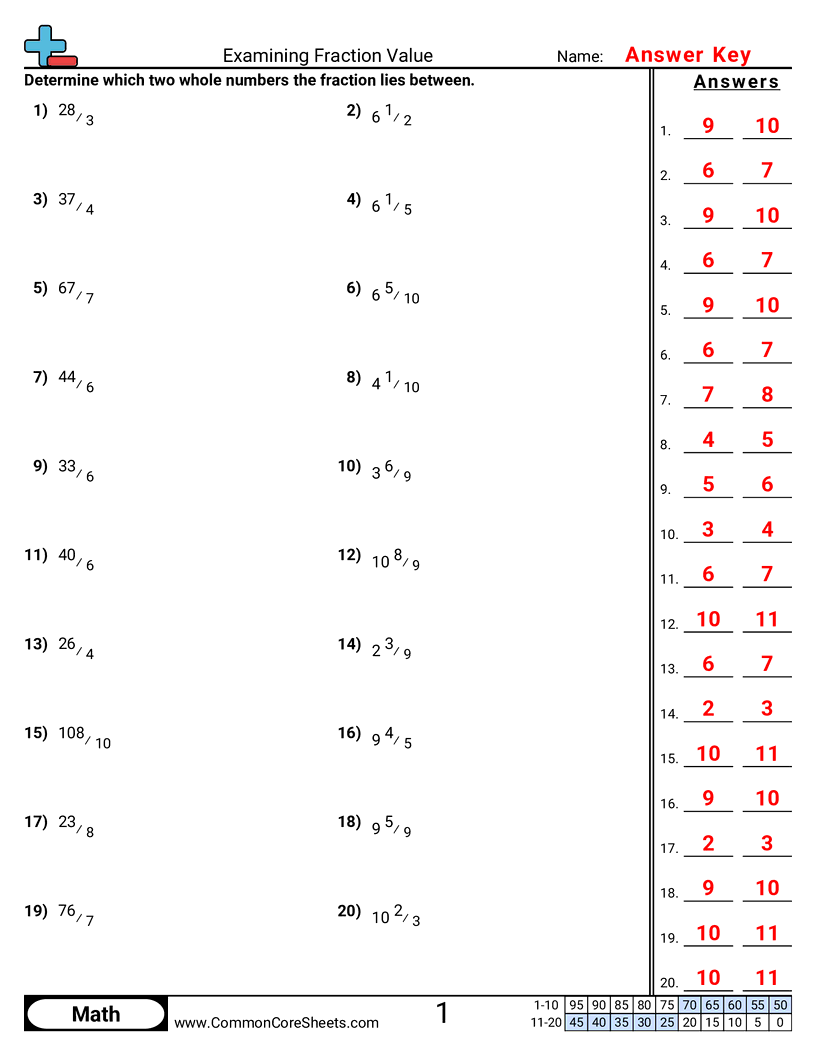
Decide which two whole numbers a fraction falls between. Convert an improper fraction to a mixed number fraction to identify the value with whole numbers.
5nbt3a
Work out what each base ten block is worth once one of them is named the whole Write the value of a set of blocks as a fraction Use a denominator of tenths, hundredths or thousandths depending on the smallest block shown See how the same block changes value when a different block is the whole
5nbt3a
Read a fraction from a point on a number line. Write the equivalent decimal for that point. Recognize a number line as a model for a fraction.
5nbt3a
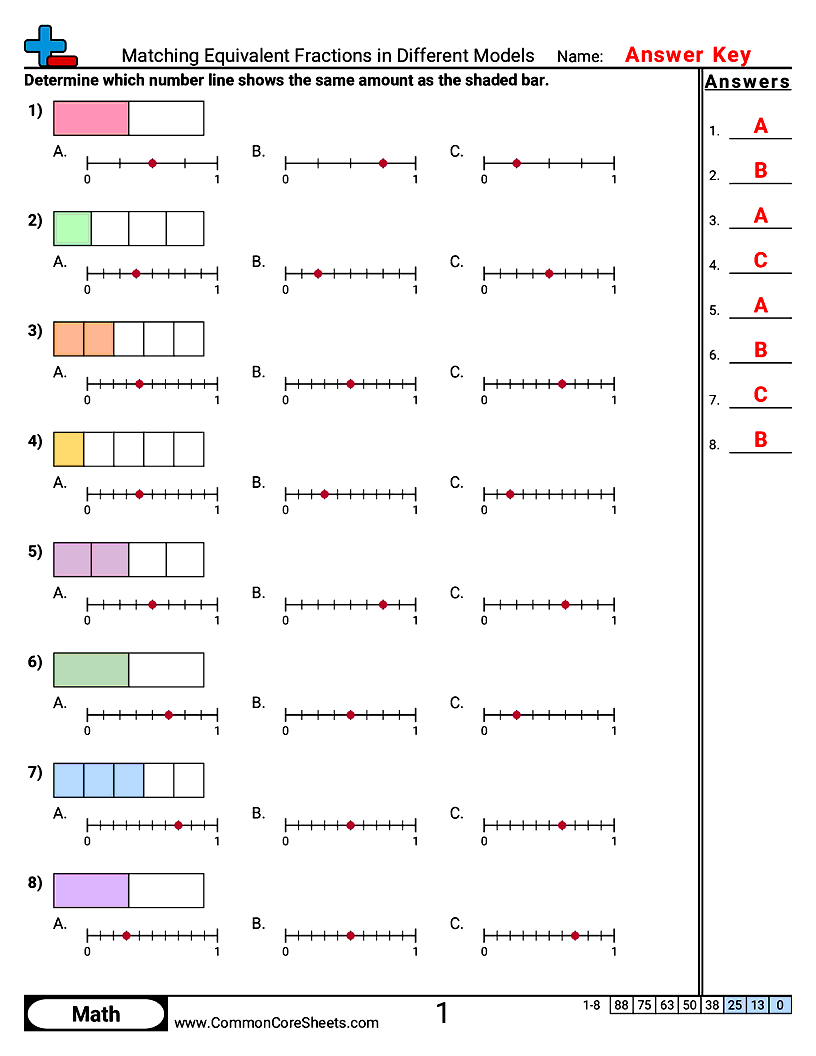
Recognize the same fraction in two different models. Match a bar model to a number line. Compare fractions with different denominators.
You are only seeing5th Grade
See all grades
23 more worksheets in this section
About these worksheets
Students practice placing fractions on a number line, a key skill for understanding fraction size and order. Worksheets cover locating fractions between 0 and 1, partitioning and labeling number lines, placing fractions between whole numbers, and working with positive and negative fractions on a number line. Aligned with third through sixth grade standards.
5nf2
Round a fraction to 0, one half or 1. Estimate a sum of two fractions. Estimate a difference of two fractions.
5nf2
Judge whether a fraction sum is reasonable. Use benchmarks to estimate before checking. Recognize the error of adding numerators and denominators.
5nf2
Round a mixed number to the nearest whole number. Estimate a sum of two mixed numbers. Estimate a difference of two mixed numbers.
You are only seeing5th Grade
See all grades
9 more worksheets in this section
About these worksheets
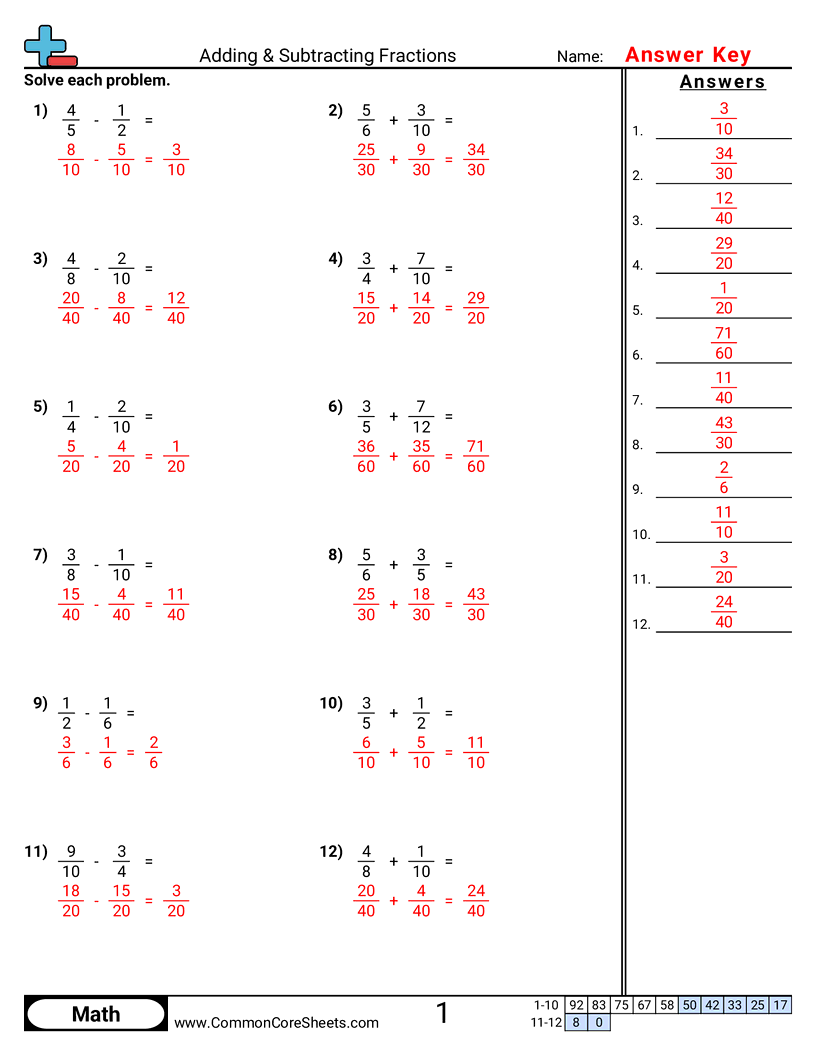
These worksheets provide comprehensive practice with fraction addition and subtraction. Topics include adding and subtracting with same and different denominators, working with mixed numbers and improper fractions, using visual models, regrouping when subtracting mixed numbers, adding tenths and hundredths, and solving fraction word problems. Resources span fourth through fifth grade and beyond.
5nf1
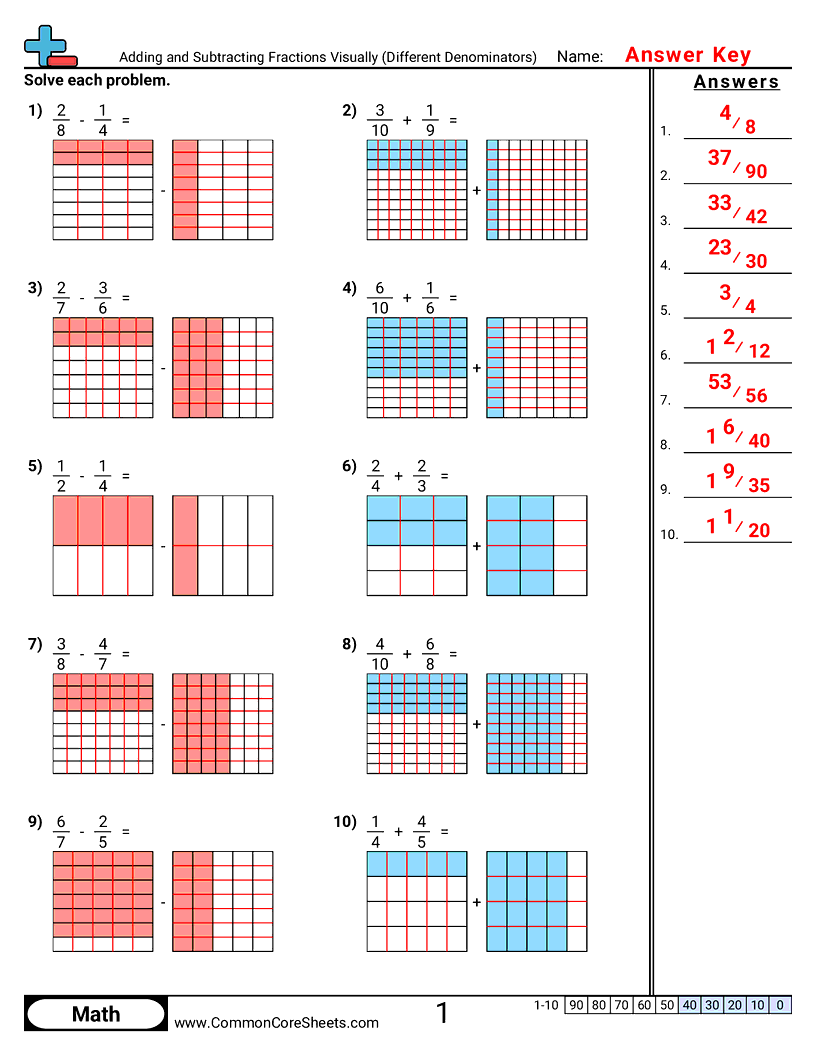
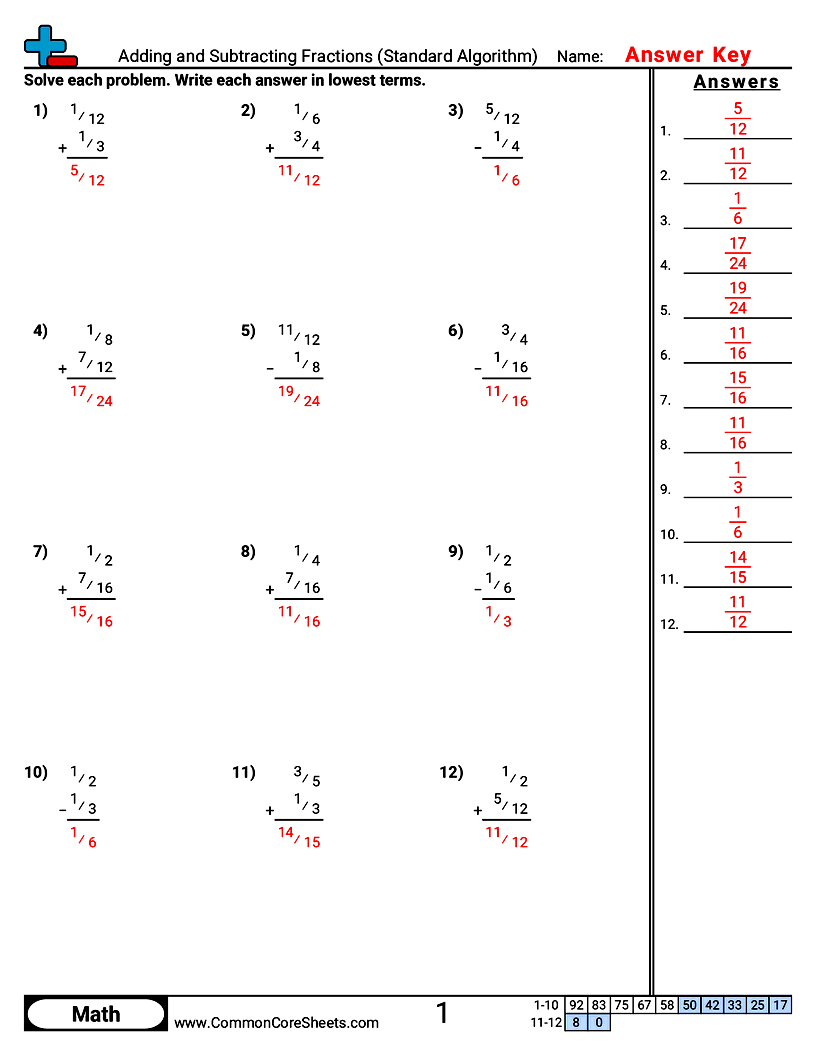
Add fractions that have different denominators by rewriting them as equivalent fractions with a common denominator. Subtract fractions that have different denominators by using a common denominator first. Use visual fraction models to see how two unlike fractions combine or how much is left after subtracting.
5nf1
Add fractions that have different denominators. Subtract fractions that have different denominators. Find a common denominator so the fractions can be combined. Rewrite fractions as equivalent fractions and simplify the final answer when possible.
5nf2
Subtract fractions that have different denominators by finding a common denominator first. Read word problems and decide whether to add or subtract fractions to answer the question. Simplify answers when possible and write them as a fraction or mixed number.
5nf1
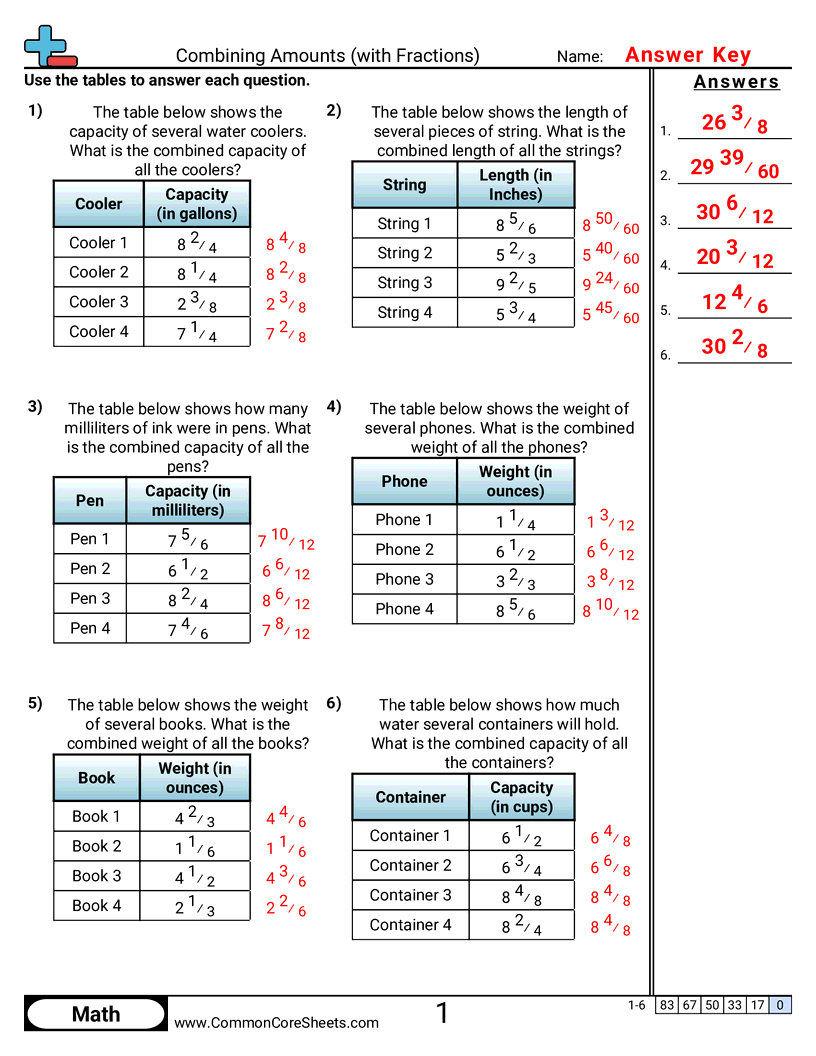
Add more than 2 fractions to find a total amount. Add fractions with the same denominator by combining the numerators. Add fractions with different denominators by rewriting them with a common denominator first.
5nf1
Add fractions that have different denominators by rewriting them as equivalent fractions with a common denominator. Subtract fractions that have different denominators by finding a common denominator first. Use the least common multiple to choose an efficient common denominator.
5nf2
Estimate a sum or difference of mixed numbers. Choose the amount closest to an answer. Judge the size of a fraction answer without calculating.
5nf1
Add fractions using a number line. Rename fractions with a common denominator using a model. Count fractional parts to find a sum.
5nf1
Subtract fractions using a number line. Rename fractions with a common denominator using a model. Count backward along a number line to find a difference.
5nf1
Add fractions using fraction strips. Rename fractions with a common denominator using a model. Compare fractional lengths drawn on equal wholes.
5nf1
Subtract fractions using fraction strips. Rename fractions with a common denominator using a model. Compare fractional lengths drawn on equal wholes.
5nf1
Add mixed numbers using a bar model. Regroup a fraction sum greater than one whole. Rename fractions with a common denominator using a model.
5nf1 5nf2
Add fractions using a tape diagram. Rename fractions with a common denominator using a model. Solve a word problem about parts of one whole.
5nf1 5nf2
Subtract fractions using a tape diagram. Rename fractions with a common denominator using a model. Solve a word problem about part of a part.
5nf1
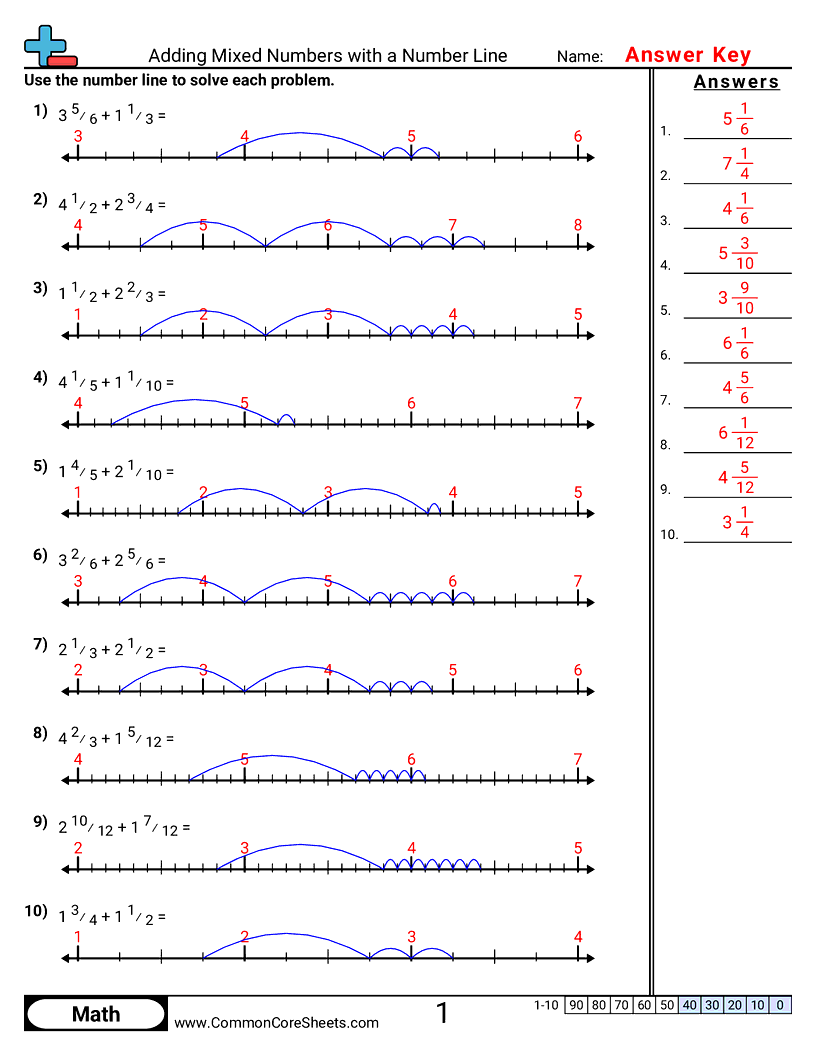
Add mixed numbers by counting on. Choose useful jumps on an open number line. Use a number line marked in the common denominator.
5nf1
Subtract mixed numbers by counting back. Choose useful jumps on an open number line. Use a number line marked in the common denominator.
5nf1
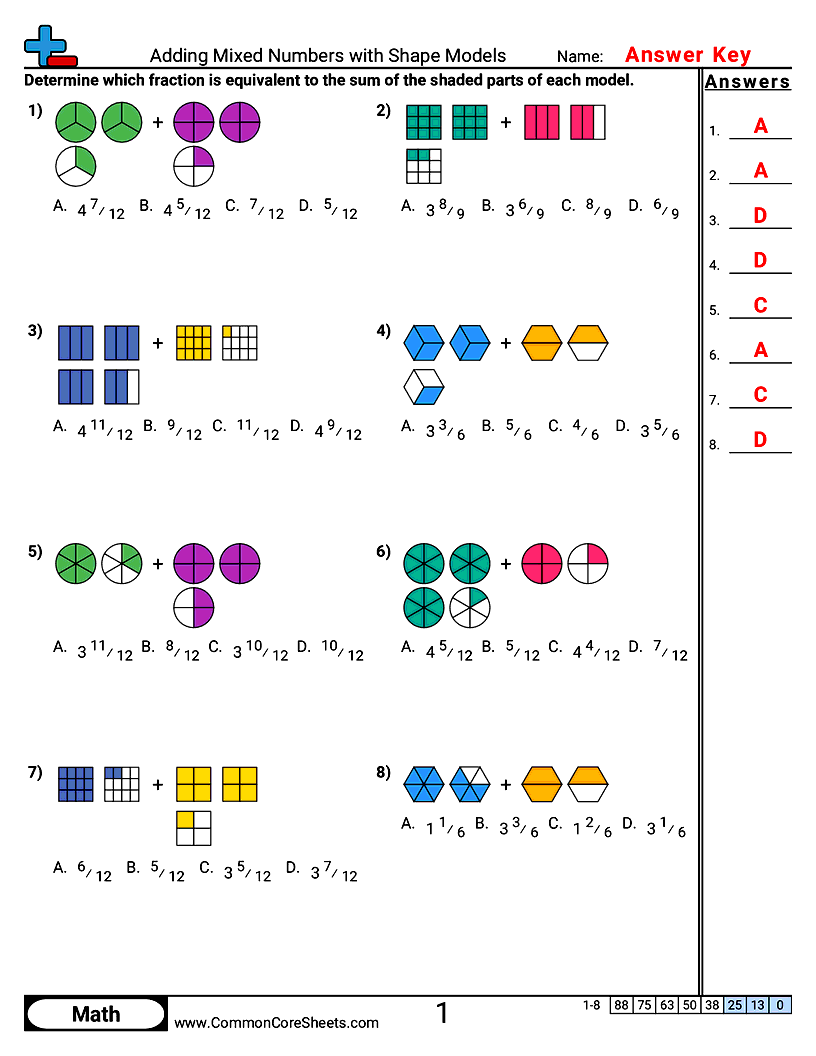
Find the sum of shaded parts shown in two models. Rename halves and thirds as sixths using a picture. Add mixed numbers with unlike denominators.
5nf1
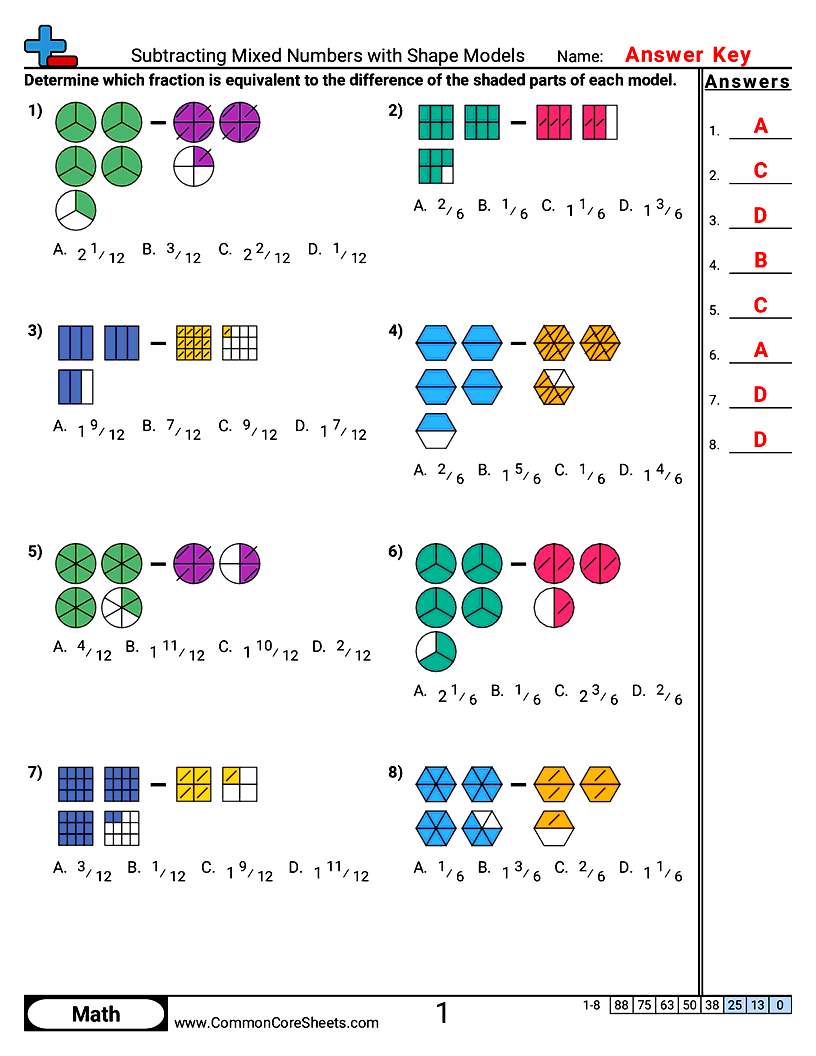
Find the difference of shaded parts shown in two models. Regroup a whole into parts to subtract. Subtract mixed numbers with unlike denominators.
5nf1
Add fractions with unlike denominators. Subtract fractions with unlike denominators. Write a fraction answer in lowest terms.
5nf1
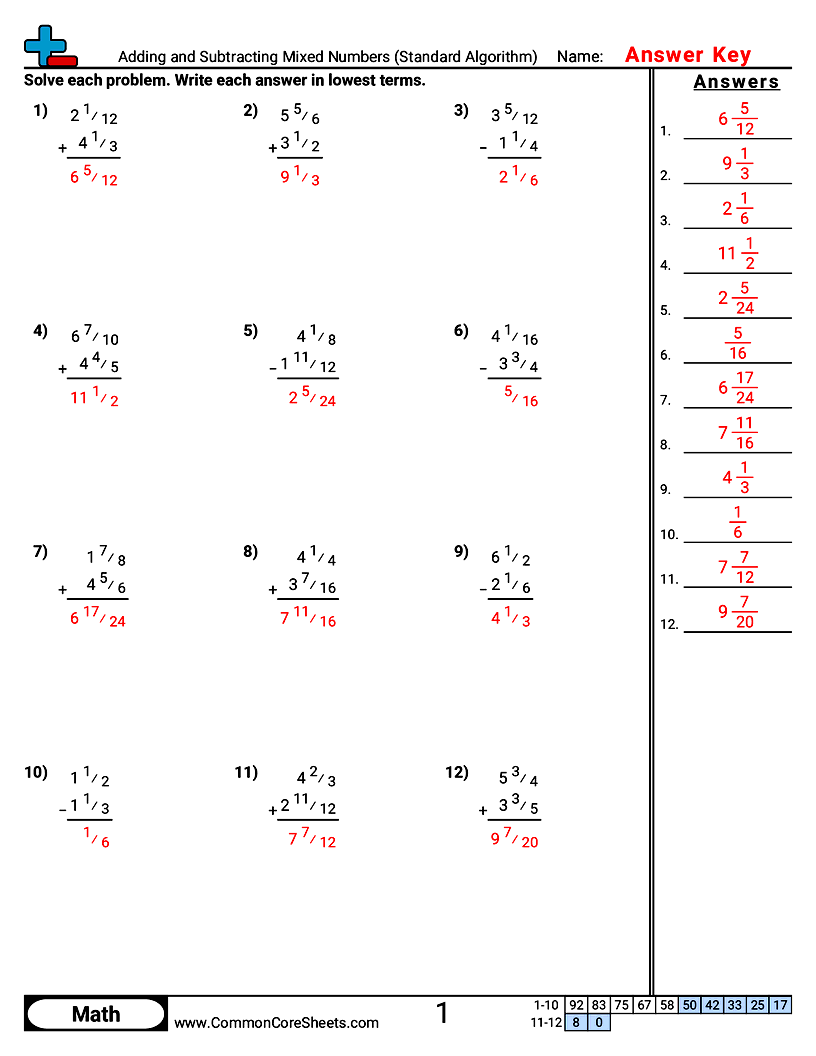
Add mixed numbers with unlike denominators. Subtract mixed numbers with unlike denominators. Regroup when the fraction parts do not fit.
You are only seeing5th Grade
See all grades
12 more worksheets in this section
About these worksheets
Students build fluency with fraction multiplication and division through a wide range of activities. Worksheets cover multiplying fractions by whole numbers and by other fractions, using visual models and number lines, estimating fraction products, cross-cancelling, dividing unit fractions, interpreting fractions as division, distributing fractional amounts, and solving word problems. Topics span fourth through sixth grade Common Core standards.
5nf5b
Estimate the product of two fractions without doing exact multiplication. Round fractions to easy benchmark fractions like 0, 1/2, 1, or whole numbers to make mental math quicker. Use compatible numbers to get a close estimate for a fraction multiplication problem. Decide which estimate makes the most sense by comparing it to the answer choices.
5nf4a
Multiply two fractions to find the product. Convert between mixed numbers and improper fractions when needed to multiply.
5nf4b
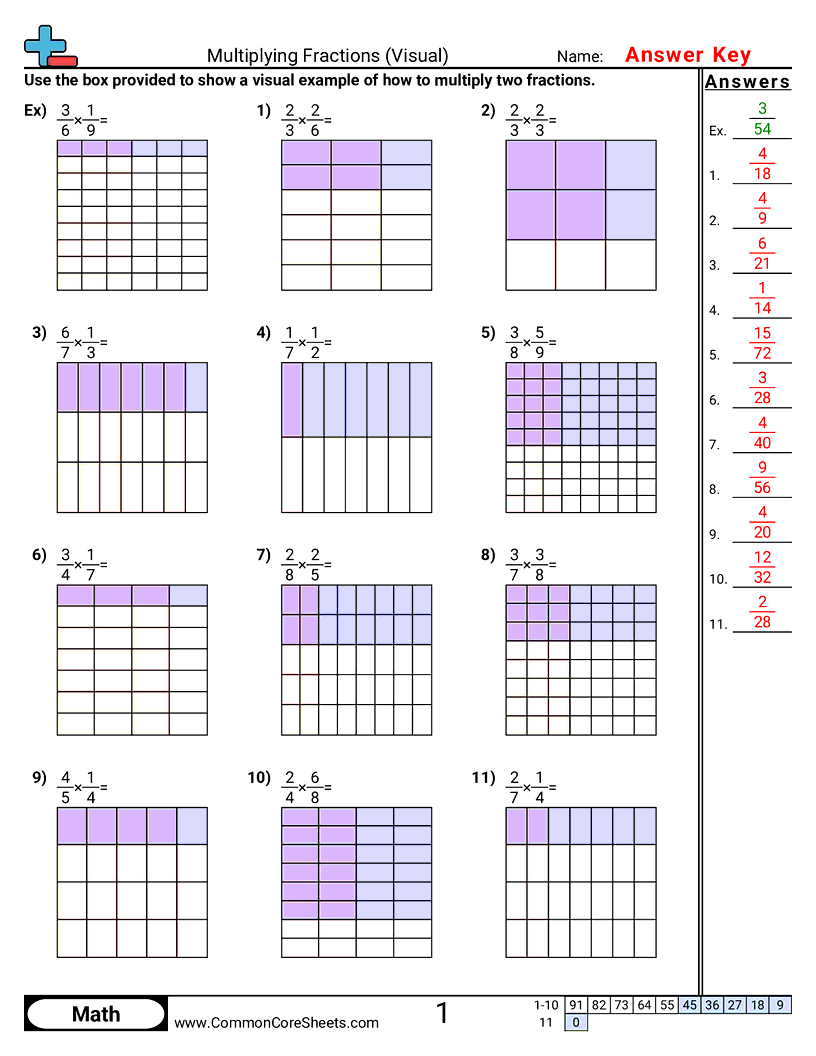
Multiply two fractions to find the product. Use shaded area models or grids to show what it means to multiply fractions.
5nf4a
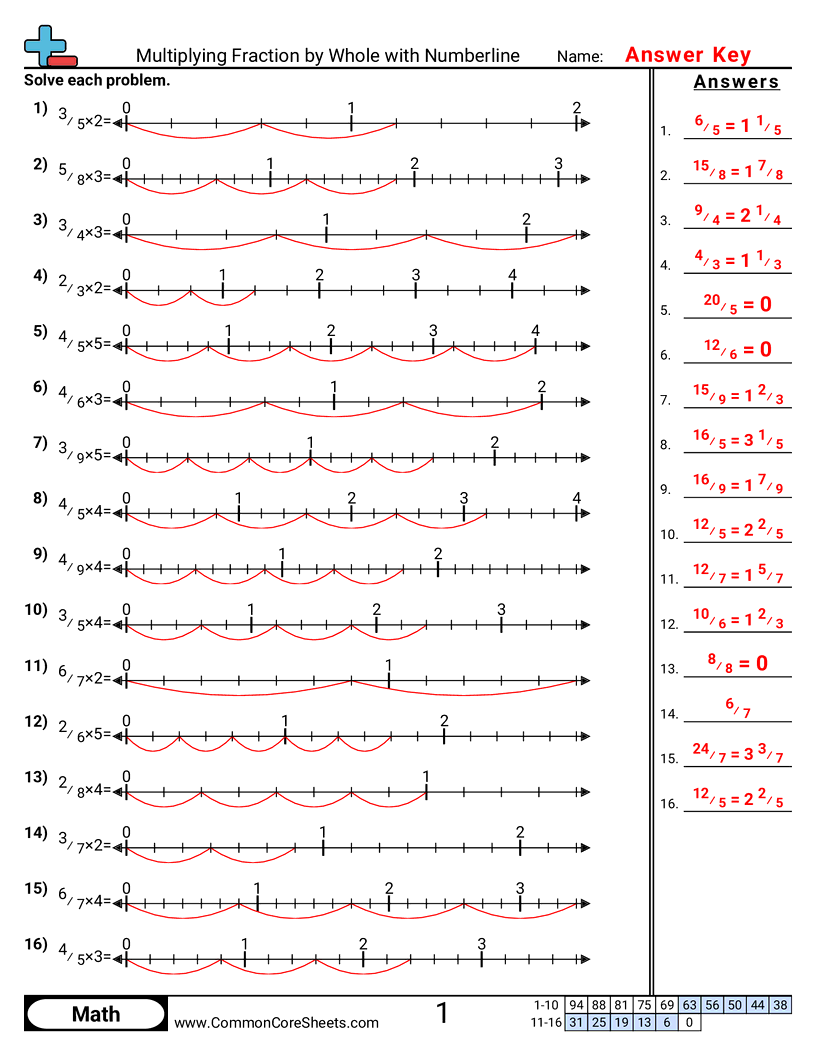
Multiply a fraction by a whole number to find the total amount. Use a number line to show equal jumps of a fraction and count how many jumps you make.
5nf5a
Decide whether a fraction product is greater than, less than, or equal to one of the factors. Use what you know about multiplying by a fraction less than 1 or greater than 1 to predict how the product will change.
5nf6
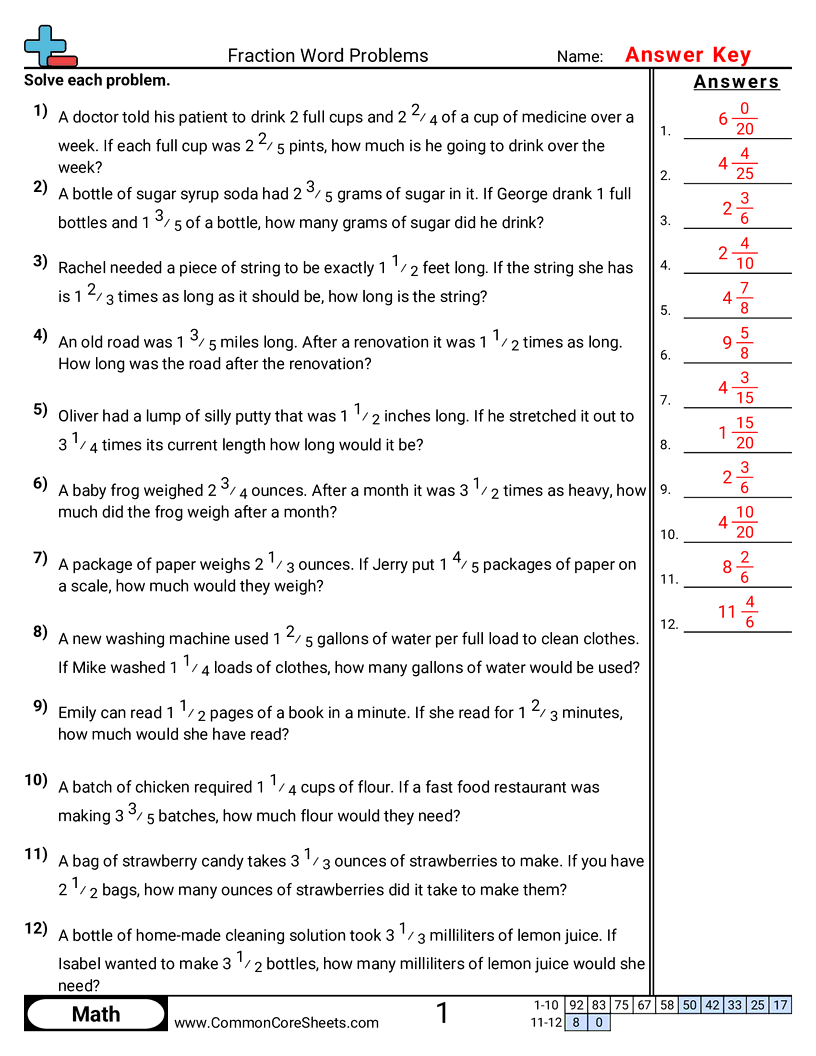
Multiply two fractions to find a product. Multiply a fraction by a whole number. Simplify products to a fraction in lowest terms or a mixed number. Solve word problems where multiplying fractions gives the answer.
5nf6
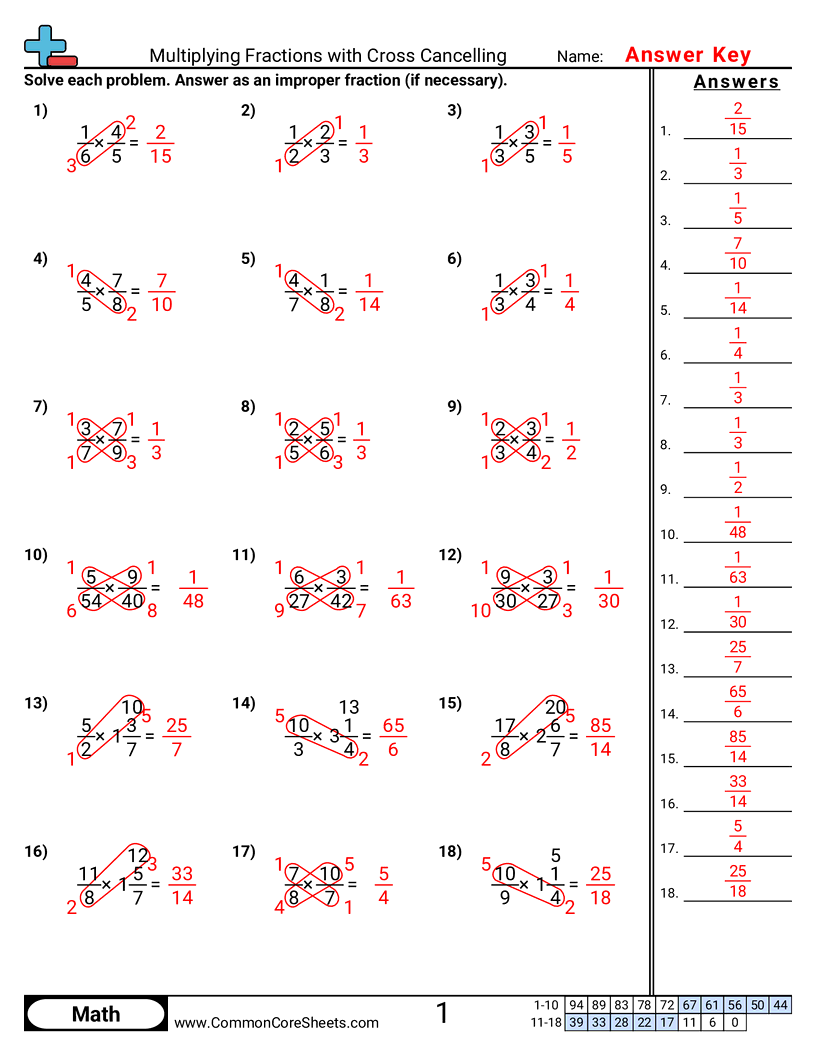
Multiply two fractions to find a product. Cross-cancel common factors between a numerator and the other fraction’s denominator before multiplying. Use factor pairs to spot numbers that can be reduced.
5nf7a
Solve division problems where a unit fraction is divided by a whole number (like 1/3 ÷ 6).
5nf7a
Divide a unit fraction by a whole number to find how much each group gets. Use a picture model to show how a fraction is split into equal parts. Connect the visual model to the rule that dividing by a whole number makes the denominator larger.
5nf7a
Divide a unit fraction by a whole number to find an equal share. Use the idea that dividing by a whole number makes the fraction smaller. Rewrite division of fractions as multiplication by the reciprocal to solve.
5nf7b
Understand what it means to divide by a unit fraction using a picture or model. Use visual models to see how many 1/b-sized parts fit into a given fraction or whole amount. Connect the visual model to the idea that dividing by a unit fraction makes the answer larger.
5nf3
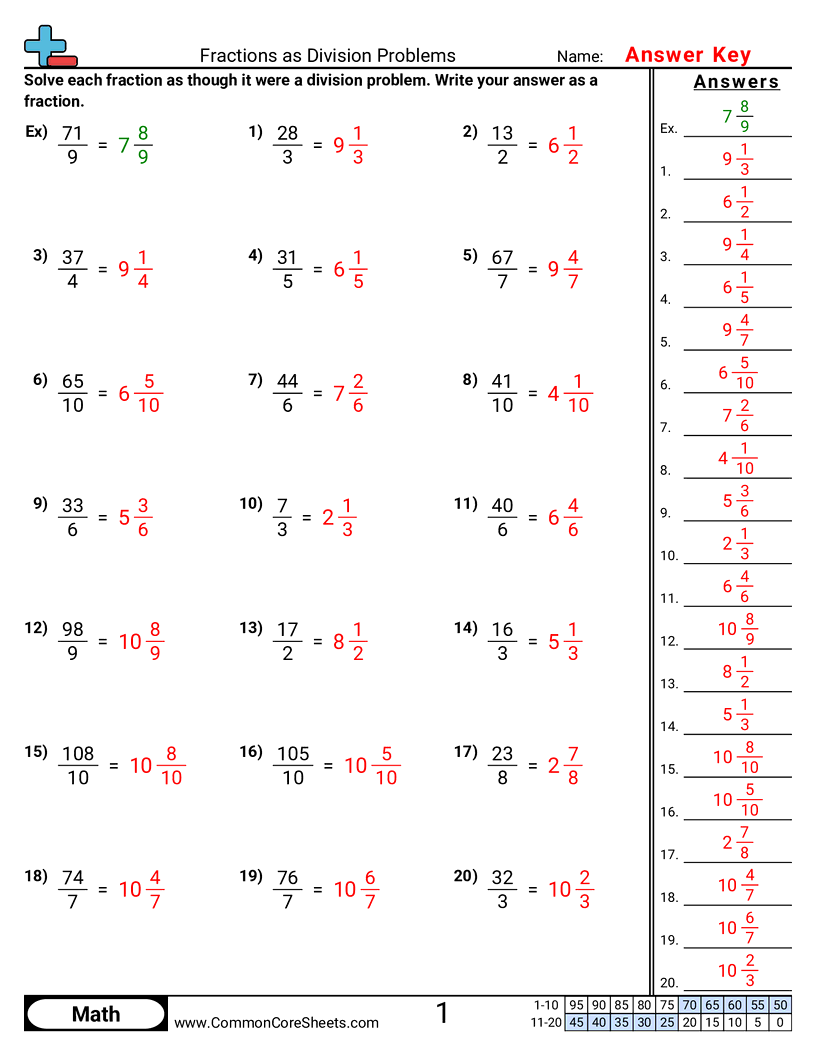
Practice reading a fraction as a division problem (numerator divided by denominator).
5nf7b
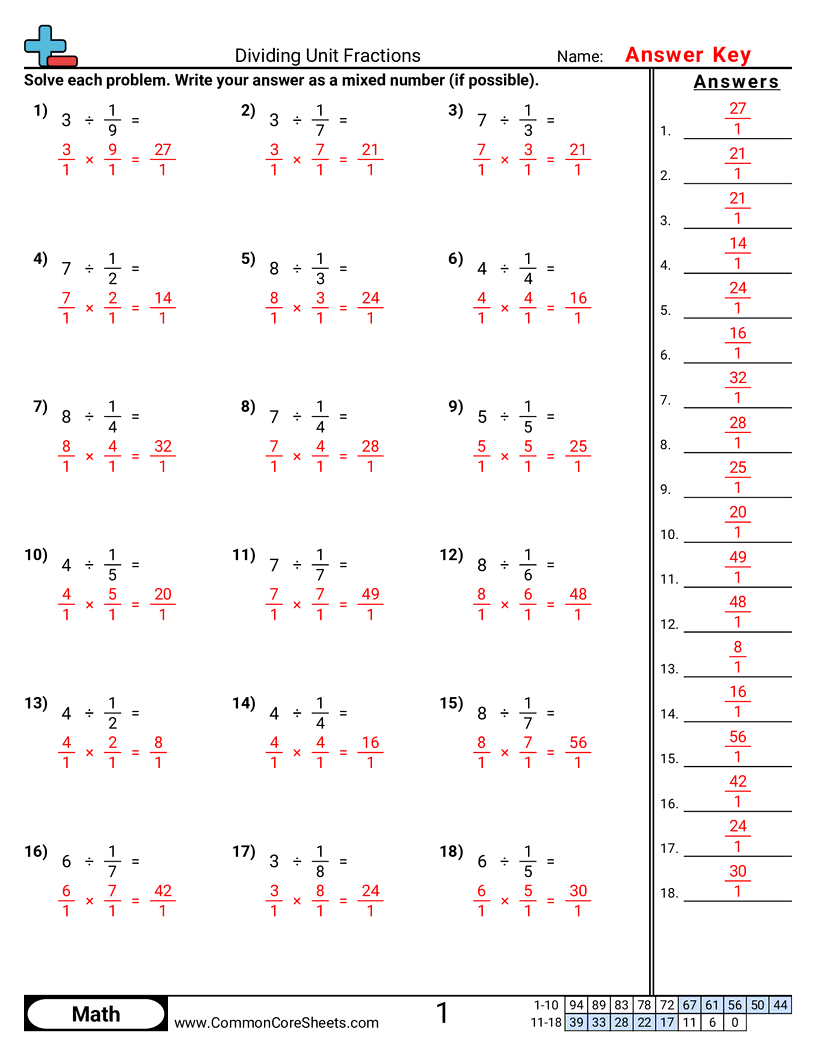
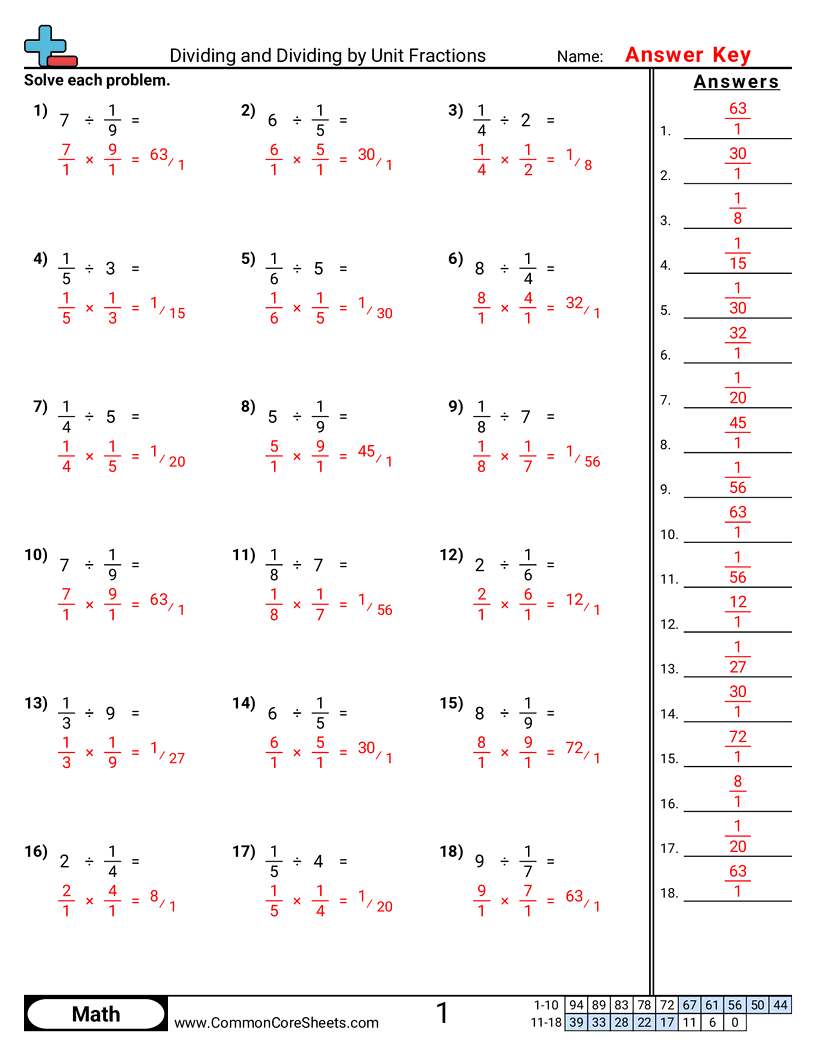
Divide a whole number by a unit fraction like 1/2 or 1/5. Use the idea that dividing by a unit fraction is the same as multiplying by its reciprocal. Find quotients that are whole numbers and understand why the answer gets larger when you divide by a fraction less than 1.
5nf7c
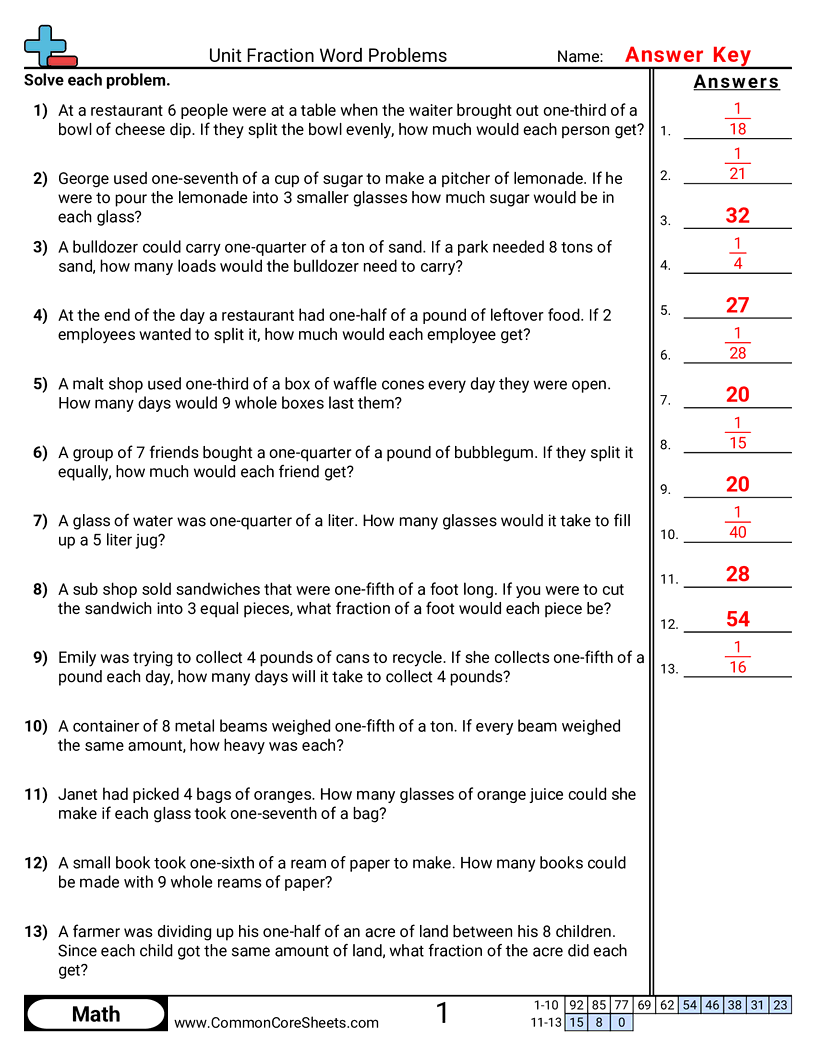
Solve word problems where you divide a whole number by a unit fraction like 1/2 or 1/4. Solve word problems where you divide a unit fraction by a whole number to find how much one share is.
5nf7c
Divide a whole number by a unit fraction like 1/2 or 1/5. Use the idea that dividing by a unit fraction is the same as multiplying by its reciprocal.
5md2
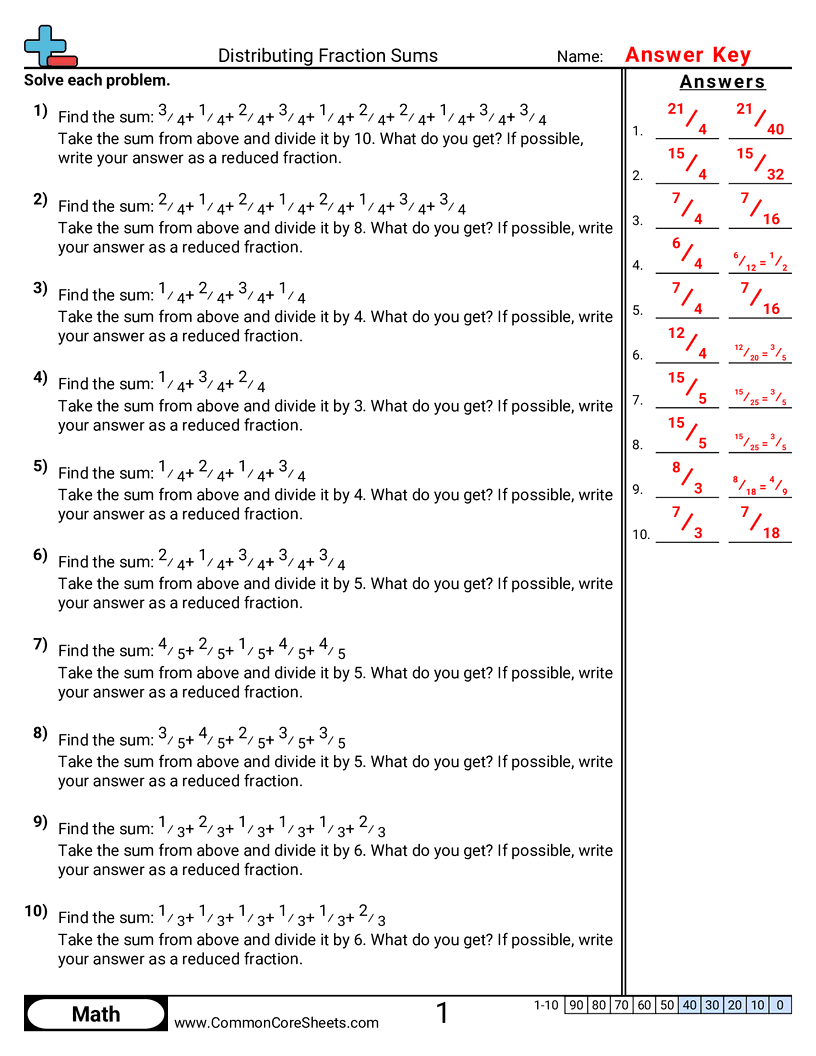
Use fraction addition to recombine the parts and confirm the total stays the same. Rewrite fractions into equivalent fractions so they can be added with a common denominator. Simplify the final fraction or mixed number when possible.
5md2
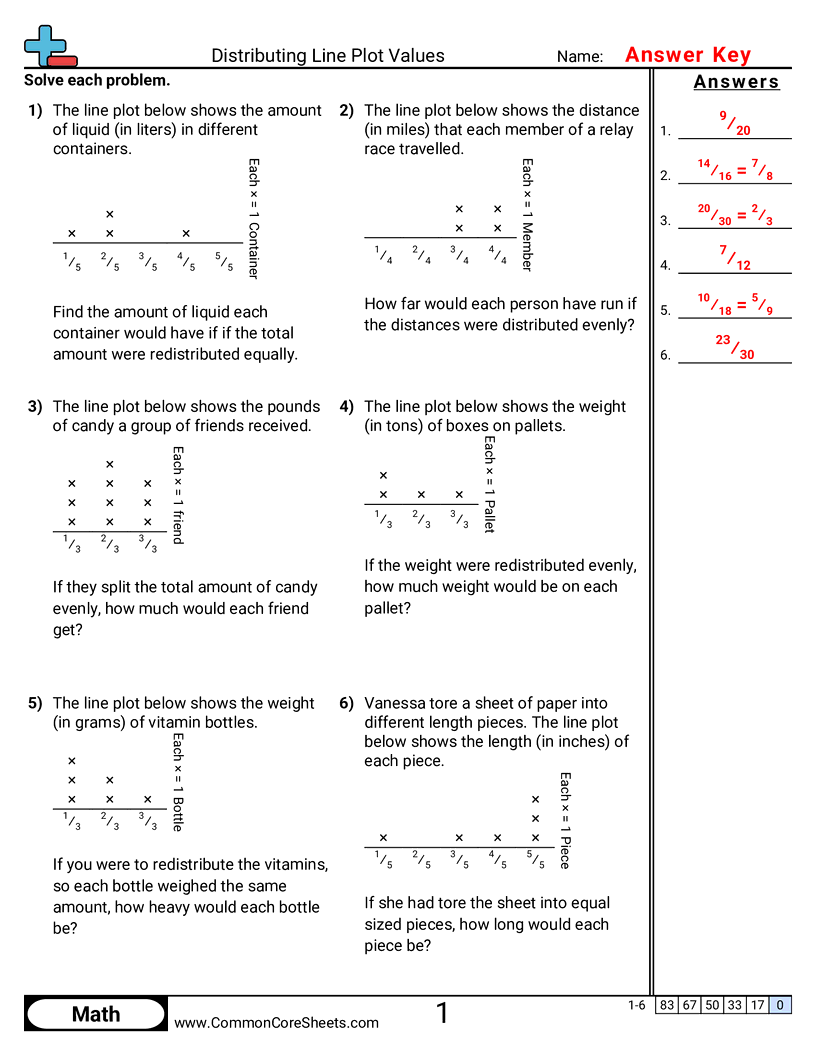
Read a line plot and tell how many data points are at each fraction measurement. Add up fractional measurements from a line plot to find the total amount. Split the total from a line plot into equal shares and figure out how much each share gets. Use the data on a line plot to answer questions about how the measurements are distributed.
5md2
Split a group of objects into equal parts and describe each part as a fraction of the whole. Combine fractional parts to make a whole or a larger fraction when you regroup the pieces. Use pictures or models to show how the same total can be redistributed into different fractional groups.
5nf3
Use the numbers in a word problem to decide what goes in the numerator and denominator. Identify which two whole numbers a fraction lies between.
5nf7a
Divide a fraction by a whole number to find how much each equal share is. Use a number line to show the division by splitting a fraction-length segment into equal parts.
5nf7a
Divide a unit fraction (like 1/3 or 1/8) by a whole number. Use a number line to show how a unit fraction is split into equal parts. Write the answer as a fraction and connect it to the number line model.
5nf7b
Divide a whole number by a fraction to find how many fractional parts fit in the whole number. Use a number line to model division by making equal jumps of a fraction and counting the jumps.
5nf7b
Divide a whole number by a unit fraction like 1/2 or 1/4. Use a number line to show equal jumps of a unit fraction and count how many jumps fit in the whole number. Explain the quotient as “how many 1/n parts are in this many wholes.”
5nf4b
Read a fraction product off an area model Match a product to the model that shows it See that the numerators go on different axes Understand why the product is the part shaded twice
You are only seeing5th Grade
See all grades
14 more worksheets in this section
Playwire Advertisement