4th Grade Angles Worksheets
Free angles worksheets with answer key. No login or account needed. From identifying the type of angle, to measuring and drawing angles, we've got you covered. A grading column and quick grade scale maker grading a breeze and a modified pages help with lower level learners or when just introducing a topic. Great for teachers or for homeschool.
Browse Sheets By Problem Type
×
About these worksheets
Students develop angle measurement and classification skills through a variety of hands-on activities. Worksheets cover using protractors to measure and create angles, identifying acute, obtuse, right, and reflex angles, finding missing angles in shapes and straight lines, and working with complementary and supplementary angle pairs. Topics also include estimating angles, finding angles in circles, and solving for variables in angle equations. These resources span fourth through seventh grade standards.
4md6

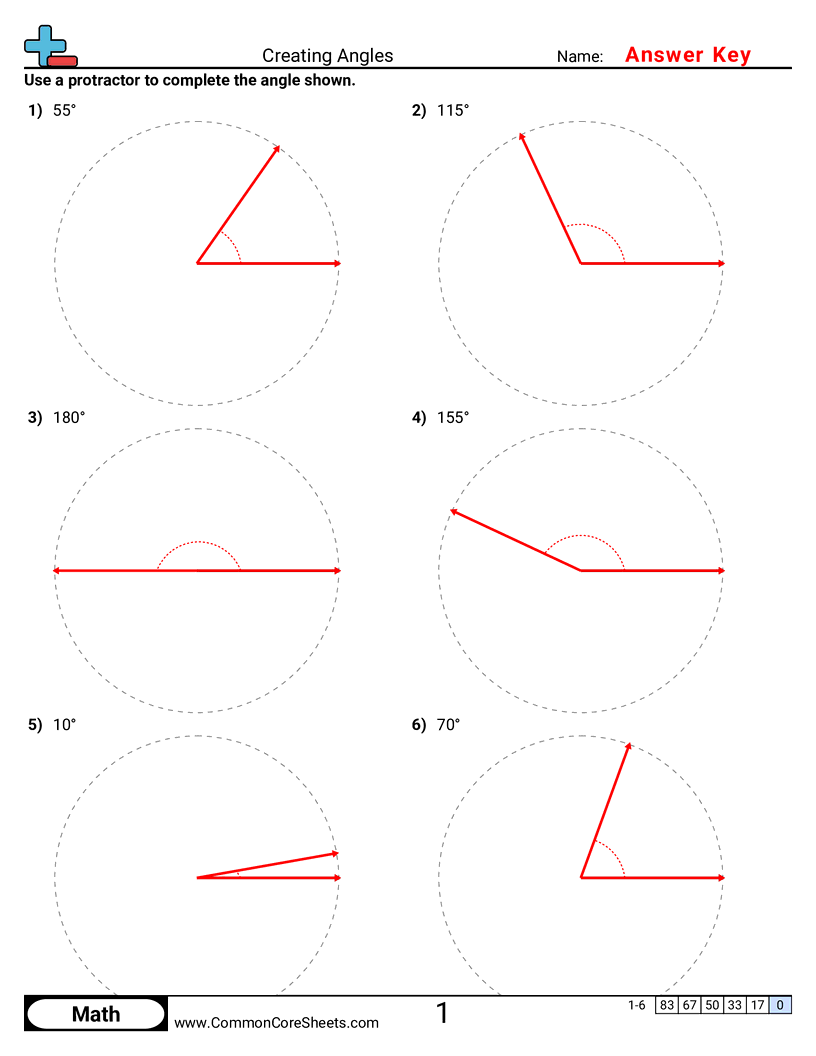
- Use a protractor correctly by lining up the center point and the baseline with a ray.
- Draw an angle with a given number of degrees by marking the correct spot on the protractor and drawing the second ray.
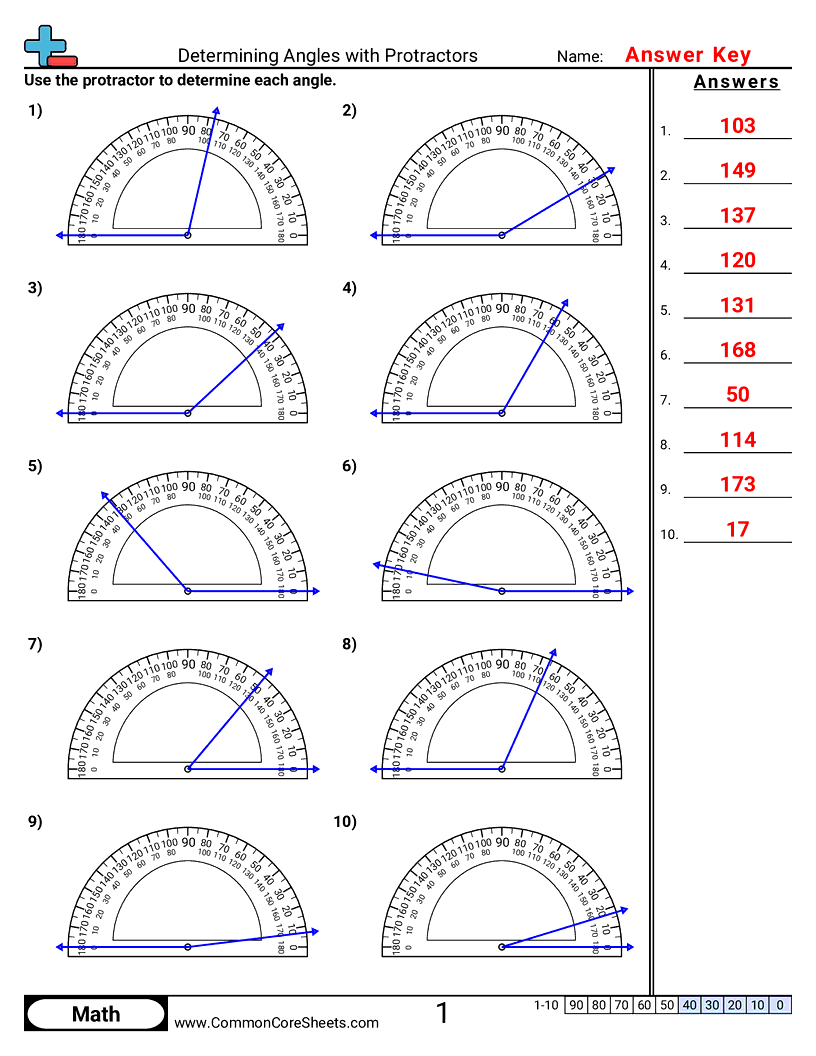
- Read degree measurements on a protractor, including choosing the correct scale.
- Label the vertex and rays of an angle and name the angle you created.
4md5a

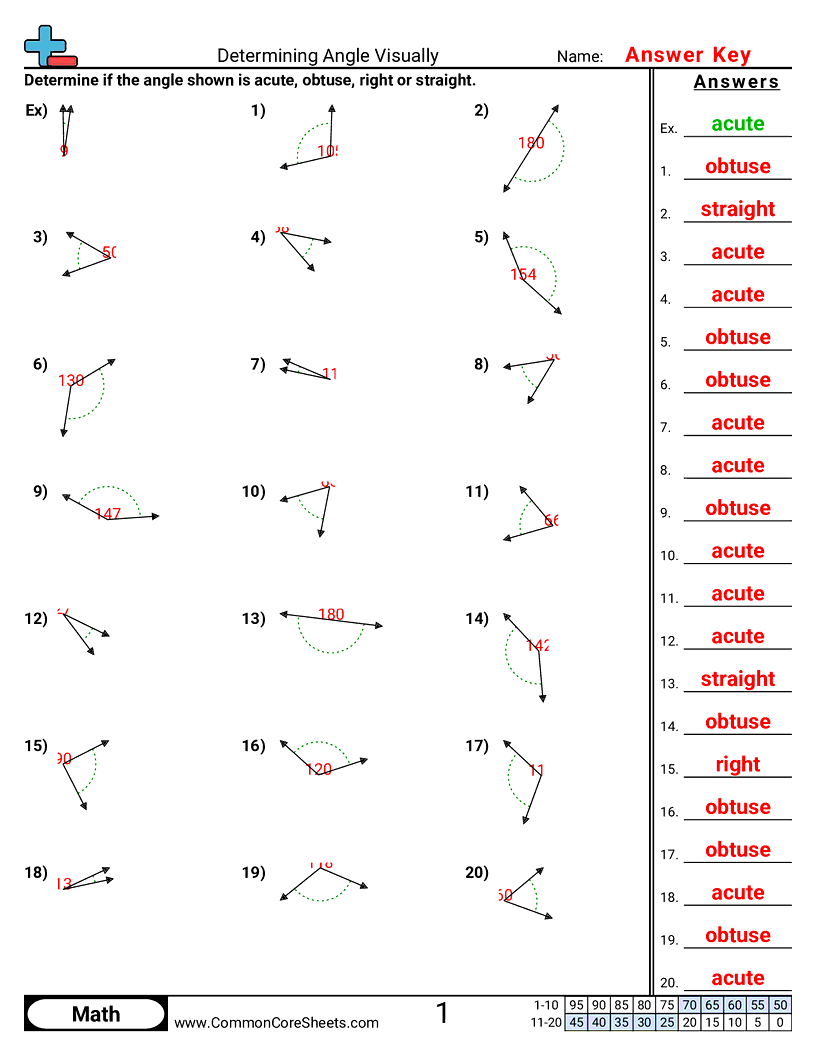
- Look at an angle and decide if it is acute, right, obtuse, or straight.
- Use the degree measure of an angle to help classify it correctly.
- Recognize benchmark angles like 90° and 180° and compare other angles to them.
4g1

- Identify whether an angle is acute, right, obtuse, or straight by looking at it.
- Compare an angle to a right angle as a quick visual benchmark.
- Notice when an angle is smaller than 90°, exactly 90°, between 90° and 180°, or exactly 180°.
- Use the shape and direction of the rays to classify angles even when they are rotated.
4g1

- Decide whether an angle shown is a right angle (90°).
- Tell the difference between right angles and angles that are smaller (acute) or larger (obtuse).
- Recognize that perpendicular lines meet to make a 90° angle.
4g1

- Spot and name acute, right, and obtuse angles in different shapes.
- Count how many of each type of angle a shape has.
- Use the corners (vertices) of a polygon to decide where the angles are.
4md6

- Choose the correct scale on the protractor (inner or outer) to read the angle correctly.
- Read and write the angle measure using the degree symbol (°).
4md6

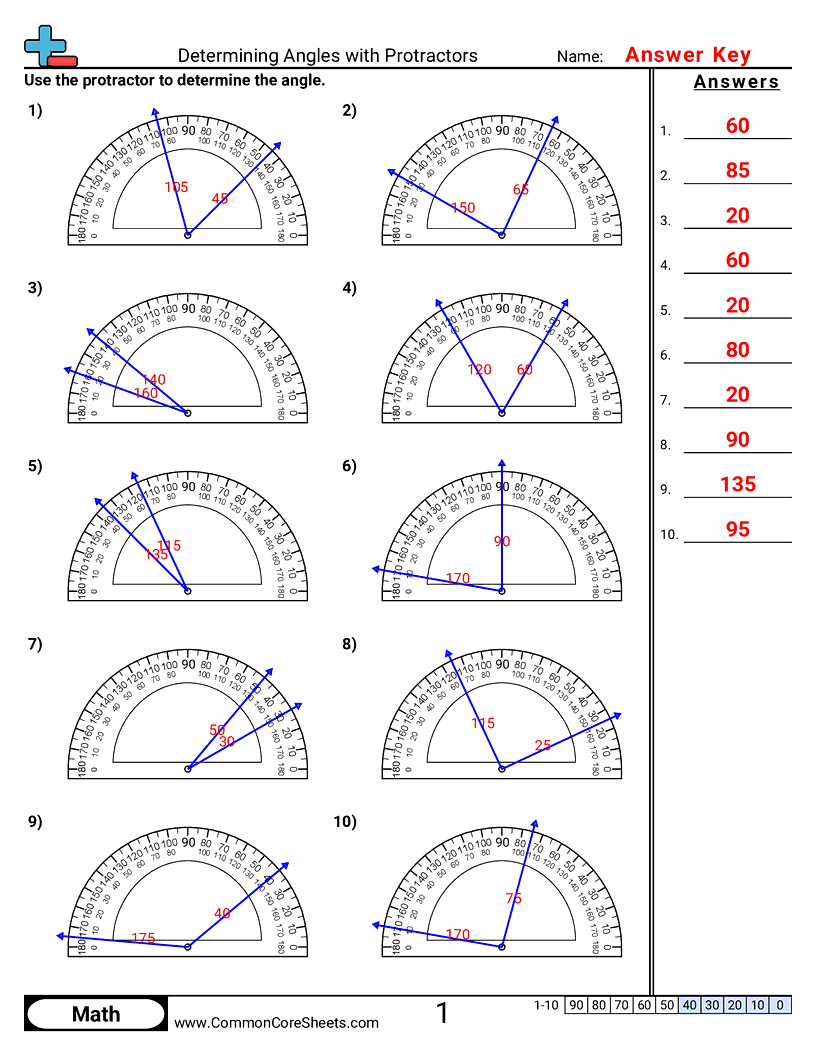
- Learn to choose the correct scale on the protractor when the angle does not start at 0.
- Measure angles in degrees by reading where the other ray crosses the protractor.
- Write the angle measure using the degree symbol (°).
4md5a

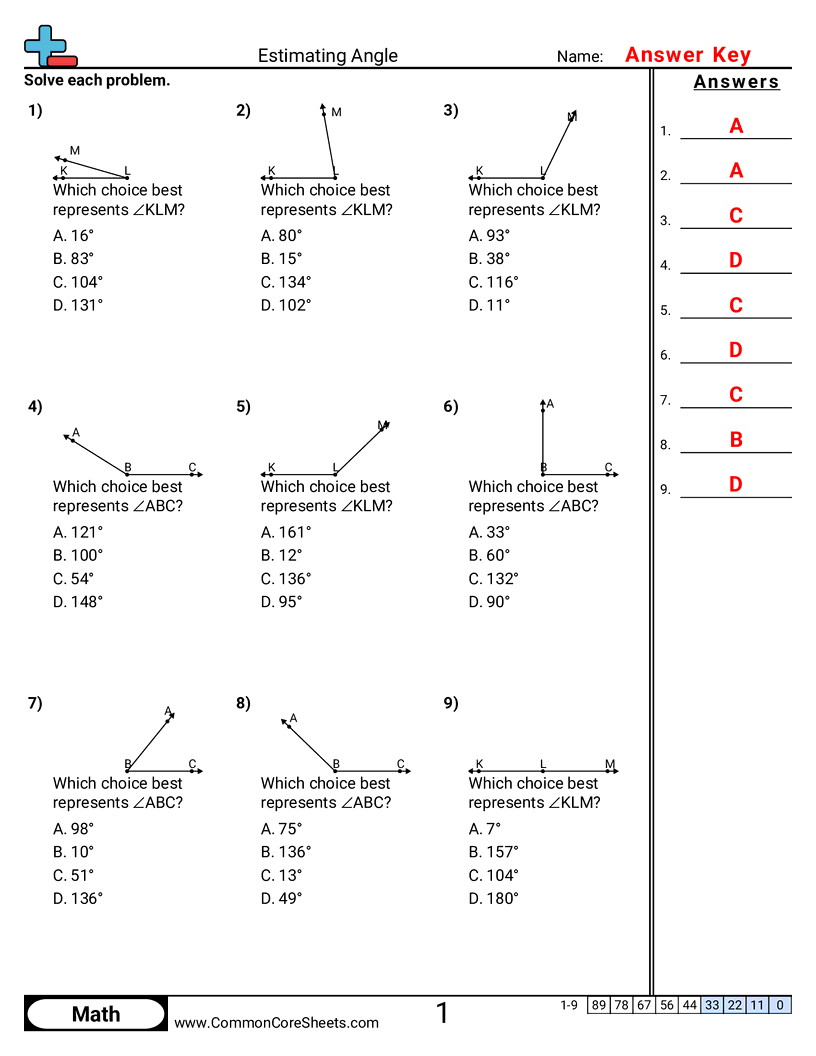
- Look at an angle and make a reasonable guess of its size in degrees.
- Use benchmark angles like 90°, 180°, and 360° to estimate other angles.
- Compare a few degree choices and pick the one that is closest to the angle shown.
4md7

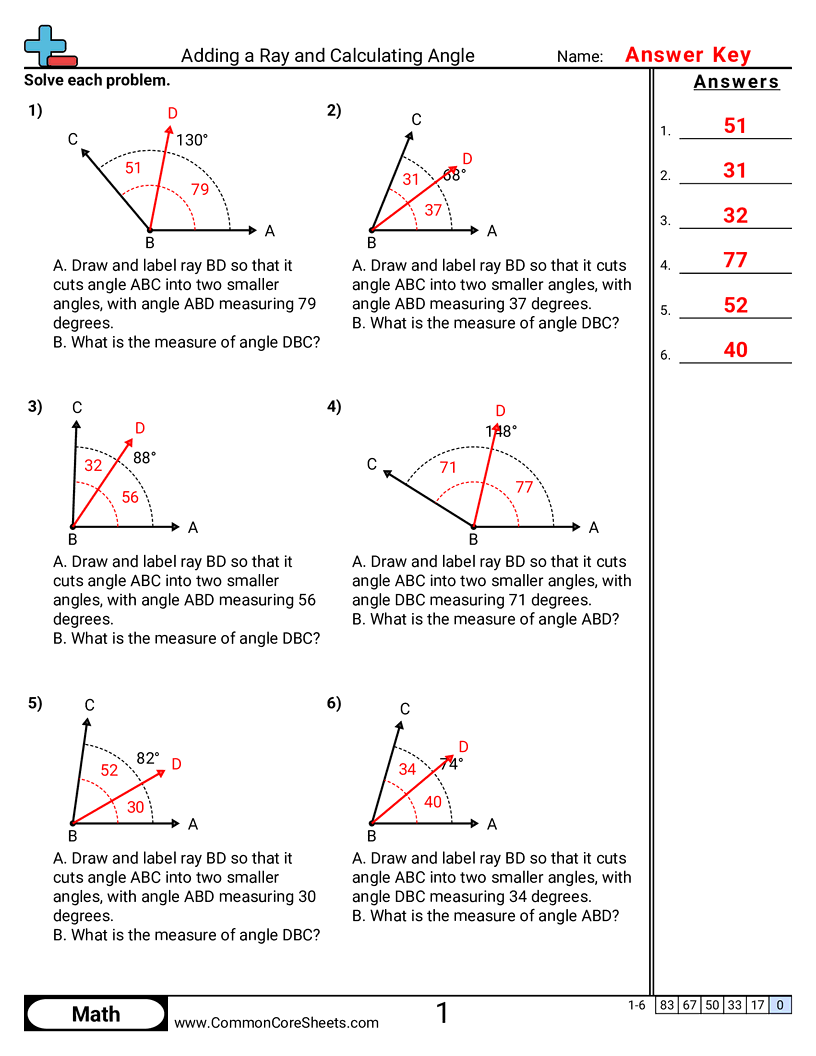
- Practice finding a missing angle when a larger angle is split into two smaller angles
- Subtract a known part from the total angle to find the unknown part
- Read angle diagrams that show how two angles combine to form a bigger angle
4md6

- Learn how to place a protractor correctly by lining up the center on the vertex and the baseline on one ray.
- Practice reading the correct scale on a protractor to measure an angle in degrees.
- Write the angle measure using the degree symbol (°).
About these worksheets
These worksheets focus on precise angle measurement skills. Students practice finding the angle between two points relative to the origin on a coordinate grid and using a protractor to draw a ray and calculate a missing angle. These activities reinforce protractor use and the concept that adjacent angles combine to form a larger angle.
4md7

- Practice drawing a new ray from a vertex at a given degree mark on a protractor.
- Find a missing angle when two adjacent angles make a larger angle.
- Use addition and subtraction with angle measures to figure out the unknown angle.