4md5a×Description:
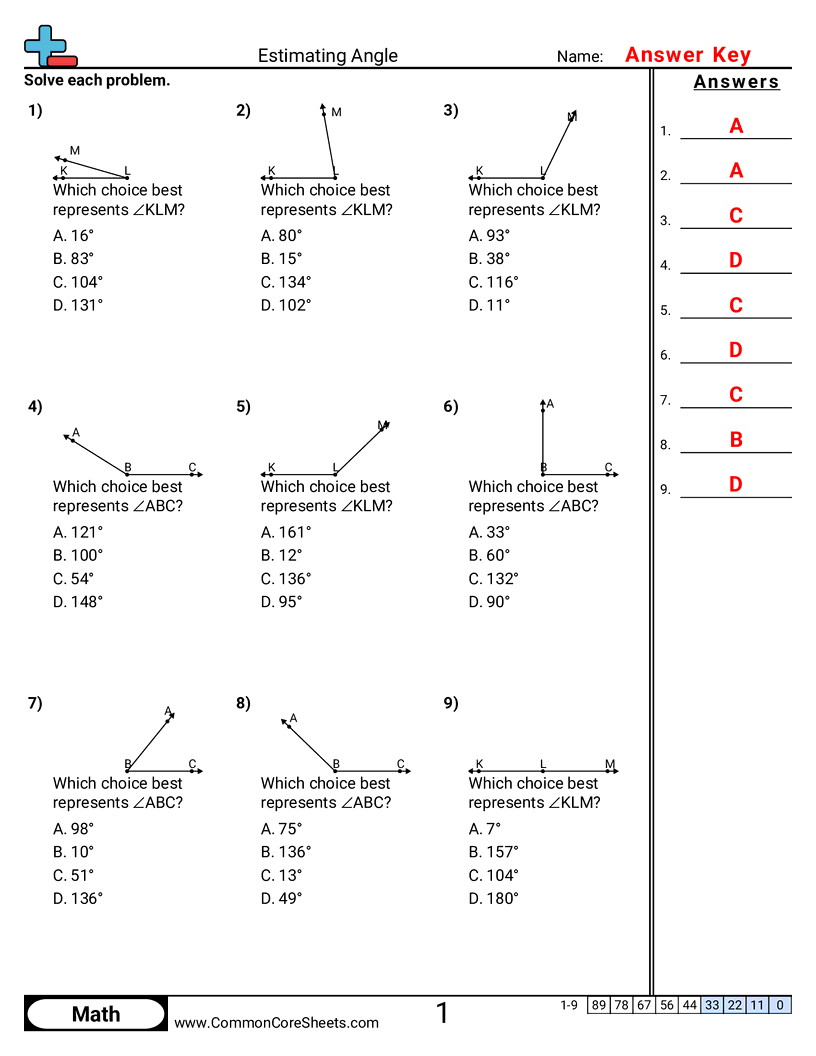
"This worksheet is designed to strengthen children's understanding and skills in estimating angles, associating mathematical knowledge with visual diagrams. With a total of 9 problems, it guides learners through angle interpretation, using labelled diagrams to aid comprehension. The resource is fully customizable to accommodate individual learning speed and level. For flexible usage, this worksheet can be converted to flash cards and complements distance learning platforms, catering to diverse learning environments."
×Student Goals: Master Estimating AnglesAfter completion of the worksheet, students will have developed proficiency in estimating angles. They will demonstrate a strong understanding of how to guess the measure of an angle, an essential skill in mathematics. They will learn how to advantages of their visual perception to estimate the degree of different angles.Understand Angular ConceptsBy successfully finishing the worksheet tasks, learners will gain a clear conceptual understanding of angles. They will grasp the key principle that an angle signifies a measure of rotation or turn, and how this turns are represented in degrees. They will also comprehend the structural formation of angles, by identifying the vertex and the sides.Enhance Problem-solving AbilitiesCompleting the worksheet also assists in enhancing learners' problem-solving abilities in mathematical concepts. They will be faced with myriad problems with varying degrees of difficulty, and being able to solve them improves their problem-solving competence. They will also showcase their ability to analyze problems and make proper estimations, contributing significantly to their general math problem-solving capabilities.Boost Critical ThinkingWorking through the worksheet and successfully completing it boosts students' critical thinking skills. The exercises are crafted in a way that will prompt the pupils to mobilize their thinking, especially when estimating the value of an angle. By doing this repeatedly, they will be promoting their higher-order thinking skills, a vital aspect not only in math but also in other subjects and life’s situations.Application in Real-life SituationsLastly, by finishing the worksheet, learners will learn how to apply the skill of angle estimation in real-life scenarios. Angles are everywhere, from ramp slopes, staircases, clocks, to sectors of a circle. Their newfound ability to estimate angles might come into play in everyday scenarios such as planning the angle to kick a ball in a soccer match or evaluating the steepness of a hill while hiking. This practicality of the skills they learn contributes to their comprehensive learning process.