Determining Angle Visually: Determining Visually Worksheet Download
Free 4th Grade (4g1) math worksheets on Determining Angle Visually . Each worksheet has 20 problems with an answer key and are ideal for teachers and homeschooling. You can download the PDF, create a set of flash cards or set it up for online learning.
Select a Different Activity
>


Sheet Information >
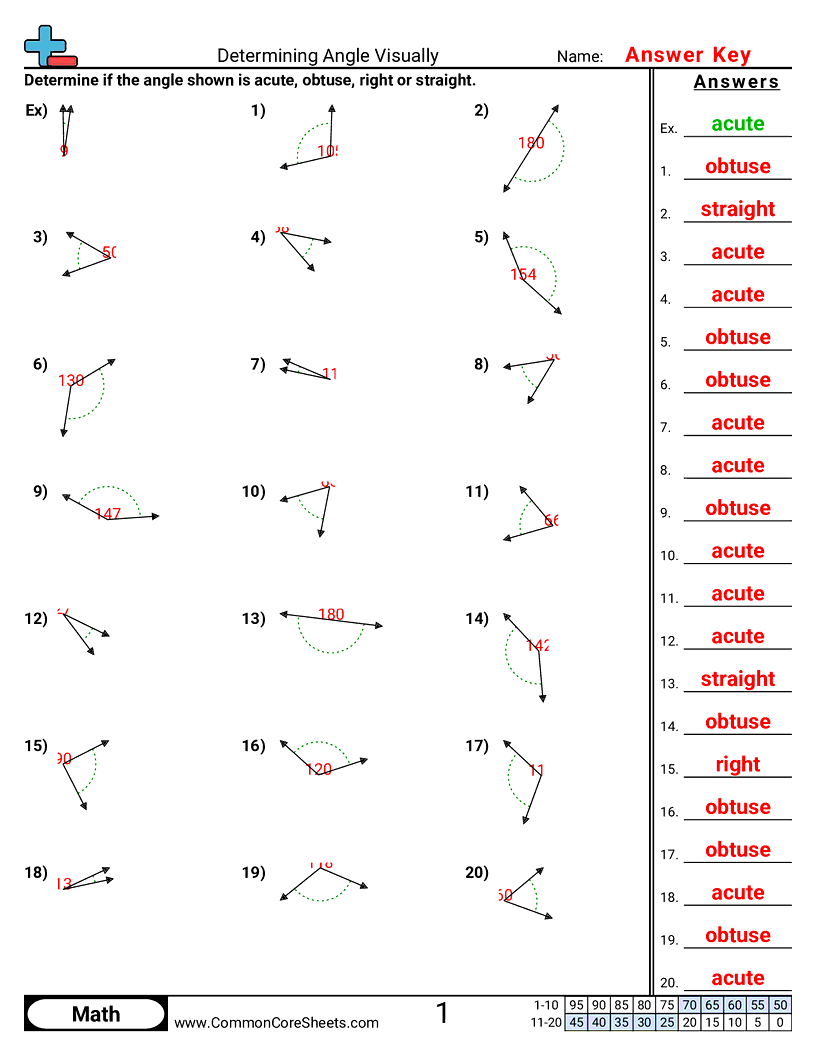
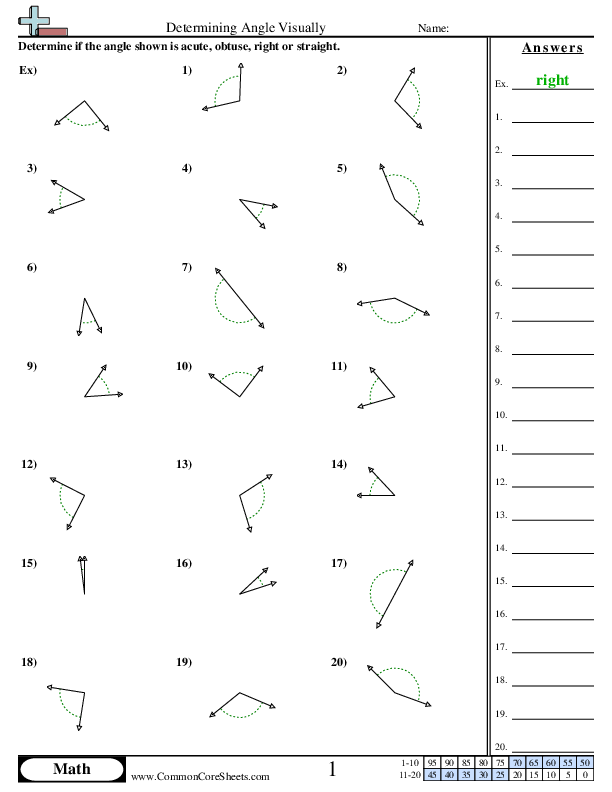
About this worksheet
Each worksheet has 20 problems determining if an angle is acute, obtuse, straight or right.
This worksheet is designed to help children in understanding and determining angles visually. It contains 20 unique problems aimed to enhance students' math skills, focusing specifically on angle calculation. Each problem features SVG graphics that simplify the learning process and captivate pupils' interest. The teacher can customize these problems, convert them into flashcards, or integrate into distance learning. It's an ideal tool to enhance online math education.
Student objectives
- Identify whether an angle is acute, right, obtuse, or straight by looking at it.
- Compare an angle to a right angle as a quick visual benchmark.
- Notice when an angle is smaller than 90°, exactly 90°, between 90° and 180°, or exactly 180°.
- Use the shape and direction of the rays to classify angles even when they are rotated.
Everyday practice
- Decide if a door is opened a little, halfway, or flat against the wall by judging the angle.
- Look at the hands on an analog clock and tell if the angle between them is acute, right, obtuse, or straight.
- Check whether a picture frame or book corner looks like a right angle when you set it down.
- Notice whether the bend in your elbow or knee is an acute or obtuse angle during sports or stretching.
- Look at the angle of a laptop screen and tell if it’s less than, about, or more than a right angle.