short sentence Multiplication Worksheets
Our short sentence multiplication worksheets provide concise, easy-to-understand problems that help students practice essential multiplication concepts. These worksheets feature clear, simple language that makes learning multiplication accessible and builds confidence through straightforward problem-solving exercises.
About these worksheets
These worksheets build the prerequisite skills students need before formal multiplication. Activities include writing arrays as addition and multiplication equations, doubling and halving numbers, partitioning rectangles into rows and columns, multiplying by multiples of ten, rewriting repeated addition as multiplication, using number lines, reading multiplication tables for patterns, estimating reasonable products, and interpreting multiplication in word problems. Resources span second through fourth grade.
Partitioning Rectangles
- Count how many equal boxes are made when a rectangle is split into rows and columns.
- Use rows × columns to find the total number of boxes in a rectangular grid.
- Read a partitioned rectangle and describe it using the number of rows and columns.
Interpreting Multiplication Problems
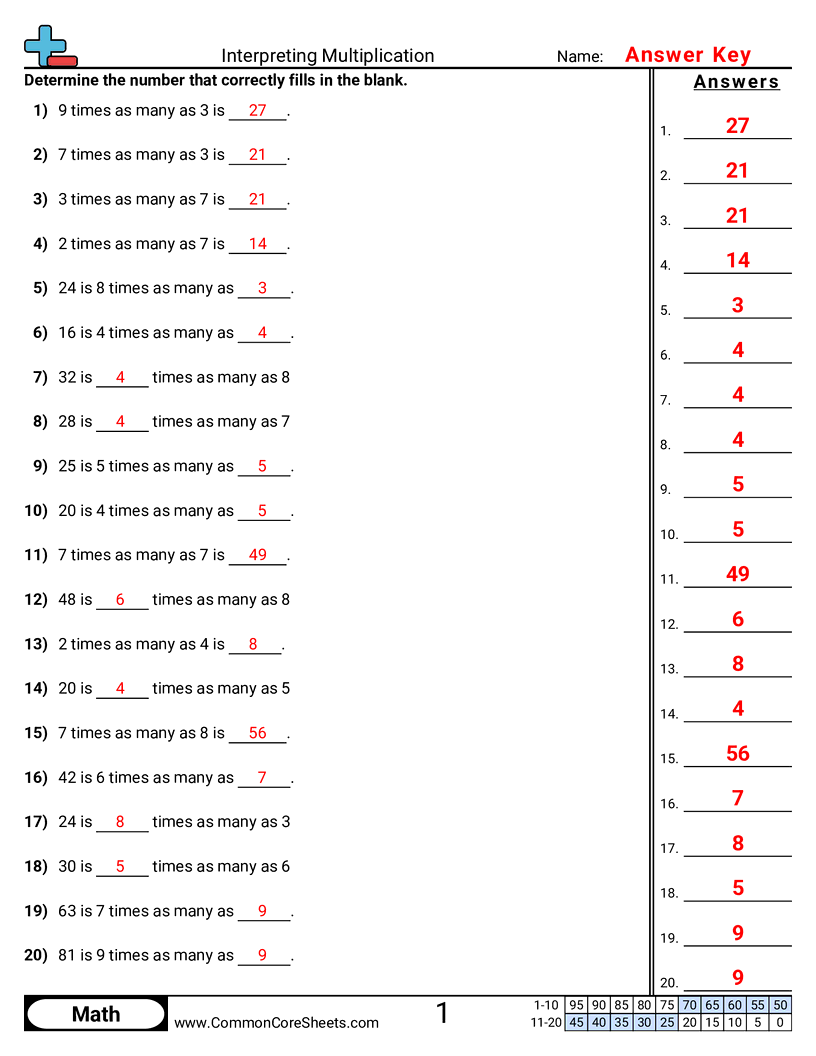
- Read a word problem and decide what the multiplication is really asking.
- Identify the two factors in a situation (how many groups and how many in each group).
About these worksheets
Students practice multiplying with multiples of ten across increasing complexity levels. Worksheets cover single-digit times multiples of ten, two-digit times multiples of ten, multiplying by 10s and 100s, and multiplying when both factors are multiples of ten. These activities reinforce place value patterns in multiplication. Aligned with third through fifth grade.
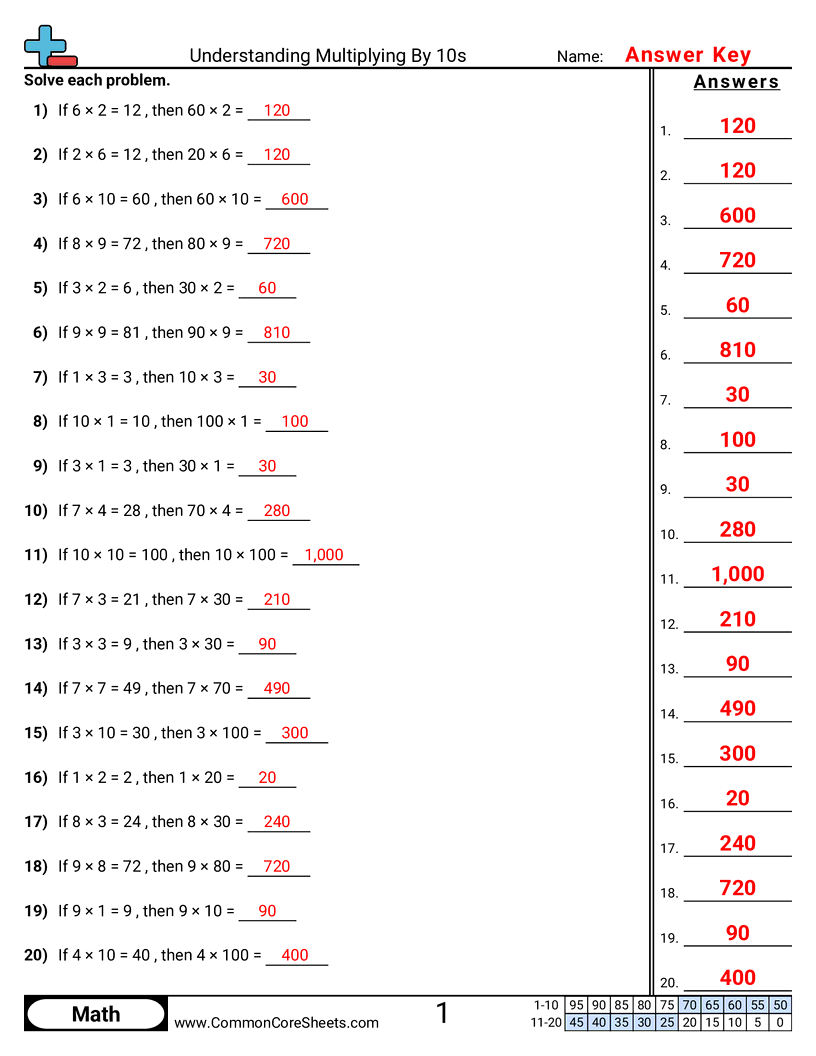
Understanding Multiplying By 10s
- Multiply a one-digit number by 10, 20, 30, and other tens numbers.
- Use place value to see why multiplying by a multiple of 10 makes the number bigger in a predictable way.
- Use the pattern of adding a zero (or shifting digits left) to solve these problems quickly in your head.
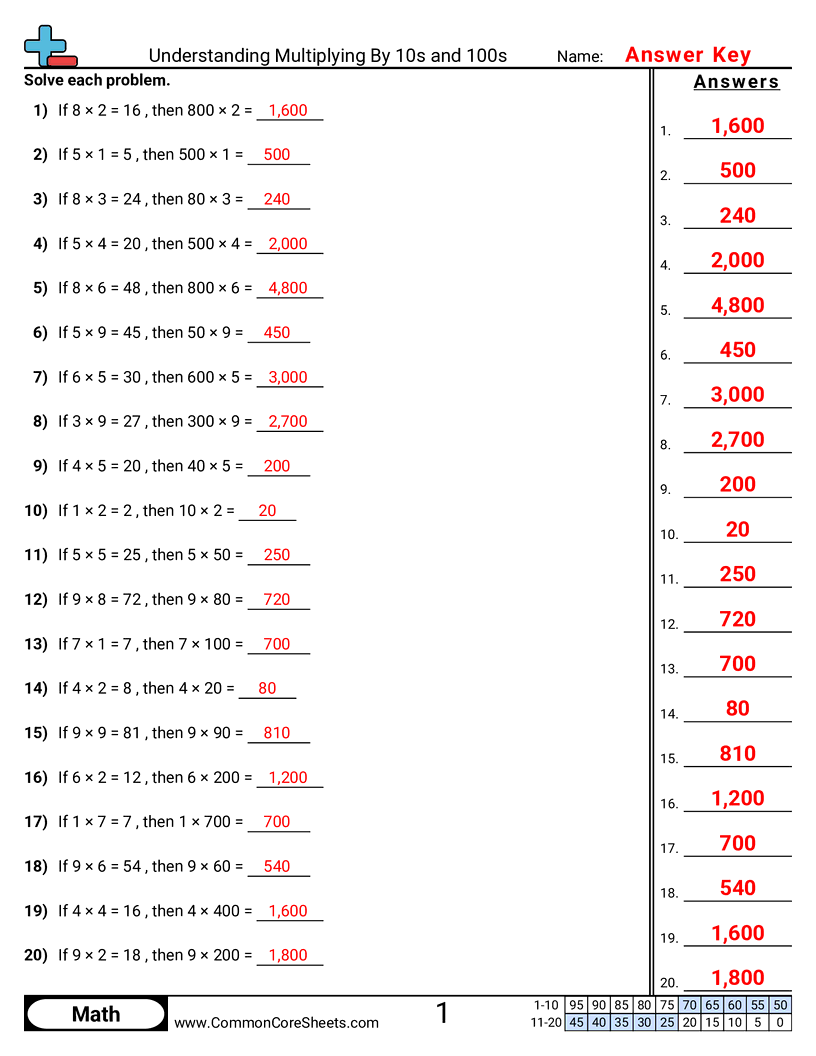
Understanding Multiplying by 10s & 100s
- Multiply a one-digit number by tens and hundreds.
- Use place value to see how multiplying by 10 or 100 changes the digits.
- Write products correctly with the right number of zeros.
Understanding Multiplying by 10s, 100s & 1,000s
- Multiply a one-digit number by 10, 100, or 1,000.
- Use place value patterns to see how the digits shift when you multiply by powers of 10.
- Spot and use patterns in a set of related multiplication facts (like 6×10, 6×100, 6×1,000).
About these worksheets
These worksheets develop students' understanding of multiples, factors, and prime numbers. Activities include identifying multiples of a number, using divisibility rules for 2, 3, 5, 6, 9, and 10, finding the least common multiple of two numbers, and determining prime factorizations. Aligned with fourth and sixth grade standards.
Multiples within 100
- Recognize which numbers are multiples of a given number up to 100.
- Decide if a number is divisible by another number using multiplication facts.
Finding Multiples
- Use multiple rules (multiples of 3 have digits that add to 3, multiples of 5 end in 5 or 0, etc) to determine if a number is a multiple of another number.
- Use multiplication facts to decide which numbers are multiples of a given number.
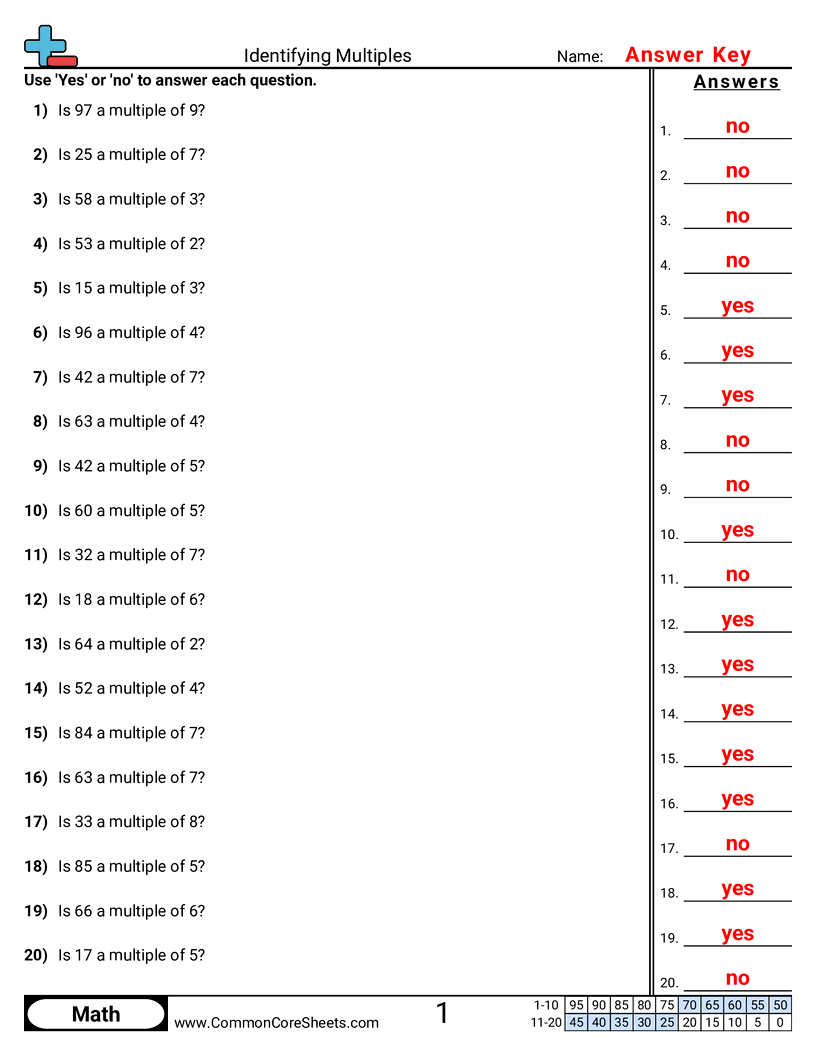
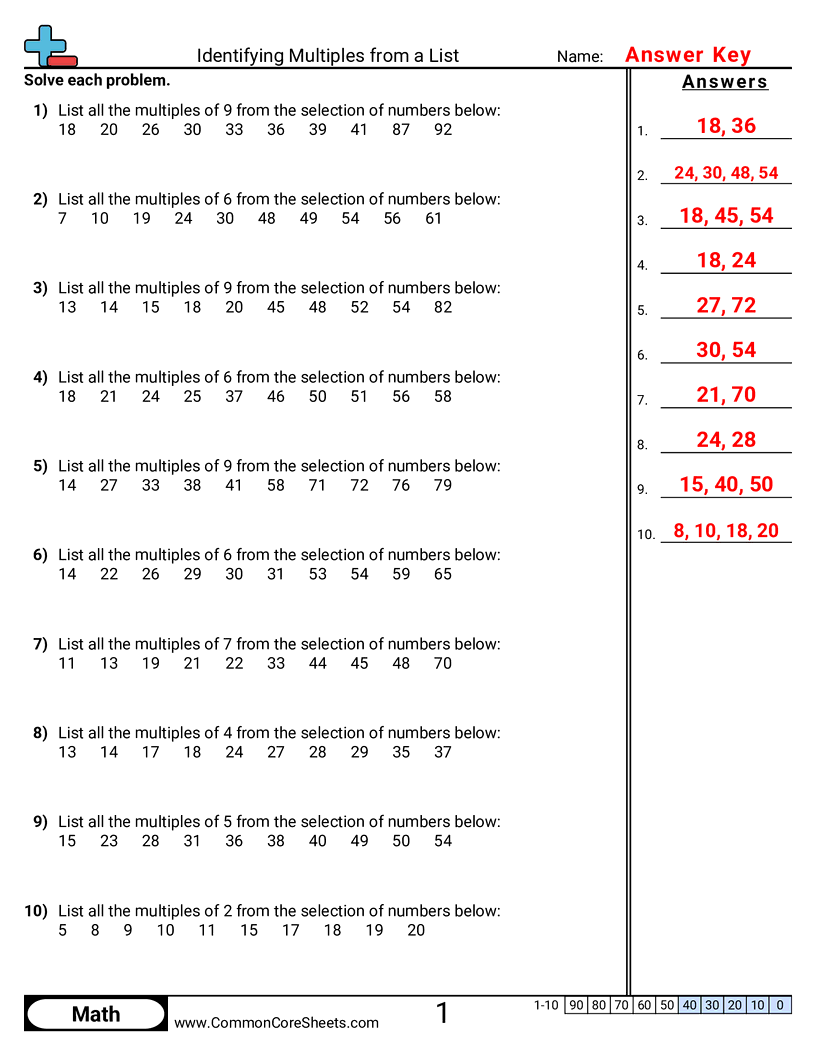
Identifying Multiples from a List
- Pick out which numbers in a group are multiples of a given number.
- Use skip-counting to check whether a number is a multiple.
- Decide if one number is divisible by another without doing long division.
- Connect multiples to multiplication facts you already know.