Texas Horned Lizard Worksheet Download
Free reading worksheets on Texas Horned Lizard. Each worksheet has 20 problems with an answer key and are ideal for teachers and homeschooling. You can download the PDF, create a set of flash cards or set it up for online learning.


Sheet Information >
Available at 2nd grade, 3rd grade, 4th grade, 5th grade and 6th grade reading levels.
Read the passage
Hey there, have you ever heard of the Texas horned lizard? This amazing creature is a small, spiky reptile that lives in the southern United States and Mexico. They have a unique look with two big horns on their head, and they can change their body color to blend in with their surroundings.
Let's talk about what Texas horned lizards like to eat and their life cycle. These fascinating creatures love to munch on ants, especially the tasty harvester ant. Their life cycle starts as an egg, then they hatch into tiny lizards, grow up, and lay eggs of their own.
Texas horned lizards have interesting relationships with humans and other animals. They are considered helpful to humans because they eat bugs that can be harmful to plants and crops. Their main defense against predators, like hawks and snakes, is to squirt blood from their eyes to scare them away. How cool is that?
So, next time you see a Texas horned lizard, remember they are our little spiky friends who help us out by eating pesky bugs!
Hey kids, let's learn about the amazing Texas horned lizard! This cool creature has a flat, round body covered in spiky scales, and two big horns on its head. They come in different shades of brown, which helps them blend in with their surroundings. These lizards can be found in the southwestern United States and Mexico, living in dry, sandy areas with lots of rocks and plants.
Now, let's talk about what Texas horned lizards like to eat. Their favorite food is ants, but they also eat beetles, spiders, and other small insects. When it comes to their life cycle, these lizards lay eggs, and the baby lizards are called hatchlings. As they grow up, they have to be careful of predators like birds, snakes, and even other lizards.
Lastly, let's discover how Texas horned lizards interact with humans and other animals. These lizards are not dangerous to humans, but they do have some unique ways to defend themselves against predators. One of their coolest tricks is squirting blood from their eyes, which can confuse and scare away their enemies. So, remember, while Texas horned lizards might look a bit scary, they're actually fascinating creatures that play an important role in their ecosystem.
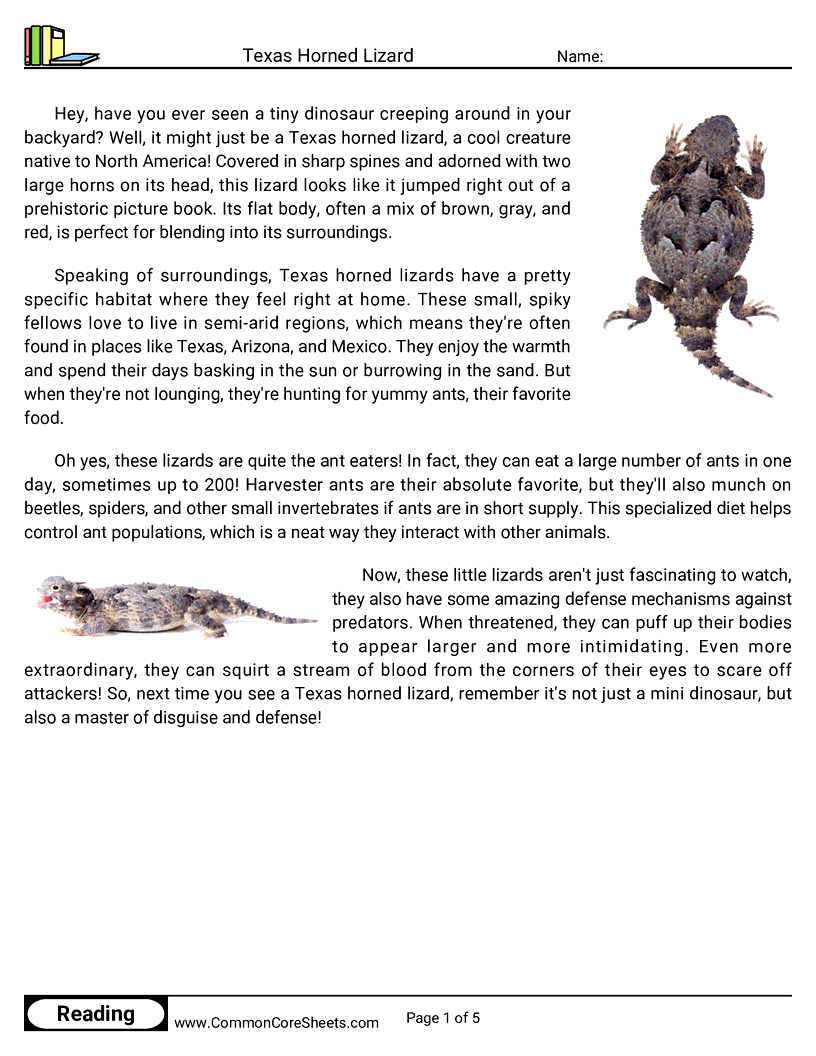
Hey, have you ever seen a tiny dinosaur creeping around in your backyard? Well, it might just be a Texas horned lizard, a cool creature native to North America! Covered in sharp spines and adorned with two large horns on its head, this lizard looks like it jumped right out of a prehistoric picture book. Its flat body, often a mix of brown, gray, and red, is perfect for blending into its surroundings.
Speaking of surroundings, Texas horned lizards have a pretty specific habitat where they feel right at home. These small, spiky fellows love to live in semi-arid regions, which means they're often found in places like Texas, Arizona, and Mexico. They enjoy the warmth and spend their days basking in the sun or burrowing in the sand. But when they're not lounging, they're hunting for yummy ants, their favorite food.
Oh yes, these lizards are quite the ant eaters! In fact, they can eat a large number of ants in one day, sometimes up to 200! Harvester ants are their absolute favorite, but they'll also munch on beetles, spiders, and other small invertebrates if ants are in short supply. This specialized diet helps control ant populations, which is a neat way they interact with other animals.
Now, these little lizards aren't just fascinating to watch, they also have some amazing defense mechanisms against predators. When threatened, they can puff up their bodies to appear larger and more intimidating. Even more extraordinary, they can squirt a stream of blood from the corners of their eyes to scare off attackers! So, next time you see a Texas horned lizard, remember it's not just a mini dinosaur, but also a master of disguise and defense!
Let's learn about the Texas horned lizard, a fascinating little creature found mainly in the southwestern United States. These lizards are known for their unique appearance, with small horns on their heads and spines on their bodies. They can grow up to 4 inches long and are usually brown or gray, which helps them blend in with their surroundings. Their coloration and spiky appearance make them look like miniature dinosaurs!
The Texas horned lizard has a very specific habitat where it thrives. These lizards are found in arid and semiarid regions, such as deserts, grasslands, and scrublands. Their ideal home is somewhere with loose soil, so they can easily dig burrows for shelter. These burrows help them stay cool during the hot days and warm during the cold nights.
Now let's talk about what the Texas horned lizard likes to eat. Their main food source is ants, especially harvester ants. They also eat other insects like beetles, grasshoppers, and spiders. By eating these insects, the Texas horned lizard plays an important role in controlling insect populations in their environment.
The life cycle of the Texas horned lizard is fascinating as well. These lizards lay eggs, usually between 10 and 30, which they bury in the sand. After about 45-60 days, the eggs hatch and the baby lizards, called hatchlings, emerge and start their lives. They grow quickly and can live up to 5 years in the wild.
Lastly, let's explore their relationship with humans and other animals. Texas horned lizards are not dangerous to humans and are often considered friendly by those who encounter them. However, they do have an interesting defense mechanism called 'blood-squirting' to scare away predators like birds or larger lizards. Despite their tough appearance, they are still preyed upon by animals like snakes, birds, and even some mammals.
In conclusion, the Texas horned lizard is a fascinating and unique species that plays an important role in its ecosystem. By learning more about them, we can better appreciate and conserve these amazing creatures.
Have you ever heard of the Texas Horned Lizard? It's a fascinating reptile that can be found in the southwestern United States and Mexico. These lizards are known for their unique appearance, which includes a flat, round body and multiple horn-like spikes on their head. They come in various colors, such as brown, tan, and gray, which help them blend in with their surroundings. Let's dive deeper into the life of this extraordinary creature!
First off, let's talk about what these horned lizards like to eat. Their main source of food is ants, especially harvester ants, but they also eat termites, beetles, and other small insects. Interestingly, they have a specialized tongue that allows them to catch their prey quickly and efficiently. However, they need to eat a lot of ants to stay healthy and maintain their energy levels. In fact, an adult Texas Horned Lizard can eat up to 70 ants in one meal!
Now, let's explore their life cycle and habitat. Texas Horned Lizards live in arid and semiarid regions such as deserts, grasslands, and scrublands. They lay eggs, and after about two months, tiny horned lizards hatch out of the eggs and begin their life journey. As they grow older and reach adulthood, they will find a mate, lay eggs, and continue the cycle. These amazing creatures can live for up to five years in the wild.
Texas Horned Lizards have some pretty cool relationships with humans and other animals. Humans often find them interesting and unique, but it's essential to remember that they are wild animals and should be respected and observed from a distance. As for other animals, horned lizards often share their habitat with various species, such as snakes, birds, and other reptiles. Their main predators are hawks, roadrunners, and snakes, but their impressive defense mechanisms help them stay safe. For example, they can inflate their body to make themselves look bigger and even squirt blood from their eyes to deter predators!
Lastly, let's compare the Texas Horned Lizard to other species. While there are over a dozen species of horned lizards, the Texas Horned Lizard is the largest. Differences between species can be found in their size, color patterns, and the number and arrangement of horns on their head. Some interesting facts about the Texas Horned Lizard are that they are the state reptile of Texas and are sometimes called 'horny toads,' even though they're not toads at all! So, now you know more about the fascinating world of the Texas Horned Lizard and what makes them unique among their relatives.
About this worksheet
Students read a nonfiction passage about the Texas horned lizard and answer comprehension questions about its traits and habits.
This worksheet is designed to enrich children's reading and comprehension skills with a focus on the Texas Horned Lizard. It presents engaging multiple-choice queries regarding the creature's habits, diet, defenses, habitat, and more. With 20 problems to solve, it can be personalized according to the learner's level, converted into flashcards for an interactive experience, or used in a distance learning environment.
Student objectives
- Read a nonfiction passage and understand the main idea
- Find specific facts about the Texas horned lizard in the text
- Learn new vocabulary about animals and their habitats
- Answer questions using details from what you read
Everyday practice
- Read a sign at a zoo or nature center and understand the animal facts
- Look up information about an animal you saw outside
- Talk about a wild animal's diet and how it protects itself
- Pick out important facts while reading a nature book or magazine