Pygmy Shrew Worksheet Download
Free reading worksheets on Pygmy Shrew. Each worksheet has 20 problems with an answer key and are ideal for teachers and homeschooling. You can download the PDF, create a set of flash cards or set it up for online learning.


Sheet Information >
Available at 2nd grade, 3rd grade, 4th grade, 5th grade and 6th grade reading levels.
Read the passage
Hey kids, let's learn about the tiny but fascinating pygmy shrew! These small creatures are one of the world's tiniest mammals, with a body length of only 2 to 2.4 inches and a weight of around 2 to 4 grams. They have a long, pointed nose, tiny eyes, and a tail that's almost as long as their body.
Now let's explore where these little guys live and what they like to eat. Pygmy shrews can be found in a variety of habitats, such as forests, grasslands, and even gardens across Europe and some parts of Asia. These tiny hunters are insectivores, which means they mainly eat insects like beetles, spiders, and ants.
Lastly, let's look at the life of a pygmy shrew and how they interact with other animals and humans. Pygmy shrews have a short life cycle of around 13 to 19 months and are mostly solitary creatures, which means they like to live alone. They don't pose any harm to humans, and their main defense against predators like birds, snakes, and larger mammals is their speedy movement and ability to hide in small spaces.
In conclusion, pygmy shrews are tiny but fascinating creatures with unique characteristics and an interesting way of life.
Let's learn about the tiny but amazing pygmy shrew! Pygmy shrews are one of the smallest mammals in the world, with a body length of about 2 inches. They have a long snout, a furry tail, and big eyes to help them see in the dark. These little creatures can be found in North America, Europe, and Asia, living in forests, grasslands, and even gardens.
Now let's explore the fascinating life cycle and diet of the pygmy shrew. These tiny animals have a short life span of about 1.5 years, and they grow up quickly, becoming adults in just a few months. Pygmy shrews are great hunters, eating insects, spiders, and other small invertebrates. They need to eat constantly, consuming up to three times their body weight in food every day!
Finally, let's look at the pygmy shrew's relationships with humans, other animals, and their unique defenses. Pygmy shrews are usually harmless to humans, but they do have a strong odor that keeps predators like birds and snakes away. These little creatures also have a special relationship with larger animals, like owls and foxes, who help control the insect population by eating the shrews. One interesting fact about pygmy shrews is that they use echolocation, just like bats, to find their way around and hunt for food.
Now that we've learned about the fascinating pygmy shrew, it's easy to see why these tiny creatures are so interesting and important in the animal kingdom.
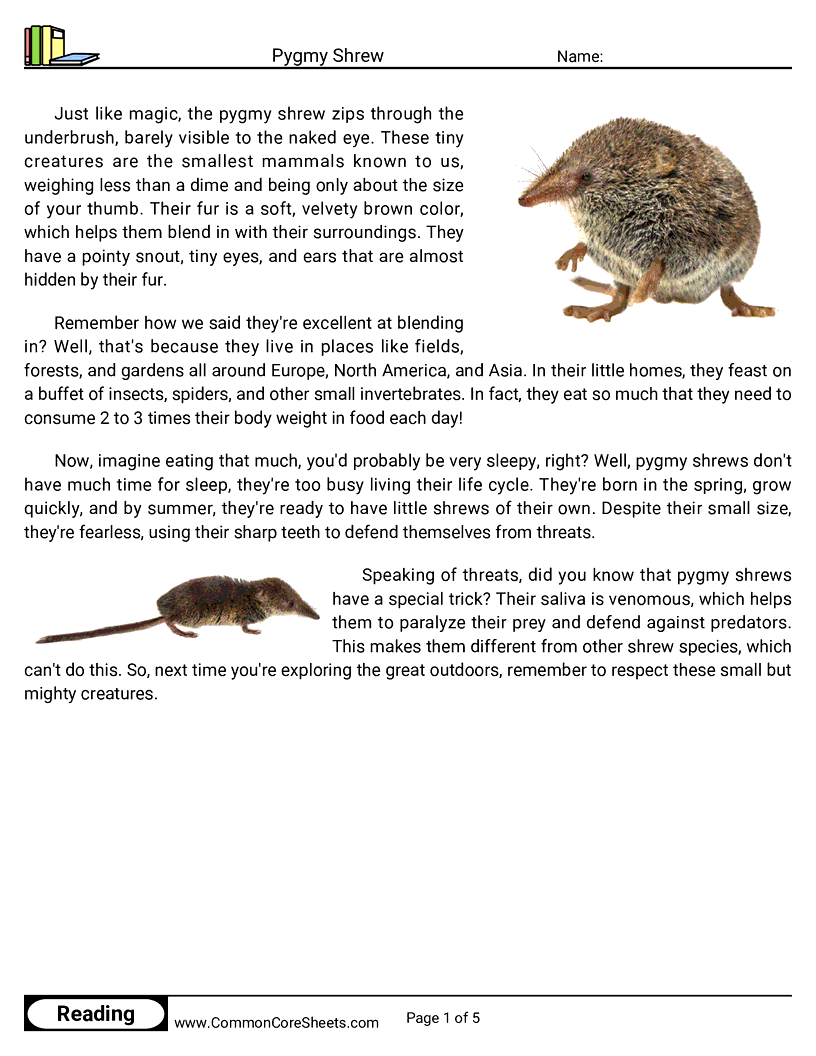
Just like magic, the pygmy shrew zips through the underbrush, barely visible to the naked eye. These tiny creatures are the smallest mammals known to us, weighing less than a dime and being only about the size of your thumb. Their fur is a soft, velvety brown color, which helps them blend in with their surroundings. They have a pointy snout, tiny eyes, and ears that are almost hidden by their fur.
Remember how we said they're excellent at blending in? Well, that's because they live in places like fields, forests, and gardens all around Europe, North America, and Asia. In their little homes, they feast on a buffet of insects, spiders, and other small invertebrates. In fact, they eat so much that they need to consume 2 to 3 times their body weight in food each day!
Now, imagine eating that much, you'd probably be very sleepy, right? Well, pygmy shrews don't have much time for sleep, they're too busy living their life cycle. They're born in the spring, grow quickly, and by summer, they're ready to have little shrews of their own. Despite their small size, they're fearless, using their sharp teeth to defend themselves from threats.
Speaking of threats, did you know that pygmy shrews have a special trick? Their saliva is venomous, which helps them to paralyze their prey and defend against predators. This makes them different from other shrew species, which can't do this. So, next time you're exploring the great outdoors, remember to respect these small but mighty creatures.
Meet the tiny and fascinating pygmy shrew! These small creatures are one of the smallest mammals on Earth, measuring only 2 to 2.5 inches in length. They have a long, pointed snout, short legs, and a tail that is almost as long as their body. Pygmy shrews are not only cute, but they are also very interesting animals that you'll enjoy learning about.
Pygmy shrews have quite the appetite for their size. They eat insects, spiders, worms, and other small invertebrates. They have to eat about 80% of their body weight every day, which means they are constantly hunting for food. These little creatures have a high metabolism, meaning they have to eat a lot to keep their energy levels up.
Let's explore the world of the pygmy shrew and where they call home. These tiny mammals can be found in the United States, Europe, and parts of Asia. They prefer habitats like grasslands, woodlands, and sometimes even gardens. Pygmy shrews like to live in nests made of leaves and grass, which they build under rocks, logs, or in small burrows.
The life cycle of a pygmy shrew is quite fascinating. These mammals have a short life span, living for only about a year to a year and a half in the wild. They reproduce once or twice a year, usually in the spring and summer, with females giving birth to a litter of 3 to 8 babies. The babies grow quickly and are independent within a month, ready to start their own life adventures.
Pygmy shrews have some interesting relationships with other animals and humans. Their small size and quick movements make them difficult to spot, but they do have natural predators like birds, snakes, and larger mammals. Pygmy shrews are generally harmless to humans and can even be helpful by controlling insect populations. So, if you see one of these tiny creatures in your backyard, remember that they are just going about their busy lives and doing their part in the ecosystem.
In conclusion, pygmy shrews are amazing little animals with fascinating characteristics. Despite their small size, they play an essential role in the ecosystem and are a valuable part of the animal kingdom.
Meet the tiny but mighty pygmy shrew, one of the smallest mammals in the world! These little creatures are so small that they can easily fit in the palm of your hand. They have long, pointy noses, and their fur is usually brown or gray, which helps them blend into their surroundings. Their tails are almost as long as their bodies, and they use them for balance when they are running around. Despite their small size, pygmy shrews are actually quite fast and agile!
Pygmy shrews can be found in various habitats, from forests to grasslands. They are especially common in Europe, Asia, and North America. These tiny mammals prefer living in areas with plenty of leaf litter and undergrowth, which provides them with shelter and protection from predators. They also like damp environments, as this helps them to find their favorite food - insects. In fact, they can be found near streams, ponds, and marshes where insects are abundant.
When it comes to their diet, pygmy shrews are insectivores, meaning they eat insects. Some of their favorite snacks include beetles, ants, spiders, and even small slugs. These tiny creatures have a huge appetite and need to eat constantly to keep up their energy levels. In fact, they eat an amount equal to their own body weight every single day! To catch their prey, pygmy shrews use their sharp teeth and quick reflexes, often hunting during the day and night.
Pygmy shrews have a fascinating life cycle, starting with their birth. The mother gives birth to a litter of 3 to 8 babies after a short gestation period of about 24 days. The babies are born blind and helpless, but they grow quickly, opening their eyes and becoming independent in just a few weeks. Pygmy shrews have a short lifespan, typically living for only 12 to 18 months. During this time, they focus on eating, growing, and reproducing to ensure the survival of their species.
Lastly, let's explore the pygmy shrew's relationship with humans and other animals. These tiny mammals are generally harmless to humans and are rarely seen due to their secretive nature. However, they do play an important role in the ecosystem by keeping insect populations in check. In terms of predators, pygmy shrews have to watch out for larger animals like birds, snakes, and even other mammals such as foxes. Their main defense mechanism is their speed, agility, and ability to hide in small spaces that predators can't reach.
In conclusion, pygmy shrews are fascinating, tiny mammals that play an important role in our ecosystems.
About this worksheet
Students read a passage about the pygmy shrew and answer questions to show they understood the key details.
This worksheet is designed to enhance children’s reading and comprehension skills through 20 targeted questions about Pygmy Shrews. Examining their unique characteristics, diet, and environment, this versatile worksheet can be customized, used for distance learning, or converted into flashcards, making it adaptable for various teaching and learning styles.
Student objectives
- Read a nonfiction passage about the pygmy shrew
- Find and recall facts stated in the text
- Answer questions using details from what you read
- Learn new words about a small mammal and its habitat
Everyday practice
- Read a fact card about an animal at the zoo and remember what it eats
- Answer a friend's questions about an animal you just read about
- Look up details about a pet or wild animal in a nature book
- Explain something interesting you learned about an animal to a family member