Green Anole Worksheet Download
Free reading worksheets on Green Anole. Each worksheet has 20 problems with an answer key and are ideal for teachers and homeschooling. You can download the PDF, create a set of flash cards or set it up for online learning.


Sheet Information >
Available at 2nd grade, 3rd grade, 4th grade, 5th grade and 6th grade reading levels.
Read the passage
Meet the green anole, a small and fascinating lizard that's a delight to observe in the wild! These little reptiles can change color from green to brown, depending on their mood and surroundings. Green anoles are native to the southeastern United States, but can also be found in some Caribbean islands.
Green anoles have some interesting eating habits, life cycles, and relationships with humans and other animals. They mainly eat insects like crickets, ants, and spiders, but they also munch on fruit and nectar from flowers. Their life cycle starts as an egg, hatches into a tiny baby anole, and grows into an adult that can live 2-8 years. Humans often enjoy watching green anoles in their backyard, while other animals such as birds and snakes see them as a tasty snack!
When it comes to defending themselves, green anoles have some unique tricks up their sleeves. Their ability to change color helps them blend in with their environment, making it harder for predators to spot them. They can also detach their tails to escape a predator's grasp, but don't worry, the tail will grow back after some time. Although they might look similar to other lizards, green anoles have a special throat fan called a dewlap, which they use to communicate with each other and attract a mate. So, the next time you spot a green anole in the wild, take a moment to appreciate their unique characteristics and fascinating behaviors.
Green anoles are fascinating little lizards that can be found in the southeastern United States. These cool creatures can change color from green to brown, which helps them blend in with their surroundings. They usually live in trees, bushes, and gardens, and love to bask in the sunlight. Green anoles can grow up to 8 inches long, but most of that length is their long, slender tail.
A green anole's diet mainly consists of insects and other small creatures. They love to eat crickets, flies, spiders, and even small worms. Green anoles have a unique way of catching their prey – they use their sticky tongues to snatch them up! These lizards are also food for other animals like birds, snakes, and even larger lizards.
Green anoles don't just have a special relationship with their environment, but also with humans. Many people enjoy having green anoles as pets because they are relatively easy to care for and fun to watch. These lizards are different from other species because they can change color and have a special flap of skin under their neck called a dewlap, which is used to attract a mate or scare away predators. Green anoles are truly amazing little creatures that play an important role in their ecosystem.
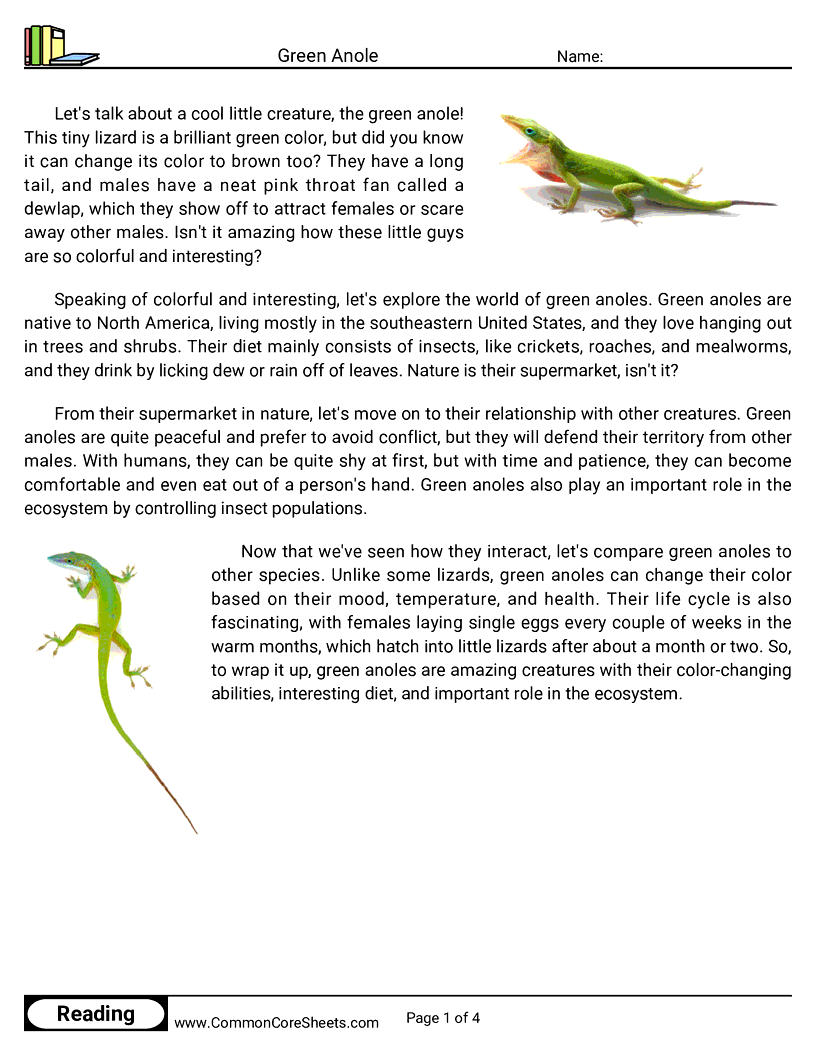
Let's talk about a cool little creature, the green anole! This tiny lizard is a brilliant green color, but did you know it can change its color to brown too? They have a long tail, and males have a neat pink throat fan called a dewlap, which they show off to attract females or scare away other males. Isn't it amazing how these little guys are so colorful and interesting?
Speaking of colorful and interesting, let's explore the world of green anoles. Green anoles are native to North America, living mostly in the southeastern United States, and they love hanging out in trees and shrubs. Their diet mainly consists of insects, like crickets, roaches, and mealworms, and they drink by licking dew or rain off of leaves. Nature is their supermarket, isn't it?
From their supermarket in nature, let's move on to their relationship with other creatures. Green anoles are quite peaceful and prefer to avoid conflict, but they will defend their territory from other males. With humans, they can be quite shy at first, but with time and patience, they can become comfortable and even eat out of a person's hand. Green anoles also play an important role in the ecosystem by controlling insect populations.
Now that we've seen how they interact, let's compare green anoles to other species. Unlike some lizards, green anoles can change their color based on their mood, temperature, and health. Their life cycle is also fascinating, with females laying single eggs every couple of weeks in the warm months, which hatch into little lizards after about a month or two. So, to wrap it up, green anoles are amazing creatures with their color-changing abilities, interesting diet, and important role in the ecosystem.
Green anoles are fascinating little creatures that you might find in your own backyard. These small lizards are native to the southeastern United States and some Caribbean islands, where they can be found in a variety of habitats such as forests, swamps, and even gardens. Their bright green color helps them blend in with leaves and plants, making them masters of camouflage. They are also known as the American chameleon because they can change color depending on their surroundings, mood, or temperature.
One of the most interesting aspects of green anoles is their diet. They are insectivores, which means they primarily eat insects like crickets, grasshoppers, and spiders. Green anoles have a unique way of catching their prey – they use their long, sticky tongues to snatch insects right out of the air. Sometimes, they even eat smaller lizards or moths.
The life cycle of green anoles is a fascinating process to observe. These lizards begin their lives as eggs, which are laid in moist areas such as under leaves, rocks, or logs. After about 5 to 7 weeks, the eggs hatch and tiny baby anoles emerge. These babies grow quickly, reaching adulthood in about 8 months, and can live up to 3 to 5 years in the wild.
Green anoles have a unique relationship with humans and other animals. While they are not considered dangerous to humans, they can be skittish and will bite if they feel threatened. In the wild, green anoles have several predators, such as birds, larger reptiles, and even some mammals. However, they are also known to eat pests like ants and mosquitoes, making them helpful to have around your home.
There are some key differences between green anoles and other species of lizards. One major difference is their ability to change color, which is not very common among other lizards. Green anoles also have adhesive pads on their toes, allowing them to easily climb and stick to surfaces. Lastly, they have a long, slender body and a pointed snout, which sets them apart from their rounder and bulkier cousins.
Now that you've learned all about green anoles, you can impress your friends with your newfound knowledge of these unique and fascinating little lizards. They are an important part of our ecosystem and a great example of nature's adaptability and diversity.
Meet the green anole, a fascinating little lizard that is both charming and captivating. These small, slender reptiles are known for their ability to change color, usually from bright green to brown. They have long tails, large eyes, and a pointed snout, making them easily recognizable. Green anoles are sometimes called the 'American Chameleon' because of their color-changing abilities, although they are not true chameleons. Let's dive deeper into the world of these amazing creatures and learn more about them!
Green anoles can be found all over the southeastern United States, from Texas to Florida. They thrive in a variety of environments, including forests, swamps, and even suburban gardens. Green anoles are arboreal, meaning they spend most of their time in trees and bushes. They have special adhesive pads on their feet that allow them to climb and cling to surfaces easily. This skill helps them stay safe from predators and find their favorite food - insects!
Speaking of food, green anoles are carnivorous creatures that love to snack on insects. Their diet mainly consists of small insects like crickets, flies, and spiders. They use their long, sticky tongue to snatch up their prey quickly and efficiently. Green anoles are also known to eat other small animals like snails and even other smaller lizards! They play an important role in controlling insect populations in their natural habitats.
The life cycle of a green anole begins when a female lays her eggs, usually one at a time, in a hidden spot. The eggs take about 5 to 7 weeks to hatch, and the baby anoles are born fully formed and ready to explore their new world. Green anoles can live for up to 5 years in the wild, but their average lifespan is around 2 to 3 years. Their main predators include birds, snakes, and even larger lizards. To defend themselves, green anoles use their color-changing abilities and speed to escape from danger.
In addition to their unique characteristics, green anoles have a special relationship with humans and other animals. They are often kept as pets and are known for being friendly and easy to care for. In the wild, green anoles play a vital role in their ecosystem by controlling insect populations and providing food for larger predators. Although green anoles are similar to other species of anoles, they can be distinguished by their bright green color, large eyes, and pointed snout. Overall, the green anole is a fascinating creature with many interesting features and an important role in its environment.
About this worksheet
Students read a passage about the green anole lizard and answer questions to show their understanding of the text.
This worksheet is designed to immerse children in the fascinating world of the green anole, a unique lizard species, through interactive, reading-based problems. Topics include behavior, physical attributes, survival mechanisms, and life cycle. Customize to your needs, conveniently convert into flashcards, or integrate into your distance learning curriculum to enrich wildlife education.
Student objectives
- Read a nonfiction passage about green anoles carefully
- Find answers to questions using details from the text
- Understand new facts about how green anoles live and behave
- Practice explaining what you read in your own words
Everyday practice
- Read a fact sheet at a reptile exhibit and tell a friend what you learned
- Look up information about a pet lizard before getting one
- Answer questions after reading an article for school
- Share interesting animal facts you found in a book