Capacity Worksheets
Free capacity worksheets with answer key. No login or account needed. From visually identifying capacity to solving capacity word problems, we've got you covered. A grading column and quick grade scale maker grading a breeze and a modified pages help with lower level learners or when just introducing a topic. Great for teachers or for homeschool. Great for teachers or for homeschool.
Browse Sheets By Problem Type
×
About these worksheets
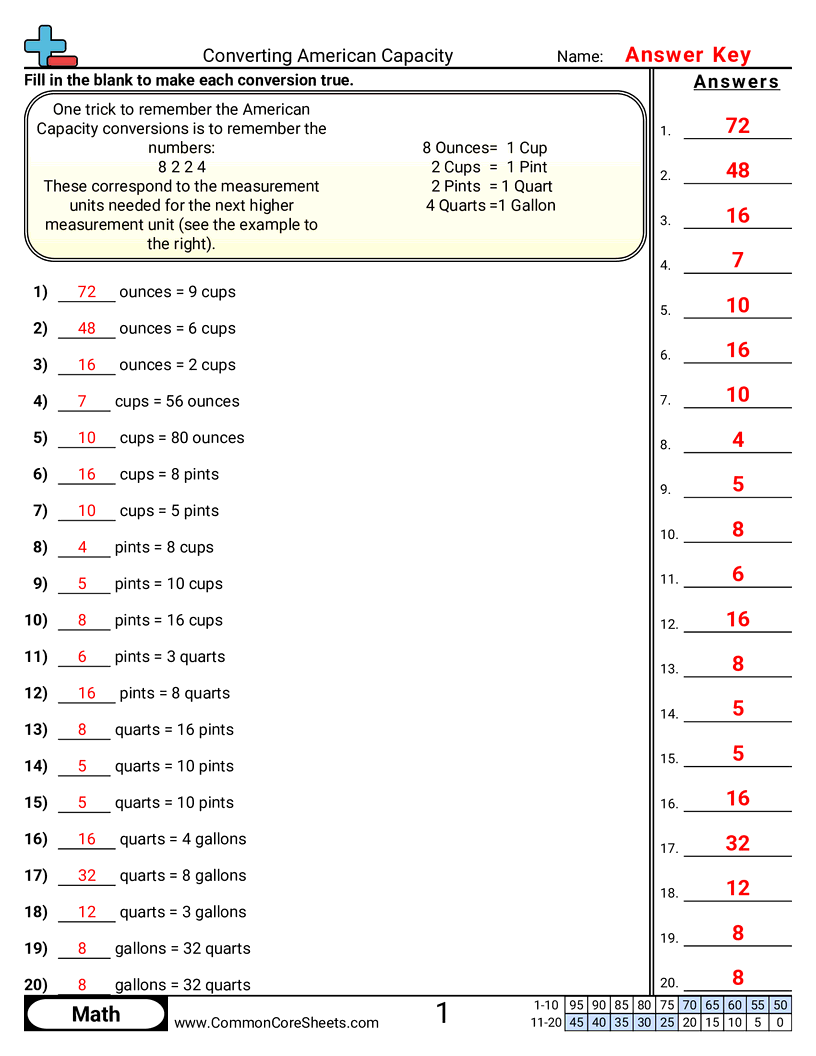
Students practice estimating and converting U.S. customary capacity units including cups, pints, quarts, gallons, and fluid ounces. Worksheets include matching real-world containers to appropriate units, choosing the best unit for a given situation, converting between units, and working with mixed measurements. Aligned with fourth and fifth grade measurement standards.
4md1

- Match everyday containers to the best U.S. capacity unit (cup, pint, quart, gallon, or fluid ounce).
- Use pictures to judge whether something holds a little, some, or a lot of liquid.
- Get familiar with what common amounts like 1 cup, 1 pint, 1 quart, and 1 gallon look like in real life.
4md1

- Choose the best US capacity unit (cup, pint, quart, gallon, or fluid ounce) to match a real-life situation.
- Tell when a container or amount is small, medium, or large and pick a unit that makes sense.
5md1

- Convert between gallons, quarts, pints, cups, and fluid ounces.
- Use a conversion table or known facts (like 4 quarts in a gallon) to change units.
- Decide whether to multiply or divide when moving to a larger or smaller unit.

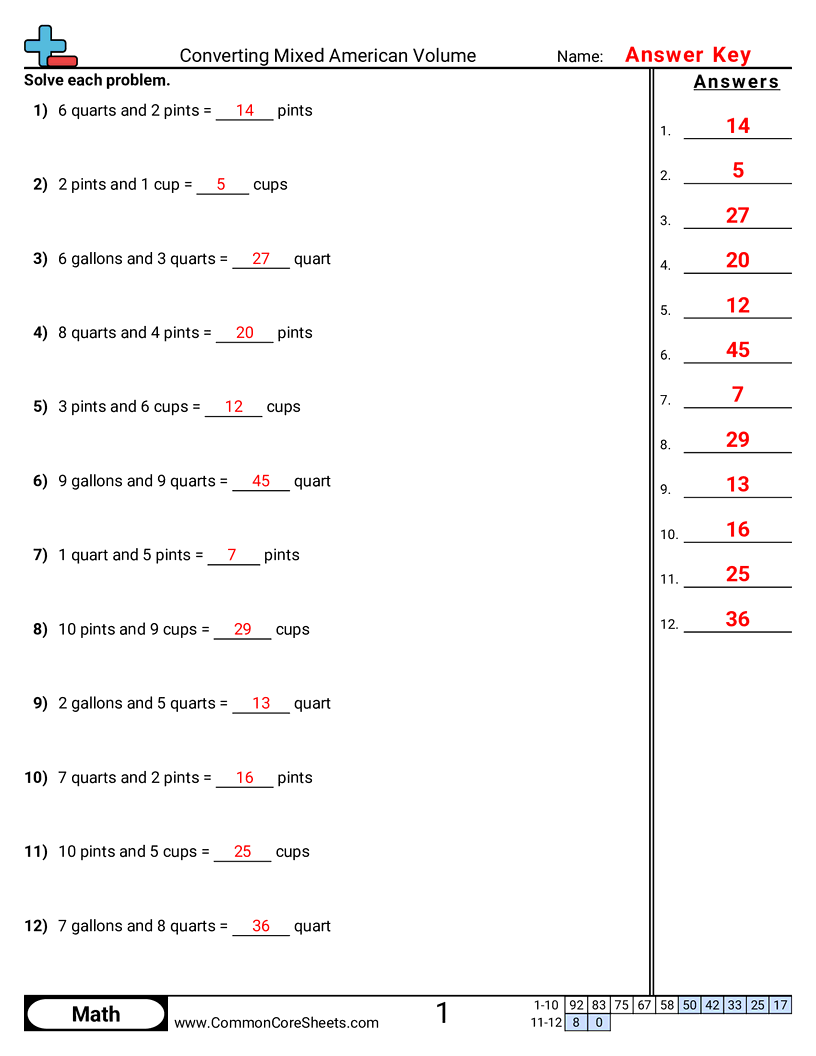
- Convert mixed customary volume amounts into one smaller unit, like turning gallons and quarts into quarts.
- Use the gallon–quart–pint–cup–fluid ounce relationships to rewrite measurements correctly.
- Combine the converted parts to get a single total in the requested unit.

- Convert mixed U.S. volume measurements into a single smaller unit.
- Use the relationships between gallons, quarts, pints, cups, and fluid ounces to rewrite amounts correctly.
About these worksheets
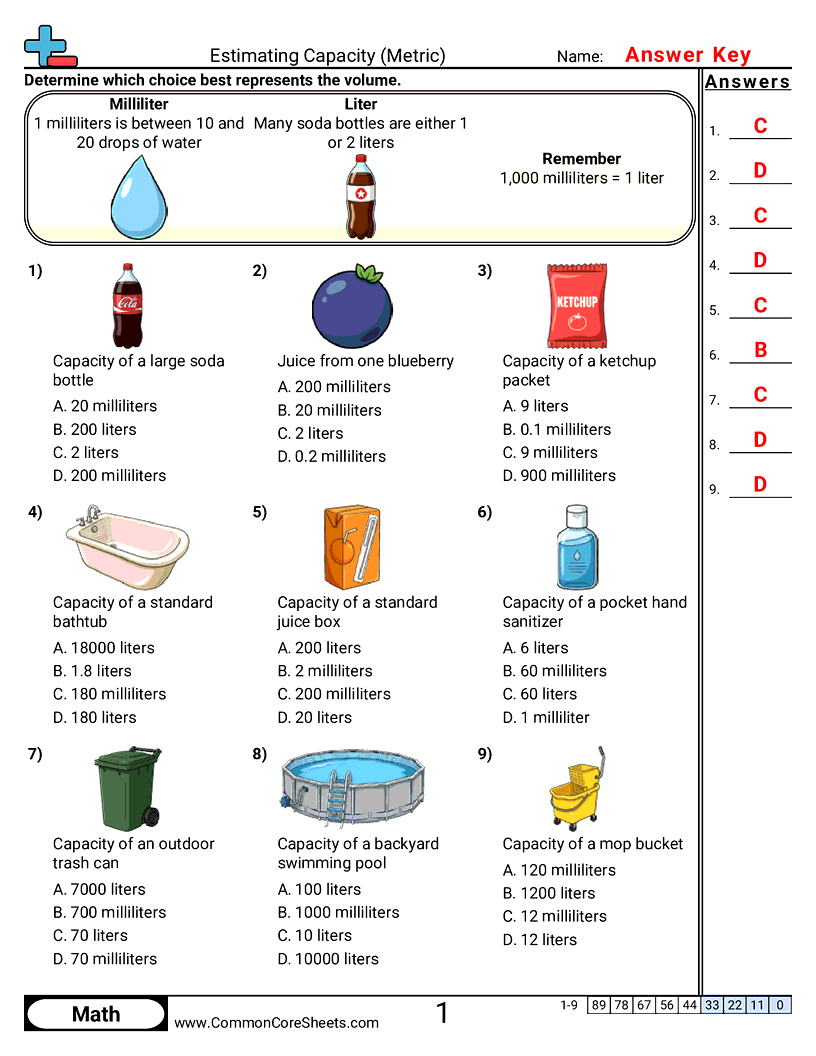
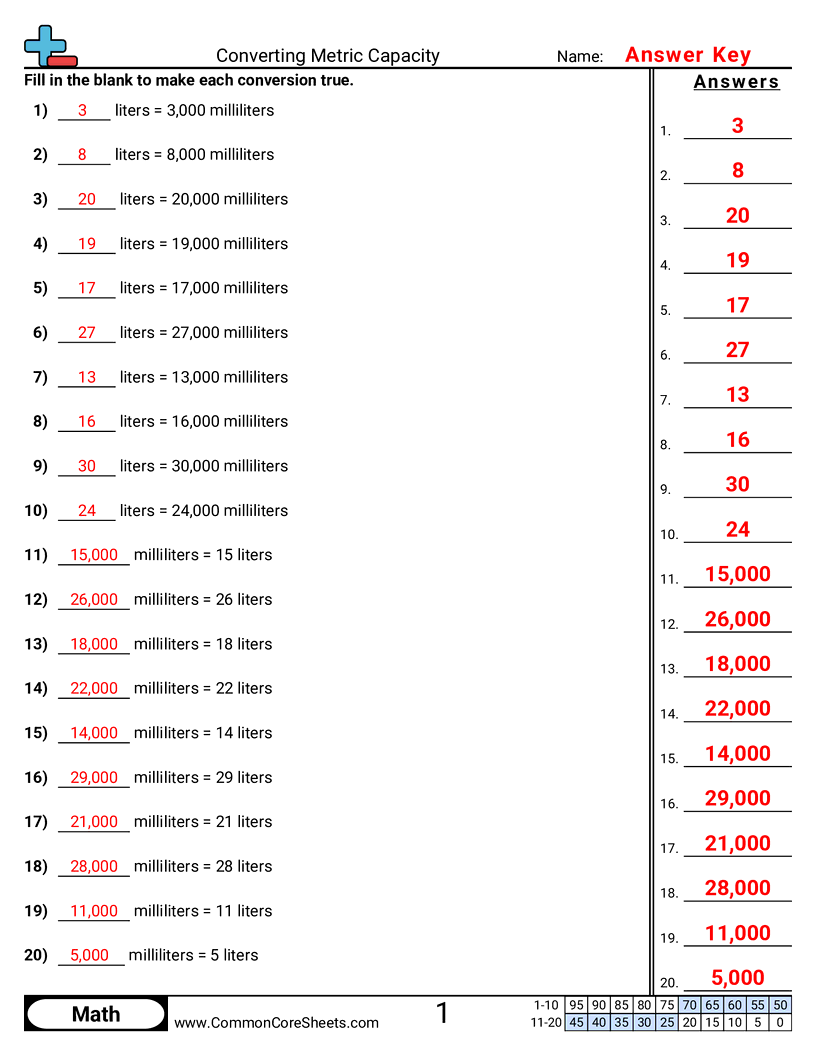
These worksheets focus on metric capacity measurement. Students estimate which metric unit best describes a container's volume, choose between milliliters and liters for real-world situations, convert between metric capacity units using powers of ten, and work with mixed metric volume measurements. Aligned with third and fifth grade standards.
3md2

- Look at a picture of a container and choose the metric unit that makes sense for how much it can hold.
- Tell the difference between milliliters and liters by thinking about small amounts versus large amounts.
3md2

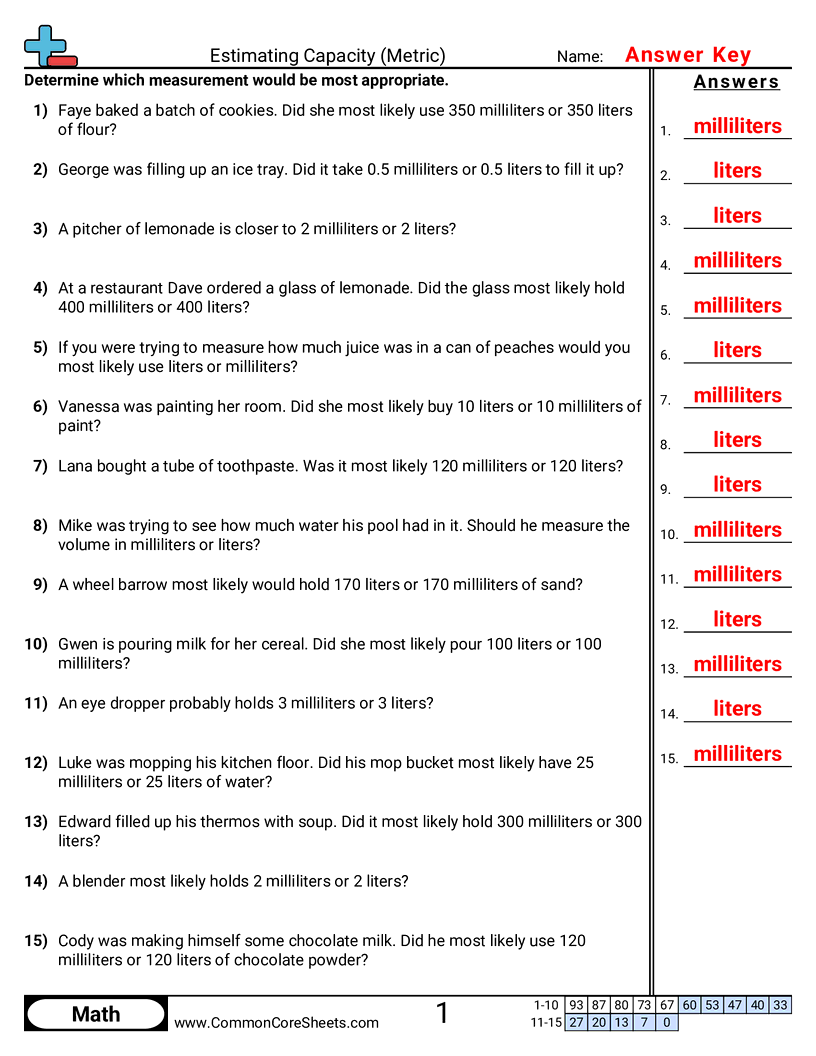
- Choose the best metric unit for how much a container can hold.
- Tell when to use liters for larger amounts and milliliters for small amounts.
- Use clues in a word problem to match an item to a reasonable capacity unit.
- Compare everyday containers to decide which one would be measured in a bigger or smaller unit.
5md1

- Convert between metric capacity units like milliliters and liters.
- Use the metric conversion factors (powers of 10) to multiply or divide to get an equivalent amount.
- Read a capacity measurement in one unit and write it correctly in another unit using the right unit label.

- Convert mixed metric volume amounts into one smaller unit, like liters and milliliters into milliliters.
- Use metric conversion facts (like 1 L = 1000 mL) to decide whether to multiply or divide.
- Combine the converted parts correctly to get a single total in the smaller unit.
About these worksheets
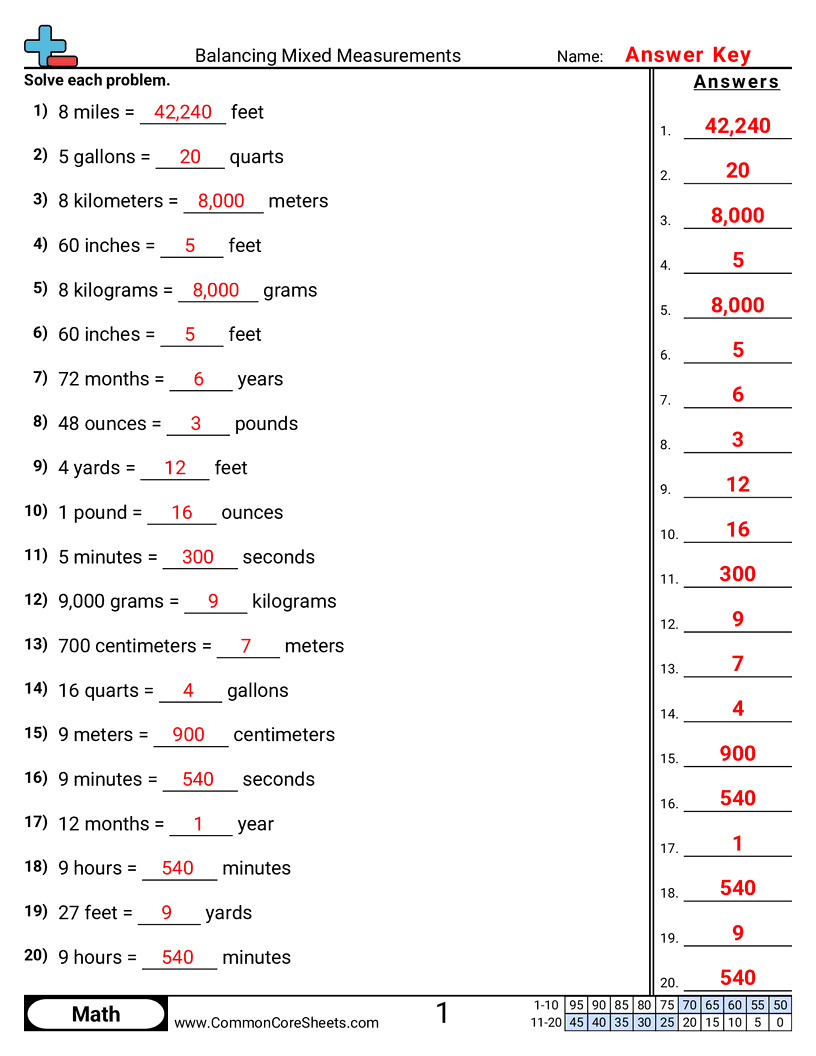
Students practice balancing equations that involve a mix of American customary and metric measurement units. These worksheets challenge students to find the missing value that makes both sides of a measurement equation equal, reinforcing unit conversion skills across both measurement systems.

- Practice balancing measurement equations by figuring out the missing amount that makes both sides equal.