Teaching Long Division, Step by Step
Long division is a handful of small skills done in a loop. When a student gets stuck, it is almost always one of these steps. Each step below has a worksheet that practices just that step.
- 1Division facts
- 2How many times does it go in?
- 3Find what's left over
- 4Where the first digit goes
- 5Divide, multiply, subtract, bring down
- 6Zeros in the answer
- 7Check by multiplying
- 8Two-digit divisors
How to use this page: start at step 1 and move on when students get most problems right. If they struggle with the full problems, find the step where they go wrong and give them that step's worksheet before trying again.
1Division facts
Long division is mostly division facts. If 42 ÷ 6 takes a student more than a few seconds, every step after this one will be slow.
Watch for: Counting up on fingers. Students who think "6 times what is 42?" use the multiplication fact and get there faster.

2How many times does it go in?
Every round of long division starts with one question: how many times does the divisor fit without going over?
Watch for: Picking 5 because 35 is "closer" to 31. The answer is the biggest number that does not go over.

3Find what's left over
Multiply back and subtract. What is left is the remainder, and it shows whether the step before was right.
Watch for: A remainder bigger than the divisor (31 ÷ 7 = 3 R 10). It means the answer digit was too small.

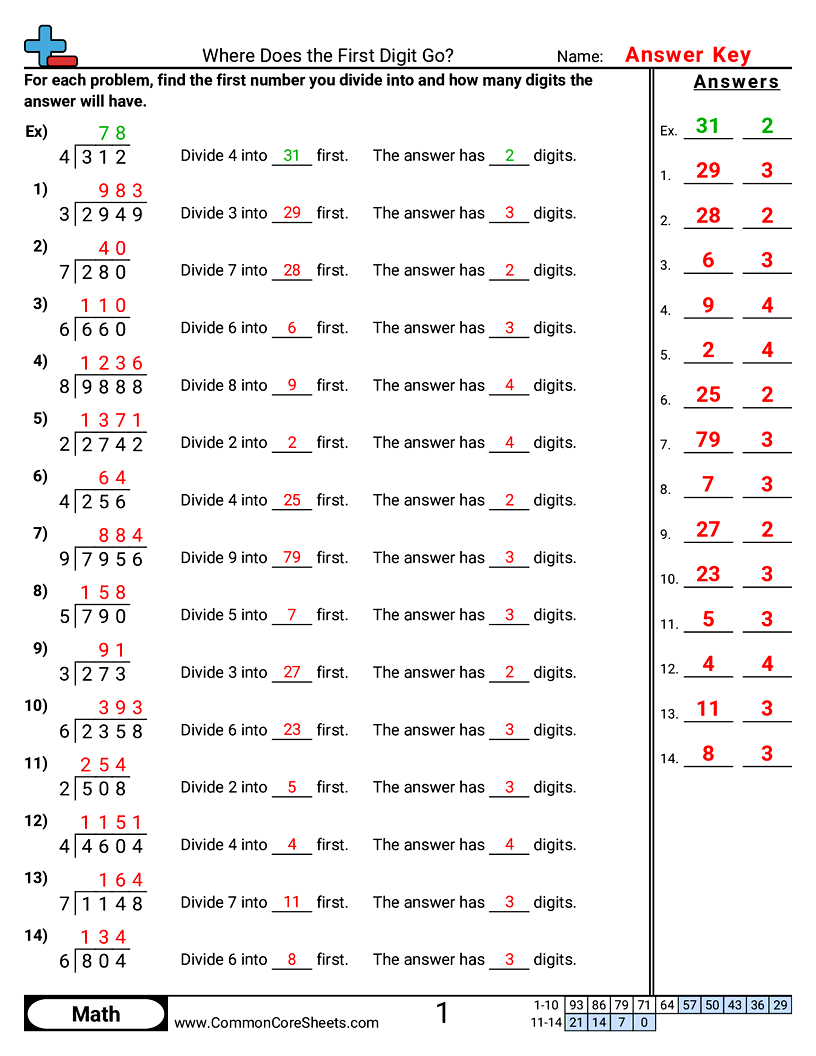
4Where the first digit goes
Look at the first digit of the number being divided. If the divisor does not fit into it, use the first two digits. That decides where the answer starts and how many digits it has.
Watch for: Writing the first digit over the wrong place, or starting the answer with a 0.
5Divide, multiply, subtract, bring down
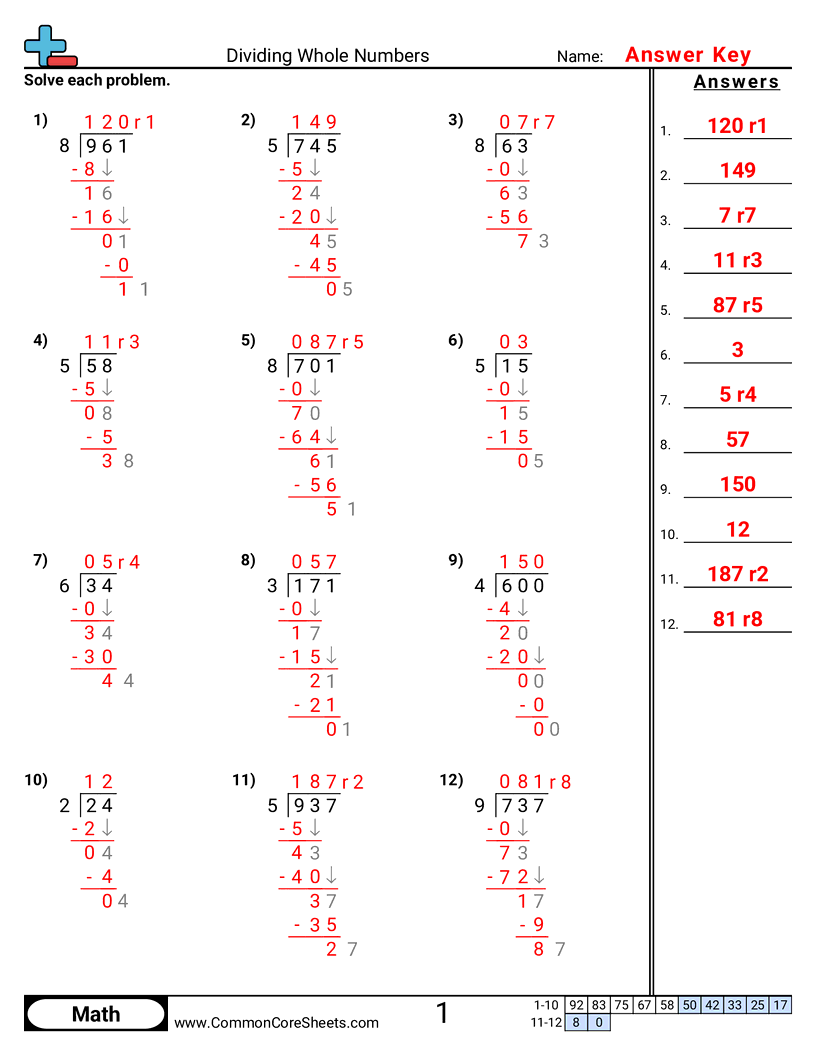
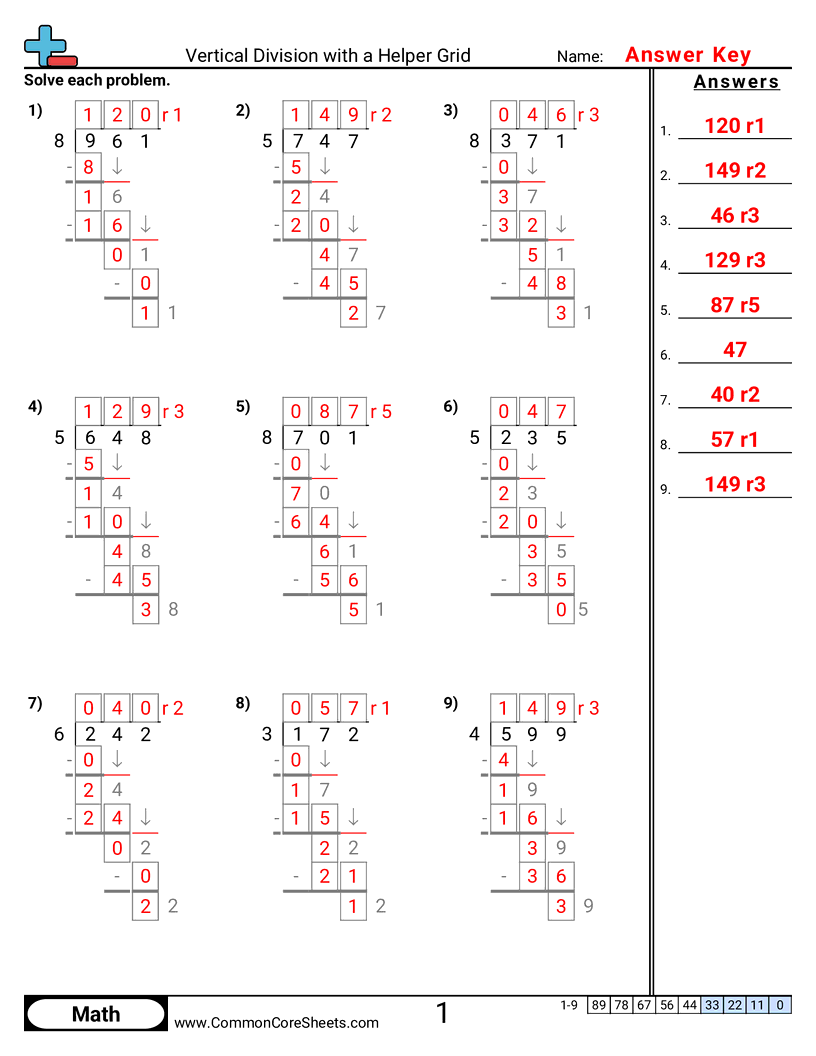
The loop that is long division. Each pass does the same four things, and a grid keeps the columns lined up.
    1 4 2
   ______
6 ) 8 5 2
  - 6
    2 5
  - 2 4
      1 2
    - 1 2
        0
Watch for: Forgetting to bring down, or bringing down two digits at once.

6Zeros in the answer
When the number brought down is too small to divide, the answer gets a 0 in that place, and the loop carries on.
Watch for: Skipping the zero and writing 24.

7Check by multiplying
Multiply the answer by the divisor and add the remainder. It should give back the number you started with.
Watch for: Forgetting to add the remainder back.

8Two-digit divisors
The same loop, with a harder "how many times". Round the divisor to estimate, then adjust.
Watch for: Keeping the first estimate when it is too big or too small.

✓Put it all together
Full long division problems, from one-digit divisors to two.
 3 ÷ 1 (w/remainder)
 Horizontal Division
 4 ÷ 2 (w/remainder)
 4 ÷ 2 (w/remainder)