Determining Change Money Worksheets
This section provides 4th grade students with comprehensive practice in determining change through 11 different worksheet types. Students work with real-world money scenarios including calculating change from single and multiple item purchases, using receipts, drawing coins, and determining equivalent coin values. These activities build essential money management skills while reinforcing mathematical operations.
More about these worksheets ▾ Show less ▴
×
About these worksheets
Students practice making change and working with money in real-world scenarios. Worksheets cover determining the fewest coins for an amount, calculating change from purchases with one or multiple items, reading receipts, deciding what can be purchased with remaining money, drawing coins, identifying change from visual payment, and comparing coin values. Aligned with fourth grade standards.
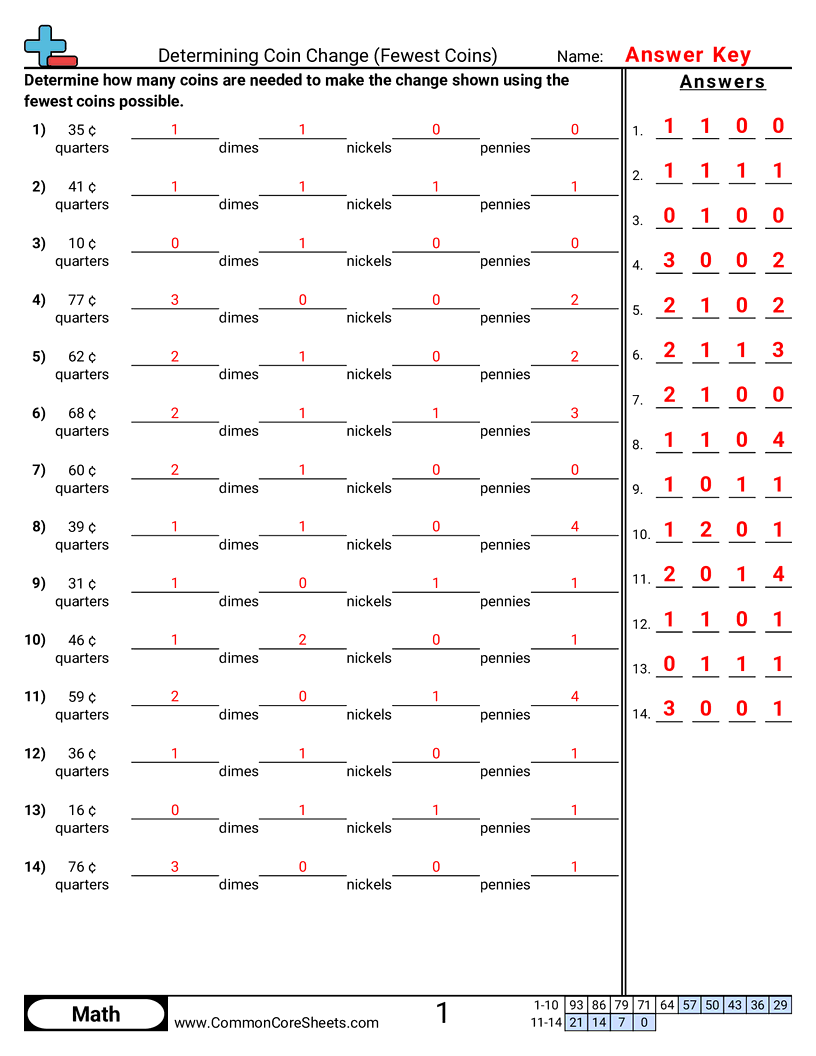
Figure out which coins add up to a given amount of cents. Choose the fewest coins possible to make the exact amount. Practice using coin values (pennies, nickels, dimes, quarters) to build totals. Compare different coin combinations and pick the most efficient one.
2md8 4md2
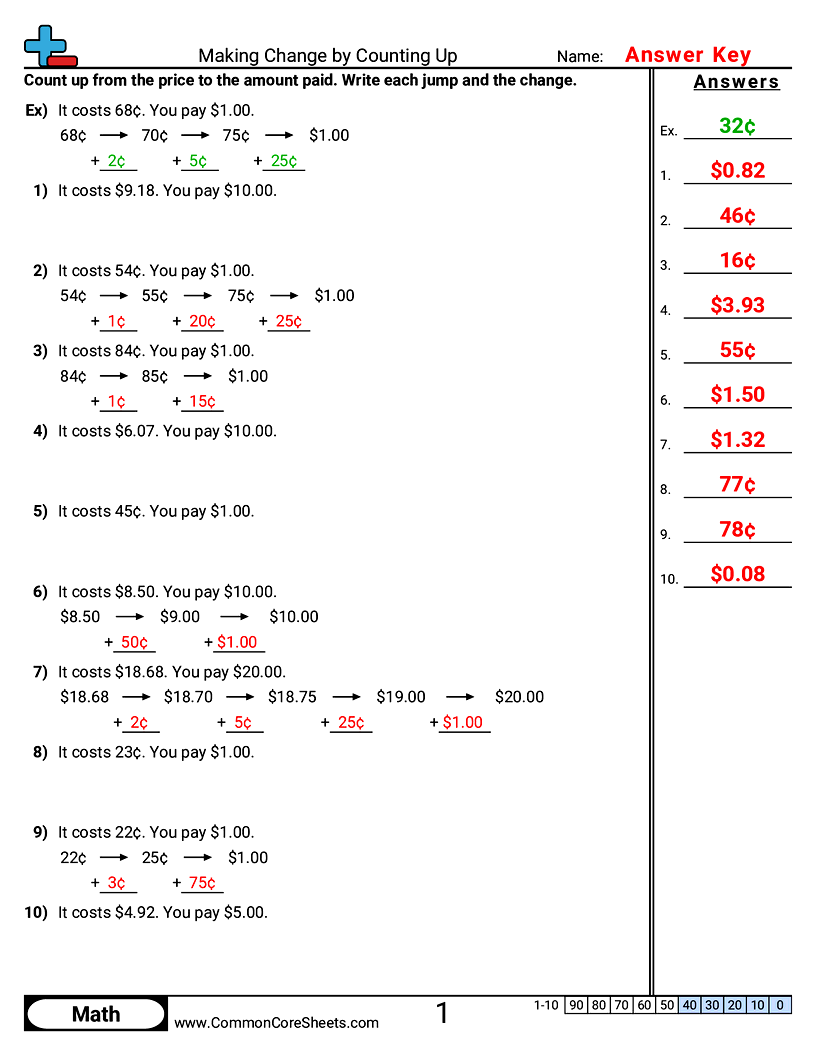
Count up from a price to the amount paid Use the next 5 cents, quarter and dollar as stops when counting up Add the jumps to find the change
2md8
Make a given amount using the fewest coins possible. Recognize a quarter, dime, nickel and penny by sight. Take the largest coin that fits first, then work down to pennies.
4md2
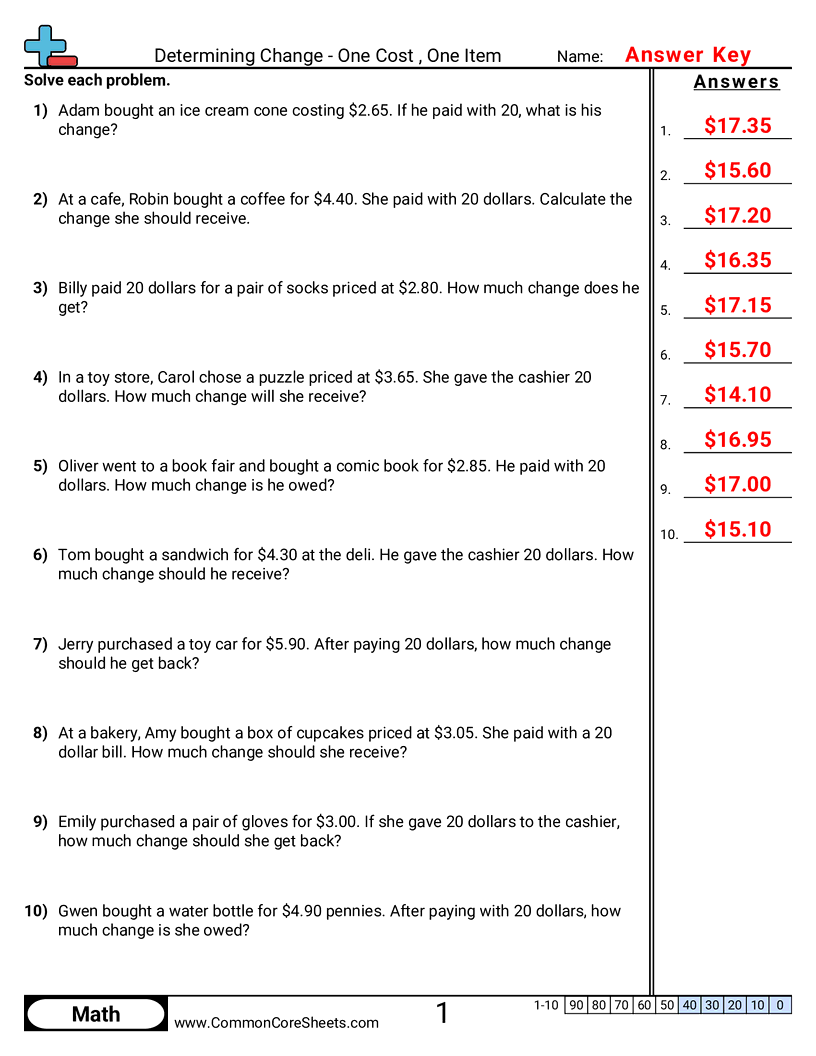
Find how much change you should get back after buying one item. Subtract a price from the amount paid using dollars and cents. Line up decimal points correctly when subtracting money amounts. Read a simple receipt-style word problem and pick the numbers to subtract.
4md2
Read a word problem about buying one item and paying with cash. Multiply to find the total cost when you buy more than one of the same item. Subtract the total cost from the amount paid to find the change.
4md2
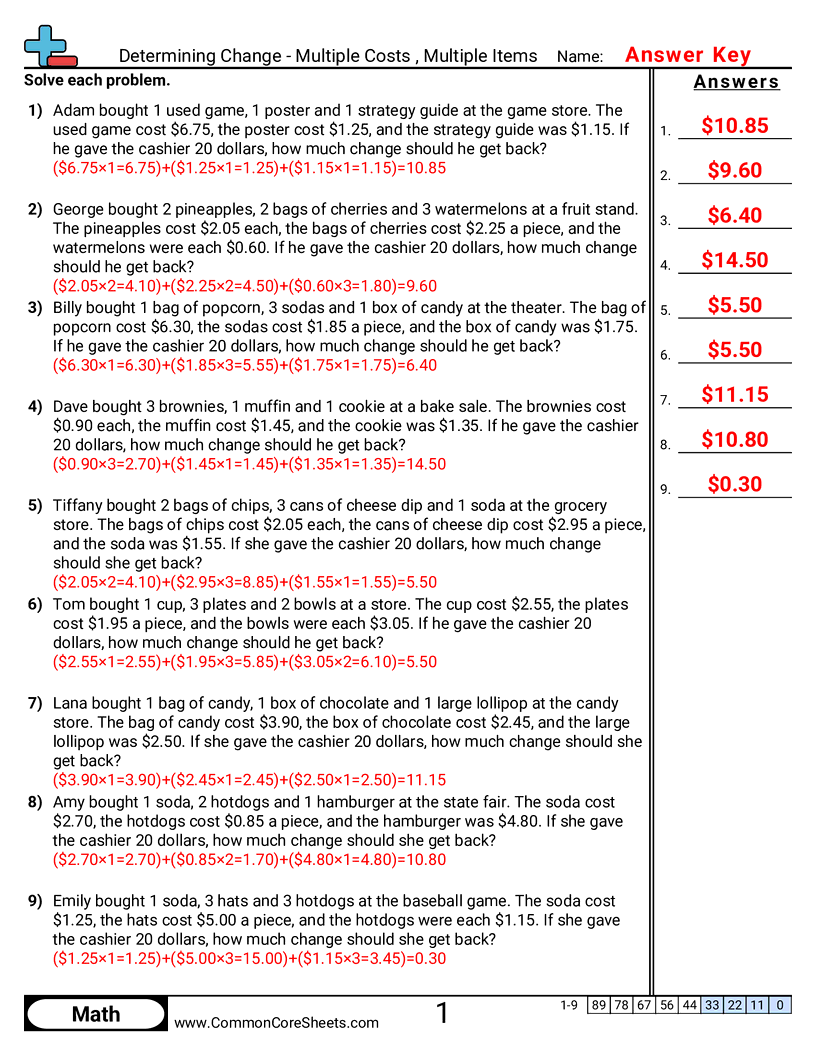
Add the prices of several different items to find the total cost. Multiply a price by a quantity when more than one of the same item is bought. Subtract the total cost from the amount paid to figure out the change. Read money word problems and pick the right steps to solve them. Work with decimal amounts in dollars and cents accurately.
4md2
Find the cost of an item from the amount paid and the change received. Subtract one money amount from another. Recognize that payment minus change gives the cost.
4md2
Find how much was handed over from the cost and the change received. Add two money amounts to find a payment. Recognize that cost plus change gives the amount paid.
4md2
Read a receipt to find the total cost of the items. Subtract the total cost from the amount paid to figure out the change. Work with dollars and cents correctly when subtracting money amounts. Match the change amount to what you should get back after paying with cash.
4md2
Subtract a purchase price from the money you have to find how much change is left. Compare prices to decide which item is the most expensive you can afford with a set amount of money. Work with dollars and cents together and keep the decimal in the right place when subtracting. Read money amounts in a shopping-style problem and pick the correct operation to solve it.
Match a money amount in cents to a set of coins by drawing the right coins. Practice adding coin values (pennies, nickels, dimes, quarters) to make a total within $1.00. Get faster at recognizing how much common coins are worth without counting by ones every time. Use different coin combinations to represent the same amount.
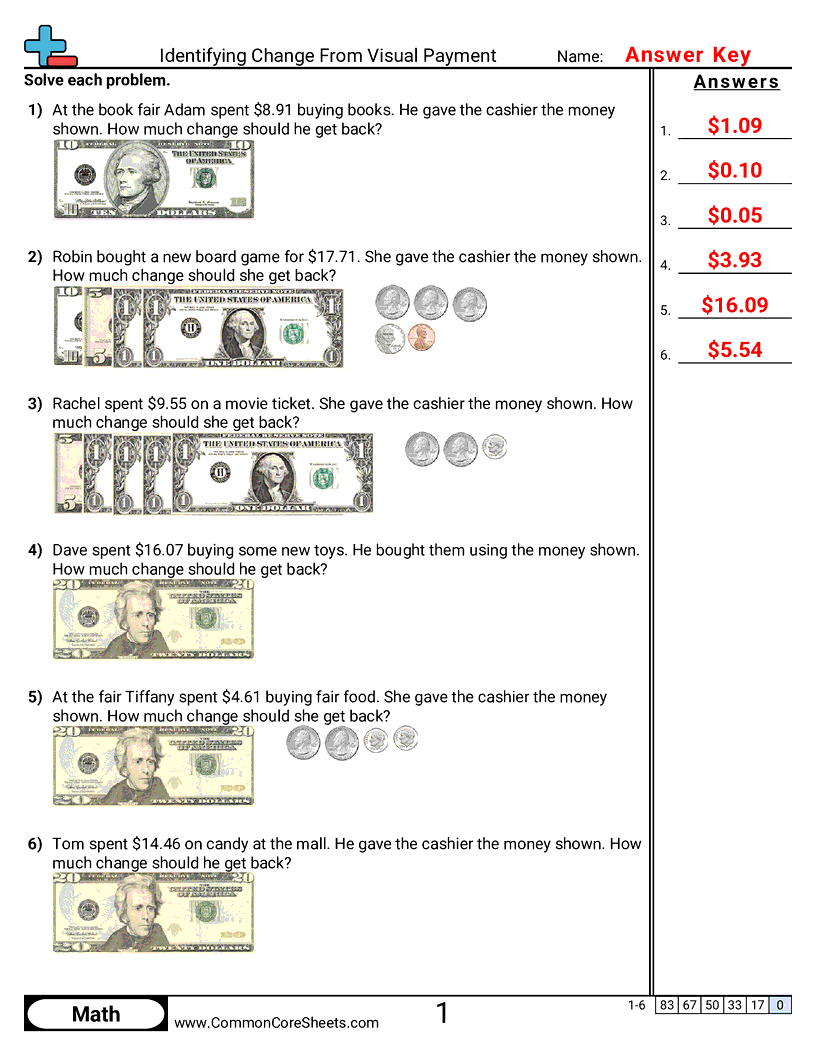
Read a picture of coins and bills to figure out how much money was paid. Subtract the cost from the amount paid to find the correct change. Work with dollars and cents written as decimals when doing money subtraction.
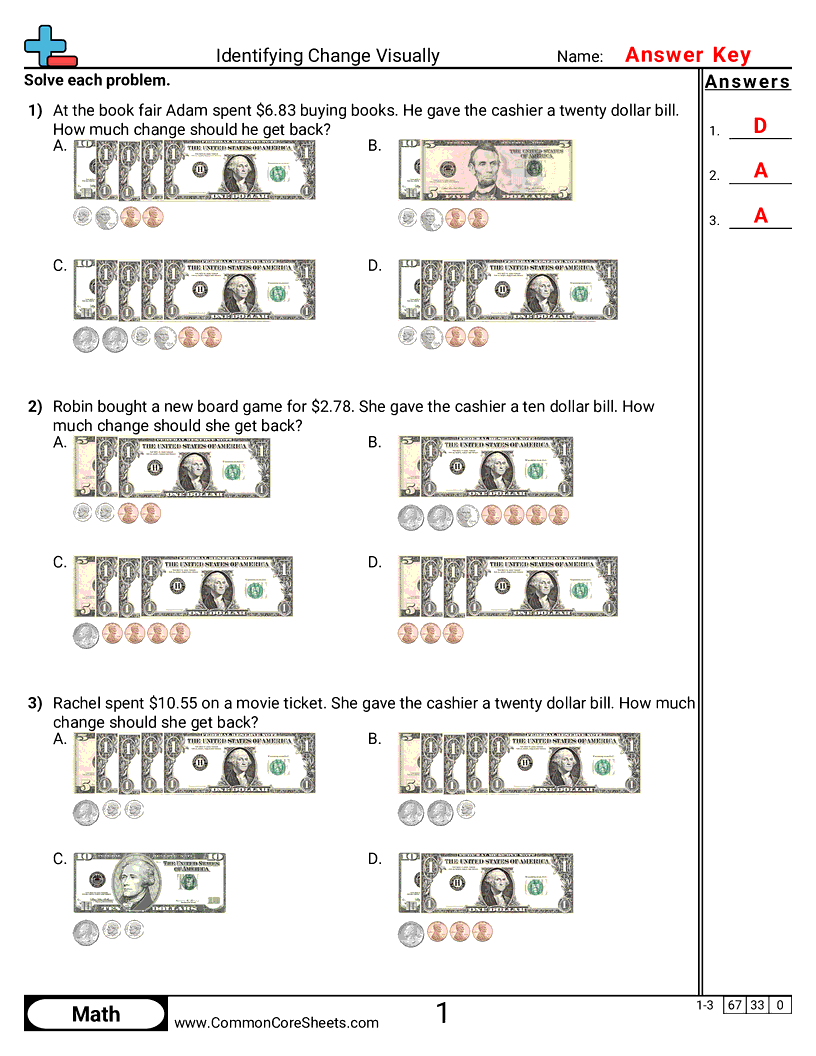
Figure out how much change you should get back after paying with a $10 or $20 bill. Read a price and a payment amount and subtract to find the difference. Use pictures of bills and coins to match the correct change amount. Recognize common bills and coins and their values when making change.
2md8
Figure out how much a group of coins is worth in cents. Recognize that different coin combinations can have the same value. Compare two sets of coins to see which is worth more or if they are equal.
Practice figuring out how much change you get back from $1.00 Break an amount of change into the fewest number of quarters, dimes, nickels, and pennies Solve money word problems by subtracting a price from a dollar
Advertisement