numeric Algebra Worksheets
Our numeric algebra worksheets provide 40 different problem types focused on computational practice and number manipulation. These worksheets emphasize solving algebraic problems through direct calculation, making them perfect for building foundational skills and reinforcing core algebraic concepts through hands-on numeric work.
×
About these worksheets
These worksheets cover a wide range of algebraic expression skills, from simplifying and expanding to factoring. Students practice combining like terms, using the distributive property, rewriting expressions as multiples of a sum, solving linear equations with variables on both sides, and expanding polynomials using the box method. Topics also include perfect square trinomials and matching equivalent expressions, making these resources ideal for sixth through eighth grade algebra.
8ee7b
Solve linear equations where the variable shows up on both sides of the equals sign. Combine like terms to simplify each side before solving. Use the distributive property to clear parentheses in an equation. Move terms across the equals sign using addition, subtraction, and multiplication to isolate the variable. Handle equations that need more than one step to get the variable alone.
About these worksheets
These worksheets bring together coordinate geometry and algebraic reasoning. Students use similar triangles to find missing coordinates and rise values, rotate shapes around the origin, and identify points of intersection by solving systems of equations. Aligned with eighth grade standards, these activities strengthen graphing skills and spatial reasoning on the coordinate plane.
8ee6
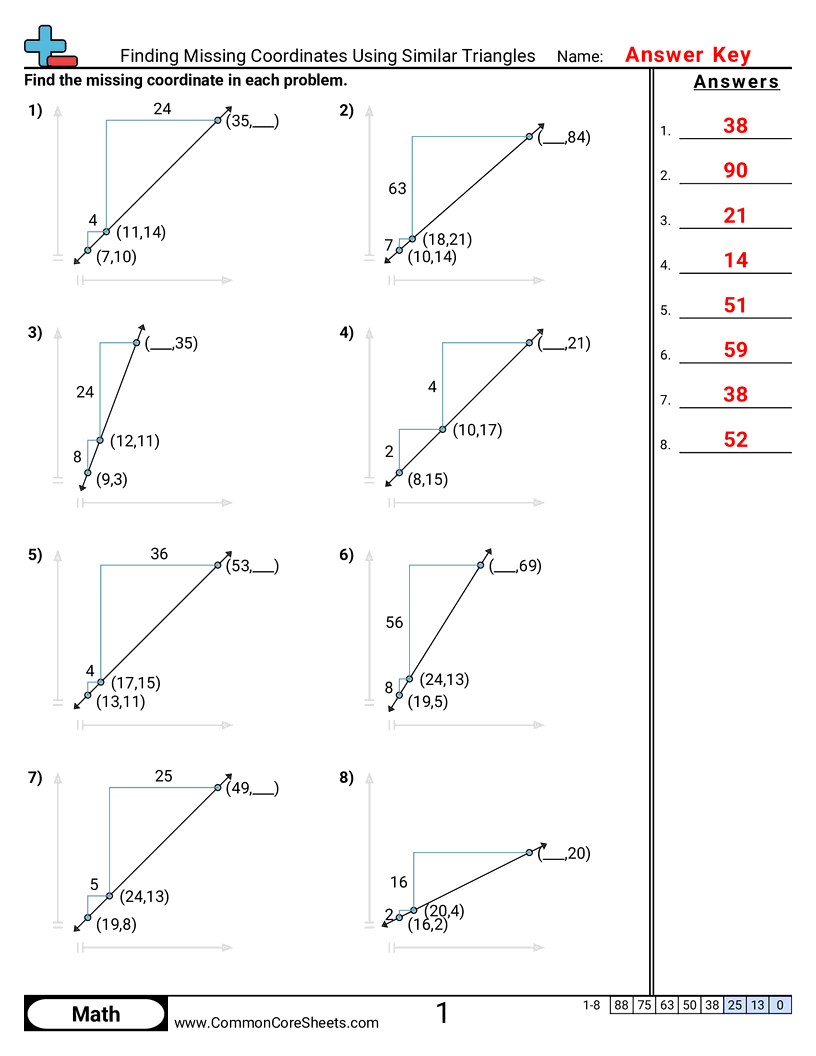
Find a missing x- or y-coordinate on a graph by using similar triangles. Set up and solve a proportion from matching side lengths in two similar triangles.
8ee8a
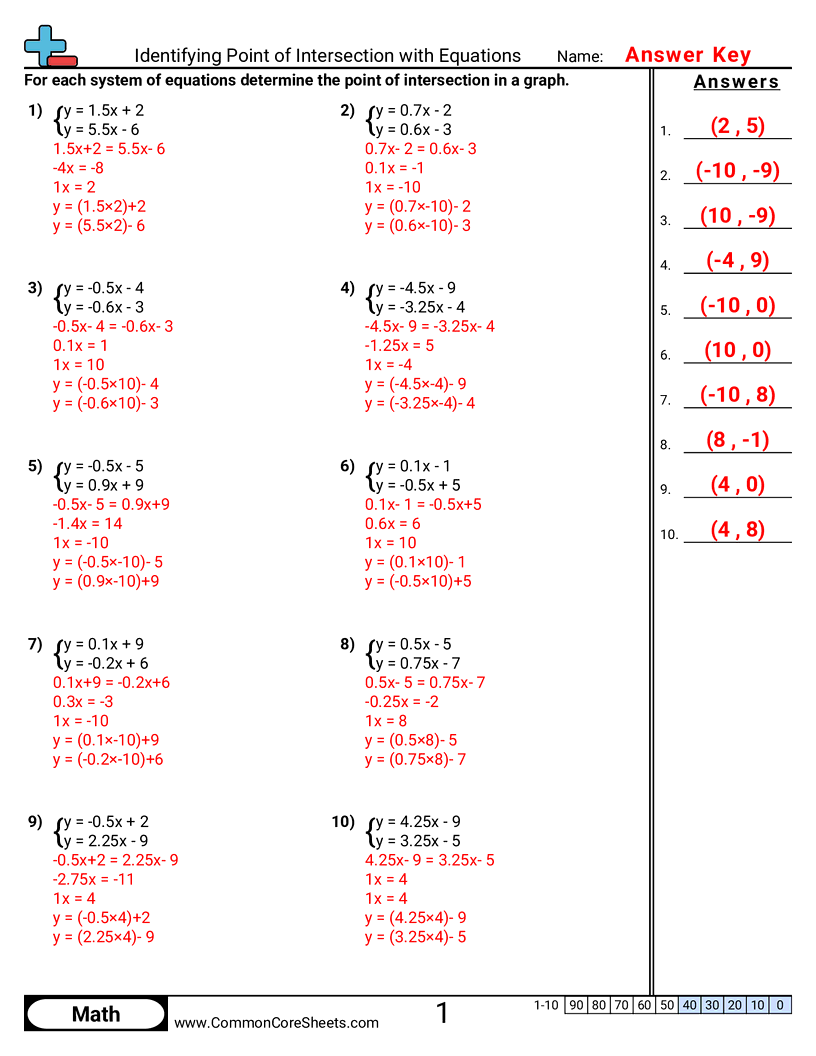
Find the exact point where two lines cross by solving both equations together. Use substitution to plug one equation into the other and solve for x and y. Use elimination to combine equations and solve for the ordered pair. Check your solution by plugging the x and y values back into both equations.
About these worksheets
These worksheets explore number concepts essential for middle school math, including square roots, cube roots, rational and irrational numbers, laws of exponents, scientific notation, radicals, and powers of ten. Students practice estimating radical values, simplifying expressions with exponents, and performing operations in scientific notation. Aligned with eighth grade Common Core standards, these resources build a strong number sense foundation for high school math.
8ns2
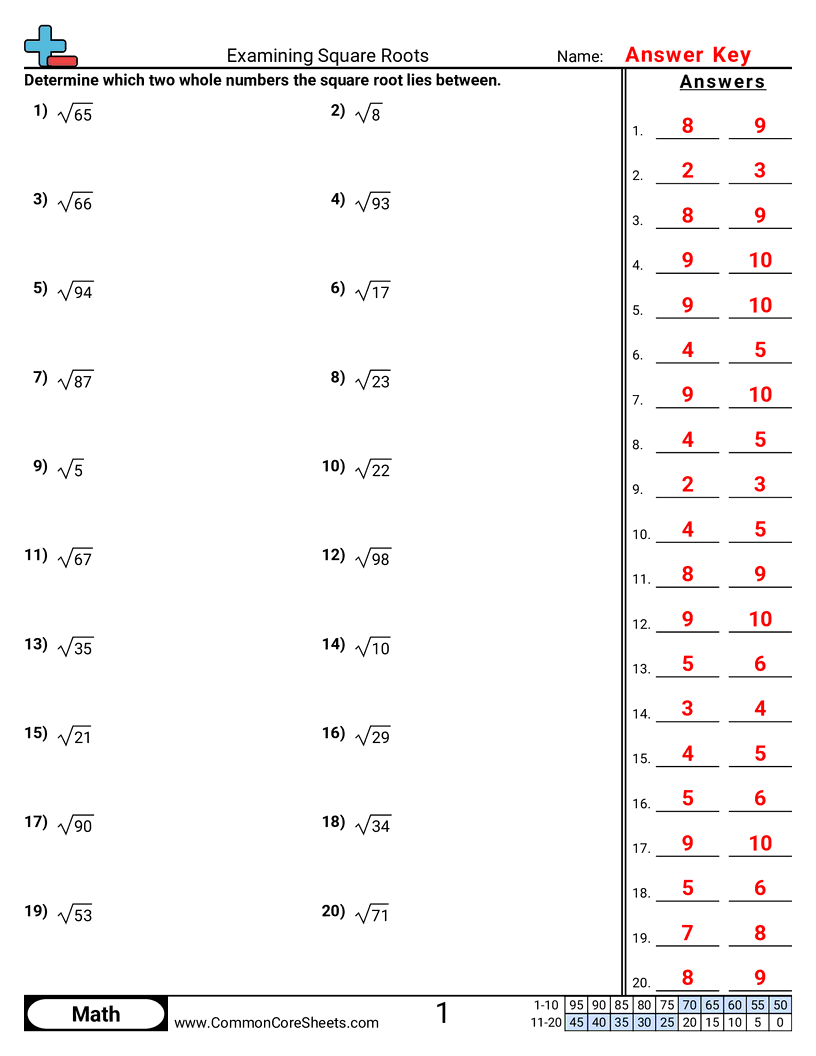
Recognize the perfect squares that are closest to a given square root. Decide which two whole numbers a square root falls between. Use nearby perfect squares to make a quick estimate of a square root’s size.
8ns1
Decide whether a number is rational or irrational. Recognize that fractions, integers, and whole numbers are rational because they can be written as a ratio of integers. Tell that terminating decimals and repeating decimals are rational numbers. Identify common irrational numbers like pi and square roots that do not simplify to a fraction.
8ns2
Place square roots on a number line by figuring out which two whole numbers they fall between. Estimate the decimal value of a square root well enough to plot it in the right spot. Use nearby perfect squares (like 16 and 25) to judge how close a square root is to a whole number.
8ee1
Rewrite expressions with exponents using the product and quotient rules. Simplify powers raised to powers by multiplying exponents. Rewrite expressions with zero and negative exponents using reciprocals.
8ee1
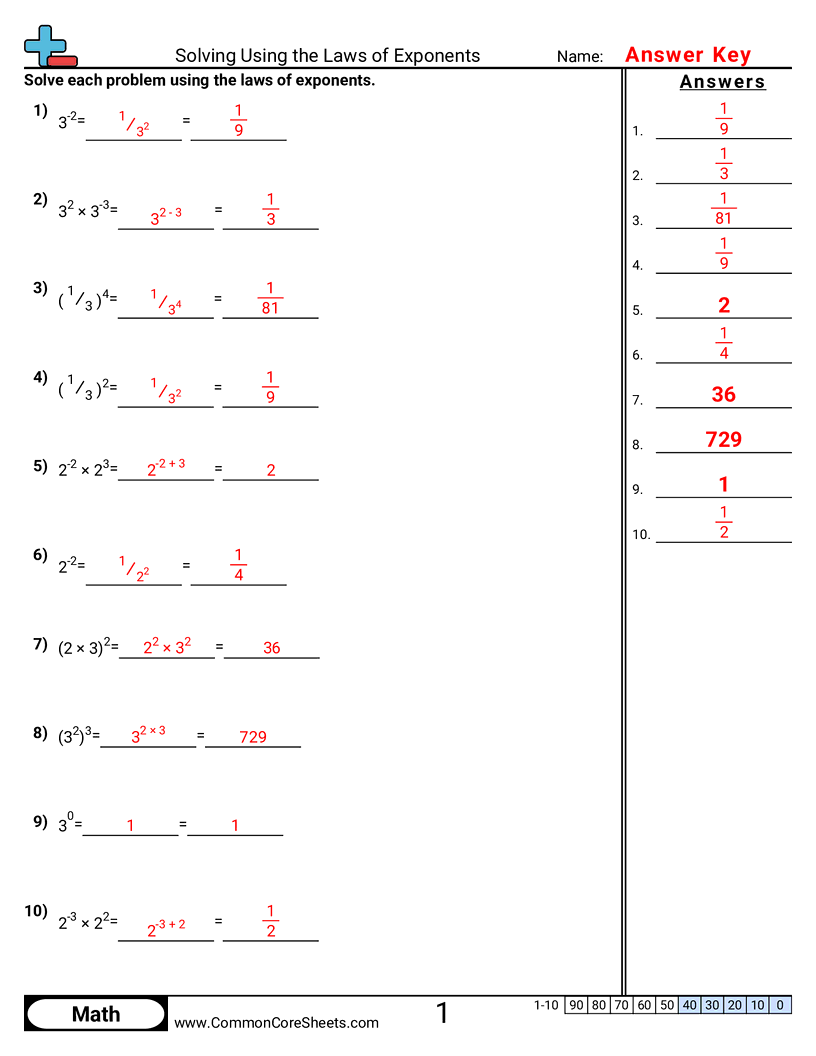
Practice rewriting negative exponents as fractions (e.g., 3⁻² becomes 1/3²) Multiply powers with the same base by adding their exponents, even when some exponents are negative Raise fractions to a power by applying the exponent to both the numerator and denominator Simplify expressions step by step to reach a final whole number or fraction
8ee2
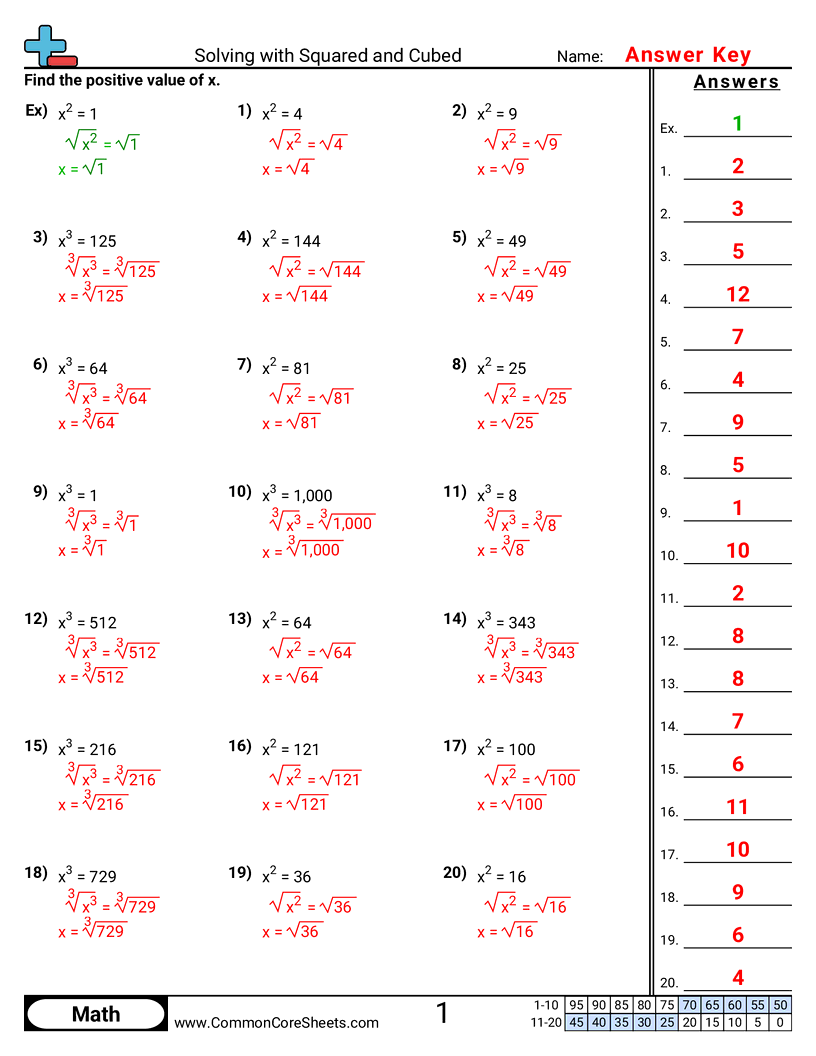
Evaluate expressions with squared and cubed numbers. Solve simple equations where a number is squared or cubed to find the missing value. Recognize perfect squares and perfect cubes and match them to their roots.
8ns2
Rewrite negative exponents as reciprocals so the exponent becomes positive. Evaluate expressions with negative powers to get the correct fraction or decimal value. Work with negative exponents on whole-number bases, fractions, and powers of 10.
8ns2
Recognize perfect squares and perfect cubes so you can solve quickly without a calculator.
8ns2
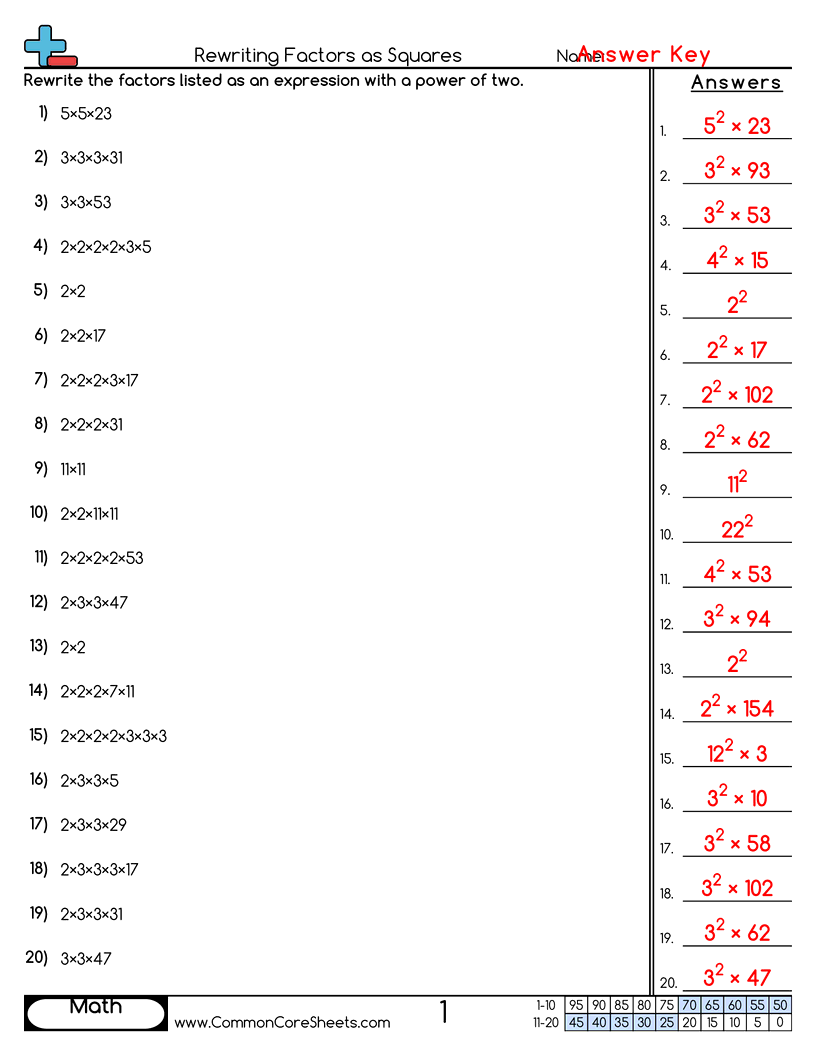
Break a number into factors and spot pairs that make a perfect square. Use exponents to write repeated factors more simply, like 3×3 as 3^2.
8ns2
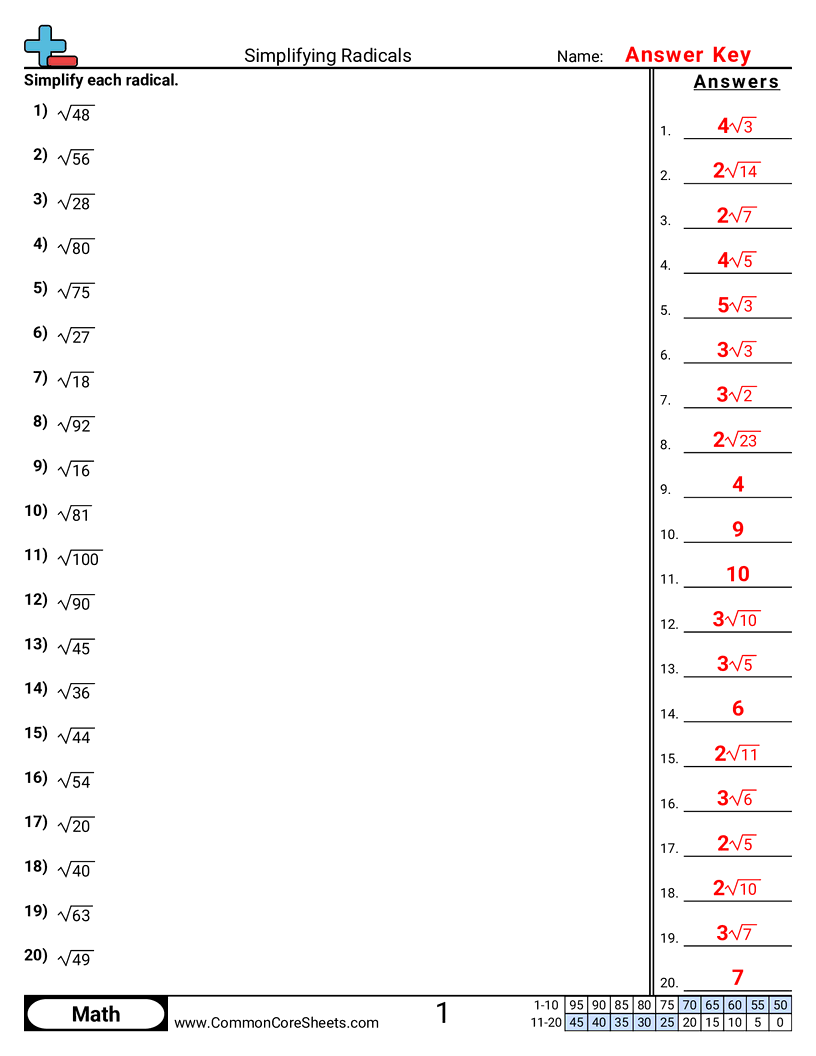
Practice rewriting square roots by pulling out perfect-square factors. Use factor pairs to break a number under a radical into simpler parts. Simplify radicals all the way to a number times a square root (like 3√2). Recognize which radicals are already in simplest form.
8ee3
Rewrite whole numbers and decimals as one digit times a power of 10. Use place value to decide how many places the decimal point moves when converting. Work with both positive and negative exponents to show very large and very small numbers. Read and write numbers in a scientific-notation style and convert back to standard form.
8ee4
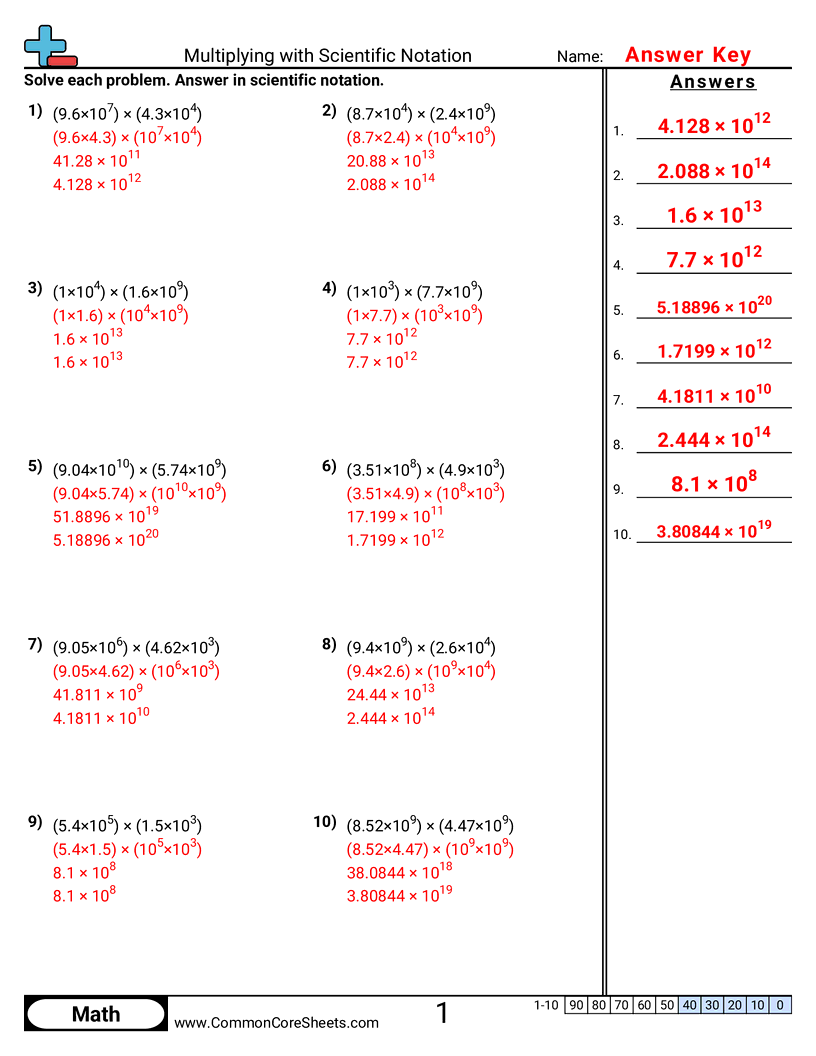
Multiply two numbers written in scientific notation. Multiply the coefficients and combine the powers of 10 using exponent rules. Rewrite answers in proper scientific notation by shifting the decimal and adjusting the exponent.
8ee2
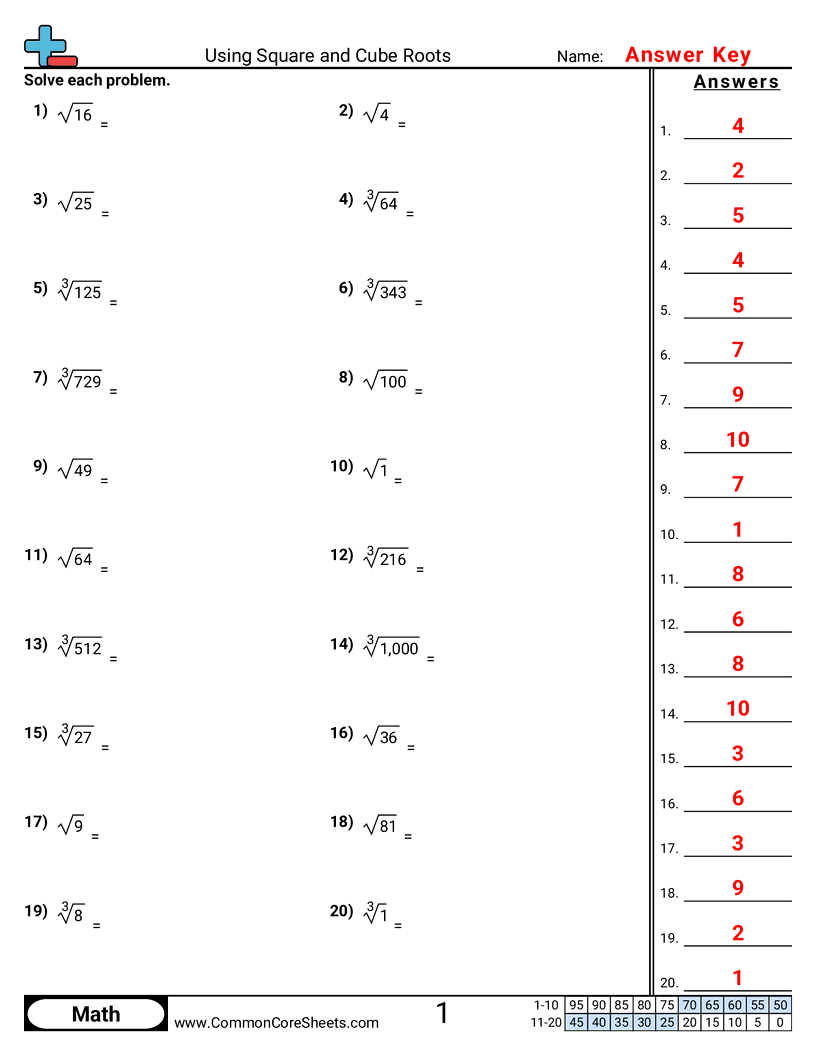
Find the square root of a perfect square and write the whole-number answer. Find the cube root of a perfect cube and write the whole-number answer. Recognize when a number is a perfect square or a perfect cube.
8ns2
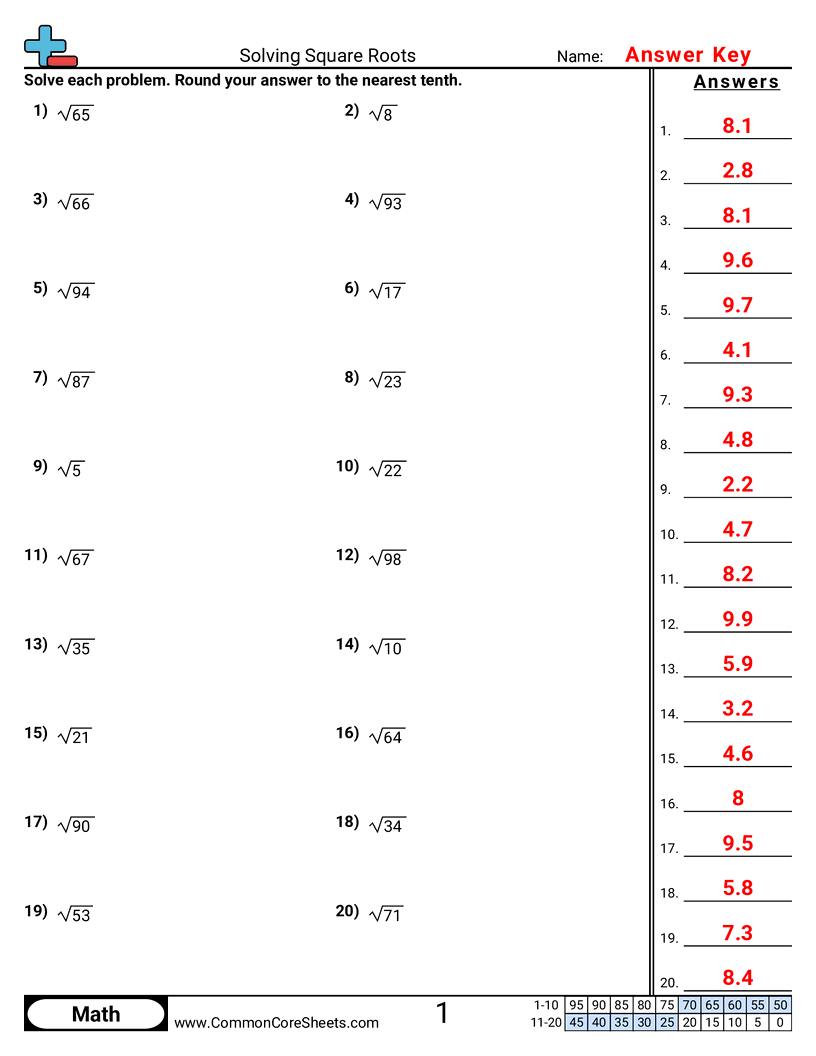
Practice estimating square roots of numbers that aren't perfect squares Figure out which two whole numbers a square root falls between Work with square roots of various sizes to build number sense around irrational numbers
8f3
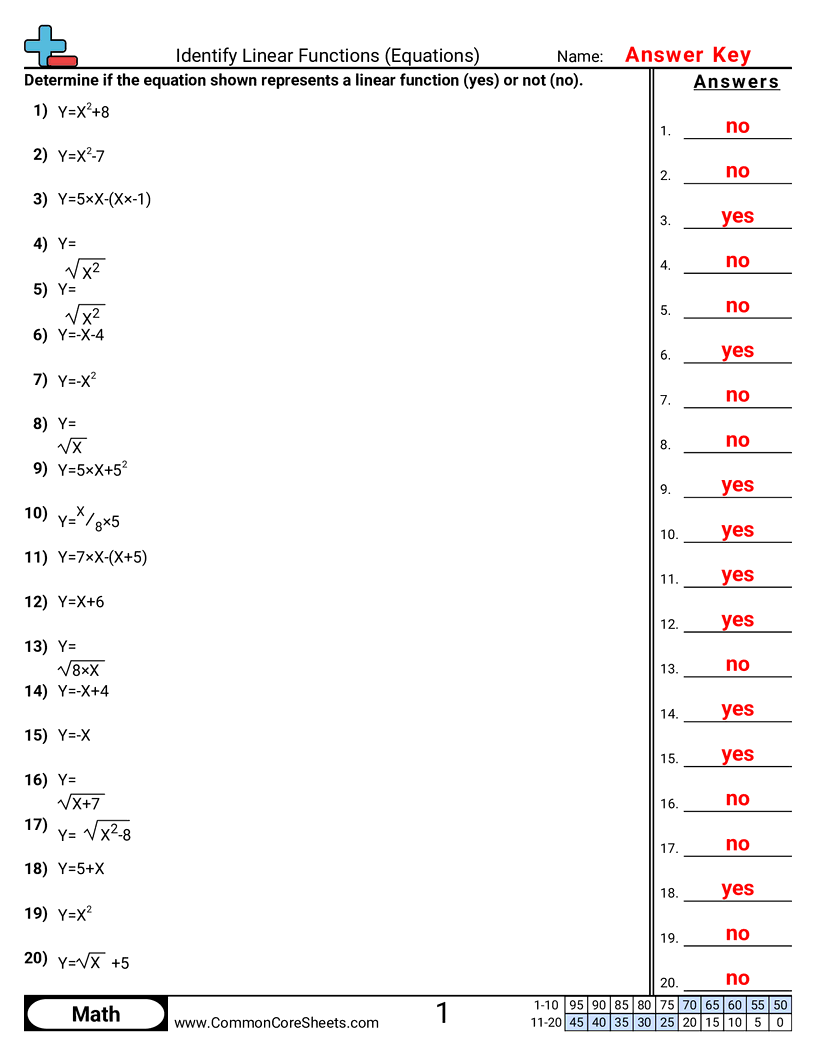
Decide whether an equation makes a straight-line relationship (a linear function) or not. Recognize common linear forms like y = mx + b, point-slope form, and standard form. Spot equations that are not linear because they have exponents, roots, variables multiplied together, or variables in the denominator.
8f3
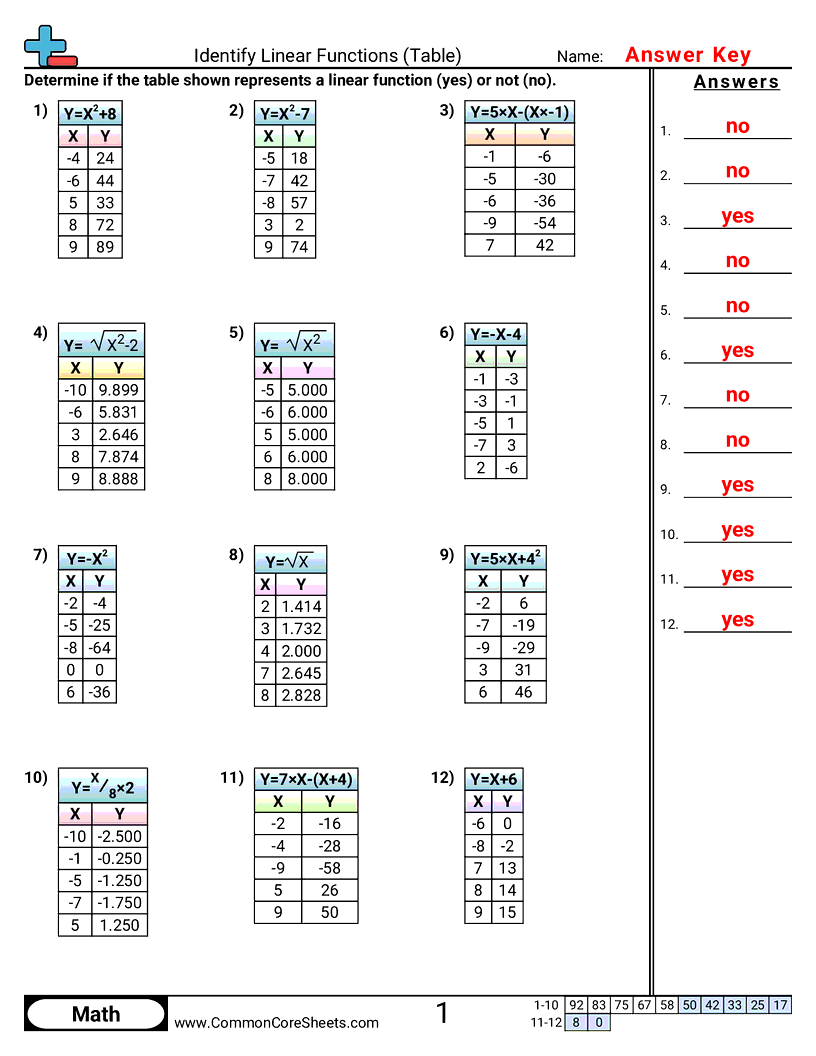
Decide whether a table of input and output values follows a linear rule. Check if the output changes by a constant amount when the input increases by the same amount. Find the rate of change (slope) from a table by comparing how much the output changes to how much the input changes. Spot tables that are not linear because the differences in the outputs are not consistent.
Playwire Advertisement