Wolverine Worksheet Download
Free reading worksheets on Wolverine. Each worksheet has 20 problems with an answer key and are ideal for teachers and homeschooling. You can download the PDF, create a set of flash cards or set it up for online learning.


Sheet Information >
Available at 2nd grade, 3rd grade, 4th grade, 5th grade and 6th grade reading levels.
Read the passage
Wolverines are fascinating creatures, and there's so much to learn about them! These animals may look like small bears, but they are actually the largest members of the weasel family. Their strong jaws and sharp claws help them to hunt, and their thick fur protects them from the cold.
These amazing animals can be found in cold places like the Arctic, northern Canada, and northern Europe. Wolverines are known to eat a variety of foods, including plants, insects, and other animals, but their favorite meal is meat from larger creatures like moose or caribou. When it comes to relationships with other animals, wolverines are known to be quite fearless, and they have even been seen chasing bears away from their territory.
Wolverines are not only interesting, but they are also very important in their ecosystems. Although they are solitary animals and rarely interact with humans, they play a key role in controlling the populations of other animals, like rodents. So, the next time you think about wolverines, remember that they are unique and essential members of their habitats.
Wolverines are fascinating animals that many kids find interesting. These furry creatures have a stocky body, short legs, and a bushy tail, which makes them look like small bears. They live in cold places like the Arctic, Northern Europe, Siberia, and North America, where they can find their favorite food: meat. Wolverines are omnivores, which means they eat both plants and animals, but they especially love to munch on small animals like rabbits, squirrels, and rodents.
Let's explore the life cycle of a wolverine and how they interact with other animals. These amazing creatures usually live around 7 to 12 years in the wild, and they begin their lives as tiny, helpless babies called kits. As they grow, wolverines learn to hunt and defend themselves from other predators like bears and wolves. Although they're generally solitary animals, wolverines do have some friendly encounters with other animals, like playing with their own siblings or sharing a meal with a fellow wolverine.
Now, let's talk about wolverines' relationship with humans and some interesting facts about them. In some cultures, wolverines are admired for their strength and resilience, and they're even seen as symbols of courage and endurance. However, wolverines can also be seen as pests because they sometimes steal food from human camps or damage property. An interesting fact about wolverines is that they have a special oil on their fur that makes it waterproof and frost-resistant, which helps them survive in freezing temperatures. In conclusion, wolverines are incredible creatures with unique adaptations to their environment and intriguing connections to both humans and other animals.
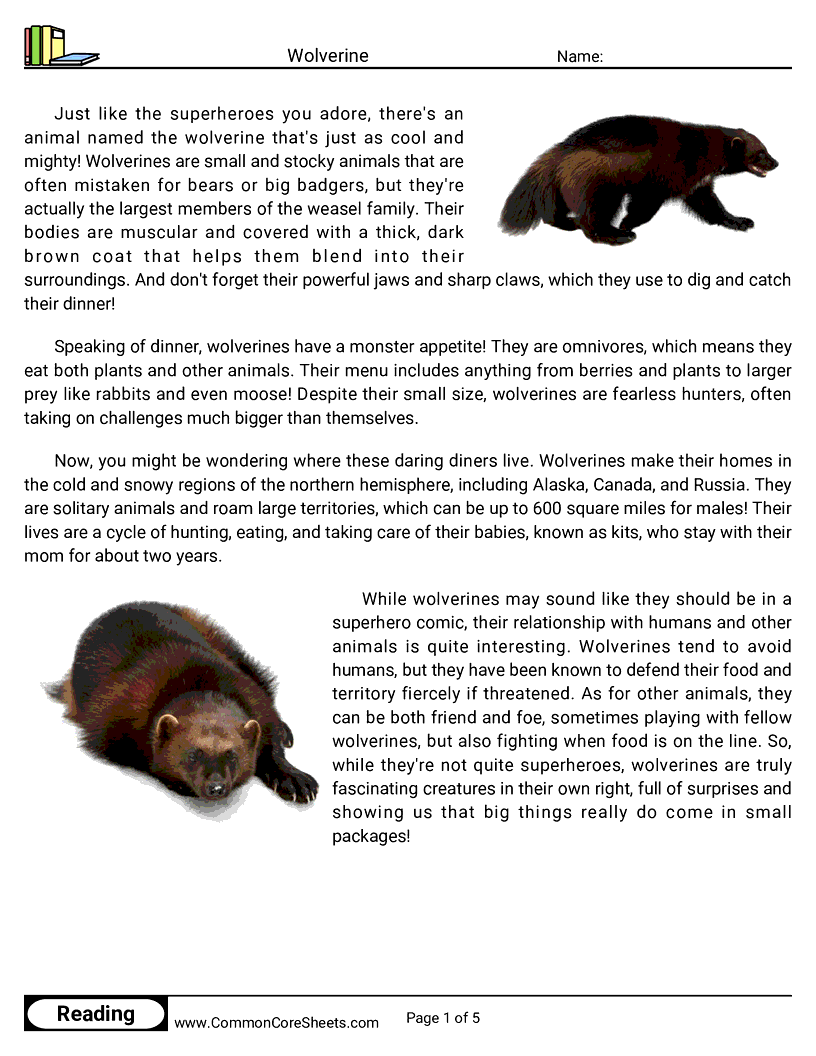
Just like the superheroes you adore, there's an animal named the wolverine that's just as cool and mighty! Wolverines are small and stocky animals that are often mistaken for bears or big badgers, but they're actually the largest members of the weasel family. Their bodies are muscular and covered with a thick, dark brown coat that helps them blend into their surroundings. And don't forget their powerful jaws and sharp claws, which they use to dig and catch their dinner!
Speaking of dinner, wolverines have a monster appetite! They are omnivores, which means they eat both plants and other animals. Their menu includes anything from berries and plants to larger prey like rabbits and even moose! Despite their small size, wolverines are fearless hunters, often taking on challenges much bigger than themselves.
Now, you might be wondering where these daring diners live. Wolverines make their homes in the cold and snowy regions of the northern hemisphere, including Alaska, Canada, and Russia. They are solitary animals and roam large territories, which can be up to 600 square miles for males! Their lives are a cycle of hunting, eating, and taking care of their babies, known as kits, who stay with their mom for about two years.
While wolverines may sound like they should be in a superhero comic, their relationship with humans and other animals is quite interesting. Wolverines tend to avoid humans, but they have been known to defend their food and territory fiercely if threatened. As for other animals, they can be both friend and foe, sometimes playing with fellow wolverines, but also fighting when food is on the line. So, while they're not quite superheroes, wolverines are truly fascinating creatures in their own right, full of surprises and showing us that big things really do come in small packages!
Wolverines are fascinating creatures that many people don't know much about. These animals are small, but they are strong and have a powerful presence in the wild. They belong to the weasel family and are sometimes called the glutton or skunk bear. Wolverines have a thick, dark brown coat with a lighter stripe running down each side of their body.
Wolverines can be found in various parts of the world, including the United States, Canada, Europe, and Asia. They prefer cold, snowy environments and usually live in tundra, boreal forests, and alpine regions. These animals are territorial and will mark their home ranges with their scent. A wolverine's territory can be as large as 620 square miles.
These animals are omnivores, meaning they eat both plants and other animals. Wolverines are known to be opportunistic feeders, which means they will eat whatever they can find, including berries, roots, insects, and even carrion. They are also known for their ability to take down larger prey, such as deer and elk. Their strong jaws and sharp teeth make it easy for them to break bones and tear through flesh.
Wolverines have a unique relationship with both humans and other animals. While they are generally shy and try to avoid humans, they have been known to attack if they feel threatened or cornered. In nature, wolverines have few natural predators, but they must watch out for wolves and bears. They are also known to steal food from other predators, like eagles and foxes.
There are many interesting facts about wolverines that make them unique compared to other species. One fun fact is that wolverines have a special adaptation called delayed implantation, which means that a female can choose when her fertilized egg will implant and begin to develop. This allows them to give birth at the most ideal time for the survival of their young. Lastly, wolverines have strong, semi-retractable claws that they use for climbing trees and digging in the snow.
Wolverines are fascinating creatures that exist within the animal kingdom. These mammals are the largest members of the weasel family, and they are known for their strength and resilience. Wolverines have a stocky build, with a thick, dark coat of fur to keep them warm in cold climates. They have strong jaws and sharp claws, which are perfect for catching their prey and climbing trees. In fact, wolverines are known for their incredible climbing abilities, even scaling steep mountain slopes.
These remarkable animals can be found in various parts of the world, including North America, Europe, and Asia. Wolverines prefer to live in cold, snowy environments, such as the Arctic and sub-Arctic regions. They make their homes in dense forests, mountains, and tundra, where they can find shelter and food. Wolverines have large territories, sometimes covering up to 240 square miles, which they defend fiercely against other animals. These solitary creatures are mostly active during the day, but they have been known to be active at night as well.
Wolverines are carnivorous animals, meaning they mainly eat meat. Their diet consists of a variety of animals, such as deer, elk, rabbits, and even other wolverines. They are known as opportunistic feeders, meaning they will eat whatever they can find, including carrion (dead animals). Wolverines also have a keen sense of smell, which helps them locate food sources buried under deep snow. Their strong jaws and sharp teeth help them crush and eat even the toughest parts of their prey, like bones and hooves.
In the wild, wolverines have a life cycle that is both fascinating and complex. Female wolverines give birth to two or three kits (baby wolverines) every year. The kits are born blind and helpless, relying on their mother for food and protection. As they grow, the young wolverines learn how to hunt and survive in their harsh environment. Wolverines can live up to 10 years in the wild, but their lifespan can be shorter due to threats from predators and humans.
Lastly, wolverines have a unique relationship with both humans and other animals. In some cultures, wolverines are considered to be symbols of strength and endurance, and their fur is highly valued. Unfortunately, this has led to overhunting and habitat loss, which has caused a decline in wolverine populations. Wolverines are also known to be fierce competitors with other animals, such as wolves and bears, for food and territory. In conclusion, wolverines are incredible creatures that have adapted to survive in some of the harshest environments on Earth.
About this worksheet
Students read a short passage about wolverines and answer questions to show they understood key facts and details.
This worksheet is designed to enhance children's reading comprehension through an engaging exploration of wolverines. It includes 20 multiple-choice problems, covering various aspects of wolverine behavior, diet, habitat, and physiology. This interactive material can be customized to individual learning needs, converted into flash cards for a more tactile experience, or used in distance learning environments to complement wildlife studies and boost literacy skills.
Student objectives
- Read a nonfiction passage about wolverines
- Find and recall facts stated in the text
- Answer questions using details from what was read
- Learn new vocabulary related to animals and habitats
Everyday practice
- Read a fact sheet at a zoo and tell someone what the animal eats
- Look up information about an animal for a school report
- Answer questions after reading an article in a kids' magazine
- Share interesting facts about an animal you just read about