Turkey Trots Worksheet Download
Free reading comprehension worksheet about Thanksgiving turkey trot races. Pick the reading level (1st grade to 8th grade), print the passage with its questions, or assign it online.


Sheet Information >
Available at 1st grade, 2nd grade, 3rd grade, 4th grade, 5th grade, 6th grade, 7th grade and 8th grade reading levels.
Read the passage
Have you ever gone for a run on Thanksgiving morning? In many towns, people join a fun race called a turkey trot. Some runners wear turkey hats, bright feathers, and silly costumes.
Silly hats are fun, but one turkey trot is very old! It began in Buffalo, New York, in the year 1896. Many call it North America's oldest yearly footrace, a race on foot.
Runners in that old race pick a pace, or speed, they can keep. Many turkey trots also collect food or money for people in need. Think of it: people have trotted on Thanksgiving morning since 1896!
Wow, can you picture thousands of people running down a street in turkey hats on Thanksgiving morning? These races are called turkey trots, and many towns hold one. Some runners wear feathers or funny costumes, and friends cheer from the sidewalk.
Those goofy hats look new, but trots are very old! The YMCA Turkey Trot in Buffalo, New York, began in 1896, before anyone had flown an airplane. Many people call it the oldest footrace in North America that is run every year.
Year after year, runners return, and today races offer short and long courses. A short race may be only about one mile, just right for kids. Many races also help neighbors in need, because runners donate, or give, money or cans of food.
Runners who want to help others also want to finish strong, so they pace themselves. Pacing means running at a steady speed instead of zooming off, because starting too fast makes you tired. Go slow, stay steady, and you may finish smiling, just like Buffalo runners since 1896.
Imagine you are standing in a crowd on a chilly Thanksgiving morning, your breath puffing like tiny clouds. Around you, people bounce to stay warm, and some wear floppy turkey hats. Then a horn blasts, and everybody runs! This is a turkey trot, a running race that many towns hold on Thanksgiving morning.
A race on Thanksgiving morning may sound new, but Buffalo, New York, held one in 1896, more than 120 years ago. The YMCA Turkey Trot there is often called the oldest footrace in North America that is run every year. A footrace is simply a race where people run on their own two feet. Today thousands of runners fill Buffalo's streets, and the route is about 5 miles long.
Five miles is a long way for short legs, so many towns offer shorter races too. A 5K is 5 kilometers, which is about 3 miles. A one-mile fun run is shorter still, about as long as 18 football fields in a row! Many turkey trots also collect canned food or raise money to help people in need.
Running all that way takes energy, so smart runners practice and learn to pace themselves. Pacing means running at a steady speed you can keep up. If you zoom off too fast, you may get tired before the finish, so start slowly. Whether people walk, jog, or wiggle in a turkey hat, they join a race tradition that began in 1896.
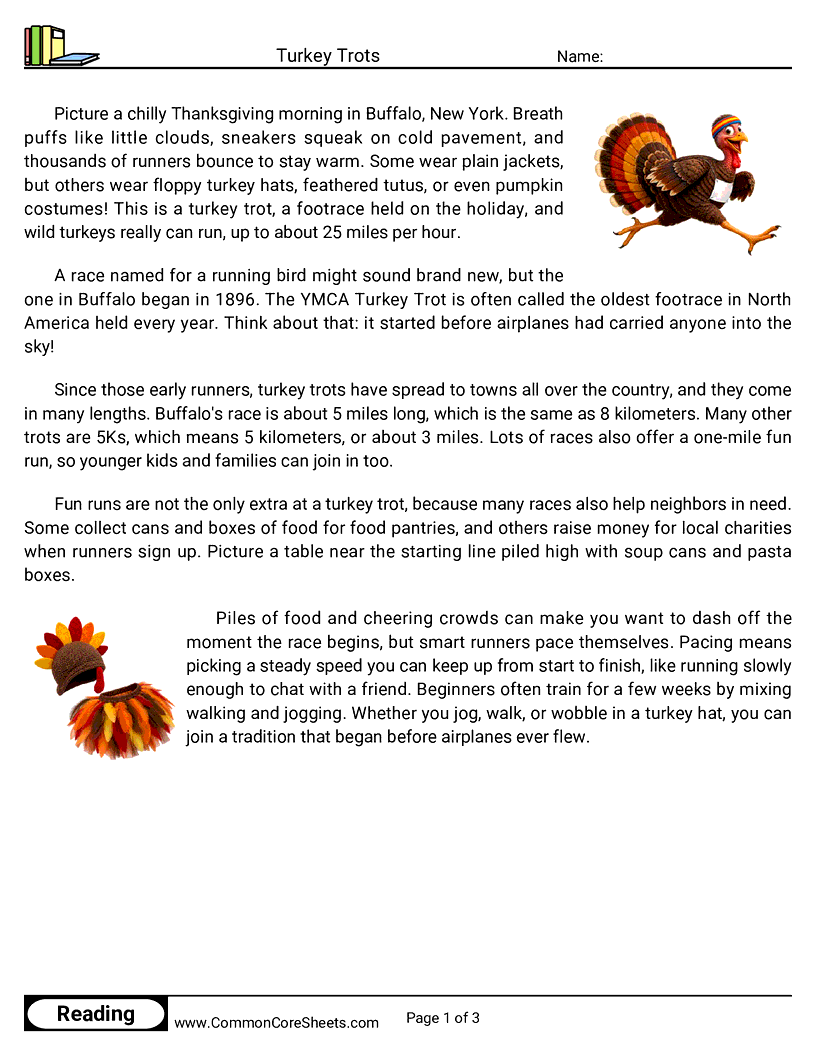
Picture a chilly Thanksgiving morning in Buffalo, New York. Breath puffs like little clouds, sneakers squeak on cold pavement, and thousands of runners bounce to stay warm. Some wear plain jackets, but others wear floppy turkey hats, feathered tutus, or even pumpkin costumes! This is a turkey trot, a footrace held on the holiday, and wild turkeys really can run, up to about 25 miles per hour.
A race named for a running bird might sound brand new, but the one in Buffalo began in 1896. The YMCA Turkey Trot is often called the oldest footrace in North America held every year. Think about that: it started before airplanes had carried anyone into the sky!
Since those early runners, turkey trots have spread to towns all over the country, and they come in many lengths. Buffalo's race is about 5 miles long, which is the same as 8 kilometers. Many other trots are 5Ks, which means 5 kilometers, or about 3 miles. Lots of races also offer a one-mile fun run, so younger kids and families can join in too.
Fun runs are not the only extra at a turkey trot, because many races also help neighbors in need. Some collect cans and boxes of food for food pantries, and others raise money for local charities when runners sign up. Picture a table near the starting line piled high with soup cans and pasta boxes.
Piles of food and cheering crowds can make you want to dash off the moment the race begins, but smart runners pace themselves. Pacing means picking a steady speed you can keep up from start to finish, like running slowly enough to chat with a friend. Beginners often train for a few weeks by mixing walking and jogging. Whether you jog, walk, or wobble in a turkey hat, you can join a tradition that began before airplanes ever flew.
Here's a puzzle: why would thousands of people hop out of bed on a chilly holiday morning and run through the streets? The answer is the turkey trot, a Thanksgiving-morning race held in towns all across the United States. Some runners wear plain sneakers, while others wear feathery turkey hats, orange tutus, or bird costumes that wobble with every step. Follow the clues, and you will find three parts to the mystery: a very old race, a good cause, and a smart plan.
Clue number one is the old race, which started in Buffalo, New York, in 1896, years before the first airplane flew. The Buffalo YMCA organized that Thanksgiving Day footrace, and people often call it the oldest footrace in North America held every year. Its course today is about 8K, which is roughly 5 miles, and it winds through downtown streets. Thousands of runners and walkers join in now, and crowds line the sidewalks to cheer for them.
Those cheering crowds hint at clue number two, because many turkey trots are about more than running. Lots of races use entry fees to raise money for local charities, and some ask runners to bring canned food. That food goes to a food bank, a place that collects groceries and shares them with families who need help. Races come in many lengths, from short fun runs to 5K races, which are about 3.1 miles, so nearly everyone fits at the starting line.
Standing at the starting line is only the beginning, so clue number three is how to reach the finish line without running out of energy. Coaches teach pacing, which means spreading your energy evenly across the whole race instead of spending it all in the first minutes. A handy check is the talk test: if you can still say a short sentence, your speed is about right. Walking breaks are fine, too, and a calm start often leaves enough energy for a speedy finish.
Cross that finish line, and the mystery nearly solves itself. People run on Thanksgiving morning to spend time outside with family, friends, and neighbors before the rest of the day begins. Some families enjoy a big meal afterward, while others do something different, but a trot welcomes anyone who wants to move. And that Buffalo race from 1896 has kept going for well over a century, long enough for turkey hats to join the fun.
Picture a race and you probably see lean athletes in matching shorts, all chasing a ribbon at the finish line. A turkey trot turns that picture upside down. On Thanksgiving morning, in towns all across the United States, people gather in the chilly air wearing turkey hats, feathered tails, and even pumpkin costumes. Some runners dash ahead, but many walk, push strollers, or jog beside their dogs. For most of them the goal is not to win but to show up, which makes the whole event feel like a parade on legs.
Showing up is a habit in Buffalo, New York, where the YMCA Turkey Trot began in 1896. That was the same year the first modern Olympic Games were held in Athens, Greece, and years before the first airplane flight. Today it is often called the oldest footrace in North America that is held every year. Think about that: runners have been lacing up on Thanksgiving morning for well over a century, even when Buffalo's weather turns cold and snowy. The course today is an 8K, which is about 5 miles, a real workout for a day known for big meals.
Five miles is a lot to ask of your legs, so most turkey trots offer shorter choices too. A 5K is about 3.1 miles, and many towns add a one-mile fun run for kids and first-timers. The word trot gives away the mood, since a trot is a steady, easygoing pace and not a flat-out gallop. In big cities the starting line can look like a river of turkey hats, with thousands of people flowing down the street at once. Costumes are half the fun, and it is common to spot runners dressed as pies, corn on the cob, and, of course, turkeys.
Whatever distance you choose, the smartest runners share a secret that begins at the starting line: hold back. Pace is how long it takes you to cover each mile, and beginners often start too fast, like someone spending a whole pocketful of coins in the first minute. Many coaches suggest a simple talk test: if you can chat in short sentences, you are going at a good speed. Experienced runners even aim for a negative split, which means running the second half of a race a little faster than the first. Warming up with a brisk walk beforehand helps your muscles wake up, too.
Slow and steady is also how many trots add up to something bigger than a race, one step and one donation at a time. Many races raise money for local charities or ask runners to bring canned food for food pantries, which help neighbors who need groceries. Families celebrate Thanksgiving in many ways, and some do not celebrate it at all, but a trot welcomes anyone who wants fresh air and company. In my view, that is what makes these races worth keeping: they turn a quiet street into a place where strangers cheer each other on. Not bad for a tradition that began in 1896 and still has room for one more turkey hat.
Here is a number to chew on before dinner: more than 125 years. That is how long runners have been lacing up their sneakers on Thanksgiving morning for the YMCA Turkey Trot in Buffalo, New York, first run in 1896. It is often called the oldest footrace in North America held every year, and it began the same year the first modern Olympic Games opened in Athens, Greece. Picture it today: breath puffing like steam, thousands of feet thumping the pavement, and runners in feathered hats jogging past cheering neighbors. Yet plenty of people on that starting line care more about fun than about finishing first.
That mix of serious and silly even shows up in the name. A trot is a horse's steady gait, slower than a gallop, so calling a race a "trot" tells everyone that joggers and walkers are welcome. Buffalo's course is 8 kilometers, about 5 miles, but plenty of towns offer a 5K, about 3.1 miles, and many add a short fun run for young children. Why so many choices? Because a family with a grandparent, a teenager, and a toddler can each pick a distance and still cheer for one another at the finish.
Once a whole family is on the starting line, the costumes usually appear. Runners show up in turkey hats, dressed as pies, or wearing capes of paper feathers, and the silliest outfits often draw the loudest cheers. Real wild turkeys, which live only in North America, would leave them all behind, since they can sprint roughly 20 to 25 miles per hour. Maybe that is why a turkey hat feels less like showing off and more like joining a joke everyone shares.
Of course, nobody needs a turkey's speed to make a difference. Many races use Thanksgiving morning to help neighbors who struggle to afford meals, so runners may bring cans of food or pay an entry fee that goes to a food bank or local charity. The idea works because a race gathers a huge crowd in one place at one time, and a small gift from each person quickly grows into a big pile of groceries. A race that looks like pure play can end the day by filling shelves.
That habit of small pieces adding up is also the secret to running a good race. Coaches often advise beginners to train a few times a week for several weeks, mixing walking and jogging and adding a little distance each time. On race day, the biggest mistake is sprinting at the start, because excitement and a crowd can trick you into using up your energy too soon. A better plan is the talk test: if you can say a full sentence without gasping, your pace is comfortable enough to last. Save a little energy for the final stretch, and you may even pass runners who started too fast.
Passing those worn-out sprinters feels great, but the finish line is not where the tradition ends. Over the decades, the idea spread from one city to towns across the country, and each race adds its own twist, from costume contests to food drives. Many families follow a run with a big meal, while others celebrate in different ways or not at all, and a race welcomes everyone because anyone can walk or jog. Think of it: a race that began before the first airplane ever flew still sends people in silly hats out into the cold every Thanksgiving morning.
On Thanksgiving morning in 1896, a small group of runners lined up in Buffalo, New York, for a race organized by the local YMCA, and nobody there could have guessed what they were starting. Today, on that same holiday morning, thousands of people crowd Buffalo's streets, their breath puffing white in the cold. Across the country, towns of every size stage their own versions, and every one of them is called a turkey trot. Picture the starting line: stamping sneakers, wool hats, a few floppy turkey hats bobbing above the crowd, and a table of steaming coffee nearby. So why does a morning run fit so comfortably beside a holiday that so many people link with a big meal?
That puzzle is easier to solve if you begin in Buffalo, whose race is often called the oldest footrace in North America held every year. Notice the careful phrase "often called": it signals that the title is widely repeated but hard to prove, since that would mean checking every local race on the continent. Still, the case for Buffalo is strong, because the YMCA started the race in 1896 and it has been a Thanksgiving fixture for well over a century. Here is a surprise: 1896 was also the year of the first modern Olympic Games, held in Athens, Greece, which included the first modern Olympic marathon. So when a runner crosses Buffalo's finish line today, the race beneath their feet is as old as the modern Olympics.
The Olympic marathon is famous for its brutal length, but turkey trots go in the opposite direction by offering a menu of distances. Many towns offer a 5K, which is about 3.1 miles, while Buffalo's course measures 8 kilometers, just under five miles. Others add one-mile fun runs for families, and plenty of races welcome walkers and strollers too. The distinction matters, because the fast runners at the front measure success by the clock, while most of the crowd measures it by who they ran beside. Even the name carries two meanings: "trot" suggests an easy, steady pace rather than a sprint, yet "turkey trot" was also the name of a popular dance in the early 1900s.
A name with that much swing in it practically begs for a costume, and runners happily oblige. Turkey hats with dangling red wattles share the course with tutus, foam pie slices, and superhero capes. A skeptic might argue that costumes make the race less serious, but that claim overlooks what the silliness does: it makes a start line feel friendly to beginners who might otherwise stay home. Even the bird on all those hats is a sprinter: wild turkeys, which live only in North America, can run at up to about 25 miles per hour. That is far faster than any runner in a Thanksgiving race, so no costumed runner will be catching one.
Most runners are not chasing anything that fast; many are chasing a good cause, since numerous turkey trots collect canned food or send part of their entry fees to food banks and local charities. One common explanation is that a holiday associated with sharing food naturally invites people to think about neighbors who may not have enough. That explanation is reasonable, but it is only one of several, because people also say the races exist for exercise, for community, or simply for tradition. Not every runner sits down to a turkey dinner afterward, since families celebrate in many different ways, and the race welcomes people either way.
Welcoming everyone includes beginners, and beginners do best with a plan. Many beginner programs last about two months, building up gradually with short runs, walking breaks, and rest days. On race day, the classic mistake is starting too fast, because the cheering crowd makes the first mile feel almost effortless. Coaches often recommend a "talk test": if you cannot speak a short sentence without gasping, ease off. Holding an even pace saves energy for the end, when the finish line comes into view and the crowd gets loudest. Maybe that is the real lesson of Buffalo's race, which started small in 1896, kept a steady pace for more than a century, and now fills the streets with thousands of runners every Thanksgiving morning.
About this worksheet
Students read a nonfiction passage about Thanksgiving turkey trot races, written at 8 reading levels (1st grade to 8th grade), and answer multiple-choice questions about it.
A reading comprehension worksheet about Thanksgiving turkey trot races with a different article for each reading level, 1st grade to 8th grade, each with its own multiple-choice questions aligned to the Common Core Reading: Informational Text standards. Printable with an answer key, and available as an online assignment at any level.
Student objectives
- Read a passage about turkey trot races and find the main idea.
- Find details that tell how long different races are and why races help others.
- Explain what it means to pace yourself in a race.
- Describe how the author organizes information by comparing and explaining.
Everyday practice
- Try the talk test on a walk or jog: can you move at a steady speed and still chat with a friend?
- Look at a map or measure a route near you to see how far a mile is, then imagine how far a 5K would be.
- Notice whether your town or school has a food drive or fun run, and see how neighbors help each other.