The Wishbone Worksheet Download
Free reading comprehension worksheet about the wishbone. Pick the reading level (kindergarten to 8th grade), print the passage with its questions, or assign it online.


Sheet Information >
Available at kindergarten, 1st grade, 2nd grade, 3rd grade, 4th grade, 5th grade, 6th grade, 7th grade and 8th grade reading levels.
Read the passage
Look at this little bone shaped like a V! It is a wishbone made of two small bones joined together. Birds have one inside their chests.
That wishbone inside the chest helps a bird fly! It springs apart and back when the bird flaps its wings. Even some dinosaurs had wishbones!
People like wishbones too! Some families let a wishbone dry and then two people pull the ends. Whoever gets the bigger piece makes a wish on a bone that helps birds fly!
Have you ever seen a bone shaped like the letter V? Birds have one, and it is called a wishbone! It sits at the front of a bird's chest, below the neck.
That bone below the neck helps the bird fly! When a bird flaps, the bone springs open, then snaps back. Some dinosaurs had wishbones too, just like birds do today!
Dinosaurs are long gone, but wishbones still bring people fun. Two people pull a dried wishbone, an old custom from England that came to America. The bigger piece wins a wish, from a bone that helps birds fly!
Wow, a bird has a tiny spring inside its chest, shaped like the letter V! Scientists call it a furcula, but most people call it a wishbone. It is really two collarbones joined together at the bottom.
Those joined collarbones make a bendy V, and that bendiness helps a bird fly. When the bird flaps its wings, the V spreads apart and springs back together like a bouncy clip. Can you imagine springing like that with every flap?
That springy V is not new, because some dinosaurs had one too! Scientists have found wishbones in fossils, the old bones of dinosaurs that lived millions of years ago. That is one clue that birds are related to dinosaurs.
A bone with a dinosaur past also has a wishing custom, one that came to America from England. Many families who cook a bird let the wishbone dry, and then two people each pull one end until it snaps. Whoever gets the bigger piece makes a wish, using a bone that helps birds fly and ties them to dinosaurs.
Imagine you are holding a small, pale bone shaped like the letter V. It is a wishbone, and scientists call it a furcula, which means "little fork." A furcula is really two collarbones joined together into one springy V. Most birds, from tiny hummingbirds to big turkeys, have one hidden inside their chests.
Hidden in a bird's chest, that little V has a big job. Each time a bird flaps its wings, the V bends apart and springs back, like the spring inside a pen. Because the bone bounces back, it helps the bird fly. A hummingbird flaps its wings dozens of times each second, so its wishbone springs back and forth very fast.
Birds are not the only animals to have had this bouncy bone. Scientists have found wishbones from some dinosaurs in fossils, the hardened remains of animals that lived long ago. Because birds and some dinosaurs share this bone, it is one clue that birds are related to dinosaurs. That means the sparrow outside your window is a distant relative of dinosaurs!
Scientists study wishbones, but many families use one to play a wishing game. First the bone dries for a while so it can snap, and then two people each pull an end. Whoever gets the bigger piece makes a wish, an old custom that came to America from England. Isn't it wonderful that one small bone can help a bird soar, hint at dinosaurs, and hold a wish?
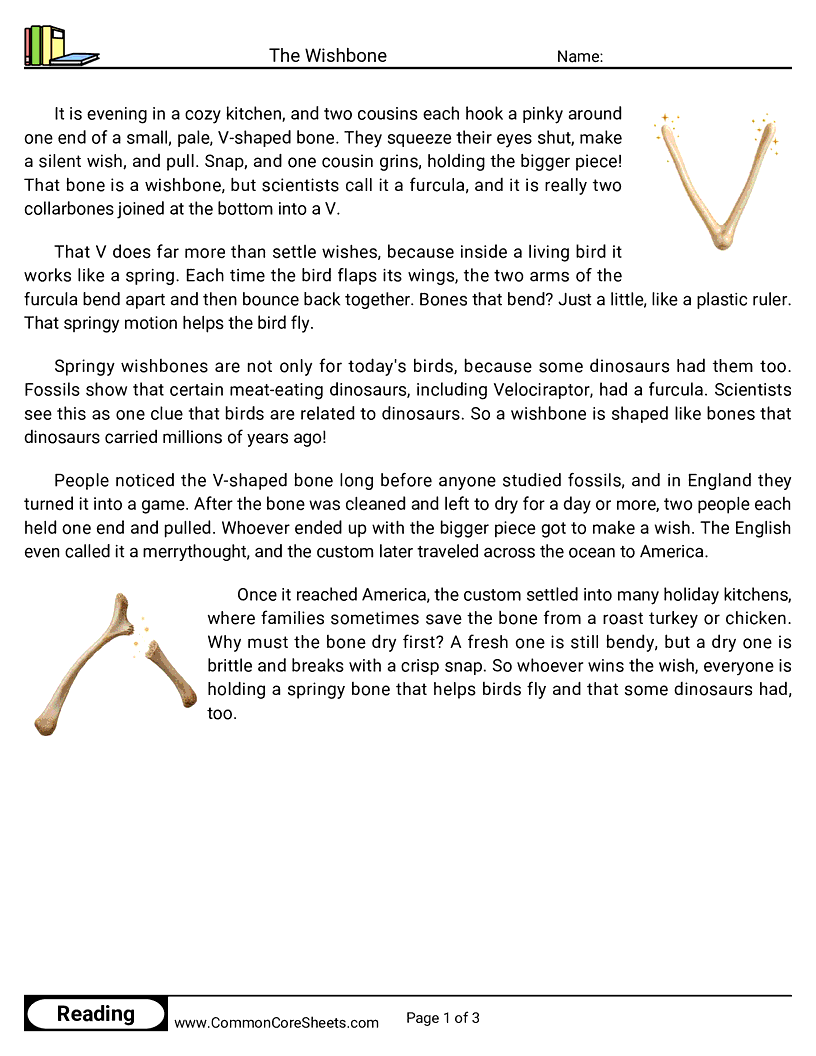
It is evening in a cozy kitchen, and two cousins each hook a pinky around one end of a small, pale, V-shaped bone. They squeeze their eyes shut, make a silent wish, and pull. Snap, and one cousin grins, holding the bigger piece! That bone is a wishbone, but scientists call it a furcula, and it is really two collarbones joined at the bottom into a V.
That V does far more than settle wishes, because inside a living bird it works like a spring. Each time the bird flaps its wings, the two arms of the furcula bend apart and then bounce back together. Bones that bend? Just a little, like a plastic ruler. That springy motion helps the bird fly.
Springy wishbones are not only for today's birds, because some dinosaurs had them too. Fossils show that certain meat-eating dinosaurs, including Velociraptor, had a furcula. Scientists see this as one clue that birds are related to dinosaurs. So a wishbone is shaped like bones that dinosaurs carried millions of years ago!
People noticed the V-shaped bone long before anyone studied fossils, and in England they turned it into a game. After the bone was cleaned and left to dry for a day or more, two people each held one end and pulled. Whoever ended up with the bigger piece got to make a wish. The English even called it a merrythought, and the custom later traveled across the ocean to America.
Once it reached America, the custom settled into many holiday kitchens, where families sometimes save the bone from a roast turkey or chicken. Why must the bone dry first? A fresh one is still bendy, but a dry one is brittle and breaks with a crisp snap. So whoever wins the wish, everyone is holding a springy bone that helps birds fly and that some dinosaurs had, too.
Here is a puzzle: what do a roasted bird on a dinner table, a hummingbird zipping past a flower, and a dinosaur that lived millions of years ago have in common? The answer is a thin, V-shaped bone called the wishbone. It sits at the front of a bird's chest, and its two slim arms join at the bottom like the letter V. How did a bone get such a wishful name, and what is it doing inside a living bird?
Inside a living bird, the wishbone is no leftover; it is a tiny spring. Scientists call it the furcula, a Latin word meaning "little fork," and it forms when a bird's two collarbones join together. Each time the wings flap, the V spreads apart and springs back together, a bit like a pair of tweezers you pull apart and let go. That springy help is important, because some hummingbirds flap their wings dozens of times every second!
Flying is not the only place a wishbone shows up, because fossil hunters have found these bones in dinosaurs, too. Many meat-eating dinosaurs called theropods had a furcula, including the mighty Tyrannosaurus rex. Scientists see this shared bone as one clue that birds are related to dinosaurs, along with other clues such as feathers on some fossils. That means a bone linking a robin to a dinosaur has been hiding in plain sight.
A bone that connects robins and dinosaurs can also connect people around a table, thanks to a very old wishing game. First, the wishbone is set aside to dry for a few days, so it turns stiff and brittle. Then two people each hold one end, make a silent wish, and pull until the bone snaps. Whoever ends up with the bigger piece gets the wish, a custom that came to America from England.
The wish stays secret, but the bone's old English nickname, merrythought, is out in the open. Here is a funny twist: the same bone that bends and bounces in a living bird must dry out before it will snap. Fresh, it is springy, but dried, it becomes brittle, so it breaks with a quick crack. So when your wishbone snaps, remember that you are holding a spring from a bird's chest, in a shape some dinosaurs carried millions of years before anyone made a wish.
Almost everyone believes the wishbone is just a funny-shaped leftover, a bone whose only job is to snap at the dinner table. Hold on, because that belief is about to be turned upside down! A wishbone is a slender, pale, V-shaped bone, with two curved arms that meet at a point like a tiny slingshot. Its scientific name is the furcula, from a Latin word meaning "little fork." Far from being a leftover, it once worked hard inside a living bird, helping it climb into the sky.
Climbing into the sky takes serious muscle, and the furcula is part of the team. It is made of two collarbones that have joined together at the bottom to form the V. Each time a bird flaps its wings, the arms of the V spread apart and then spring back, like a pair of tweezers being squeezed and released. Scientists have seen this happen by filming flying birds with X-ray video, flap after flap. Researchers still debate exactly how much energy the springy bone saves, but many agree that it is a clever part of a bird's flying machinery.
That springy V has a past stretching back millions of years, long before any turkey strutted across a farmyard. Fossil hunters have found wishbones in meat-eating dinosaurs called theropods, including Tyrannosaurus rex. Picture one of the largest hunters ever to walk on land carrying the same V-shaped bone as a backyard chicken! Wishbones are one of several features that birds share with these dinosaurs, which is a big clue that the two are related. In fact, scientists now think of birds as a living branch of the dinosaur family tree, so a sparrow hopping past your window is a distant cousin of T. rex.
A bone with a history that grand deserves a tradition of its own, and it got one: the wish. In England, the wishbone was once nicknamed the "merrythought," and the wishing custom came to America with people who moved there from England. First, the bone has to dry for a few days, because a fresh one is rubbery and bends instead of snapping. Then two people each hook a finger around one end, close their eyes, and pull. Whoever is left holding the bigger piece gets to make a wish, or so the old custom goes.
Wishes may depend on luck, but the wishbone's science depends on evidence. Families celebrate in many ways, and some pull a wishbone from a chicken or duck, while others skip the tradition altogether. Meanwhile, scientists still study wishbones, both living and fossil, to learn how animals are related and how flight may have developed. That is why I think this small bone deserves far more credit than it gets: it shows that an everyday object can hide a giant story. The little bone you pull for a wish once flexed inside dinosaurs that lived millions of years ago.
Here is a bone that is older than every holiday on the calendar, yet you can snap it in half in less than a second. Tucked between a bird's shoulders, the wishbone is a slender, springy V, a bit like a tiny slingshot made of bone. Scientists call it the furcula, a Latin word meaning "little fork," and it is really two collarbones fused together at the bottom. You have two collarbones too, but yours stay separate and stretch sideways across your chest. A bird's pair joined into one, and that small change turned out to matter a great deal.
To see how much it matters, watch a bird in flight, because the wishbone is hard at work with every flap. With each wingbeat, the V bends apart and then springs back, like a paper clip you pull open and let go. In the late 1980s, researchers used high-speed X-ray film to watch starlings flying, and they saw the wishbone flex in rhythm with the wings. Many scientists think the springiness helps brace the shoulders and may save some of the energy needed for flapping, though they are still working out how much. That is a lot of flexing for a hummingbird, whose wings can beat dozens of times every second.
A bone built for such fast flexing sounds like a purely bird invention, yet fossil hunters have found wishbones in an unexpected place: inside dinosaurs. Meat-eating dinosaurs called theropods, including Velociraptor and Tyrannosaurus rex, had a furcula, even though they never took to the air. Birds are living descendants of theropods, and the shared wishbone is one clue, alongside feathered fossils and similar hollow bones. So when a wishbone dries on a kitchen counter, you are looking at a design that goes back to the age of dinosaurs.
People have been giving that little bone a second look for a very long time, though not always for its science. Some writers trace the idea back to ancient Italy, where people watched chickens for hints about the future, though historians say the evidence is thin. In England, the bone had a cheerful nickname, the "merrythought," which hints at how playful the game was. People moving from England to North America carried the custom across the ocean, and it took root in American kitchens.
Once the bone reached those kitchens, the game demanded one thing above all: patience. A fresh wishbone is a little bendy, so it tends to bow before it breaks, but a day or more of drying leaves it brittle and ready to snap. Then two people each grab an end, make a silent wish, and pull, and tradition says the one left holding the larger piece gets the wish. The silent part matters, because the old rule says a wish spoken aloud will not come true. Since a break is rarely perfectly even, there is nearly always a winner, which may be one reason the game has lasted.
A game that almost always crowns a winner is easy to hand down, and each new dinner table has added its own twists. Some families hook pinky fingers on the ends, others take turns, and some save the bone from a chicken, turkey, or goose. Plenty of families never cook a whole bird at all, and they make their wishes in other ways, such as over birthday candles. Whichever way a family makes its wish, the bone in their hands is a design that has been flexing inside birds, and dinosaurs before them, for well over 150 million years.
In the 1920s, a Danish artist and naturalist named Gerhard Heilmann built a bold argument on one small bone. Birds have a wishbone, he pointed out, but the dinosaur fossils known back then seemed to have nothing like it, so he concluded that birds must have come from somewhere else. That bone, called the furcula, is the V-shaped piece between a bird's shoulders, formed when its two collarbones join at one end. Thin and springy, it looks like a tiny slingshot, and a turkey's is small enough to hold in one hand. Could something so slight really settle a question about the history of life? Hold that thought, because the answer was bigger than Heilmann guessed.
Heilmann was right about one thing: a wishbone matters enormously to a bird in flight. With each downstroke of the wings, the two arms of the V bend apart, and then they spring back together, rather like a clothespin being squeezed and released. In the late 1980s, a team led by researcher Farish Jenkins used X-ray film to watch starlings fly in a wind tunnel and saw the bone spread and recoil with every wingbeat, which inspired the popular idea that the wishbone works like a spring. Later studies complicated the picture, suggesting it may act mostly as a brace that keeps the shoulders from squeezing together, and scientists still debate how much energy it returns. Either way, it is a bone built to flex.
That bendy bone also turned up somewhere Heilmann never expected: inside dinosaurs. Later fossil finds showed that many theropods, the mostly meat-eating group that includes Velociraptor and Tyrannosaurus rex, had wishbones of their own. Because those dinosaurs could not fly, their wishbones must have had a different job at first, perhaps bracing the shoulders. Nature often works this way, reusing an old part for a new purpose, and in birds the bone became part of the flying machine. Along with feathers and hollow bones found in other fossils, the shared wishbone is one reason most paleontologists now consider birds to be living dinosaurs. Heilmann's missing bone, in other words, had been in the fossils all along, waiting to be found.
No dinosaur ever made a wish on its wishbone, so when did people start? One popular explanation points to the Etruscans, who lived in what is now Italy more than 2,000 years ago and were known for reading signs in the behavior of birds. In this story, the Romans picked up the habit from them and carried it to Britain. Historians are more cautious, noting that the chain of evidence is thin, and that clear descriptions of people pulling a bone in a contest come from England, centuries later. The English also had a second name for it, merrythought, a word that still appears in dictionaries. That gap between a good story and good evidence is something historians wrestle with all the time.
Whatever its true beginning, the game crossed the Atlantic, carried to North America by English families who kept the custom alive. The routine has barely changed: after the meal, the wishbone is set aside to dry, often for a day or more. Drying matters because a fresh bone is bendy and tends to bend before it breaks, while a dry one turns brittle and snaps. Then two people each hook a finger around one end, make a silent wish, and pull. By tradition, whoever ends up with the larger piece gets the wish. Since a bone almost never breaks exactly in the middle, someone nearly always walks away with the bigger piece.
Whether you win the bigger piece or not, the game has stretched far beyond the old English table. Many families serve turkey, others roast a chicken, and some gather for a meal with no bird at all, so the wishbone is just one tradition among many. Some families add rules of their own, such as taking turns pulling year after year. Scientists, meanwhile, keep studying how the same bone works inside living birds, and historians keep sifting for the earliest clues about the wish. So when a dried wishbone finally snaps, you are holding a design that dinosaurs carried more than 100 million years ago and that birds still use to fly.
About this worksheet
Students read a nonfiction passage about the wishbone, written at 9 reading levels (kindergarten to 8th grade), and answer multiple-choice questions about it.
A reading comprehension worksheet about the wishbone with a different article for each reading level, kindergarten to 8th grade, each with its own multiple-choice questions aligned to the Common Core Reading: Informational Text standards. Printable with an answer key, and available as an online assignment at any level.
Student objectives
- Read a passage about the wishbone and find details about how a furcula works in a bird.
- Explain how the author uses evidence, such as fossils, to show that birds are related to dinosaurs.
- Find the cause and effect that explains why a wishbone must dry before it is pulled.
- Use context clues to work out the meaning of the word merrythought.
Everyday practice
- Bend a plastic ruler or a thin strip of cardboard a little and let go. Notice how it springs back, the way a bird's furcula does.
- Watch birds at a window or park as they flap their wings, and think about the springy V-shaped bone inside their chests.
- Ask a family member whether they have ever made a wish on a wishbone, or if they have another way of making wishes.