Swallow Worksheet Download
Free reading worksheets on Swallow. Each worksheet has 20 problems with an answer key and are ideal for teachers and homeschooling. You can download the PDF, create a set of flash cards or set it up for online learning.
Select a Different Activity
>


Sheet Information >
Available at 2nd grade, 3rd grade, 4th grade, 5th grade and 6th grade reading levels.
Read the passage
Hello there, have you ever seen a swallow flying around in the sky? Swallows are small birds with dark, glossy-blue backs, red throats, pale undersides and long tail streamers. They are incredibly fast fliers, and that's because they have to catch flying insects right out of the air to eat!
Now let's talk about where these amazing birds live and their life cycle. Swallows are found all over the world, living in areas near water and where they can find mud to build their nests. In their life cycle, they hatch from eggs, grow into fledglings (young birds), then eventually become adults who can lay eggs of their own.
Swallows have an interesting relationship with humans and other animals. With humans, they are mostly friendly and often build nests in barns or under the eaves of houses, and with other animals, they can sometimes help by eating insects that bother them. Isn't it amazing how swallows are different from other birds and also so helpful?
Hello there, do you know about swallows, those amazing little birds that you might have seen darting around in the sky? Swallows are small, agile birds with a very distinct look, they have dark, glossy-blue backs, red throats, pale underparts and long tail streamers. You can find them almost all over the world, living in a variety of habitats, from grasslands to deserts, and they even love to build their nests near human homes! Interesting fact, swallows are known to return to the same nesting spot year after year, isn't that cool?
Let's explore more about what swallows eat and their life cycle, shall we? Swallows have a big appetite for insects, they catch them mid-air during their flight, which is a pretty neat trick! Now, when it comes to their life cycle, swallows lay eggs once or twice a year in a nest made of mud pellets and lined with feathers. The baby swallows, or 'chicks', are born without feathers and with their eyes closed, but grow quickly and leave the nest after about a month.
Swallows have a pretty interesting relationship with humans and other animals. Farmers love swallows because they eat insects that can harm crops, and their chirping is a cheerful addition to a summer's day. When it comes to other animals, swallows have to be careful of predators like cats and larger birds, but they're pretty good at defending themselves with their swift flying skills. In conclusion, swallows are truly fascinating creatures with unique habits and abilities that set them apart from other birds.
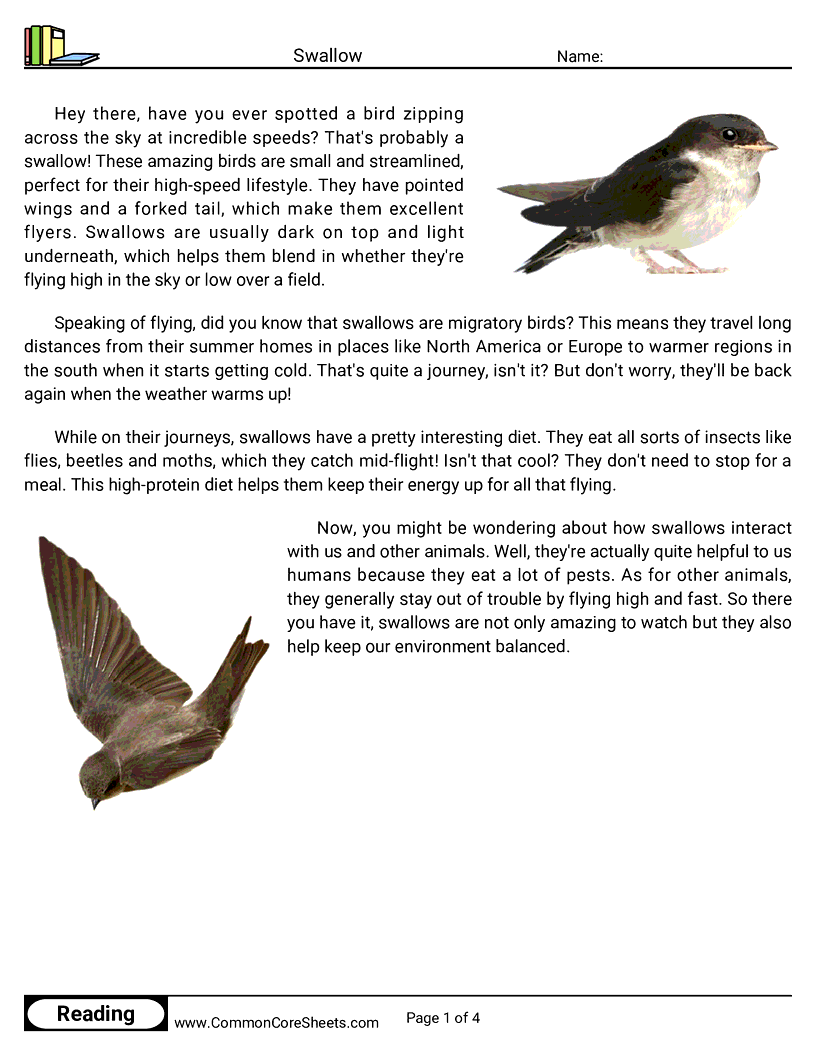
Hey there, have you ever spotted a bird zipping across the sky at incredible speeds? That's probably a swallow! These amazing birds are small and streamlined, perfect for their high-speed lifestyle. They have pointed wings and a forked tail, which make them excellent flyers. Swallows are usually dark on top and light underneath, which helps them blend in whether they're flying high in the sky or low over a field.
Speaking of flying, did you know that swallows are migratory birds? This means they travel long distances from their summer homes in places like North America or Europe to warmer regions in the south when it starts getting cold. That's quite a journey, isn't it? But don't worry, they'll be back again when the weather warms up!
While on their journeys, swallows have a pretty interesting diet. They eat all sorts of insects like flies, beetles and moths, which they catch mid-flight! Isn't that cool? They don't need to stop for a meal. This high-protein diet helps them keep their energy up for all that flying.
Now, you might be wondering about how swallows interact with us and other animals. Well, they're actually quite helpful to us humans because they eat a lot of pests. As for other animals, they generally stay out of trouble by flying high and fast. So there you have it, swallows are not only amazing to watch but they also help keep our environment balanced.
Hello, young explorer! Let's dive into the exciting world of swallows. Swallows are small, agile birds known for their swift flight. Their glossy, colorful feathers and unique fork-tail make them easy to identify. These fascinating birds can be found almost all over the world, except in the driest deserts and the coldest regions.
So, what do these little birds eat? Swallows are insectivores, which means they eat insects! They catch their meals on the wing, meaning they eat while they fly. Their diet includes a variety of insects like flies, beetles, and mosquitoes.
Now, let's explore the life cycle of a swallow. Swallows usually live around 4 years, but some have been known to live up to 12 years! They mate for life and build nests to lay their eggs, which hatch after about two weeks. Baby swallows, called fledglings, learn to fly when they are about a month old.
What about their relationship with humans and other animals? Swallows are generally friendly birds and often build their nests close to human settlements. They are beneficial to us as they eat many insects that are considered pests. As for other animals, swallows have to watch out for predators like cats, hawks, and snakes.
Let's wrap up with some interesting facts and differences between swallows and other birds. Unlike many birds, swallows don't walk or hop - they only perch or fly. And did you know that swallows migrate thousands of miles every year to find warmer climates? Swallows are truly fascinating creatures, don't you think?
Welcome to the fascinating world of swallows, agile and graceful birds that fill the sky with beauty. These birds are easily recognized by their sleek bodies, pointed wings, and forked tails, which help them perform breathtaking aerial acrobatics. Swallows can be found across the globe, except for Antarctica, making their homes in a variety of environments from grasslands to deserts, and even in your backyard! There are around 90 species of swallows and they can range in size from 4.5 inches to a foot in length. Swallows are not only beautiful, but they also play an important role in our ecosystem.
Diving into their diet, swallows are insectivores, meaning they eat insects. They catch their meals on the fly, swooping and darting through the air to snatch up beetles, flies, mosquitoes, and other small insects. They also drink while flying, skimming the surface of a body of water and scooping up a beakful. Their ability to eat on the go is not only impressive, but it also helps control the population of pesky insects. Think of them as nature's pest control!
Now, let's talk about the life cycle of a swallow. Swallows usually mate for life and build their nests in the spring using a mix of mud and saliva, often on the sides of buildings or cliffs. The female swallow lays 2-7 eggs at a time, which both parents help incubate for about two weeks until they hatch. The young swallows, or fledglings, leave the nest after about a month but continue to be fed by their parents until they can hunt insects on their own. Swallows usually live for about 4 to 5 years, but some have been known to live up to 16 years.
Swallows have an interesting relationship with humans and other animals. For humans, they help control insect populations and their nests are believed to bring good luck in some cultures. However, they can also be seen as a nuisance when they build their nests in or on buildings. As for other animals, swallows have few predators in the air thanks to their speed and agility, but their eggs and fledglings can be prey for snakes, cats, and other climbing predators. They are also known to have symbiotic relationships with some animals like cows, where they eat the flies off the cow's back.
Finally, let's explore some fun and interesting facts about swallows. Did you know that swallows migrate thousands of miles each year, travelling from Europe to Africa for the winter? They also have an amazing sense of direction and can find their way back to the same nest, year after year. Also, unlike many birds, swallows can sleep while flying and they even molt, or shed and regrow their feathers, during their long migration. In conclusion, swallows are incredible creatures with unique abilities and interesting behaviors, truly deserving of our admiration and respect.
About this worksheet
Students read, spell, and use the word "swallow" while exploring its meaning as both an action and a bird.
This worksheet is designed to enhance children's reading comprehension by exploring interesting facts around swallows. Comprising 20 customized questions, it covers subjects such as bird behavior, migratory patterns, and the vital role swallows play in our ecosystem. Ready for conversion into flash cards or suited to distance learning, it's an efficient tool to foster learning while cultivating curiosity about the natural world.
Student objectives
- Learn to spell the word swallow correctly
- Understand that swallow can mean to eat or drink and also a type of bird
- Use the word swallow in a complete sentence
- Recognize the word swallow when reading
Everyday practice
- Describe how you swallow food or a drink at dinner
- Point out a swallow bird you see flying outside
- Use the word swallow when talking about taking medicine
- Spell swallow while writing a story or journal entry