Star Nosed Mole Worksheet Download
Free reading worksheets on Star Nosed Mole. Each worksheet has 20 problems with an answer key and are ideal for teachers and homeschooling. You can download the PDF, create a set of flash cards or set it up for online learning.


Sheet Information >
Available at 2nd grade, 3rd grade, 4th grade, 5th grade and 6th grade reading levels.
Read the passage
Have you ever heard of the star-nosed mole? This little creature is very unique and has a special nose that looks like a star! They are small, black, and furry, and their star-shaped nose helps them feel their way around and find food.
Let's talk about where they live and what they eat. These moles can be found in North America, living in wet, swampy areas. Their diet includes insects, worms, and even small fish, which they catch using their super-fast, star-shaped nose!
Now, let's learn about their life cycle and relationship with other animals. Star-nosed moles have a short life span of about 3 to 4 years, and they don't have many predators due to their underground lifestyle. Humans don't have much interaction with these moles, but they can be helpful to us by eating insects that can harm plants and crops.
The star-nosed mole is a fascinating creature that has a unique nose, lives in wet environments, and contributes to a healthy ecosystem.
Meet the star-nosed mole, a fascinating creature with a unique appearance! These moles have a circle of 22 tiny, pink tentacles at the end of their nose, which they use to feel their way around and find food. Star-nosed moles live in wet, swampy areas in North America, where they dig tunnels in the soft, muddy soil. They are small, only about the size of a hamster, and have dark, water-repellent fur that helps them stay warm and dry in their damp homes.
Now let's learn about the star-nosed mole's diet and life cycle. These little creatures are insectivores, which means they eat insects, worms, and other small invertebrates. Their life cycle begins with a mother mole giving birth to a litter of 2-7 babies, called pups, which are born blind and hairless. As they grow, they develop their star-shaped noses and become expert hunters, using their amazing sense of touch to find food in their dark underground world.
Lastly, let's explore the star-nosed mole's relationship with humans, other animals, and their unique features. While they don't have much interaction with humans, they do play an important role in controlling insect populations and aerating the soil with their tunnels. Some predators, like birds of prey and larger mammals, may hunt star-nosed moles, but their main defense is their secretive, underground lifestyle. Compared to other mole species, star-nosed moles have a much better sense of touch and can even swim, which allows them to catch aquatic prey like small fish and crustaceans.
So there you have it, the star-nosed mole is an amazing animal with incredible adaptations that help it thrive in its unique environment.
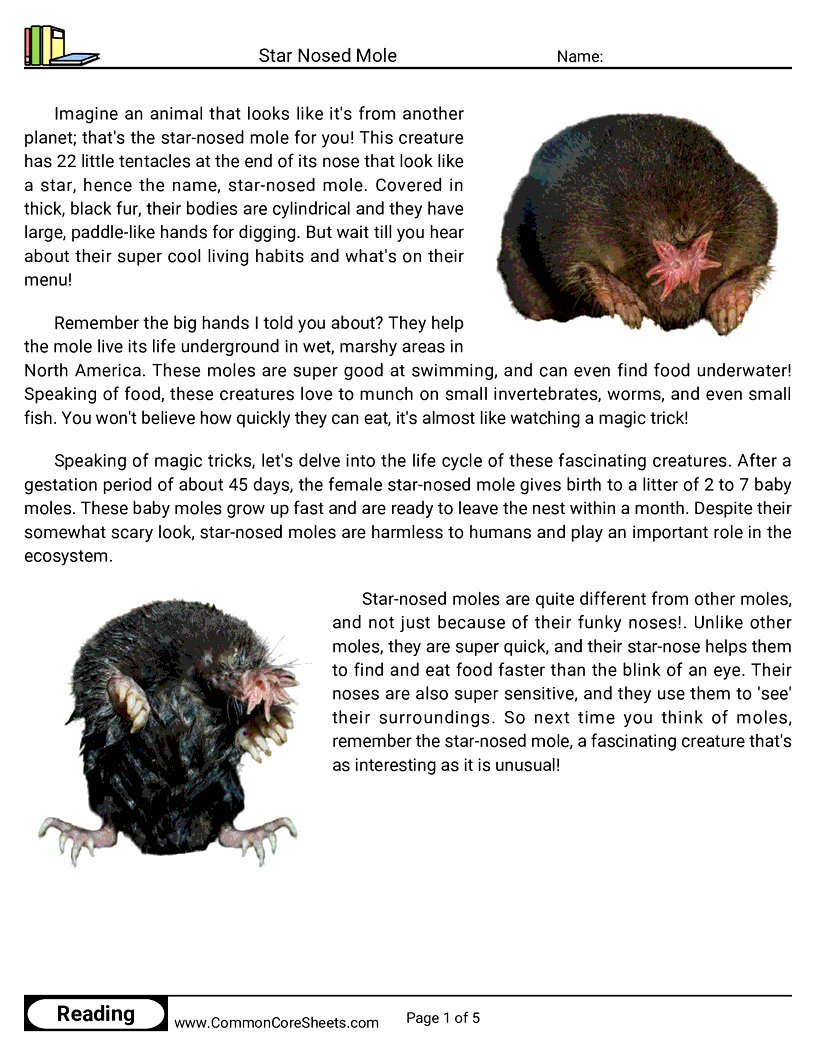
Imagine an animal that looks like it's from another planet; that's the star-nosed mole for you! This creature has 22 little tentacles at the end of its nose that look like a star, hence the name, star-nosed mole. Covered in thick, black fur, their bodies are cylindrical and they have large, paddle-like hands for digging. But wait till you hear about their super cool living habits and what's on their menu!
Remember the big hands I told you about? They help the mole live its life underground in wet, marshy areas in North America. These moles are super good at swimming, and can even find food underwater! Speaking of food, these creatures love to munch on small invertebrates, worms, and even small fish. You won't believe how quickly they can eat, it's almost like watching a magic trick!
Speaking of magic tricks, let's delve into the life cycle of these fascinating creatures. After a gestation period of about 45 days, the female star-nosed mole gives birth to a litter of 2 to 7 baby moles. These baby moles grow up fast and are ready to leave the nest within a month. Despite their somewhat scary look, star-nosed moles are harmless to humans and play an important role in the ecosystem.
Star-nosed moles are quite different from other moles, and not just because of their funky noses!. Unlike other moles, they are super quick, and their star-nose helps them to find and eat food faster than the blink of an eye. Their noses are also super sensitive, and they use them to 'see' their surroundings. So next time you think of moles, remember the star-nosed mole, a fascinating creature that's as interesting as it is unusual!
Meet the star-nosed mole, a fascinating little creature that lives underground. These moles are easily recognizable by their unique nose, which has 22 tentacle-like appendages. These tentacles help them to feel their way around and find their favorite meals. Their small size, around 15-20 centimeters long, makes them perfectly suited for their underground lifestyle.
Now let's explore where these unique creatures call home. Star-nosed moles are primarily found in North America, particularly in the northeastern United States and eastern Canada. They prefer wet, swampy environments, as these areas provide the perfect conditions for their favorite meals. Their underground tunnels can be found close to the water's surface, making it easy for them to catch their prey.
Speaking of meals, the star-nosed mole has a varied diet. They primarily feast on insects, worms, and other small invertebrates that they find in the soil. Their impressive speed when devouring their prey has earned them the record for being one of the fastest eaters in the animal kingdom. Interestingly, they can even catch and eat small fish and aquatic insects when they venture into the water.
One thing that makes the star-nosed mole unique is its life cycle. They usually mate in late winter or early spring, and the female gives birth to a litter of 2-7 babies after about 45 days. These babies quickly grow and are able to leave the nest in just a few weeks. As they grow up, they learn to be independent and will eventually start families of their own.
Lastly, let's talk about the star-nosed mole's relationships with humans and other animals. While they don't have any direct interactions with humans, they do play an important role in the ecosystem by controlling insect populations. Their main predators include birds of prey, snakes, and larger mammals. Their unique nose, along with their ability to quickly dig tunnels, helps them evade these predators and stay safe.
As we've discovered, the star-nosed mole is a truly fascinating creature with a unique appearance, interesting habitat, diverse diet, and important role in the ecosystem. Next time you come across a swampy area, just think – there might be a star-nosed mole nearby, busy helping to maintain balance in nature.
Have you ever heard of the star-nosed mole? This unique little creature is known for its peculiar nose that looks like a star. The star-nosed mole is a small, furry mammal with 22 fleshy tentacles on its nose that it uses to feel its way around and find food. They are found in North America, primarily in the eastern United States and Canada. These moles are fascinating animals with some pretty amazing abilities.
Let's dive into the world of the star-nosed mole's diet. These little critters are carnivorous and eat a variety of small animals and insects. Their menu includes worms, insect larvae, small fish, and even amphibians like frogs. The star-nosed mole is incredibly fast at catching its prey, taking only a fraction of a second to identify, grab, and devour its meal. This amazing speed makes it one of the fastest-eating mammals on Earth.
Now, let's explore their life cycle and habitat. Star-nosed moles live in wet, swampy areas near bodies of water, like marshes, ponds, and streams. They dig tunnels and create burrows in the soft soil to make their homes. These moles have a life span of around four years and breed once a year, usually producing a litter of two to seven babies. The babies, called pups, are born blind and hairless and rely on their mother for the first few weeks of their lives.
What is the relationship between star-nosed moles, humans, and other animals? Well, these moles are not considered pests and generally do not cause any trouble for humans. In fact, they can be beneficial to the environment by controlling insect populations. As for their relationship with other animals, they don't have many predators, but some birds of prey, snakes, and larger mammals might view them as a meal. However, their underground lifestyle and excellent digging skills help them avoid many dangers.
Lastly, let's discuss some interesting facts and differences between the star-nosed mole and other species. One incredible fact is that the star-nosed mole is semi-aquatic, meaning it can swim and even hunt for food underwater! This sets it apart from other mole species that mostly stay on land. Another interesting fact is that the star-nosed mole is the only known mammal that can smell underwater by blowing bubbles and then re-inhaling them. This truly makes them one of the most fascinating creatures in the animal kingdom.
In conclusion, the star-nosed mole is a remarkable and unique animal with incredible abilities and characteristics that set it apart from other species. It's always exciting to learn about the amazing creatures that share our planet.
About this worksheet
Students read an informational passage about the star nosed mole and answer comprehension questions about its features and habits.
This worksheet is designed to enhance children's reading and comprehension skills with interesting facts about the Star-Nosed Mole. It features 20 detailed questions on the creature's lifestyle, appearance, habits and more. The versatile worksheet can be customized for different learner needs, easily converted into flash cards for an interactive experience or efficiently used in distance learning settings.
Student objectives
- Read and understand facts about the star nosed mole
- Find key details in a nonfiction passage
- Answer questions using information from the text
- Learn new vocabulary about animals and their habitats
Everyday practice
- Read an animal fact page at the zoo and remember details about it
- Look up information about an unusual animal you saw in a video
- Explain to a friend what makes an animal special after reading about it
- Answer questions about a nature article you read for a school report