Margay Worksheet Download
Free reading worksheets on Margay. Each worksheet has 20 problems with an answer key and are ideal for teachers and homeschooling. You can download the PDF, create a set of flash cards or set it up for online learning.
Select a Different Activity
>


Sheet Information >
Available at 2nd grade, 3rd grade, 4th grade, 5th grade and 6th grade reading levels.
Read the passage
Hey kids! Let\'s learn about the amazing Margay, a small wild cat that lives in the rainforests of Central and South America. These fascinating creatures have a beautiful coat of fur with spots and stripes, making them look like tiny leopards. They have large, expressive eyes that help them see very well at night, and they are excellent climbers who can even hang upside down from tree branches using their strong paws.
Now, let\'s talk about what Margays eat and their life cycle. These little cats are carnivores, which means they eat other animals, like birds, lizards, and small mammals such as monkeys and rodents. Margays usually live alone, and after a momma Margay has her baby, called a kitten, she takes care of it for about a year before it goes off on its own to start its own life.
Lastly, let\'s explore the Margay\'s relationship with humans and other animals. While Margays are not considered dangerous to humans, they are sometimes hunted for their beautiful fur or captured for the illegal pet trade, which is very sad. In the wild, Margays have few natural predators, but they must always be on the lookout for larger animals like eagles, snakes, and even some big cats.
Remember, kids, it\'s important to protect and respect the amazing animals like the Margay, so they can continue living happily in their natural habitats.
Let\'s learn about the mysterious and beautiful margay cat! These fascinating creatures are small wild cats that live in the forests of Central and South America. They have stunning fur patterns, similar to ocelots, and are excellent climbers, even able to hang from branches using their strong paws and limbs. Margays are nocturnal, meaning they are active during the night and sleep during the day.
Now, let\'s talk about what margays eat and their life cycle. Margays are carnivores, which means they eat meat, and their diet consists of small animals like birds, lizards, and rodents. A margay\'s life begins as a tiny kitten, and after about a year, they are fully grown and ready to start a family of their own. These amazing cats can live up to 20 years in the wild!
Finally, let\'s discuss margays' relationship with humans and other animals. Most of the time, margays avoid humans and prefer to live in the deep forests away from human settlements. They are known to share their habitat with other animals, like monkeys and birds, but they usually keep to themselves. Their main defense is their incredible ability to climb trees and camouflage themselves in the forest, helping them to stay safe from predators.
In this fun article, we learned about the mysterious and beautiful margay cat, their diet, life cycle, and relationships with humans and other animals. These amazing creatures are truly a wonder of nature!
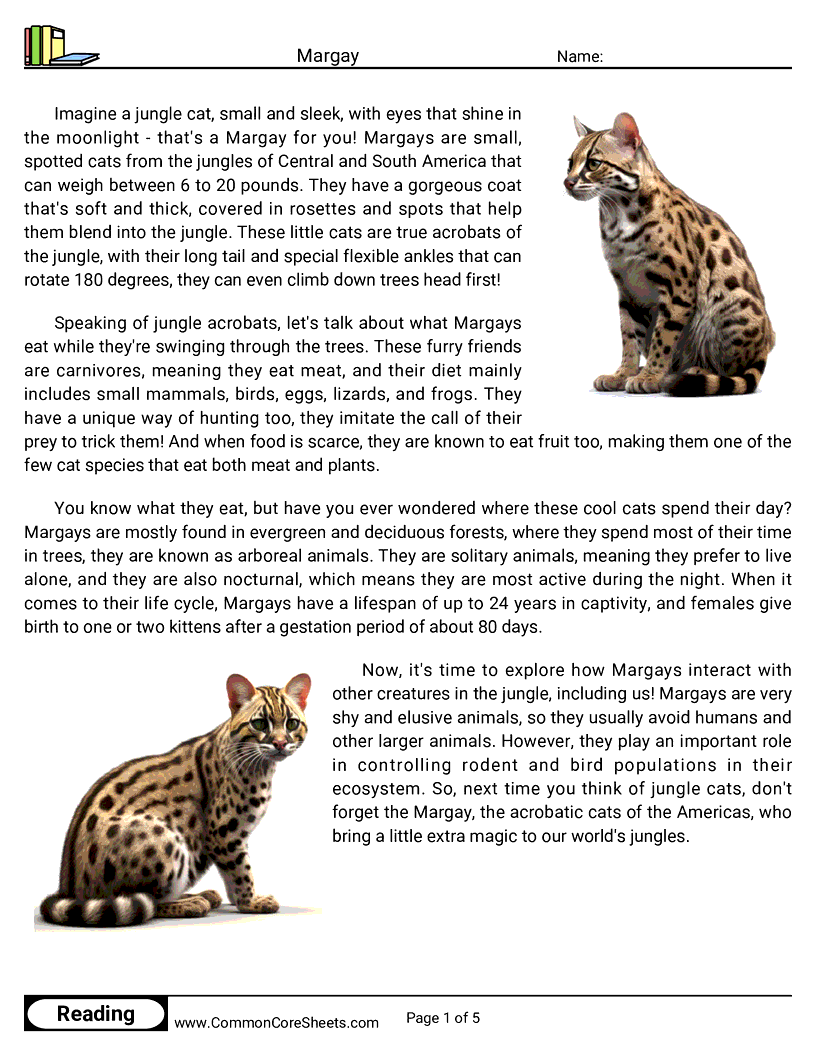
Imagine a jungle cat, small and sleek, with eyes that shine in the moonlight - that's a Margay for you! Margays are small, spotted cats from the jungles of Central and South America that can weigh between 6 to 20 pounds. They have a gorgeous coat that's soft and thick, covered in rosettes and spots that help them blend into the jungle. These little cats are true acrobats of the jungle, with their long tail and special flexible ankles that can rotate 180 degrees, they can even climb down trees head first!
Speaking of jungle acrobats, let's talk about what Margays eat while they're swinging through the trees. These furry friends are carnivores, meaning they eat meat, and their diet mainly includes small mammals, birds, eggs, lizards, and frogs. They have a unique way of hunting too, they imitate the call of their prey to trick them! And when food is scarce, they are known to eat fruit too, making them one of the few cat species that eat both meat and plants.
You know what they eat, but have you ever wondered where these cool cats spend their day? Margays are mostly found in evergreen and deciduous forests, where they spend most of their time in trees, they are known as arboreal animals. They are solitary animals, meaning they prefer to live alone, and they are also nocturnal, which means they are most active during the night. When it comes to their life cycle, Margays have a lifespan of up to 24 years in captivity, and females give birth to one or two kittens after a gestation period of about 80 days.
Now, it's time to explore how Margays interact with other creatures in the jungle, including us! Margays are very shy and elusive animals, so they usually avoid humans and other larger animals. However, they play an important role in controlling rodent and bird populations in their ecosystem. So, next time you think of jungle cats, don't forget the Margay, the acrobatic cats of the Americas, who bring a little extra magic to our world's jungles.
Let\'s learn about the fascinating Margay, a small wild cat that lives in the forests. These beautiful creatures have a distinctive look with their big eyes, golden-brown fur, and leopard-like spots. They are nocturnal animals, which means they are mostly active during the night and sleep during the day. Margays are known for their incredible agility and can even climb trees upside down!
The Margay\'s diet consists of a variety of small animals. They love to eat birds, lizards, frogs, insects, and even small mammals like monkeys and rodents. Using their excellent climbing skills, Margays can easily catch prey in the trees or on the ground. Did you know that Margays are one of the few cat species that can eat fruit as well?
Margays mainly live in the tropical rainforests of Central and South America. They can be found in countries like Mexico, Brazil, and Argentina. Margays prefer dense forests with lots of trees, which provide them with cover and a perfect hunting ground. Sadly, their habitat is threatened by deforestation, which puts the Margay\'s survival at risk.
These wild cats have a unique life cycle and relationship with other animals. Margays are solitary creatures, coming together only to mate. After a gestation period of about 80 days, the female gives birth to a single kitten, which becomes independent after about 9 months. While Margays don\'t have many predators, they must always be cautious of larger animals like jaguars and eagles.
Lastly, let\'s explore the Margay\'s relationship with humans and their differences from other species. Margays are often mistaken for ocelots, but they have a smaller body size and longer tail. Unfortunately, humans have hunted Margays for their beautiful fur, and their habitat is being destroyed by deforestation. It\'s essential for us to protect these amazing creatures and their environment for future generations to enjoy and learn from.
Meet the Margay, a fascinating feline found in the wild! These small, agile cats are often mistaken for ocelots due to their similar appearance. Margays have beautiful fur with a base color of brown or gray and dark spots and stripes that help them camouflage in their environment. They are nocturnal animals, which means they are most active during the night. With their large, expressive eyes, they have excellent night vision, perfect for hunting prey in the dark.
Let\'s explore the habitat of the elusive Margay. These amazing cats live in the forests of Central and South America, from Mexico all the way down to Argentina. Margays prefer dense, undisturbed rainforests with lots of trees to climb and hide. They are talented climbers and spend most of their time up in the trees, which is why they are also known as tree ocelots. Unfortunately, due to deforestation, their natural habitat is shrinking, making it harder for them to survive.
Now let\'s take a closer look at the Margay\'s diet and hunting habits. Margays are carnivores, which means they eat meat, and their favorite meals include small mammals, birds, and reptiles. They have sharp teeth and claws perfect for catching and devouring their prey. Margays are also known to be skilled mimics, imitating the sounds of their prey to lure them in. This incredible hunting tactic makes them successful predators in their environment.
What about their life cycle and relationship to other animals? Margays are solitary creatures, only interacting with each other during mating season. After a gestation period of about 80 days, a female Margay will give birth to one or two kittens, which she raises and teaches to hunt on her own. Margays can live up to 20 years in the wild, but their lifespan is often shorter due to threats from other animals and humans. Although they are not considered to be a threat to humans, they do contribute to maintaining a balance in their ecosystem by controlling the population of their prey.
Lastly, let\'s discuss some interesting facts and differences between Margays and other cat species. One unique feature of the Margay is its incredible flexibility, as it can rotate its hind legs 180 degrees, allowing it to climb down trees headfirst. Margays are also known for their amazing leaping ability, jumping up to 12 feet in one bound! Although they are similar in appearance to ocelots, Margays are smaller, lighter, and have a longer tail, which helps them balance while climbing. These remarkable felines are truly one of nature\'s most captivating creatures.
About this worksheet
Students read a short passage about the margay and answer questions to show they understood the key details.
This worksheet is designed to enhance children's reading skills through engaging, interactive exercises about the Margay, a small, spotted cat from the jungles of Central and South America. The 20-question worksheet teaches kids about the Margay’s diet, hunting techniques, social behavior, habitat, and more. The worksheet is fully customizable, can be converted into flashcards, and is suitable for distance learning, making it an adaptable tool to facilitate comprehensive reading and learning.
Student objectives
- Read a nonfiction passage about the margay wild cat
- Find key details and facts within the text
- Answer questions using evidence from the passage
- Learn new vocabulary related to animals and their habitats
Everyday practice
- Read an article about an animal at the zoo and remember facts about it
- Answer questions after reading a book to check you understood it
- Tell a friend interesting facts you learned about a wild cat
- Look up information about an animal for a school report