How Pie Crust Gets Flaky Worksheet Download
Free reading comprehension worksheet about the science of a flaky pie crust. Pick the reading level (3rd grade to 8th grade), print the passage with its questions, or assign it online.


Sheet Information >
Available at 3rd grade, 4th grade, 5th grade, 6th grade, 7th grade and 8th grade reading levels.
Read the passage
Imagine you are at a cozy table with a warm slice of pie in front of you. You press your fork down, and the crust cracks with a soft crunch. Look closely, and you will see thin, crisp layers stacked like pages in a book. How does a crust get so flaky?
The secret to those layers hides in the dough as tiny lumps of cold butter. First, a baker cuts cold butter into flour until the bits are about the size of peas. Then a little cold water is added, and the dough is pressed together gently. Always bake with a grown-up, because ovens get very hot.
Once a grown-up slides the pie into the oven, those buttery bits get their big moment. Butter is partly water, so the heat turns that water into steam. Steam takes up much more room than water, so it puffs the thin layers of dough apart. The butter melts away, leaving gaps, and the crisp sheets around them are the flakes!
Flakes are delicate, so bakers keep everything cold, which stops the butter from melting into the dough. They also do not overmix, because too much mixing builds gluten, stretchy strands that make crust tough. Once the pie is baked, its sweet filling needs time to cool and set, so each slice stays neat. So when you hear that soft crunch, you are hearing layers that steam lifted apart!
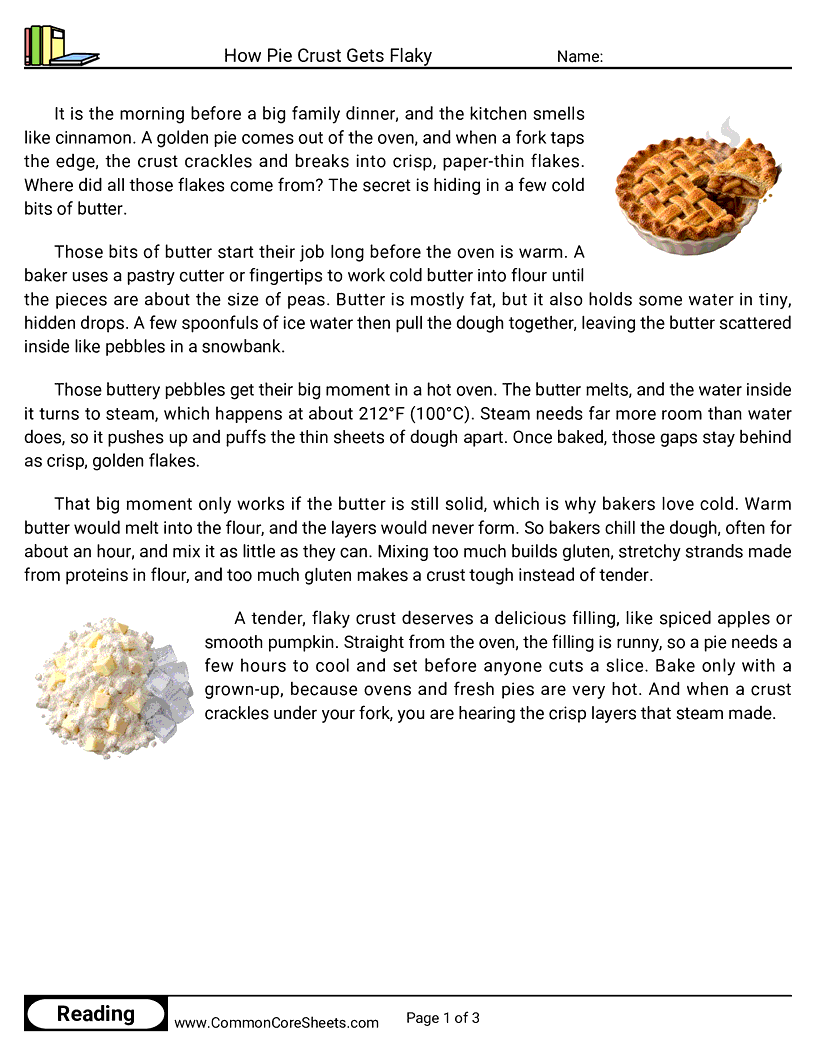
It is the morning before a big family dinner, and the kitchen smells like cinnamon. A golden pie comes out of the oven, and when a fork taps the edge, the crust crackles and breaks into crisp, paper-thin flakes. Where did all those flakes come from? The secret is hiding in a few cold bits of butter.
Those bits of butter start their job long before the oven is warm. A baker uses a pastry cutter or fingertips to work cold butter into flour until the pieces are about the size of peas. Butter is mostly fat, but it also holds some water in tiny, hidden drops. A few spoonfuls of ice water then pull the dough together, leaving the butter scattered inside like pebbles in a snowbank.
Those buttery pebbles get their big moment in a hot oven. The butter melts, and the water inside it turns to steam, which happens at about 212°F (100°C). Steam needs far more room than water does, so it pushes up and puffs the thin sheets of dough apart. Once baked, those gaps stay behind as crisp, golden flakes.
That big moment only works if the butter is still solid, which is why bakers love cold. Warm butter would melt into the flour, and the layers would never form. So bakers chill the dough, often for about an hour, and mix it as little as they can. Mixing too much builds gluten, stretchy strands made from proteins in flour, and too much gluten makes a crust tough instead of tender.
A tender, flaky crust deserves a delicious filling, like spiced apples or smooth pumpkin. Straight from the oven, the filling is runny, so a pie needs a few hours to cool and set before anyone cuts a slice. Bake only with a grown-up, because ovens and fresh pies are very hot. And when a crust crackles under your fork, you are hearing the crisp layers that steam made.
Picture a pie crust that crackles into golden shards the moment your fork touches it. Now picture one as tough as a cardboard box. Here is the puzzle: both can be made from the same few ingredients, flour, fat, water, and salt. The clue hides in the dough as tiny, cold lumps of butter, so let's follow them into the oven!
Those lumps begin when a baker cuts cold butter into flour until the pieces are about the size of peas. When the dough is rolled out, the pieces flatten into thin sheets, like tiny pancakes stacked between layers of dough. Food scientists say butter is about 80 percent fat, and most of the rest is water. That hidden water is the hero of our mystery, even though each lump holds very little.
That hero gets its big moment when the pie slides into a hot oven. At sea level, water turns to steam at 212°F (100°C), and steam takes up more than 1,000 times the space of the water it came from. Trapped inside the dough, the expanding steam pushes the thin layers apart, like fingers prying open the pages of a book. Then the butter melts into the dough, the heat bakes each puffed layer crisp, and air gaps are left behind.
Those gaps only appear if the butter is still in lumps when the pie goes in, which is why bakers keep everything cold. They chill the butter, stir in ice water, and often rest the dough in the refrigerator. Bakers also go easy on mixing, because stirring and kneading builds gluten, a stretchy web that forms when flour proteins meet water. Bread bakers want lots of gluten for chewy loaves, but too much of it makes pie crust tough.
Going gently takes patience, and so does the final step: waiting for the pie to cool. A just-baked filling is runny, but as the pie rests for a few hours, starches and eggs in many fillings firm up, so slices keep their shape. Ovens are very hot, so baking a pie is a job to do with a grown-up. And when a crust crackles under your fork, you are hearing a few drops of water, once hidden in butter, that turned to steam and lifted dough into flakes.
You might think the secret to a perfect pie crust is smooth, evenly blended dough, but bakers know it is nearly the opposite! A flaky crust is really a stack of paper-thin layers, and it shatters into crisp, golden shards when your fork presses down. Look at the edge of a slice and you can spot them, like the pages of a tiny edible book. Those pages do not come from fancy ingredients, since most pie dough is just flour, fat, water, and salt. The magic comes from how a baker handles them, and that is where the science begins.
That handling starts with a surprising rule: lumpy dough beats smooth dough. Bakers "cut in" cold butter or shortening with a pastry blender, two knives, or their fingertips, until the fat breaks into pieces about the size of peas. Those bits stay separate from the flour instead of melting into it, so the dough ends up marbled with tiny pockets of fat. Butter is roughly 80 percent fat, and most of the rest is water, a detail that matters enormously once the oven heats up. Shortening is pure fat with no water, so it makes a very tender crust, while butter adds flavor and extra steam.
Those watery bits of butter become the stars the moment a pie slides into a hot oven. As the heat climbs, the water boils into steam, which needs more than a thousand times as much room as the liquid did. Trapped inside the dough, that steam shoves against the layers around it and puffs them apart like thousands of tiny balloons. Meanwhile the fat melts away and leaves hollow gaps, and the flour beside it bakes into crisp, brittle sheets. Those sheets are the flakes you hear crackle at the table.
Those crackling flakes are easy to ruin, because the whole trick only works if the fat is still solid when the baking begins. That is why bakers treat warmth like an enemy, chilling the butter, using ice-cold water, and resting the dough in the refrigerator. Fat that melts too soon soaks into the flour, and the layers never form. Overworking is the other danger, since stirring and kneading flour with water links its proteins into stretchy strands called gluten. Gluten is great in chewy bread, but in pie crust it makes a tough shell, so good bakers touch the dough as little as possible.
That kind of restraint matters again at the very end, when a warm pie tempts everyone to grab a knife. Sweet fillings are scalding and loose when they leave the oven, and they thicken as they cool, so a pie cut too soon slumps into a puddle. The same cold-and-steam rules still guide bakers making croissants and puff pastry, so I think one humble crust is a lesson in real food science. Since ovens and hot fillings can burn, always bake with a grown-up. And when a forkful crackles at your table, remember that every flake you hear was shaped by water that turned to steam long before dessert.
A stick of butter is about 80 percent fat, and most of the rest is water, which means every slice hides countless tiny droplets, like a pocketful of microscopic water balloons. Hold onto that picture, because it explains why a great pie crust crackles, flakes, and then melts on your tongue. Many families serve pie at holiday tables, yet few stop to wonder why the crust looks like a stack of paper-thin pages. The answer is not magic. It is a chain of cause and effect, and every baking rule you have ever heard is one link.
The first link is a job that sounds simple: cutting cold fat into flour. Bakers use a pastry cutter, two knives, or quick fingertips to break the butter into pieces about the size of peas, and they stop while plenty of lumps remain. That surprises beginners, since smooth dough seems like success. In pie dough, though, a baker who spots chunks of butter is relieved, not worried. When the dough is rolled out, each lump is stretched into a thin, flat sheet of fat sandwiched between layers of flour and water.
Those flat sheets of fat finally get their moment in a hot oven. As the butter melts, the water inside it heats up and, at sea level, boils at 212°F (100°C), turning into steam. Steam takes up well over a thousand times more space than the same water as a liquid, so it shoves upward with surprising force. The dough above and below the butter gets pushed apart into thin, blistered layers. Meanwhile the heat firms up the flour's starches and proteins, locking the puffed layers in place before the steam escapes.
Locking in those layers only works if the dough stays tender, and that depends on a quiet battle that starts when water first touches flour. Flour contains proteins that link into stretchy chains called gluten when they get wet and are worked. Gluten is a hero in bread, where chewiness is the goal, but in pie dough too much of it makes a crust tough and rubbery. So bakers fight it with little water, gentle handling, and a rest in the refrigerator that lets the gluten relax. Fat helps too, because it coats bits of flour and keeps those protein chains from connecting.
That battle explains why pie bakers sound like spies repeating one code word: cold, cold, cold. Warm butter melts into the flour instead of staying in lumps, so the separate layers never form and the crust turns out sandy and crumbly. Cold water slows gluten and keeps the fat firm, which is why many recipes call for ice water and a chilled dough. Some bakers use shortening, which is 100 percent fat with no water, so it makes a tender crust but offers no steam and less buttery flavor. Because butter offers flavor and steam while shortening offers tenderness, plenty of bakers use a mix of both.
Even the perfect mix of fats cannot save a crust from impatience once the pie leaves the oven. Fruit fillings are made of fruit, sugar, and a thickener such as starch, and while they are hot the juices are runny. As the pie cools, usually for a few hours, the thickener sets into a soft gel, so a slice holds its shape instead of flooding the plate. Because ovens get hundreds of degrees hot, young bakers should make pie only with a grown-up. Next time a fork crackles through a crust, remember that you are hearing the empty spaces where steam once pushed.
In the 2000s, the cooks at a magazine test kitchen startled home bakers with a pie dough recipe that called for vodka. It was no prank. Extra water makes dough easy to roll but also makes a crust tough, and vodka, a mix of water and alcohol, moistens dough without toughening it, and most of it bakes away. Bakers who tried it reported a crust that still shattered into crisp, golden flakes. Behind that odd ingredient hides a real puzzle: what turns a few plain ingredients into a stack of paper-thin layers?
That puzzle has two classic explanations, and the best answer borrows from both. The first points to fat: cold butter cut into flour stays in small pieces, and rolling flattens them into thin sheets between layers of dough. The second points to steam: U.S. rules require butter to be at least 80 percent milkfat, so most of the rest is water, which turns to steam at 212°F (100°C) at sea level. How can a droplet move dough? Water expands roughly 1,600 times in volume as it becomes steam, enough to shove layers upward. Many bakers and food scientists treat the two as partners: the fat builds the layers, and the steam pries them apart.
Steam can only pry layers apart if the dough is tender enough to give way, and that is where gluten becomes the villain. Wheat flour holds two proteins that link into a stretchy network called gluten when they are wet and worked. Bread bakers want that springy web, but pie bakers fear it, because strong dough resists rising steam and bakes up tough. Fat fights back by coating bits of flour and shortening the gluten strands, which is how shortening got its name. Water is the other half of the equation, since gluten forms mainly when those proteins are wet, so swapping some water for alcohol leaves less to build the network.
Working the dough gently is only half the plan for a tender crust; the other half is keeping everything cold, even the bowl. Warm butter smears into the flour like paste instead of staying in pieces, and without pieces there are no layers to lift. Butter that melts too early can also leak out before its water reaches the steam stage. Chilling the dough, often for at least 30 minutes, also lets the flour soak up water evenly and lets stretched gluten relax. Shortening, which is pure fat with no water in it, shows the trade-off: it stays solid at warmer temperatures and bakes tender, but it cannot make steam and lacks butter's flavor.
Because each fat has strengths, many bakers blend them, and a quick look at the dough shows whether the plan is working. Good pie dough looks a little messy, marbled with streaks and with flecks of fat about the size of peas. A perfectly smooth dough is actually a warning sign, since it means the fat has blended into the flour. In a hot oven, often 375°F to 425°F, those flecks melt, their water flashes into steam, and the dough firms up around the puffs. What remains is a crust full of tiny air pockets where the butter used to be, which is why it crackles under a fork.
A crust with its flakes locked in place still has one more job: holding up a filling that is hotter and wetter than it looks. A fruit filling is sugar, juice, and a thickener such as starch or pectin, and while it is hot, that mixture is still runny. As the pie cools, often for a few hours, the thickener sets into a soft gel. Slice too soon and the filling floods the plate, while trapped steam softens the crisp layers. If you ever try any of this yourself, bake only with a grown-up, because ovens and hot pans cause real burns. So when a slice holds its shape and the crust crackles, remember that those flakes began as tiny drops of water hiding inside cold butter.
About this worksheet
Students read a nonfiction passage about the science of a flaky pie crust, written at 6 reading levels (3rd grade to 8th grade), and answer multiple-choice questions about it.
A reading comprehension worksheet about the science of a flaky pie crust with a different article for each reading level, 3rd grade to 8th grade, each with its own multiple-choice questions aligned to the Common Core Reading: Informational Text standards. Printable with an answer key, and available as an online assignment at any level.
Student objectives
- Read a science passage and explain how steam and cold butter make flaky layers.
- Find the cause and effect steps that happen inside a pie crust in the oven.
- Explain why bakers keep dough cold and mix it as little as possible.
- Use context to work out the meaning of words such as set and gluten.
Everyday practice
- Next time you see a pie or a pastry, look closely at its edge and notice the thin layers.
- Ask a grown-up who bakes why they chill dough, and listen for words like cold, butter and gluten.
- Watch a pot of water on the stove with a grown-up nearby and notice the steam rising as it gets hot.