Hen Worksheet Download
Free reading worksheets on Hen. Each worksheet has 20 problems with an answer key and are ideal for teachers and homeschooling. You can download the PDF, create a set of flash cards or set it up for online learning.


Sheet Information >
Available at 2nd grade, 3rd grade, 4th grade, 5th grade and 6th grade reading levels.
Read the passage
Hey there, kiddos! Let's chat about hens, the popular farm birds. Hens are usually brown or white, but some can be other fun colors like black, blue, or even red! They live in a special house called a coop, where they sleep on perches and lay eggs in cozy nests.
Now, let's peck into what hens eat and their life cycle. Hens are like us, they eat a variety of food - grains, fruits, vegetables and sometimes small bugs, yum! As for their life cycle, it begins when they are cute little chicks, then they grow into pullets (young hens) before becoming fully grown hens.
Hens have a fascinating relationship with humans and other animals, and they have unique ways to protect themselves. We humans have been friends with hens for thousands of years, using their eggs for food and their feathers for pillows and blankets. They might look defenseless, but hens can actually peck or flap their wings to scare away other animals, and believe it or not, they are different from ducks and turkeys in many ways, like having shorter necks and different sounds!
Let's embark on an exciting journey to explore the world of hens, our feathered friends! Hens are usually kept in a chicken coop and they love to roam around in open spaces where they can peck for food. Their diet consists of grains, seeds, and insects, but they will also appreciate some kitchen scraps like vegetable peels and bread. Interesting fact, a hen can recognize more than 100 different faces of their species!
Now, let's unravel the life cycle of a hen and its relationship with humans and other animals. The life of a hen begins as a chick inside an egg, and it takes about 21 days to hatch. Hens have been companions to humans for thousands of years, providing us with eggs and meat, and they are often kept on farms or in backyards. While they have a peaceful relationship with most animals, hens need to be protected from predators like foxes and hawks.
Time for us to learn about their defenses and how they differ from other bird species. Hens have a sharp beak and strong wings which they can use to peck and flap when they feel threatened. Unlike many birds who can fly high, hens can only fly for short distances, but they are excellent runners. So, as we can see, hens are pretty amazing creatures with their own unique way of living life.
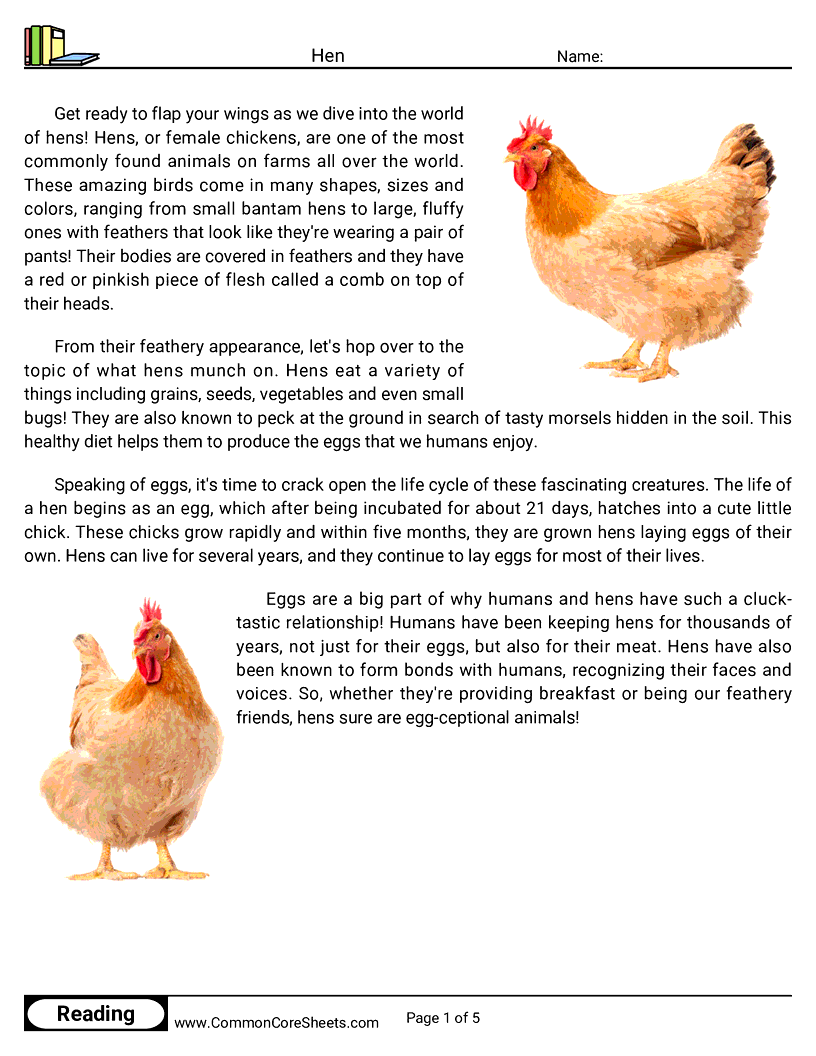
Get ready to flap your wings as we dive into the world of hens! Hens, or female chickens, are one of the most commonly found animals on farms all over the world. These amazing birds come in many shapes, sizes and colors, ranging from small bantam hens to large, fluffy ones with feathers that look like they're wearing a pair of pants! Their bodies are covered in feathers and they have a red or pinkish piece of flesh called a comb on top of their heads.
From their feathery appearance, let's hop over to the topic of what hens munch on. Hens eat a variety of things including grains, seeds, vegetables and even small bugs! They are also known to peck at the ground in search of tasty morsels hidden in the soil. This healthy diet helps them to produce the eggs that we humans enjoy.
Speaking of eggs, it's time to crack open the life cycle of these fascinating creatures. The life of a hen begins as an egg, which after being incubated for about 21 days, hatches into a cute little chick. These chicks grow rapidly and within five months, they are grown hens laying eggs of their own. Hens can live for several years, and they continue to lay eggs for most of their lives.
Eggs are a big part of why humans and hens have such a cluck-tastic relationship! Humans have been keeping hens for thousands of years, not just for their eggs, but also for their meat. Hens have also been known to form bonds with humans, recognizing their faces and voices. So, whether they're providing breakfast or being our feathery friends, hens sure are egg-ceptional animals!
Hello there, let's talk about hens, the most common type of domesticated fowl! Hens are usually a vibrant mix of white, brown, and black feathers, with a red comb on top of their head. They are quite small, weighing only about 5 to 7 pounds, and have a life span of 5 to 10 years. Their eyes are a beautiful bright orange or red, and they have a sharp beak and claws.
Now, let's talk about where hens live and what they eat. Hens are typically found in farmyards all around the world, but they can also live happily in a suburban backyard! Their diet mainly consists of grains like corn and wheat, but they also eat insects, seeds, and even small mice and lizards. Hens are known to be great foragers, spending their days scratching the ground in search of food.
Hens have a fascinating life cycle that's worth knowing about. After a hen lays an egg, it takes about 21 days for the chick to hatch. In just a few months, the chicks grow into hens or roosters, and the females start laying eggs when they are about 5 months old. This cycle of laying eggs, hatching chicks, and growing into adults continues throughout a hen's life.
Hens also have special relationships with humans and other animals. Humans have kept hens for thousands of years for their eggs, meat, and feathers. Hens can also live peacefully with other farm animals like cows and sheep, and they can even help control pests by eating insects. However, hens need to be protected from predators like foxes and hawks, as they don't have many defenses.
Finally, let's look at how hens are different from other species and some interesting facts. Unlike many other birds, hens can't fly long distances because of their heavy body weight. Did you know that hens communicate with each other using over 30 different sounds? So, that's our friendly neighborhood hen, a small bird with a big personality and a crucial role in our lives.
Let's embark on an exciting journey to learn about hens, the wonderful and fascinating creatures. Hens are a type of female chicken that are known for their egg-laying abilities. They come in a variety of shapes, sizes, and colors, from small bantam hens to large Jersey Giant hens. Hens often have a red or orange comb on top of their heads, which helps them to regulate their body temperature. One fun fact about hens is that they can recognize and remember over 100 different faces, both of other chickens and humans!
Hens live in a variety of environments, but are often found in chicken coops or hen houses. These structures provide them with shelter, protection from predators, and a place to lay their eggs. Inside these coops, hens have their own nesting boxes where they sleep and lay their eggs. These coops are often designed with perches for hens to roost (sleep) on, as they naturally prefer to sleep off the ground. In the wild, hens often live in small groups known as flocks.
Let's take a peek at what hens eat. Their diet is quite diverse and includes grains, fruits, vegetables, and even small insects. Hens are omnivores and will eat almost anything that they can find. Chickens have a crop, a storage area in their throat, where they can store food to be digested later. This allows them to eat a lot at once and then digest it over time.
Now, onto the life cycle of a hen. It all starts when a hen lays an egg, which she will often do once a day. After about 21 days of incubation, a baby chick hatches from the egg. This chick grows into a hen over the course of about 5 months, and then the cycle starts all over again. Hens can live for 5 to 10 years, depending on their breed and environment.
Lastly, let's explore the relationship between hens and other animals, including humans. Hens have been domesticated by humans for thousands of years, and are often kept for their eggs and for meat. Despite their domestication, hens still retain many of their wild instincts, such as the desire to roost in trees and to form social hierarchies. They also have a variety of defenses against predators, including the ability to fly short distances and a strong pecking beak. Now that we've learned so much about hens, you can see why they are such interesting and important creatures in our world.
About this worksheet
Students practice recognizing, reading, and writing the sight word "hen" through matching, tracing, and identification activities.
This worksheet is designed to enhance children's reading skills while educating them about hens. Containing 20 interactive problems, the worksheet touches on concepts such as hen's physical attributes, diet, habitat, lifecycle, and behavior. Malleable for numerous teaching styles, it can be customized, converted into flashcards, or adopted for distance learning, making it suitable for multifaceted educational settings.
Student objectives
- Recognize the word "hen" when you see it
- Practice sounding out the letters h, e, and n
- Trace and write the word "hen" correctly
- Match the word "hen" to a picture of a hen
Everyday practice
- Point out the word "hen" in a picture book about farm animals
- Read the word "hen" on a sign at a petting zoo or farm
- Spell out "hen" when talking about where eggs come from
- Name the hen when reading a story about barnyard animals