Fleas Worksheet Download
Free reading worksheets on Fleas. Each worksheet has 20 problems with an answer key and are ideal for teachers and homeschooling. You can download the PDF, create a set of flash cards or set it up for online learning.


Sheet Information >
Available at 2nd grade, 3rd grade, 4th grade, 5th grade and 6th grade reading levels.
Read the passage
Fleas are tiny insects that love to jump around and explore. Their favorite meal is the blood of animals, like cats, dogs, and even humans. These little creatures are really small, but they can jump over 100 times their own body length!
When it comes to where fleas live, they can be found almost anywhere, but they especially love the fur of animals. Fleas have four stages in their life: egg, larva, pupa, and adult. The adult fleas lay eggs on their animal hosts, and the eggs fall off and hatch into larvae, which then grow into pupae and finally into adult fleas.
Fleas can be a real problem for humans and other animals. They cause itchy bites and can even spread diseases. However, not all fleas are the same; there are more than 2,000 different species of fleas, each with their own unique characteristics.
In this fun and friendly article, we learned about the fascinating world of fleas. These tiny insects may be small, but they surely have a big impact on the lives of humans and animals alike. So next time you see a flea, remember just how interesting and complex these little creatures are!
Hey there, have you ever heard of fleas? These tiny creatures are insects that love to live on furry animals like dogs and cats. Fleas are very small, usually around 2-3 millimeters long, and they have six legs which help them jump really high. They enjoy feasting on the blood of their animal hosts, which gives them the energy they need to survive and lay eggs. It's important for pet owners to keep an eye out for fleas, as they can cause itchiness and discomfort for our furry friends.
Now let's talk about the life cycle of fleas. The life cycle has four stages: egg, larva, pupa, and adult. Female fleas lay their eggs on their host, and once the eggs hatch, the tiny larvae start to feed on organic debris like skin flakes and adult flea droppings. Eventually, the larvae will spin a cocoon and become pupae, which is the stage where they transform into adult fleas, ready to jump onto a new host.
Fleas and humans have a unique relationship. While fleas prefer to live on animals, they sometimes bite humans when their preferred host isn't available. Even though fleas are small, they have some impressive defenses, like their strong exoskeleton that protects them from being easily squished. Did you know that there are over 2,000 different species of fleas? Each species has its own unique characteristics and preferred host animals.
In conclusion, fleas are fascinating little creatures that have a strong connection with both animals and humans. While they might be a nuisance at times, learning about them helps us understand the world around us and how to keep our pets happy and healthy.
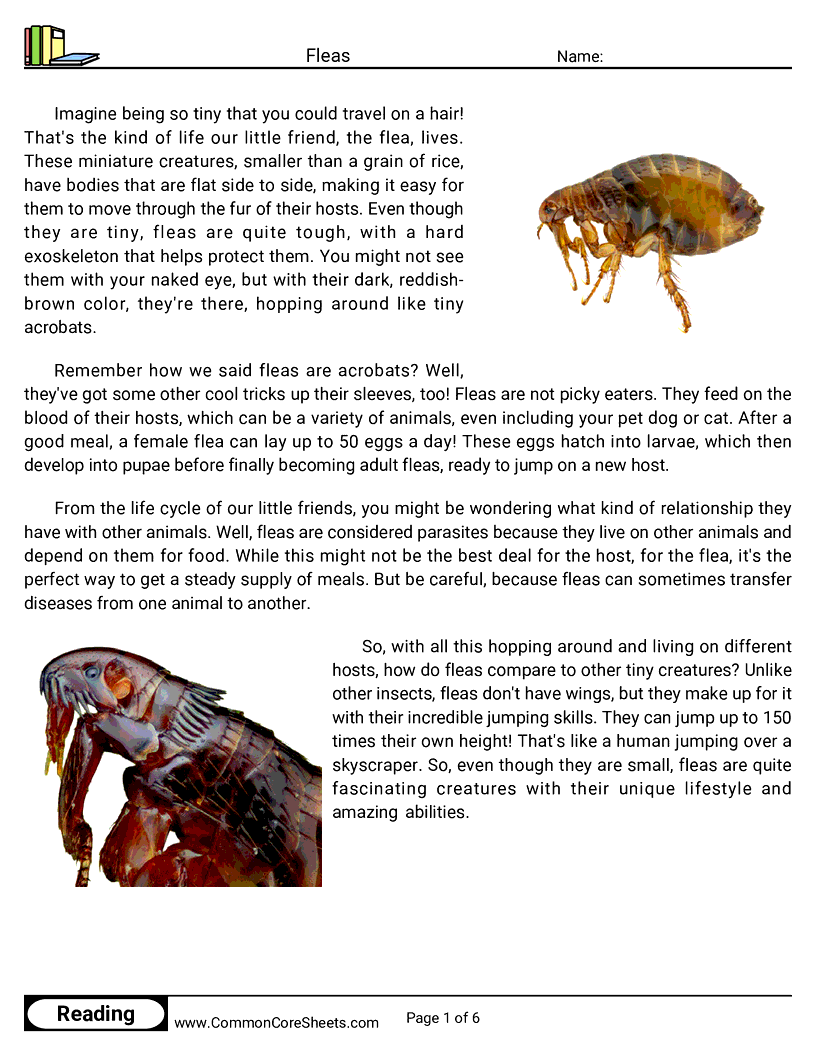
Imagine being so tiny that you could travel on a hair! That's the kind of life our little friend, the flea, lives. These miniature creatures, smaller than a grain of rice, have bodies that are flat side to side, making it easy for them to move through the fur of their hosts. Even though they are tiny, fleas are quite tough, with a hard exoskeleton that helps protect them. You might not see them with your naked eye, but with their dark, reddish-brown color, they're there, hopping around like tiny acrobats.
Remember how we said fleas are acrobats? Well, they've got some other cool tricks up their sleeves, too! Fleas are not picky eaters. They feed on the blood of their hosts, which can be a variety of animals, even including your pet dog or cat. After a good meal, a female flea can lay up to 50 eggs a day! These eggs hatch into larvae, which then develop into pupae before finally becoming adult fleas, ready to jump on a new host.
From the life cycle of our little friends, you might be wondering what kind of relationship they have with other animals. Well, fleas are considered parasites because they live on other animals and depend on them for food. While this might not be the best deal for the host, for the flea, it's the perfect way to get a steady supply of meals. But be careful, because fleas can sometimes transfer diseases from one animal to another.
So, with all this hopping around and living on different hosts, how do fleas compare to other tiny creatures? Unlike other insects, fleas don't have wings, but they make up for it with their incredible jumping skills. They can jump up to 150 times their own height! That's like a human jumping over a skyscraper. So, even though they are small, fleas are quite fascinating creatures with their unique lifestyle and amazing abilities.
Fleas are tiny insects that you might have heard of, but there's more to them than meets the eye. They are small, wingless creatures with a shiny, dark brown body and strong legs for jumping. In fact, they are one of the best jumpers in the animal kingdom, able to jump up to 150 times their own body length! Fleas can be found all over the world and there are over 2,000 different species of them.
Let's learn about what fleas eat and where they live. Adult fleas feed on the blood of their host, which can be animals like dogs, cats, or even humans. Fleas prefer to live on animals with fur because it provides a warm and safe environment for them to hide and lay their eggs. However, they can also be found in your home, hiding in carpets, furniture, and bedding.
The life cycle of a flea is quite fascinating. It begins as an egg, which hatches into a larva after a few days. The larva then spins a cocoon and becomes a pupa, which can stay in this stage for several weeks before emerging as an adult flea. Once the adult flea finds a host, it can start the cycle all over again by laying eggs.
Fleas can be quite a nuisance to humans and animals alike. When they bite, they can cause itchiness and irritation, and sometimes even allergic reactions. In addition, fleas can transmit diseases and parasites, such as tapeworms, to both animals and humans. Because of this, it is important to keep our pets and homes clean and free from fleas.
Finally, let's explore some differences between flea species and other interesting facts. While most fleas are similar in appearance, some species have unique features, like the water flea which has a translucent body and is actually a type of crustacean. Fleas can also survive without a blood meal for several months, making it difficult to eliminate them from your home. One interesting fact is that fleas were responsible for spreading the bubonic plague, also known as the Black Death, which killed millions of people in the 14th century.
Fleas are tiny insects that are found all over the world and are well-known for being pests. These little creatures are usually only about 2.5 millimeters long and have a flat body, which makes it easy for them to move through an animal's fur. Although they are small, fleas can jump up to 150 times their body length, making them one of the best jumpers in the animal kingdom. They are wingless insects but have long and powerful legs, which help them make these incredible jumps. Fleas are usually dark brown or reddish-brown in color, making them hard to spot on animals with similar fur colors.
Fleas have a very interesting life cycle that goes through four stages: egg, larva, pupa, and adult. The adult female flea lays eggs on its host, which then fall off and land in the environment, like on carpets or in animal bedding. These eggs hatch into larvae, which are tiny, worm-like creatures that feed on organic matter, like dead skin cells and flea droppings. After a while, the larvae spin a cocoon and become pupae, which is the stage where they develop into adult fleas. The whole life cycle can take anywhere from two weeks to several months, depending on factors like temperature and humidity.
Fleas are parasites, which means that they survive by feeding on the blood of other animals, like dogs, cats, and even humans. Their sharp mouthparts allow them to pierce the skin of their host and consume the blood. When fleas bite, they inject saliva into the host's skin, which can cause itching and irritation. In some cases, animals and humans can develop an allergic reaction to flea bites, which can lead to more severe symptoms and even infections. Besides being a nuisance, fleas can also transmit diseases and parasites, like tapeworms, to their hosts.
Fleas have a close relationship with other animals, particularly pets like dogs and cats, as they rely on them for food and reproduction. Because of their small size and incredible jumping abilities, fleas can easily spread from one animal to another, making them a common problem for pet owners. While fleas are most commonly associated with pets, they can also be found on wild animals like rodents, birds, and even bats. Animals with fleas can experience discomfort, itching, and even hair loss due to excessive scratching. To help protect your pets from fleas, it's important to use preventative measures like flea collars, topical treatments, or oral medications.
There are many different species of fleas, but the most common one found on pets is the cat flea (Ctenocephalides felis). Despite its name, the cat flea can infest both cats and dogs, as well as other animals and even humans. Each species of flea has its preferred host, but they can sometimes feed on other animals if their preferred host is not available. An interesting fact about fleas is that they have been around for millions of years and have even been found preserved in amber, which is fossilized tree resin. Fleas are fascinating creatures with unique abilities, but they can also be a problem for pets and humans alike, so it's important to take steps to prevent and treat infestations.
About this worksheet
Students read a short passage about fleas and answer questions to show they understood the key details and information.
This worksheet is designed to enhance children's reading and comprehension skills through 20 engaging questions about fleas. It covers diverse concepts, from their physical attributes and lifecycle, to their behavioral traits and societal impacts. This worksheet can be easily customized, converted to flashcards, or incorporated into distance learning for a more interactive and adaptable educational experience.
Student objectives
- Read a nonfiction passage about fleas
- Find specific facts and details in the text
- Answer questions using information from the reading
- Understand new words used to describe fleas
Everyday practice
- Read the label on pet flea medicine to understand how it works
- Explain to a family member why a pet keeps scratching
- Look up facts about bugs you find outside
- Read a short article about animals and tell someone what it said