Colorado Chipmunk Worksheet Download
Free reading worksheets on Colorado Chipmunk. Each worksheet has 20 problems with an answer key and are ideal for teachers and homeschooling. You can download the PDF, create a set of flash cards or set it up for online learning.


Sheet Information >
Available at 2nd grade, 3rd grade, 4th grade, 5th grade and 6th grade reading levels.
Read the passage
Say hello to the Colorado chipmunk, a cute and furry little critter that lives in the mountains of Colorado. These chipmunks have striped fur with brown, black, and white colors that help them blend in with their surroundings. They have small bodies with big, bushy tails which they use for balance when they're climbing trees or running around.
The Colorado chipmunk is a very social animal and likes to be around other chipmunks. They are omnivores, which means they eat both plants and other animals, like nuts, seeds, fruits, and insects. Their life cycle starts when they are born in a nest made of leaves and twigs, and they grow up to be adults in just a few months.
Humans usually find these chipmunks very adorable, and sometimes they even become friendly with people. Their main defense against predators, like hawks and snakes, is their speed and ability to hide in small places. An interesting fact about the Colorado chipmunk is that it can stuff its cheeks with food to carry it back to its burrow, making it look like it has a big, puffy face.
So, the next time you're in Colorado, keep your eyes peeled for these charming little creatures and remember all the fun facts you've learned about them.
Meet the Colorado chipmunk, a small and friendly critter that lives in the Rocky Mountains. These little animals have brown fur with white stripes on their faces and backs, making them look really cute! Did you know that Colorado chipmunks live in burrows, which are underground tunnels they dig? These tunnels provide them shelter from predators and bad weather.
Now let's talk about what Colorado chipmunks eat and how they live. These tiny creatures love to munch on seeds, nuts, fruits, and insects. They have a unique life cycle, as they mate between April and May, and the female gives birth to 3-5 babies called pups. The pups stay with their mom for about six weeks before they go out and live on their own.
Colorado chipmunks are important to both humans and other animals. They help to spread seeds, which helps plants grow, and they are a food source for other animals like birds of prey and foxes. While they are similar to other species of chipmunks, Colorado chipmunks have a more distinct white stripe on their back and larger ears. One interesting fact is that they communicate with each other using a variety of sounds like chirps and trills.
In conclusion, Colorado chipmunks are fascinating creatures that play an important role in their ecosystem. Next time you're in the Rocky Mountains, keep an eye out for these cute and helpful little animals!
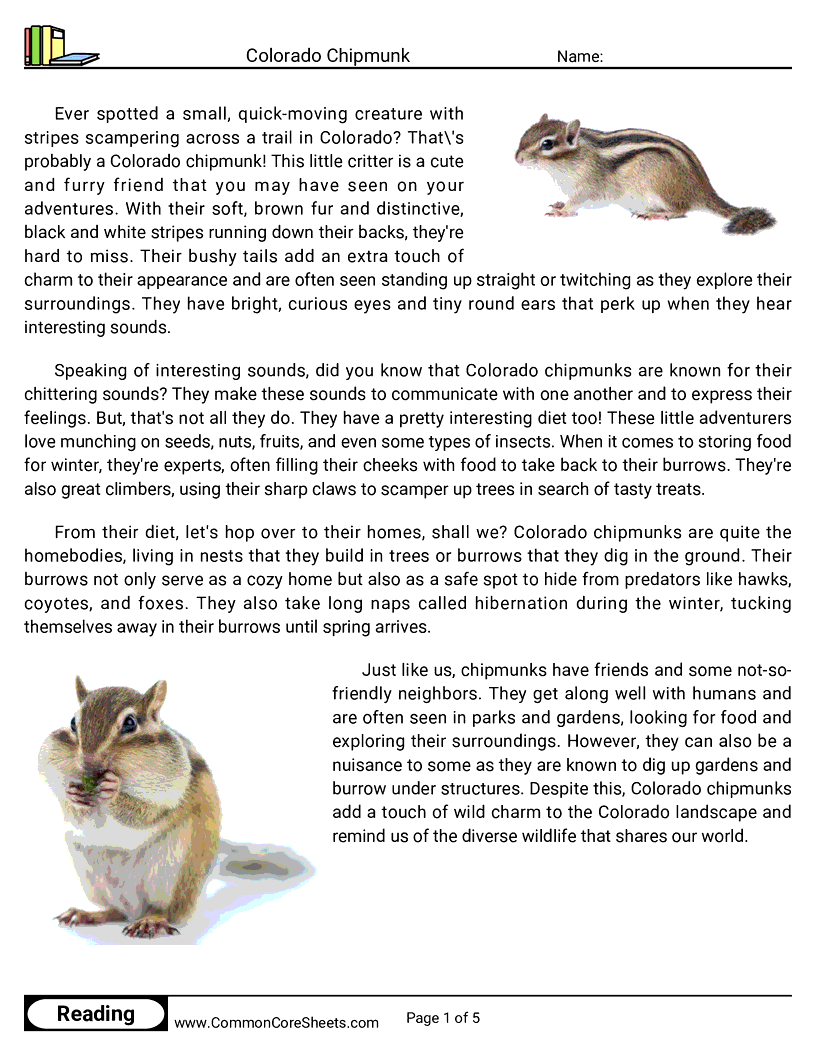
Ever spotted a small, quick-moving creature with stripes scampering across a trail in Colorado? That's probably a Colorado chipmunk! This little critter is a cute and furry friend that you may have seen on your adventures. With their soft, brown fur and distinctive, black and white stripes running down their backs, they're hard to miss. Their bushy tails add an extra touch of charm to their appearance and are often seen standing up straight or twitching as they explore their surroundings. They have bright, curious eyes and tiny round ears that perk up when they hear interesting sounds.
Speaking of interesting sounds, did you know that Colorado chipmunks are known for their chittering sounds? They make these sounds to communicate with one another and to express their feelings. But, that's not all they do. They have a pretty interesting diet too! These little adventurers love munching on seeds, nuts, fruits, and even some types of insects. When it comes to storing food for winter, they're experts, often filling their cheeks with food to take back to their burrows. They're also great climbers, using their sharp claws to scamper up trees in search of tasty treats.
From their diet, let's hop over to their homes, shall we? Colorado chipmunks are quite the homebodies, living in nests that they build in trees or burrows that they dig in the ground. Their burrows not only serve as a cozy home but also as a safe spot to hide from predators like hawks, coyotes, and foxes. They also take long naps called hibernation during the winter, tucking themselves away in their burrows until spring arrives.
Just like us, chipmunks have friends and some not-so-friendly neighbors. They get along well with humans and are often seen in parks and gardens, looking for food and exploring their surroundings. However, they can also be a nuisance to some as they are known to dig up gardens and burrow under structures. Despite this, Colorado chipmunks add a touch of wild charm to the Colorado landscape and remind us of the diverse wildlife that shares our world.
Say hello to the Colorado chipmunk, a cute and furry little animal that lives in the mountains and forests of western North America. They are small mammals, usually measuring between 7 and 10 inches long, with brown fur and stripes on their back and tail. One interesting fact is that they can climb trees just like squirrels and are known to be excellent jumpers. These adorable creatures have tiny hands with sharp claws, perfect for digging and holding their food.
Now let's talk about what these little critters love to eat. Colorado chipmunks are omnivorous, which means they eat both plants and other animals. Their diet includes seeds, nuts, berries, fruits, and even insects like grasshoppers and beetles. During the summer, they store food in their burrows to prepare for the long winter months ahead.
In order to survive and thrive, Colorado chipmunks have a unique life cycle. They usually mate in the late spring, and after about a month, the female gives birth to a small litter of babies called 'kits'. The kits stay with their mother for about six weeks before venturing out on their own in search of their own territory. Colorado chipmunks have a short lifespan, typically living for only 2 to 3 years in the wild.
When it comes to relationships, Colorado chipmunks have a few friends and enemies. Humans often find them adorable and harmless, but it's important to remember that they are wild animals and should be observed from a distance. Their natural predators include hawks, foxes, and snakes, and they have a unique defense mechanism to avoid becoming a meal. When in danger, they use their speed and agility to escape, and their striped fur helps them blend into their surroundings.
Lastly, let's explore some differences between the Colorado chipmunk and other chipmunk species. There are around 25 different species of chipmunks, and while they may look similar, they have different color patterns and habitats. The Colorado chipmunk has a unique stripe pattern, with five dark stripes and four lighter stripes on their back. They also have a distinct white stripe above their eyes, which sets them apart from other species.
In conclusion, Colorado chipmunks are fascinating little creatures with unique features, diets, and habitats. While they may be small, they play a vital role in the ecosystem, and we should appreciate and protect them for future generations to enjoy.
Say hello to the Colorado chipmunk, a cute and energetic little creature that can be found scampering around the Rocky Mountains. With their bushy tails and chubby cheeks, these tiny mammals are a common sight in the western United States. They are known for their agility and quick movements, which help them evade predators and find food in their natural habitat. You might even spot them in your own backyard if you live in the right area! In this article, we'll explore everything you need to know about these fascinating little animals.
First, let's talk about what these chipmunks munch on to fuel their energetic lifestyles. Colorado chipmunks are omnivores, which means they eat both plants and animals. Their diet mainly consists of seeds, nuts, berries, and insects. During the warmer months, they store food in their burrows to prepare for winter hibernation. This helps ensure they have enough to eat when food sources become scarce.
Now, let's dive into the life cycle of the Colorado chipmunk. These chipmunks typically mate in the spring, and the female gives birth to a litter of 3-5 baby chipmunks, called pups, after about a month of gestation. Pups are born hairless and blind but quickly grow fur and open their eyes within a few weeks. By the time they are six weeks old, the pups are independent and ready to venture out on their own. Colorado chipmunks usually live for about 2-3 years in the wild.
Let's explore the relationship between Colorado chipmunks, humans, and other animals. These chipmunks are known to be quite friendly and curious, often approaching humans for food or just to investigate. However, it's important not to feed wild chipmunks, as this can lead to an unhealthy dependency on human food sources. In their natural habitat, they share their environment with other animals like birds, squirrels, and rabbits. Colorado chipmunks have a few predators, such as hawks, foxes, and snakes, but they rely on their quick reflexes and agility to escape danger.
Finally, let's learn about some interesting facts and the differences between Colorado chipmunks and other chipmunk species. One unique feature of the Colorado chipmunk is its distinct stripe pattern, which sets it apart from other similar species. These chipmunks are also known to communicate with each other using a range of vocalizations, from chirps to trills. Colorado chipmunks are excellent climbers and can often be found scurrying up trees or scaling rocky terrain. These little creatures may be small, but they are full of personality and are an important part of the ecosystem in which they live.
About this worksheet
Students read an informational passage about the Colorado chipmunk and answer questions about its habitat, diet, and behavior.
This worksheet is designed to enhance children's reading comprehension level, focusing on the Colorado Chipmunk. It comprises 20 customized problems, covering physical traits, behaviors, habitats, and interactions with humans and other animals. The questions can be converted into flashcards for efficient revision or utilized for distance learning. It provides an engaging way for youngsters to explore the fascinating lives of these unique creatures.
Student objectives
- Read a nonfiction passage about an animal and understand the main ideas
- Find specific facts about where the Colorado chipmunk lives and what it eats
- Answer questions using details from the text
- Learn new words related to animals and their habitats
Everyday practice
- Read a plaque about an animal at the zoo and tell someone what it eats
- Look up facts about a chipmunk you spotted in the yard
- Share what you learned about an animal with a friend or sibling
- Point out where an animal lives when reading a nature book