Cardinal Bird Worksheet Download
Free reading worksheets on Cardinal Bird. Each worksheet has 20 problems with an answer key and are ideal for teachers and homeschooling. You can download the PDF, create a set of flash cards or set it up for online learning.


Sheet Information >
Available at 2nd grade, 3rd grade, 4th grade, 5th grade and 6th grade reading levels.
Read the passage
Have you ever seen a bright red bird called a cardinal? Cardinals are songbirds that are very easy to spot because the males are so bright red, while the females are a pretty brownish color with red highlights. Interesting fact, did you know that these little birds can live up to 15 years?
Now, let's discover where these beautiful birds live and what they eat. Cardinals love to live in woodlands, gardens, shrublands, and swamps, and their favorite foods include seeds, grains, fruits, and insects. They can even crack open sunflower seeds with their strong beaks, isn't that cool?
Humans and other animals have interesting relationships with cardinals. Many people enjoy watching them, and they can even recognize themselves in a mirror, which is quite rare in the animal kingdom. Remember, if you see a cardinal, it's best to admire it from a distance and let it enjoy its natural habitat.
Cardinal birds are pretty fascinating creatures, don't you think? Known for their bright red feathers and cheerful songs, these birds are unlike any other species out there. They are mostly found in North and South America, living in woodlands, gardens, shrublands, and swamps. Interestingly, the male cardinals are vibrant red, while the females are a lovely shade of brownish-gray with warm red accents.
Let's talk about what these beautiful birds eat and their life cycle. Cardinal birds are omnivores, meaning they eat both plants and other animals - their diet mainly consists of seeds, grains, small insects and fruit. As for their life cycle, after hatching from eggs, they grow up to be fledglings, then juveniles, and finally adults. Did you know that cardinals mate for life? That means once they find a partner, they stay together forever!
Cardinal birds have a special relationship with humans and other animals. Many people enjoy watching these birds and listening to their songs, and they play an important role in the ecosystem by controlling insect and seed populations. They have a pointed crest on their heads, which they can raise or lower depending on how threatened they feel, and a strong beak they can use for defense. So, next time you spot a cardinal, remember how unique and important these beautiful birds are to our world.
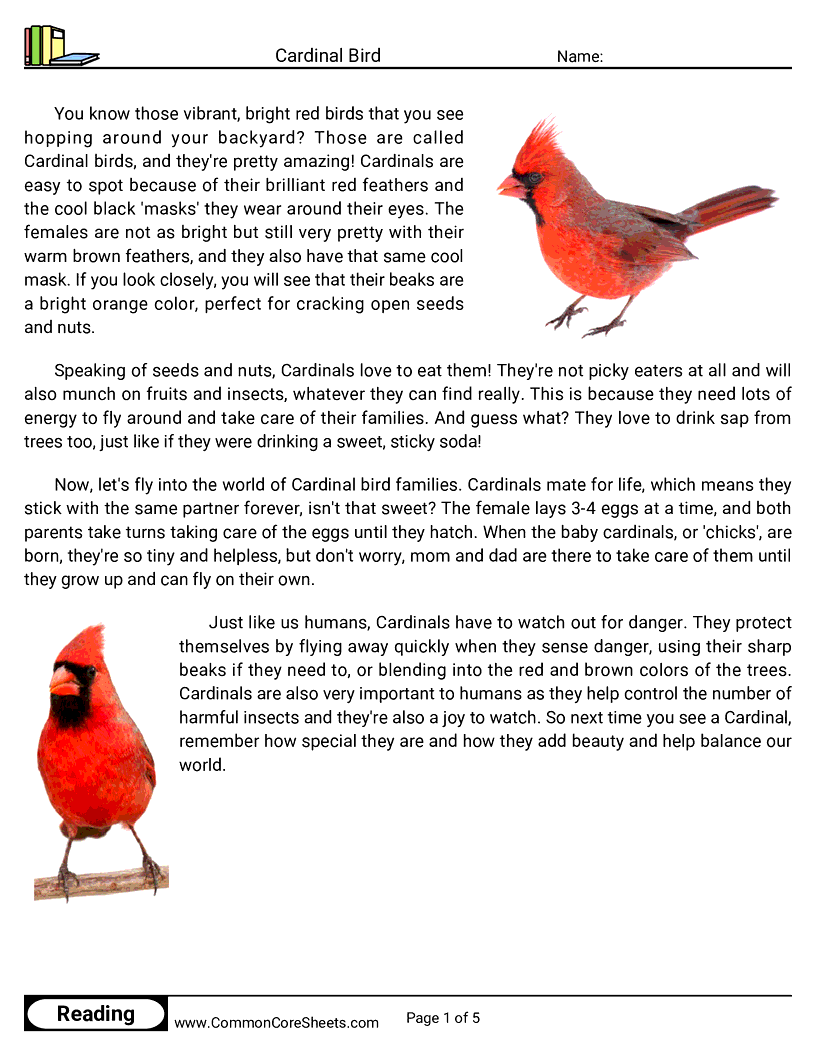
You know those vibrant, bright red birds that you see hopping around your backyard? Those are called Cardinal birds, and they're pretty amazing! Cardinals are easy to spot because of their brilliant red feathers and the cool black 'masks' they wear around their eyes. The females are not as bright but still very pretty with their warm brown feathers, and they also have that same cool mask. If you look closely, you will see that their beaks are a bright orange color, perfect for cracking open seeds and nuts.
Speaking of seeds and nuts, Cardinals love to eat them! They're not picky eaters at all and will also munch on fruits and insects, whatever they can find really. This is because they need lots of energy to fly around and take care of their families. And guess what? They love to drink sap from trees too, just like if they were drinking a sweet, sticky soda!
Now, let's fly into the world of Cardinal bird families. Cardinals mate for life, which means they stick with the same partner forever, isn't that sweet? The female lays 3-4 eggs at a time, and both parents take turns taking care of the eggs until they hatch. When the baby cardinals, or 'chicks', are born, they're so tiny and helpless, but don't worry, mom and dad are there to take care of them until they grow up and can fly on their own.
Just like us humans, Cardinals have to watch out for danger. They protect themselves by flying away quickly when they sense danger, using their sharp beaks if they need to, or blending into the red and brown colors of the trees. Cardinals are also very important to humans as they help control the number of harmful insects and they're also a joy to watch. So next time you see a Cardinal, remember how special they are and how they add beauty and help balance our world.
"Hey there, have you ever spotted a bright red bird in your backyard?" That's probably a cardinal, a bird known for its vibrant colors and beautiful songs. Cardinals, also known as Northern Cardinals, are mid-sized birds that are native to North America. They are a delight to spot due to their striking red color, especially the males, while the females are more of a subdued, brownish-red.
"Let's talk about where these wonderful creatures live." Cardinals are quite adaptable, you can find them in woodlands, gardens, shrublands, and even in our backyards! They are mostly found in the eastern United States, southern Canada, Mexico, and Central America. Cardinals don't migrate, they love their home so much that they stay there all year round!
"Now, what do you think cardinals like to munch on?" Well, cardinals love to eat seeds, grains, fruits, and insects. Their strong beaks are perfect for cracking open seeds. When it comes to insects, they help us out by keeping the insect population under control!
"Curious about the life cycle of a cardinal?" Well, after a male and female cardinal pair up, they mate and then the female lays about 3 to 4 eggs. Then, both parents take turns incubating the eggs for about 12-13 days, and once the chicks hatch, they continue to care for them until they're ready to fly on their own. Cardinals usually have two broods, or sets of babies, each year!
"Lastly, let's explore cardinals' relationship with us and other animals." Humans enjoy watching cardinals, and we often put out bird feeders to attract them. As for other animals, cardinals have to watch out for predators like cats and hawks. But don't worry, cardinals are pretty smart and they have a few tricks up their wings to protect themselves, like flying away quickly or using their sharp beak to defend themselves.
In conclusion, cardinals are really fascinating creatures. From their bright colors and beautiful songs to their interesting life cycle and relationships with other creatures, there's so much to learn and appreciate about these wonderful birds!
Let's take a journey into the world of cardinal birds, an incredibly vibrant and interesting species of birds! Cardinals are not hard to spot thanks to their bright red feathers and the black "masks" around their beaks. They are medium-sized birds with a body length of 8.3–9.1 inches and a wingspan of 10–12 inches. These birds have strong beaks, which they use for eating seeds, their favorite food. But they also like to munch on insects and fruits, ensuring they get a rounded diet.
Now, let's talk about where these beautiful birds call home. Cardinals are found in North and South America, living in woodlands, gardens, shrublands, and swamps. They are non-migratory birds, which means they don't fly south for the winter like some birds do. Instead, they brave the cold and stay in their home range throughout the year. This means you can spot them in your backyard all year round, brightening up even the gloomiest winter day.
Cardinals have a fascinating life cycle that's worth knowing about. Once the female cardinal chooses a mate, they stay together for life, helping each other raise their young. The female lays 2-5 eggs, which she incubates for 11-13 days before they hatch into chicks. The chicks stay in the nest for another 9-11 days, with both parents taking turns feeding them. After about two weeks, the chicks are ready to leave the nest and start their own life adventure.
Cardinals also have a unique relationship with humans and other animals. They often live near people, and many birdwatchers and nature lovers enjoy their beautiful songs and vibrant colors. In terms of other animals, cardinals have to watch out for predators like hawks and cats. To protect themselves, they use their sharp beaks and also hide in thorny bushes or dense vegetation. They can also make loud alarm calls to warn other cardinals about danger.
Lastly, there are some key differences between cardinals and other bird species. For one, unlike many bird species where only males are brightly colored, both male and female cardinals have vibrant colors, though males are typically brighter. Another unique feature is their crests, a pointed feather group on top of their head, which they can raise or lower depending on their mood. And did you know that the cardinal is the state bird of seven U.S. states? That's more than any other bird! So next time you see a cardinal, remember just how special these birds truly are.
About this worksheet
Students read a short informational passage about cardinal birds and answer comprehension questions about the text.
This worksheet is designed to enhance children's reading and comprehension skills around the topic of Cardinal Birds. It presents 20 varied questions exploring details like color, diet, and lifecycle characteristics. The customizable content is equally effective for distance learning, ideal for being converted into flashcards to facilitate engaging, interactive learning.
Student objectives
- Read a nonfiction passage about cardinal birds
- Find and recall facts stated in the text
- Answer questions using details from what they read
- Learn new words related to birds and their habitats
Everyday practice
- Read a fact sheet at a nature center about a bird you spotted
- Look up information about a cardinal you see in your backyard
- Talk about what a bird eats or where it lives after reading about it
- Answer questions a friend asks about an animal you just read about