Brown Recluse Spider Worksheet Download
Free reading worksheets on Brown Recluse Spider. Each worksheet has 20 problems with an answer key and are ideal for teachers and homeschooling. You can download the PDF, create a set of flash cards or set it up for online learning.
Select a Different Activity
>
Sheet Information >
Available at 2nd grade, 3rd grade, 4th grade, 5th grade and 6th grade reading levels.
Read the passage
Let\'s learn about the brown recluse spider, a fascinating little creature! These spiders are usually light to dark brown, with a violin-shaped mark on their back. Brown recluse spiders like to live in dark, quiet places, like attics, garages, and even inside shoes!
Now, let\'s explore what these spiders eat and their life cycle. Brown recluse spiders love to munch on insects like cockroaches, crickets, and even other spiders! Their life cycle starts with an egg, which hatches into a tiny spiderling, and then grows into an adult spider in about a year.
Lastly, we\'ll discuss the brown recluse spider\'s relationship with humans and other insects. While they usually don\'t bother humans, their bite can be dangerous, so it\'s best to give them space and be careful around their hiding spots. Brown recluse spiders help control insect populations by eating them, and they have special silk that\'s stronger than other spider species!
Hey there, curious kids! Let\'s learn about the brown recluse spider, a fascinating little creature that\'s often misunderstood. These spiders have a light brown body with a dark violin-shaped mark on their back, and they grow to be about the size of a quarter. Brown recluse spiders are shy and like to hide in dark, quiet places like woodpiles, closets, and attics. They also like to eat insects like cockroaches, crickets, and even other spiders!
Now, let\'s talk about the life cycle of the brown recluse spider and how they interact with other insects and humans. Their life cycle starts with the female spider laying eggs, which hatch into tiny spiderlings, and eventually grow into adult spiders over the course of about a year. Although they don\'t usually bother humans, their venom can be harmful if they feel threatened and bite. Luckily, they\'re not aggressive and would rather run away than attack.
Finally, let\'s explore some interesting facts and differences between the brown recluse spider and other spider species. One cool fact is that they have six eyes instead of the usual eight that most spiders have. Another difference is that they don\'t spin large, round webs like other spiders, but instead create irregular webs in hidden corners. And did you know that some brown recluse spiders can live up to two years? That\'s a long time for a spider!
Now that you\'ve learned all about the brown recluse spider, you can share your new knowledge with your friends and family. Remember, it\'s important to respect all creatures, big and small. Happy exploring!
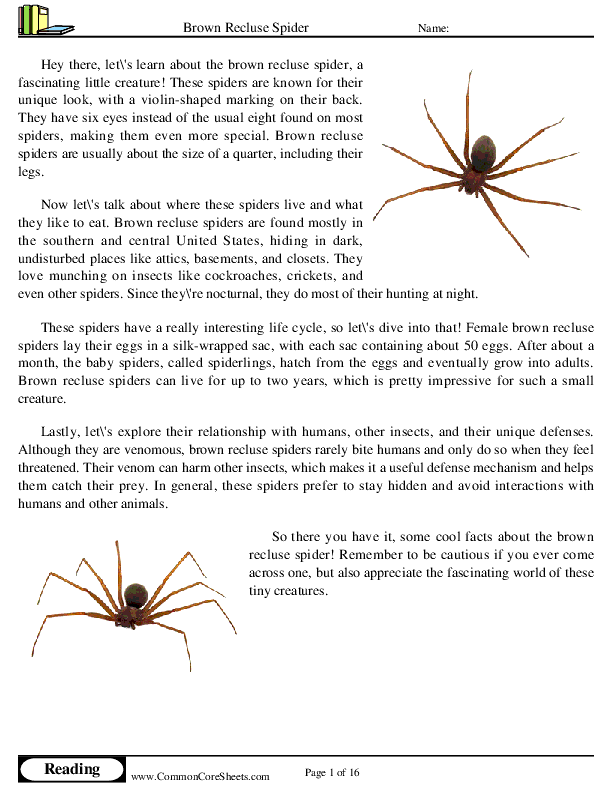
Guess who's tiny, brown, and has a violin-like marking on its back? That's right, it's the brown recluse spider! This little arachnid is about the size of a quarter, including its legs, and its color can vary from sandy beige to dark brown. The marking on its back, which kind of looks like a violin, is one of the things that sets the brown recluse apart from other spiders. Another unique feature is that it has only six eyes instead of the usual eight that most spiders have!
If you're wondering where this six-eyed creature calls home, you'll find them mostly in the central and southern parts of the United States. They prefer to live in dark, secluded places, like under rocks or in woodpiles, and they even sometimes sneak into people's houses! These spiders are not social, so they like to be alone most of the time. And when it comes to dinner time, they like to feast on little insects like cockroaches and crickets.
Now let's talk about the life cycle of our violin-backed friend. The female brown recluse lays eggs in a sticky, off-white silken sac, and after about a month, tiny spiderlings emerge. These little ones grow up to become adults in about a year, and can live for two to four years, which is quite long for a spider. Did you know that these spiders play an important role in the ecosystem by controlling the population of the insects they eat?
Now, you might be wondering, do these spiders get along with humans? Well, brown recluse spiders are actually quite shy and prefer to keep to themselves rather than interact with humans or other animals. They only bite when they feel threatened, and their venom can be harmful to humans, so it's best to leave them alone if you see one. And that's our little six-eyed, violin-backed friend, the brown recluse spider, a unique creature that prefers a quiet life, munching on insects and playing its part in the balance of nature.
Hey there! Did you know that the brown recluse spider is one of the most fascinating spiders in the world? These spiders are usually small, with a body size of about 0.24 to 0.79 inches. Their color can range from light to dark brown, and they have a distinctive violin-shaped marking on their back. They\'re called 'recluse' because they like to hide in dark, quiet places during the day and come out at night to hunt for food.
Speaking of food, brown recluse spiders have quite an appetite for various insects. They love to munch on cockroaches, crickets, and even other spiders! To catch their prey, they use a unique hunting strategy by spinning small, irregular webs to trap their victims. Once caught, the brown recluse spider injects venom into its prey to paralyze it before enjoying its meal.
Now, let\'s talk about where these fascinating spiders live. Brown recluse spiders can be found in the south-central and midwestern United States. They prefer to make their homes in dark, undisturbed areas like basements, attics, and even inside old shoes or clothes! Outdoors, they can be found hiding under rocks, logs, or in piles of leaves.
Ever wonder how brown recluse spiders grow and develop? Their life cycle starts with the female laying eggs in a small, silk cocoon. Once the eggs hatch, the baby spiders go through several stages of development called 'instars' before reaching adulthood. Brown recluse spiders can live for up to two years, which is quite impressive for such a small creature.
Finally, let\'s discuss their relationship with humans and other insects. Brown recluse spiders are usually not aggressive towards humans and will only bite if they feel threatened. Their venom can cause a painful reaction in some people, but it\'s important to remember that they help control insect populations by eating other pests. In the insect world, they have both predators, like birds and other spiders, and prey, making them an important part of the ecosystem.
In conclusion, brown recluse spiders are fascinating creatures with unique characteristics and an important role in our environment. So next time you come across one, remember to appreciate its contribution to the ecosystem and treat it with respect.
Hey there, curious minds! Let\'s dive into the world of brown recluse spiders. These little creatures are pretty fascinating and have some cool features. Brown recluse spiders are usually light to dark brown, with a violin-shaped mark on their back. They are about the size of a quarter, including their legs. Despite their small size, they have a lot to offer in the world of spiders.
Now, let\'s explore the habitat of the brown recluse spider. They are native to the United States, particularly in the south-central region. These spiders are quite the homebodies, preferring to live in dark, quiet spaces like basements, closets, and attics. They are also known to live outdoors, hiding under rocks, logs, or woodpiles. As their name suggests, they are rather reclusive and avoid humans when possible.
What\'s for dinner? Brown recluse spiders have a varied diet. They typically eat insects, such as cockroaches, crickets, and other spiders. They use their venom to paralyze their prey, then use their powerful jaws to crush it. These spiders are also known to eat other brown recluse spiders, which is called cannibalism. Their eating habits help keep the population of other insects in check.
Let\'s take a look at the life cycle of the brown recluse spider. Female brown recluse spiders lay their eggs in a silken egg sac, usually containing 50 or more eggs. After about a month, the eggs hatch and tiny spiderlings emerge. These spiderlings go through several molts, or shedding of their exoskeleton, before reaching adulthood. Brown recluse spiders can live for about two to four years, which is quite impressive for a spider!
Lastly, let\'s talk about their relationship with humans and other insects. While brown recluse spiders are venomous, they rarely bite humans unless they feel threatened. Their venom can cause some serious health issues, so it\'s important to be cautious around them. However, they are extremely beneficial to the environment as they help control insect populations. Remember, these spiders are more scared of us than we are of them, so let\'s be kind and give them their space.
I hope you enjoyed learning about the fascinating world of brown recluse spiders. Remember, they play an important role in our ecosystem and are just as amazing as any other creature on our planet.
About this worksheet
Students read an informational passage about the brown recluse spider and answer comprehension questions about its habits, appearance, and dangers.
This worksheet is designed to enhance children's reading comprehension through engaging with the intriguing topic of the Brown Recluse Spider. Covering aspects from its appearance to habitat preferences and dietary habits, the material enables a deep understanding of this creature. The 20-problem worksheet can be customized, converted into flash cards for interactive learning, or adapted for distance learning, reinforcing knowledge and improving reading skills.
Student objectives
- Read a nonfiction passage about the brown recluse spider
- Find and recall key facts from what you read
- Answer questions using details from the text
- Learn new vocabulary related to spiders and insects
- Understand the main idea of an informational article
Everyday practice
- Read a nature article and remember important facts about an animal
- Identify a spider by its markings after reading about it
- Answer questions about a book or article a friend asks you
- Learn facts to share about dangerous animals in your area
- Look up information about a bug you found outside