Assassin Bug Worksheet Download
Free reading worksheets on Assassin Bug. Each worksheet has 20 problems with an answer key and are ideal for teachers and homeschooling. You can download the PDF, create a set of flash cards or set it up for online learning.


Sheet Information >
Available at 2nd grade, 3rd grade, 4th grade, 5th grade and 6th grade reading levels.
Read the passage
Hey kids, have you ever heard of the Assassin bug? These cool insects are super skilled hunters and come in many different shapes and colors. You can find them almost all over the world, living in forests, fields, and even in our gardens.
Assassin bugs are not picky eaters and love to munch on other insects like caterpillars, beetles, and even other bugs! They have a sharp needle-like mouth, called a rostrum, which they use to pierce their prey and inject venom. This venom dissolves the insides of the unlucky insect, and the Assassin bug then slurps it up like a tasty bug smoothie.
Even though they might sound a bit scary, Assassin bugs are not dangerous to humans. However, some species can give a painful bite if they feel threatened, so it's best to admire them from a safe distance. These fascinating insects are an important part of our ecosystem, helping to control the populations of other insects, and showing us just how diverse and incredible the world of bugs can be.
Hey kids, let's talk about the amazing Assassin bug! These cool insects are found in many parts of the world, like North and South America, Africa, Asia, and Australia. They come in various shapes and colors, and they are known to be excellent hunters of other insects. Assassin bugs live in different habitats, like forests, fields, and even in your backyard!
Now, let's learn about the life cycle and eating habits of these fascinating creatures. Assassin bugs go through three stages: egg, nymph, and adult, just like other insects. They are carnivorous insects, which means they eat other insects like spiders, caterpillars, and even other bugs. Assassin bugs use their sharp mouthparts called a 'rostrum' to stab their prey and inject them with a special venom that turns their insides into liquid, making it easy for the bug to suck up its meal.
Lastly, let's explore their relationships with humans and other insects, as well as their unique defenses. Most Assassin bugs are harmless to humans, but some can bite if they feel threatened, causing mild pain and itching. They help control the population of other insects, which can be beneficial for us and our gardens. Assassin bugs have different ways to defend themselves, like camouflage, warning colors, or even a sticky substance they can release to trap their enemies. Remember, these bugs are different from other species because of their hunting skills and unique features, making them truly fascinating creatures to learn about!
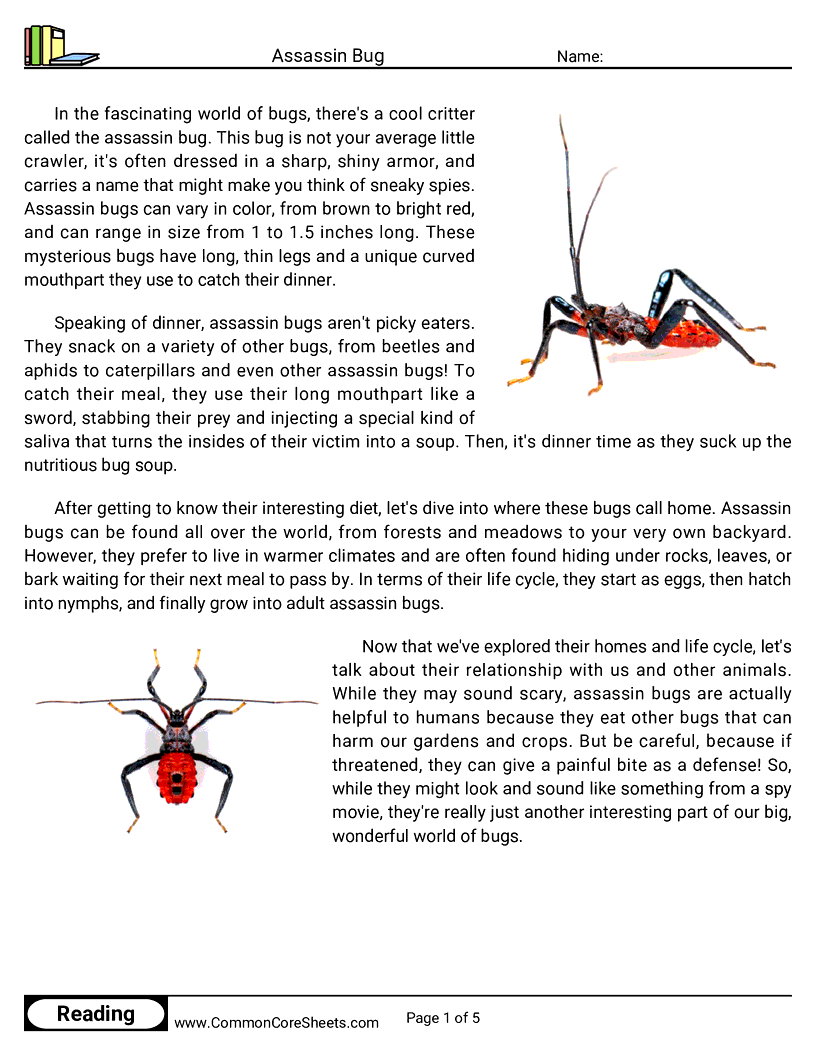
In the fascinating world of bugs, there's a cool critter called the assassin bug. This bug is not your average little crawler, it's often dressed in a sharp, shiny armor, and carries a name that might make you think of sneaky spies. Assassin bugs can vary in color, from brown to bright red, and can range in size from 1 to 1.5 inches long. These mysterious bugs have long, thin legs and a unique curved mouthpart they use to catch their dinner.
Speaking of dinner, assassin bugs aren't picky eaters. They snack on a variety of other bugs, from beetles and aphids to caterpillars and even other assassin bugs! To catch their meal, they use their long mouthpart like a sword, stabbing their prey and injecting a special kind of saliva that turns the insides of their victim into a soup. Then, it's dinner time as they suck up the nutritious bug soup.
After getting to know their interesting diet, let's dive into where these bugs call home. Assassin bugs can be found all over the world, from forests and meadows to your very own backyard. However, they prefer to live in warmer climates and are often found hiding under rocks, leaves, or bark waiting for their next meal to pass by. In terms of their life cycle, they start as eggs, then hatch into nymphs, and finally grow into adult assassin bugs.
Now that we've explored their homes and life cycle, let's talk about their relationship with us and other animals. While they may sound scary, assassin bugs are actually helpful to humans because they eat other bugs that can harm our gardens and crops. But be careful, because if threatened, they can give a painful bite as a defense! So, while they might look and sound like something from a spy movie, they're really just another interesting part of our big, wonderful world of bugs.
Meet the fascinating Assassin bug, a unique and interesting insect. These cool bugs come in many shapes, sizes, and colors, making them quite the sight to see. While they might look a little scary, they are not harmful to humans, so there's no need to be afraid of them. Let's explore more about their lives, what they eat, and how they interact with other insects and humans.
First, let's talk about where these amazing creatures live and what they eat. Assassin bugs can be found all over the world, from forests and grasslands to deserts and even in our gardens. These bugs are predators that hunt other insects like flies, caterpillars, and even mosquitoes. They use their long, sharp mouthparts called a 'rostrum' to stab their prey and inject a deadly saliva that turns the insides of their prey to mush so they can easily suck it up.
Now let's dive into the life cycle of an Assassin bug. Their life begins as an egg, which the mother lays in a safe place like under leaves or in tree bark. After a few weeks, a tiny nymph hatches from the egg and starts to grow by shedding its exoskeleton several times. Finally, after about two months, the nymph turns into an adult Assassin bug, ready to hunt and lay eggs of its own.
Assassin bugs have a unique relationship with humans and other insects. While they can bite humans if they feel threatened, they are generally not harmful and can even be considered helpful because they eat pests that bother us, like mosquitoes and flies. Some Assassin bugs, like the Wheel bug, are considered beneficial insects because they help control the populations of other insects that can damage plants. However, not all Assassin bugs are nice to other insects, as some species are known to attack bees and other helpful pollinators.
Lastly, let's take a look at some of the interesting differences between Assassin bug species. Some species, like the Cone-nosed bug, are known for their unique shape which helps them blend in with their environment. The Ambush bug is another fascinating species that uses camouflage to hide and wait for its prey to come close before striking. One thing all Assassin bugs have in common is their incredible hunting skills, making them a force to be reckoned with in the insect world.
In conclusion, Assassin bugs are fascinating creatures with a wide variety of appearances and behaviors. As we've learned, they can be both helpful and harmful to other insects and have a unique relationship with humans. Keep an eye out for these incredible insects in your own backyard!
Hey there, have you ever heard of the fascinating insect called the Assassin bug? These cool creatures are not your average bug, they're actually a type of insect that belongs to the Reduviidae family. They got their unique name because they are skilled predators, often sneakily hunting down and attacking their prey. Assassin bugs come in many shapes and sizes, with over 7,000 different species found all over the world! Let's dive into their world and learn more about these incredible insects.
First, let's talk about what Assassin bugs like to eat. These predatory insects are carnivorous, which means they eat other insects and small invertebrates, like spiders and caterpillars. Using their long, sharp beaks, they inject a powerful venom into their prey, which turns their insides into a liquid. Then, they suck up the tasty insides like a straw! This might sound a bit gross, but it's a really effective way for them to get their nutrients.
Now, let's explore where these amazing bugs live. You can find Assassin bugs all over the world, from the hot deserts of Africa to the lush forests of South America. These insects are experts at blending in with their surroundings, often hiding under rocks or leaves, waiting for their next meal to come along. Some species even live in human homes or gardens, helping to control other pesky insects! So, if you see an Assassin bug around, remember they might be doing you a favor.
The life cycle of an Assassin bug is quite interesting. They start off as tiny eggs, which are often laid in groups on leaves or other safe places. Once the eggs hatch, the baby bugs, called nymphs, will molt several times as they grow into their adult forms. During this time, they will learn to hunt and fend for themselves, becoming expert insect assassins. After reaching adulthood, they will mate and lay eggs, starting the cycle all over again.
Lastly, let's talk about their relationship with humans and other insects. While some species of Assassin bugs can bite humans if they feel threatened, most are harmless and are actually helpful in controlling other insect populations. Their main defense mechanism is their venomous bite, which can be painful to humans, but is usually not dangerous. Other insects and small creatures should definitely watch out for these skilled hunters, as they are masters at capturing their prey. In conclusion, Assassin bugs are fascinating creatures that play an important role in keeping the balance of nature in check.
About this worksheet
Students read an informational passage about the assassin bug and answer comprehension questions about its traits and behavior.
This worksheet is designed to enrich children's reading and comprehension skills through intriguing topics like Assassin Bugs. It offers 20 comprehensive questions that cover the insect's attributes, habitat, life cycle, and relationship with humans. The versatile worksheet format can be customized to suit various learning techniques, converted into flash cards, or integrated into distance learning programs for an engaging educational experience.
Student objectives
- Read a nonfiction passage about the assassin bug and understand the main ideas
- Find specific facts in the text to answer questions
- Learn new vocabulary related to insects and their behavior
- Practice explaining what the passage says in your own words
Everyday practice
- Read a fact sheet at a zoo or nature center and talk about what you learned
- Look up information about a bug you find in the yard
- Explain an interesting animal fact to a friend or family member
- Answer questions about an article you read in a kids' magazine