Ant Lions Worksheet Download
Free reading worksheets on Ant Lions. Each worksheet has 20 problems with an answer key and are ideal for teachers and homeschooling. You can download the PDF, create a set of flash cards or set it up for online learning.


Sheet Information >
Available at 2nd grade, 3rd grade, 4th grade, 5th grade and 6th grade reading levels.
Read the passage
Hey kids, have you ever heard of ant lions? These fascinating little creatures may look like tiny dragons, but they're actually a type of insect! Ant lions can be found all around the world, living in warm, sandy habitats where they can dig their unique traps.
Speaking of traps, ant lions are quite clever when it comes to catching their favorite meal: ants! They dig small, funnel-shaped pits in the sand, and when an unsuspecting ant falls in, the ant lion quickly grabs it with its powerful jaws. The life cycle of an ant lion is pretty interesting, too; they start as tiny larvae, then grow into pupae, and finally transform into winged adult insects that look a bit like dragonflies.
Ant lions don't really have much of a relationship with humans, but they play an important role in the ecosystem. They help control ant populations and serve as food for other insects and animals. So, next time you're out exploring nature, keep an eye out for these amazing little creatures and appreciate their unique place in the world.
Hey there, have you ever heard of ant lions? They are super cool insects that live in sandy or dusty environments, like deserts and warm, dry forests. Ant lions are small, but they are fierce predators, and their favorite meal is ants! These little creatures create cone-shaped pits in the sand to trap their prey, then they hide and wait for an unsuspecting ant to fall in.
Ant lions go through an interesting life cycle, starting as eggs. After a few weeks, the eggs hatch into larvae, which are the ones that make those clever sand traps. Eventually, the larvae turn into pupae and then into adult ant lions, which can fly and lay their own eggs. While humans don't have much interaction with ant lions, they can be helpful by controlling ant populations in some areas.
Ant lions have a unique relationship with other insects, especially ants. Their traps are designed specifically to catch ants, which they use their powerful jaws to eat. Interestingly, ant lions are not the only species that use traps to catch their prey; some spiders also dig pits in the sand. But ant lions are the masters of this technique, making them quite different from other insects. So, next time you see a tiny sand pit, you might just be looking at the home of a fascinating little ant lion!
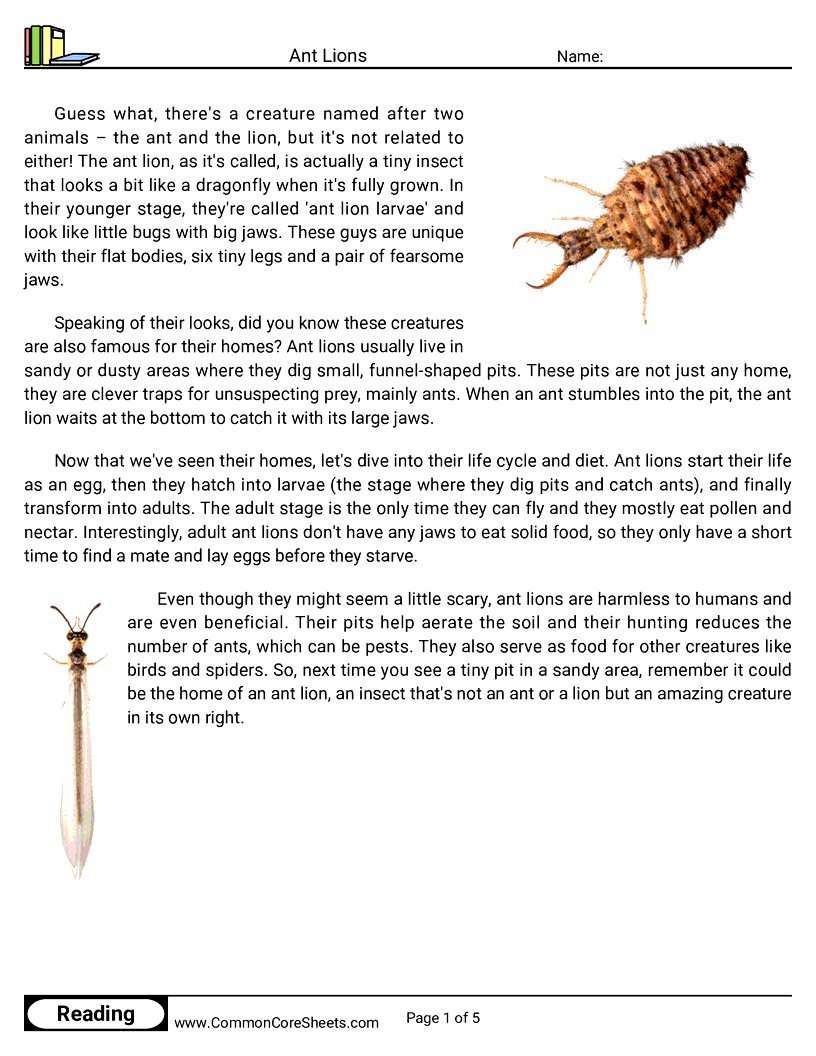
Guess what, there's a creature named after two animals – the ant and the lion, but it's not related to either! The ant lion, as it's called, is actually a tiny insect that looks a bit like a dragonfly when it's fully grown. In their younger stage, they're called 'ant lion larvae' and look like little bugs with big jaws. These guys are unique with their flat bodies, six tiny legs and a pair of fearsome jaws.
Speaking of their looks, did you know these creatures are also famous for their homes? Ant lions usually live in sandy or dusty areas where they dig small, funnel-shaped pits. These pits are not just any home, they are clever traps for unsuspecting prey, mainly ants. When an ant stumbles into the pit, the ant lion waits at the bottom to catch it with its large jaws.
Now that we've seen their homes, let's dive into their life cycle and diet. Ant lions start their life as an egg, then they hatch into larvae (the stage where they dig pits and catch ants), and finally transform into adults. The adult stage is the only time they can fly and they mostly eat pollen and nectar. Interestingly, adult ant lions don't have any jaws to eat solid food, so they only have a short time to find a mate and lay eggs before they starve.
Even though they might seem a little scary, ant lions are harmless to humans and are even beneficial. Their pits help aerate the soil and their hunting reduces the number of ants, which can be pests. They also serve as food for other creatures like birds and spiders. So, next time you see a tiny pit in a sandy area, remember it could be the home of an ant lion, an insect that's not an ant or a lion but an amazing creature in its own right.
Let's dive into the fascinating world of ant lions, unique insects that might just surprise you! These little creatures are sometimes called 'doodlebugs' because of the strange patterns they make in the sand. Ant lions belong to the family Myrmeleontidae and are closely related to lacewings and owlflies. They have a unique way of hunting their prey, which sets them apart from other insects.
Ant lions can be found in various parts of the world, such as Africa, Asia, Europe, and the Americas. They prefer living in dry, sandy areas like beaches, dunes, and even playground sandboxes. These habitats provide the perfect environment for ant lions to build their traps and catch their prey. It's important to remember that ant lions are not dangerous to humans and are actually beneficial to the ecosystem.
The life cycle of an ant lion is quite interesting and consists of three stages: egg, larva, and adult. Female ant lions lay their eggs in the sand, which hatch into the larval stage after about three weeks. The larva, which is the most famous stage of the ant lion, creates a funnel-shaped trap in the sand to catch its prey. After a few months or years, depending on the species, the larva will spin a cocoon and transform into an adult ant lion.
Ant lions have some unique relationships with other insects and animals. Their main prey is ants, but they also eat other small insects that fall into their traps. Some birds, like the shrike, are known to eat ant lions, while other creatures like spiders and frogs may fall victim to their traps. Despite their predatory nature, ant lions play an important role in controlling insect populations and maintaining balance in the ecosystem.
Finally, let's explore some fascinating facts and differences between ant lions and other species. Unlike most insects, ant lions do not have a pupal stage in their life cycle, making them unique in the insect world. Ant lion larvae are known for their impressive jaws, which they use to grab and inject venom into their prey. Adult ant lions are often mistaken for dragonflies or damselflies, but they can be distinguished by their longer antennae and different wing patterns. As we've discovered, ant lions are truly remarkable creatures with a fascinating life cycle, unique hunting methods, and important roles in the ecosystem.
Hey there! Have you ever heard of ant lions? They are fascinating little creatures that are also known as doodlebugs. These insects may look like something out of a science fiction movie, but they are very real and can be found all around the world. Ant lions are not actually lions, of course, but they get their name because they are ferocious predators of ants. They belong to the family Myrmeleontidae, which is part of the order Neuroptera, which also includes lacewings and owlflies. Now, let's dive into the amazing world of these tiny hunters!
Ant lions prefer to live in warm, dry environments like sandy or dusty areas, where they can easily create their traps. These traps are called pitfall traps, and they are actually small, cone-shaped holes that the ant lion digs in the sand. When an unsuspecting ant or other small insect falls into the trap, the ant lion quickly grabs it with its powerful jaws and pulls it under the sand to eat it. Ant lions have a unique way of capturing their prey, which is one of the reasons they are so interesting to study. Their diet mainly consists of ants, but they can also eat other small insects like spiders and termites.
The life cycle of an ant lion is quite fascinating, as it goes through four stages: egg, larva, pupa, and adult. During the larval stage, the ant lion looks like a small, hairy, grayish-brown creature with six legs and sharp jaws. This stage lasts for about one to three years, during which time the ant lion will molt several times. Once it's ready to become an adult, the ant lion forms a cocoon-like structure called a pupa, where it will stay for about one month. Finally, the adult ant lion emerges, looking more like a dragonfly with its delicate wings and slender body.
Ant lions are generally harmless to humans and are not considered pests. In fact, they can be beneficial to humans because they help control ant populations. However, their relationship with other insects can be quite competitive, as they need to fight for their food. Ant lions have several defenses against other predators, such as their powerful jaws, their ability to blend in with their surroundings, and their impressive speed. Other species of insects may have similar features, but the ant lion's unique trapping method sets it apart from the rest.
Here are some interesting facts about ant lions: The name 'doodlebug' comes from the spiral-shaped trails they leave in the sand while searching for a spot to dig their pitfall traps. Some people believe that if you can find an ant lion's trap, it means that rain is on the way, because ant lions do not like wet sand. Even though adult ant lions have wings and can fly, they are not very good at it and prefer to crawl or walk. Adult ant lions are not predators like their larval stage; they feed on nectar and pollen from flowers. So, the next time you're out exploring nature, keep an eye out for these amazing little creatures and their fascinating pitfall traps.
About this worksheet
Students read a short passage about ant lions and answer questions to show they understood the key details and information.
This worksheet is designed to improve reading comprehension through 20 interactive problems about Ant Lions. It covers concepts about their physical characteristics, lifecycle, habitat, and interaction with the environment. This flexible educational tool can be customized, converted to flash cards, or used in distance education programs, making learning about nature engaging and adaptable.
Student objectives
- Read a nonfiction passage about ant lions and understand the main ideas
- Find answers to questions using details from the text
- Learn new facts about how ant lions live and hunt
- Practice pulling out important information from what you read
Everyday practice
- Read a fact sheet at a nature center and answer a friend's questions about it
- Explain to a family member what you learned about an insect from a book
- Look up information about a bug you found outside and share the facts
- Read an article and point out the details that answer a question