American Mink Worksheet Download
Free reading worksheets on American Mink. Each worksheet has 20 problems with an answer key and are ideal for teachers and homeschooling. You can download the PDF, create a set of flash cards or set it up for online learning.


Sheet Information >
Available at 2nd grade, 3rd grade, 4th grade, 5th grade and 6th grade reading levels.
Read the passage
Hey kids, let's talk about the American mink, a fascinating little creature that has a lot to offer! These small mammals have soft, shiny fur that comes in various shades of brown, and they have a white patch under their chin. The American mink is found throughout North America, living near rivers, streams, and lakes where they can find plenty of food and shelter.
Now, let's learn about what American minks eat and their life cycle. These little carnivores love to snack on fish, frogs, birds, and small mammals, making them an important part of the food chain. When it comes to their life cycle, minks usually mate in late winter, and after a couple of months, the female gives birth to a litter of 3-6 baby minks called kits.
Lastly, let's explore the American mink's relationship with humans and other animals, as well as their defenses and differences from other species. Humans have both admired and hunted minks for their beautiful fur, while minks are known to help control pests like rats and mice. Their strong swimming skills and sharp teeth help them evade predators like eagles and foxes, and their scent glands distinguish them from other similar-looking animals, like weasels and ferrets.
As we can see, the American mink is a fascinating and essential part of our ecosystem, playing an important role in controlling pests and maintaining the balance in nature.
Let's learn about the amazing American mink, a small and curious creature! These furry little animals have dark brown fur and are about the same size as your pet cat. They love to live near water, usually in forests, swamps, or marshes where they can find their favorite foods. Speaking of food, minks are carnivores, which means they eat other animals like fish, frogs, and even birds!
Now, let's explore the life cycle of the American mink and their relationship with other animals and humans. Minks usually live for about 3 to 6 years, and they have babies, called kits, once a year in the springtime. These cute little kits stay with their mom for a few months before heading out on their own. While minks are shy and try to avoid humans, they are sometimes hunted for their beautiful fur or kept on mink farms.
Lastly, let's discover some interesting facts about the American mink and how they are different from other animals. Did you know that minks are excellent swimmers and can dive up to 15 feet underwater? They also have special glands that release a stinky smell to scare off predators and protect themselves. Even though they look similar to other animals like ferrets or weasels, minks are actually part of their own unique species called Neovison vison. So now you know a bit more about the fascinating American mink and how they live, eat, and interact with the world around them!
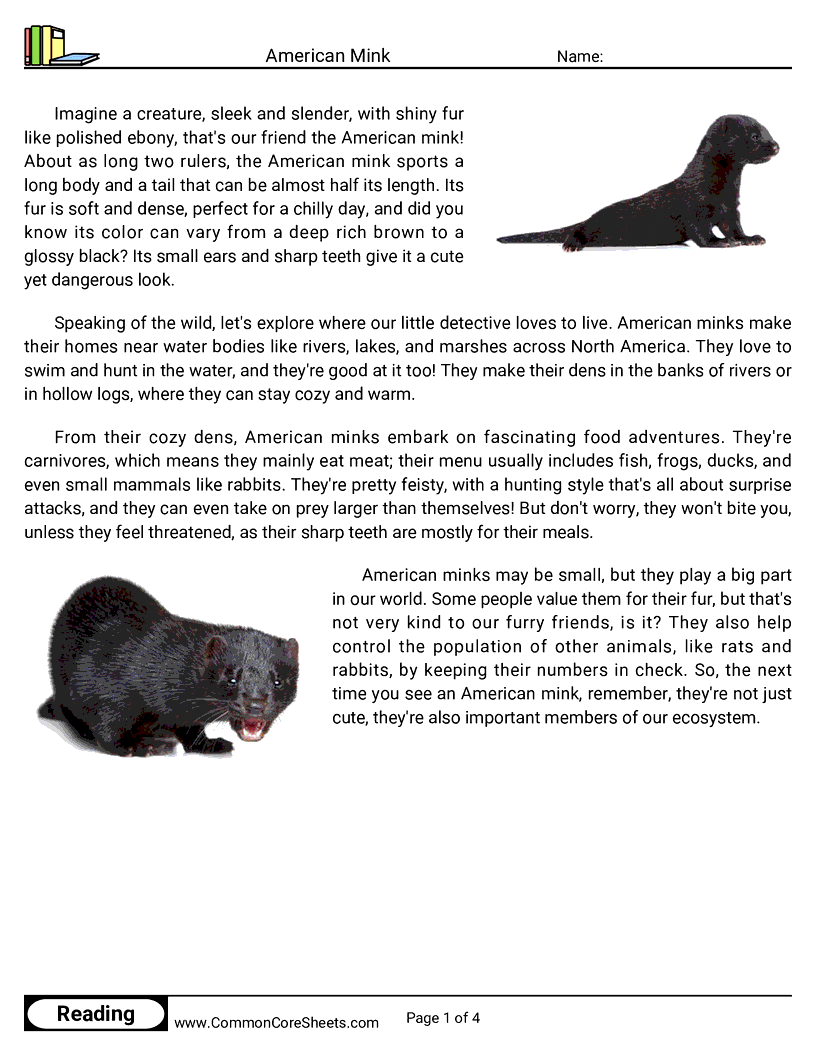
Imagine a creature, sleek and slender, with shiny fur like polished ebony, that's our friend the American mink! About as long two rulers, the American mink sports a long body and a tail that can be almost half its length. Its fur is soft and dense, perfect for a chilly day, and did you know its color can vary from a deep rich brown to a glossy black? Its small ears and sharp teeth give it a cute yet dangerous look.
Speaking of the wild, let's explore where our little detective loves to live. American minks make their homes near water bodies like rivers, lakes, and marshes across North America. They love to swim and hunt in the water, and they're good at it too! They make their dens in the banks of rivers or in hollow logs, where they can stay cozy and warm.
From their cozy dens, American minks embark on fascinating food adventures. They're carnivores, which means they mainly eat meat; their menu usually includes fish, frogs, ducks, and even small mammals like rabbits. They're pretty feisty, with a hunting style that's all about surprise attacks, and they can even take on prey larger than themselves! But don't worry, they won't bite you, unless they feel threatened, as their sharp teeth are mostly for their meals.
American minks may be small, but they play a big part in our world. Some people value them for their fur, but that's not very kind to our furry friends, is it? They also help control the population of other animals, like rats and rabbits, by keeping their numbers in check. So, the next time you see an American mink, remember, they're not just cute, they're also important members of our ecosystem.
Let's dive into the fascinating world of the American mink, a small but mighty creature. These mammals are a part of the weasel family and have a slender body that's covered in a beautiful, dark brown fur. Known for their agility and speed, they have partially webbed feet, perfect for swimming. Their size ranges from 18 to 28 inches, including their bushy tail, and they weigh between 1.5 and 3.5 pounds.
American minks are found across North America, living near rivers, lakes, and marshes. They make their homes, called dens, in hollow logs, abandoned burrows, or even under rocks. American minks are nocturnal, which means they are most active during the night. They are also known to be territorial and mark their territory with a strong-smelling scent.
These skilled hunters have quite an appetite and eat a variety of foods. Their diet mainly consists of fish, frogs, crayfish, and other small mammals like mice and rabbits. They have been known to eat birds and their eggs too. Minks are opportunistic feeders, meaning they'll eat whatever is available and easy to catch.
The life cycle of the American mink is quite interesting. Mating season occurs between January and April, and after a gestation period of around 51 days, females give birth to 1-8 kits (baby minks) in spring. The kits are born blind and helpless, but they grow quickly and are ready to leave their mother by 10-12 weeks. American minks live for an average of 3-4 years in the wild.
American minks have a complex relationship with humans and other animals. Their fur has been highly valued by humans for centuries, leading to overhunting and farming. In the wild, they have few predators, but they must watch out for larger animals like coyotes, owls, and snakes. One interesting fact is that they are related to, but are not the same as, European minks, which are slightly smaller and have a different fur color.
In conclusion, American minks are fascinating creatures with unique characteristics and an interesting life cycle. Their relationship with humans and other animals is complex, and they play an important role in their ecosystems.
Meet the American mink, a fascinating creature found across North America. These furry animals are part of the Mustelidae family, which includes other mammals like weasels and otters. They have a long, slender body covered in beautiful, thick fur that can be brown or black in color. Minks have small, rounded ears and sharp teeth, which help them catch their prey. Their webbed feet and agile bodies make them excellent swimmers, allowing them to easily navigate through their watery habitats.
Now let's dive into what American minks like to eat. These carnivorous creatures have a diverse diet that includes fish, frogs, birds, mice, and other small mammals. Minks are skilled hunters who use their sharp teeth and quick reflexes to catch their prey. They often eat near the water, as they prefer to hunt in those areas. Their diet helps to control the population of some of their prey, keeping the ecosystem balanced.
American minks can be found in various habitats throughout North America. They prefer to live near water sources like rivers, lakes, and marshes. Minks create dens by digging burrows or using natural shelters, such as hollow logs or rock crevices. These dens provide a safe place for them to rest, care for their young, and hide from predators. Their habitats can sometimes overlap with those of other animals, leading to interesting interactions.
Let's explore the life cycle of an American mink. Minks usually mate between January and April, with babies, called kits, being born around April or May. A mother mink will care for her kits in their den, teaching them important survival skills. By the time they are about two months old, the kits are ready to leave the den and venture out on their own. American minks have a lifespan of about 3 to 6 years in the wild.
Lastly, let's discuss the American mink's relationship with humans and other animals. Minks have been hunted by humans for their fur, which is used to make clothing and accessories. In some cases, minks have been bred in captivity for this purpose. As for their relationship with other animals, minks are known to be fierce defenders of their territory and can sometimes be aggressive towards other animals, including larger predators like foxes. Ultimately, the American mink is a fascinating creature with unique adaptations that allow it to thrive in its environment.
About this worksheet
Students read an informational passage about the American mink and answer questions about its habitat, diet, and physical traits.
This worksheet is designed to enhance reading comprehension using the topic of the American Mink. It explores concepts such as the animal's feeding habits, habitat, ecological role, and physical attributes. With versatility for customization, the 20-problem worksheet can transform into flashcards or a distance learning tool, aiding in effective and engaging education for children.
Student objectives
- Read a nonfiction passage about the American mink
- Find facts about where the mink lives and what it eats
- Answer questions using details from the text
- Learn new vocabulary about animals and their environment
Everyday practice
- Recognize a mink or its tracks near a pond or river during a nature walk
- Talk about what animals eat when visiting a zoo or wildlife area
- Understand facts you hear in an animal documentary
- Explain to a friend how a mink survives in the wild