American Badger Worksheet Download
Free reading worksheets on American Badger. Each worksheet has 20 problems with an answer key and are ideal for teachers and homeschooling. You can download the PDF, create a set of flash cards or set it up for online learning.


Sheet Information >
Available at 2nd grade, 3rd grade, 4th grade, 5th grade and 6th grade reading levels.
Read the passage
Hey kids, let's talk about the American badger, a fascinating animal that lives in North America. These cute, furry creatures have a stocky body, short legs, and a bushy tail. They make their homes, called burrows, in grasslands, prairies, and deserts.
American badgers have a diverse diet, making mealtime super interesting! They eat small animals like mice, squirrels, and rabbits, but also enjoy insects, birds, and even some plants. When it comes to their life cycle, badgers usually live about 4 to 14 years, and baby badgers, called kits, are born in the spring.
Now, let's explore how American badgers interact with humans and other animals. These animals are generally shy and prefer to avoid humans, but they can be quite helpful to farmers by controlling rodent populations. Badgers can also form a unique partnership with coyotes, where they work together to hunt prey, showing that teamwork makes the dream work!
So, now you know more about the amazing American badger, a unique and helpful creature that plays an important role in our ecosystem. Keep exploring the animal kingdom, and you'll discover many more fascinating facts!
Hey there, have you ever heard of the American badger? These cool creatures are medium-sized mammals with a flat body, short legs, and a triangle-shaped face with a black nose. They live in grasslands, fields, and forests across North America. American badgers are known for their expert digging skills, creating burrows to live in and find their food.
Speaking of food, American badgers are carnivores, which means they eat other animals. Their diet consists of small mammals like mice, squirrels, and rabbits, as well as insects and birds. When it comes to their life cycle, American badgers mate in the late summer and early fall, with baby badgers, called kits, being born in the spring. Kits will stay with their mothers for a few months before heading out on their own.
American badgers have some fascinating relationships with both humans and other animals. For example, they sometimes team up with coyotes to hunt for food, with the badger digging up prey and the coyote catching it. While they might look similar to European badgers, American badgers are actually more closely related to weasels and otters. In conclusion, American badgers are amazing animals with unique features and interesting behaviors that make them a fascinating species to learn about!
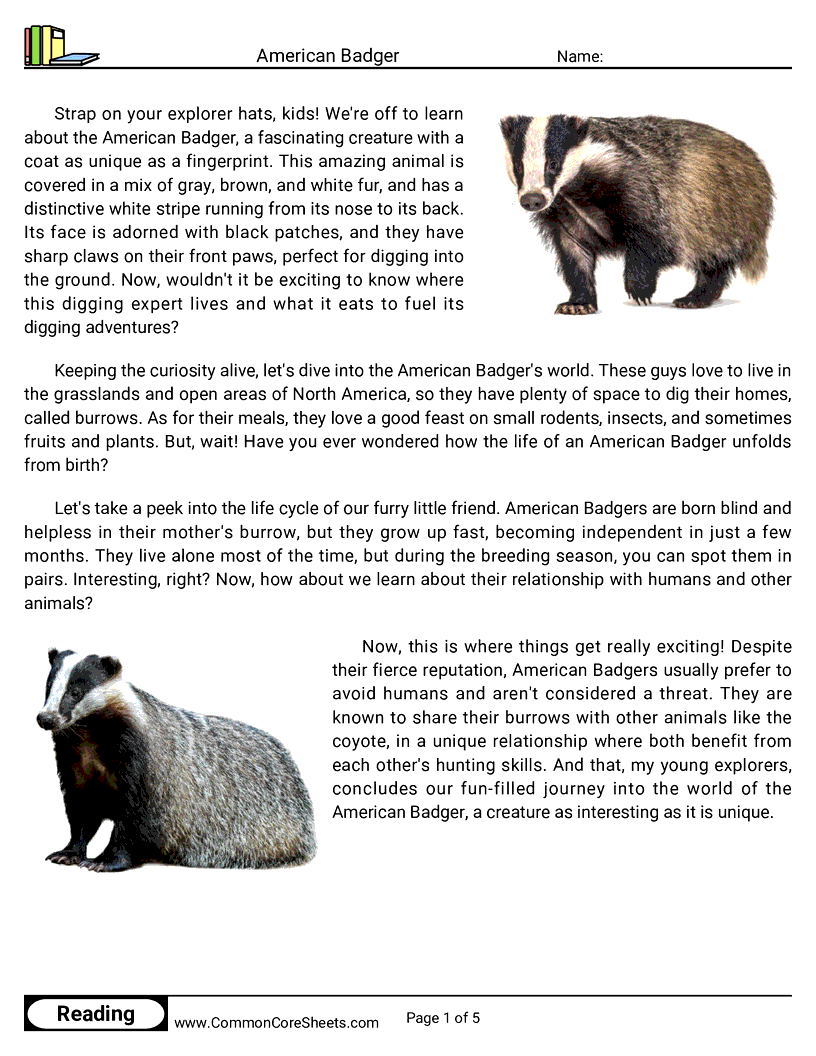
Strap on your explorer hats, kids! We're off to learn about the American Badger, a fascinating creature with a coat as unique as a fingerprint. This amazing animal is covered in a mix of gray, brown, and white fur, and has a distinctive white stripe running from its nose to its back. Its face is adorned with black patches, and they have sharp claws on their front paws, perfect for digging into the ground. Now, wouldn't it be exciting to know where this digging expert lives and what it eats to fuel its digging adventures?
Keeping the curiosity alive, let's dive into the American Badger's world. These guys love to live in the grasslands and open areas of North America, so they have plenty of space to dig their homes, called burrows. As for their meals, they love a good feast on small rodents, insects, and sometimes fruits and plants. But, wait! Have you ever wondered how the life of an American Badger unfolds from birth?
Let's take a peek into the life cycle of our furry little friend. American Badgers are born blind and helpless in their mother's burrow, but they grow up fast, becoming independent in just a few months. They live alone most of the time, but during the breeding season, you can spot them in pairs. Interesting, right? Now, how about we learn about their relationship with humans and other animals?
Now, this is where things get really exciting! Despite their fierce reputation, American Badgers usually prefer to avoid humans and aren't considered a threat. They are known to share their burrows with other animals like the coyote, in a unique relationship where both benefit from each other's hunting skills. And that, my young explorers, concludes our fun-filled journey into the world of the American Badger, a creature as interesting as it is unique.
Meet the American badger, a fascinating and adaptable animal found in North America. These medium-sized mammals have a distinctive appearance with their flat bodies, short legs, and a black and white-striped face. The American badger is a member of the Mustelidae family, which also includes animals like weasels, otters, and ferrets. Let's dive deeper into the world of the American badger and learn more about their unique traits, behavior, and habitat.
In their natural habitat, American badgers can be found across the United States, from the Great Lakes region to the West Coast. They prefer open grasslands, prairies, and farmlands, where they can easily dig burrows to live in. In these tunnels, they sleep, give birth, and stay safe from predators. Amazingly, they are known for their incredible digging skills, which help them create complex tunnel systems.
When it comes to their diet, American badgers are carnivorous, meaning they primarily eat meat. Their favorite meals include small mammals like mice, squirrels, and gophers, but they also eat birds, insects, and reptiles. They have strong, sharp claws that help them catch their prey, as well as dig their burrows. These powerful hunters play an important role in controlling pest populations and maintaining a balanced ecosystem.
The life cycle of an American badger begins when they are born, typically in litters of one to five babies called kits. Kits are born blind and helpless, relying on their mother for protection and nourishment for the first few months of their lives. By the time they are five months old, the kits are ready to live on their own and will leave their mother's burrow. American badgers can live up to 14 years in the wild, but their average lifespan is usually around 4 to 5 years.
American badgers have interesting relationships with both humans and other animals. While they are shy and tend to avoid human contact, they can become aggressive if they feel threatened, so it's best to admire them from a distance. In the wild, badgers are known to form surprising alliances with coyotes, as both animals hunt for the same prey. By working together, they increase their chances of finding food, showcasing the amazing adaptability of the American badger.
Meet the American badger, a fascinating furry mammal that lives in North America. These animals are usually found in grasslands, prairies, and deserts. They have a distinctive grayish-brown coat, and their face features a white stripe from their nose to the back of their head. American badgers have powerful front legs and long claws, which are perfect for digging burrows. These burrows serve as their home, providing shelter and protection from predators.
The diet of the American badger consists mainly of small mammals, insects, and even some plants. Their favorite meals include gophers, ground squirrels, and prairie dogs. Sometimes, they will also eat snakes, lizards, and ground-nesting birds. They have powerful jaws and sharp teeth, which help them catch and eat their prey. When food is scarce, badgers may also munch on roots, fruits, and other vegetation.
The life cycle of the American badger is quite interesting. They mate in the summer and early fall, but the female doesn't give birth until the following spring. This is because the fertilized eggs don't implant into the female's uterus until winter. Once the babies, called 'kits,' are born, they stay with their mother for about five to six months. After that, they leave to establish their own territories and begin their adult lives.
American badgers have a unique relationship with humans and other animals. They are known to be fierce when cornered and will use their sharp claws for defense. However, they are generally not aggressive towards humans unless they feel threatened. In fact, they can even be beneficial to humans by controlling rodent populations. One interesting relationship is with the coyote, as they have been known to hunt cooperatively for food.
There are a few differences between the American badger and other badger species. The European badger, for example, is larger and has a more social lifestyle. While American badgers are mostly solitary, European badgers often live in large groups called 'clans.' Another difference is the habitat, as European badgers are found in woodlands and forests rather than grasslands. Despite these differences, both species share similarities in their appearance and behavior.
About this worksheet
Students read a nonfiction passage about the American badger and answer questions about its habitat, diet, and behavior.
This worksheet is designed to enhance children's reading comprehension skills through 20 engaging problems about the American Badger. It covers various concepts including the badger's physical characteristics, lifestyle, habitat, and relationships with other animals. Ideal for distance learning, the customizable content can also be converted into educational flashcards for easier studying and recall.
Student objectives
- Read a nonfiction passage about the American badger
- Find key facts about where badgers live and what they eat
- Answer questions using details from the text
- Learn new vocabulary related to animals and nature
- Understand the main idea of an informational passage
Everyday practice
- Read facts about an animal you saw at the zoo or on a nature show
- Look up information about a wild animal for a school report
- Talk about what an animal eats and where it lives after reading about it
- Understand a sign or brochure describing wildlife at a park