Home Favorites My Account Menu
login
Playwire Advertisement

Wood Stork Worksheet Download

Free reading worksheets on Wood Stork. Each worksheet has 20 problems with an answer key and are ideal for teachers and homeschooling. You can download the PDF, create a set of flash cards or set it up for online learning.

Select a Different Activity >
Sheet Information >
Wood Stork
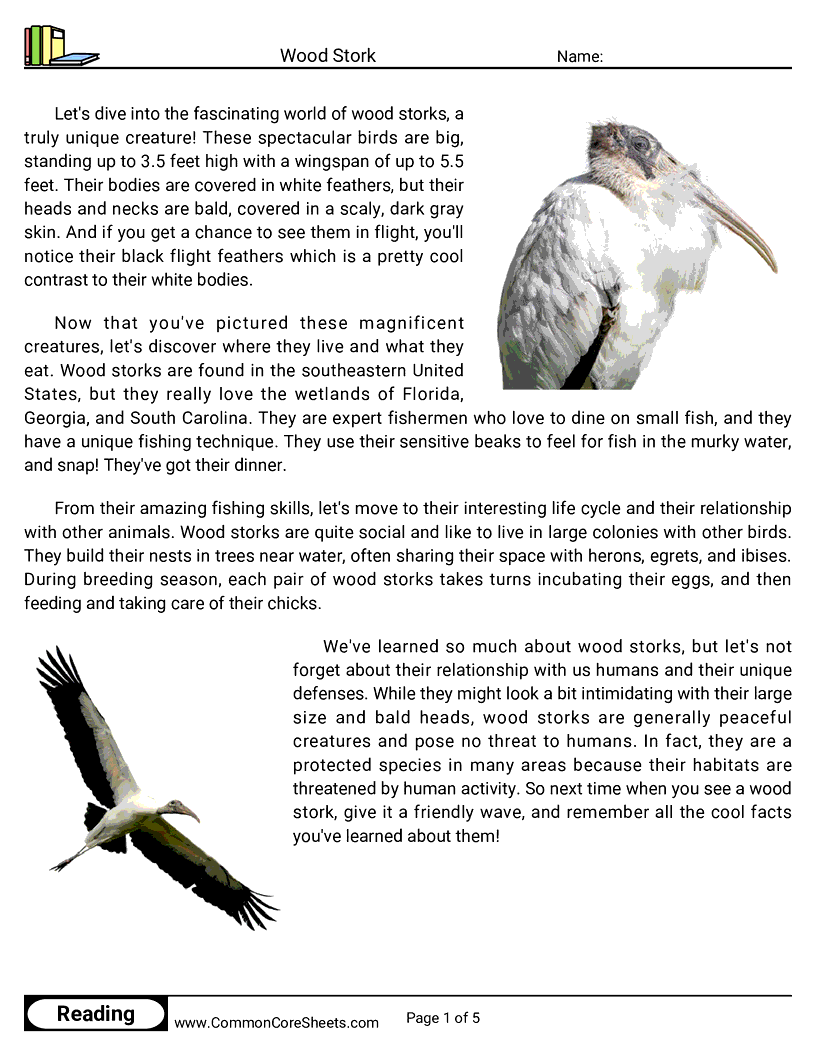
Students read an informational passage about the wood stork and answer comprehension questions about its habitat, diet, and traits.
Wood Stork worksheet preview
Wood Stork worksheet
Open PDF
Customize preview
open in new window
Select Worksheet
pages
Select Problem Type
Customize Problems
×
Problem type
Save
Sheet Layout>
Seed
title
Instructions
Number of Problems
Due Date
Include standard on Sheet
Font
Font Size pt
Minimum Space Below Problems mm
Answer Column
Problem Number
sheet orientation

Available at 2nd grade, 3rd grade, 4th grade, 5th grade and 6th grade reading levels.

Read the passage
Reading level:

Let's dive into the fascinating world of wood storks, a truly unique creature! These spectacular birds are big, standing up to 3.5 feet high with a wingspan of up to 5.5 feet. Their bodies are covered in white feathers, but their heads and necks are bald, covered in a scaly, dark gray skin. And if you get a chance to see them in flight, you'll notice their black flight feathers which is a pretty cool contrast to their white bodies.

Now that you've pictured these magnificent creatures, let's discover where they live and what they eat. Wood storks are found in the southeastern United States, but they really love the wetlands of Florida, Georgia, and South Carolina. They are expert fishermen who love to dine on small fish, and they have a unique fishing technique. They use their sensitive beaks to feel for fish in the murky water, and snap! They've got their dinner.

From their amazing fishing skills, let's move to their interesting life cycle and their relationship with other animals. Wood storks are quite social and like to live in large colonies with other birds. They build their nests in trees near water, often sharing their space with herons, egrets, and ibises. During breeding season, each pair of wood storks takes turns incubating their eggs, and then feeding and taking care of their chicks.

We've learned so much about wood storks, but let's not forget about their relationship with us humans and their unique defenses. While they might look a bit intimidating with their large size and bald heads, wood storks are generally peaceful creatures and pose no threat to humans. In fact, they are a protected species in many areas because their habitats are threatened by human activity. So next time when you see a wood stork, give it a friendly wave, and remember all the cool facts you've learned about them!

About this worksheet

Students read an informational passage about the wood stork and answer comprehension questions about its habitat, diet, and traits.

This worksheet is designed to enhance children's reading skills through interactive questions about wood storks, a protected species of bird. It comprises 20 varied questions that unravel fascinating details about the bird's habitat, diet, and behavior. Tailor-made for distance learning, this worksheet can be customized and converted into flashcards, making it an inventive learning tool for young readers.

Student objectives

  • Read an informational passage about the wood stork
  • Find and recall facts stated in the text
  • Answer questions about the bird's habitat and diet
  • Understand new vocabulary about birds and wetlands
  • Explain main ideas and details from what was read

Everyday practice

  • Read a sign or exhibit label about birds at a zoo or nature park
  • Look up facts about an animal you saw outside
  • Talk about what a bird eats and where it lives after reading about it
  • Share interesting facts about an animal with family or friends
Playwire Advertisement