Wheel Bug Worksheet Download
Free reading worksheets on Wheel Bug. Each worksheet has 20 problems with an answer key and are ideal for teachers and homeschooling. You can download the PDF, create a set of flash cards or set it up for online learning.
Select a Different Activity
>


Sheet Information >
Available at 2nd grade, 3rd grade, 4th grade, 5th grade and 6th grade reading levels.
Read the passage
Hey there, have you ever heard of the Wheel Bug? This amazing insect is named after the wheel-shaped armor on its back. Wheel Bugs can be found in North and Central America, living in gardens, forests, and fields.
Let\'s learn about the life of a Wheel Bug and the insects it interacts with! Wheel Bugs are great helpers in the garden because they eat harmful insects like aphids, caterpillars, and beetles. Their life cycle goes from an egg to a nymph, and finally, to an adult Wheel Bug.
It\'s important to understand how Wheel Bugs protect themselves and how they are different from other insects. They have a special beak that can deliver a painful bite if they feel threatened, so it\'s best to observe them from a safe distance. One unique feature of the Wheel Bug is their slow, stealthy movement, which helps them sneak up on their prey.
Now you know all about the fascinating Wheel Bug, a stealthy and helpful insect that plays an important role in our ecosystem. Remember, it\'s always fun to learn and explore, but make sure to admire these creatures from a safe distance. Happy bug watching!
Wheel bugs are fascinating insects that many kids find exciting! These cool creatures are part of the assassin bug family and can be found in North and Central America, mostly in gardens and fields. They have a unique appearance with their long legs, big eyes, and a wheel-shaped structure on their backs. These bugs are about an inch long and come in colors like brown or gray.
You might be wondering what these amazing bugs like to eat and how they live. Wheel bugs are carnivorous, which means they eat other insects like caterpillars, beetles, and even some spiders. Their life cycle starts with laying eggs, then hatching into tiny nymphs, and eventually becoming adult wheel bugs after several molts. Their relationship to other insects is mostly as predators, helping to control the population of other bugs.
Wheel bugs are not only interesting to look at but also have unique features that make them different from other species. One of their defenses is a sharp beak that they use to inject venom into their prey, causing it to be paralyzed. While they are not aggressive to humans, their bite can be painful, so it\'s best to admire them from a safe distance. Now that you know all about wheel bugs, you can impress your friends with your knowledge of these amazing insects!
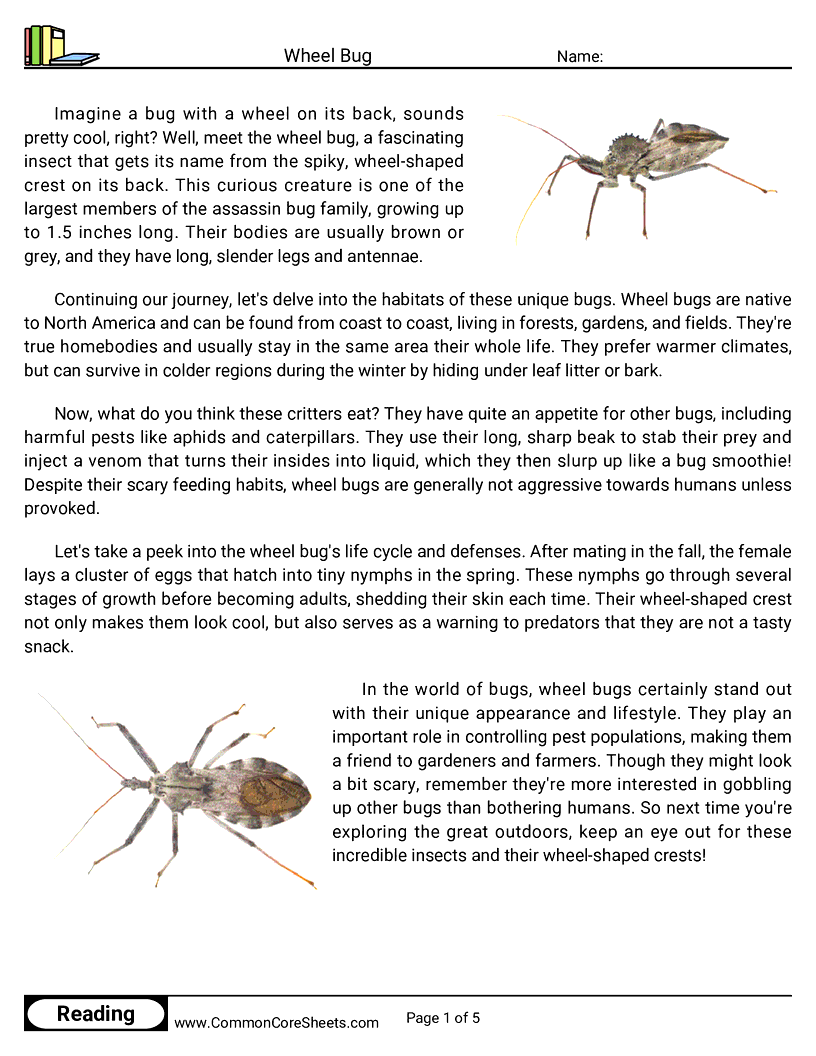
Imagine a bug with a wheel on its back, sounds pretty cool, right? Well, meet the wheel bug, a fascinating insect that gets its name from the spiky, wheel-shaped crest on its back. This curious creature is one of the largest members of the assassin bug family, growing up to 1.5 inches long. Their bodies are usually brown or grey, and they have long, slender legs and antennae.
Continuing our journey, let's delve into the habitats of these unique bugs. Wheel bugs are native to North America and can be found from coast to coast, living in forests, gardens, and fields. They're true homebodies and usually stay in the same area their whole life. They prefer warmer climates, but can survive in colder regions during the winter by hiding under leaf litter or bark.
Now, what do you think these critters eat? They have quite an appetite for other bugs, including harmful pests like aphids and caterpillars. They use their long, sharp beak to stab their prey and inject a venom that turns their insides into liquid, which they then slurp up like a bug smoothie! Despite their scary feeding habits, wheel bugs are generally not aggressive towards humans unless provoked.
Let's take a peek into the wheel bug's life cycle and defenses. After mating in the fall, the female lays a cluster of eggs that hatch into tiny nymphs in the spring. These nymphs go through several stages of growth before becoming adults, shedding their skin each time. Their wheel-shaped crest not only makes them look cool, but also serves as a warning to predators that they are not a tasty snack.
In the world of bugs, wheel bugs certainly stand out with their unique appearance and lifestyle. They play an important role in controlling pest populations, making them a friend to gardeners and farmers. Though they might look a bit scary, remember they're more interested in gobbling up other bugs than bothering humans. So next time you're exploring the great outdoors, keep an eye out for these incredible insects and their wheel-shaped crests!
Wheel bugs are fascinating insects that you may not have heard of before. These bugs belong to the assassin bug family and get their name from the wheel-like structure on their backs. Wheel bugs are usually brown or gray, and they can grow up to 1.5 inches in length. You\'ll often find these unique creatures in North and Central America, living in gardens, forests, and fields.
These stealthy predators have a varied diet and are essential in controlling other insect populations. They love to munch on soft-bodied pests like caterpillars, aphids, and flies. Wheel bugs inject their prey with a venom that turns the insides of the insect into liquid, which they then suck out using their straw-like mouthparts. This makes them beneficial to gardeners and farmers, as they help keep pesky insects under control.
Wheel bugs have a fascinating life cycle that takes them from egg to adult in just a few months. The female wheel bug lays her eggs in a cluster on a tree branch or plant stem. After hatching, the young wheel bugs, called nymphs, go through five stages of growth called instars. They shed their exoskeleton every time they grow, until they finally become adults with fully developed wings.
Wheel bugs are generally harmless to humans, but they do have a few ways of defending themselves. When threatened, they can release a foul-smelling substance to deter predators. If they are grabbed or mishandled, they can deliver a painful bite, but it\'s not life-threatening. However, it\'s always best to observe these interesting bugs from a safe distance and appreciate their unique features.
Compared to other insects, wheel bugs have some distinct characteristics that make them stand out. One of the most noticeable differences is the cog-like structure on their backs, which is unique to this species. They also have long, slender legs and antennae, which help them to sense their surroundings and locate their prey. Wheel bugs are truly one-of-a-kind creatures that play an important role in maintaining a balanced ecosystem.
Meet the Wheel Bug, a fascinating insect that you might not know much about yet. This unique creature gets its name from the distinctive wheel-shaped crest on its thorax, making it look like it has a tiny cogwheel on its back. It is one of the largest insects in the assassin bug family, measuring up to 1.5 inches in length. The Wheel Bug can be found all across the United States and even in parts of Canada and Central America. These insects prefer to live in gardens, fields, and forests, where they can easily hide among the leaves and branches.
The Wheel Bug\'s diet consists mainly of other insects, making them beneficial to have around. They are known as predators and use their long, needle-like mouthparts to pierce their prey and inject a venomous saliva. This saliva not only paralyzes their prey but also turns their insides into a liquid, which the Wheel Bug then sucks up like a juice box. Some of their favorite meals include caterpillars, beetles, and even other assassin bugs. Because they eat pests that can harm plants, Wheel Bugs are considered helpful to gardeners and farmers.
Let\'s take a closer look at the Wheel Bug\'s life cycle, which has four main stages: egg, nymph, adult, and mating. In the fall, female Wheel Bugs lay clusters of brown, bottle-cap shaped eggs on leaves or branches. After several months, the eggs hatch into small, red nymphs that will molt five times before becoming adults. Once they\'ve reached adulthood, Wheel Bugs mate, and the females lay more eggs to start the cycle all over again. The entire life cycle of a Wheel Bug takes about a year to complete.
Wheel Bugs may look a bit scary, but they\'re generally not harmful to humans. In fact, they are quite shy and will usually try to avoid people if they can. However, if a Wheel Bug feels threatened, it may bite in self-defense, and their bite can be quite painful. If you find a Wheel Bug in your garden or yard, it\'s best to observe it from a safe distance and let it go about its business. Remember, they are our friends in the fight against plant-eating pests!
There are some interesting differences between Wheel Bugs and other species of assassin bugs. For one, the Wheel Bug\'s unique crest sets it apart from other assassin bugs, which usually have a more streamlined appearance. Additionally, Wheel Bugs are solitary creatures and don\'t form colonies like some other insect species. This means that you\'ll typically find them alone rather than in large groups. Now that you know more about the amazing Wheel Bug, you can impress your friends with your newfound insect knowledge.
About this worksheet
Students read a nonfiction passage about the wheel bug and answer comprehension questions about its features and behavior.
This worksheet is designed to engage children in a fun-filled learning process about Wheel Bugs. Covering diverse topics like their feeding habits, physical attributes, preferential habitat, and seasonal behavior, it's an excellent educational resource. The worksheet contains customizable content, making it a great fit for distance learning, class activities, or conversion to flash cards, enhancing children's understanding about this unique insect.
Student objectives
- Read a short informational passage about the wheel bug
- Find and recall facts stated in the text
- Answer questions using details from the reading
- Learn new vocabulary related to insects
Everyday practice
- Read a fact card at a zoo or museum and explain what you learned
- Look up information about a bug you found outside
- Tell a family member facts about an insect after reading about it
- Understand a nature magazine article about animals