Three Kings Day Worksheet Download
Free reading comprehension worksheet about Three Kings Day (Epiphany). Pick the reading level (1st grade to 8th grade), print the passage with its questions, or assign it online.


Sheet Information >
Available at 1st grade, 2nd grade, 3rd grade, 4th grade, 5th grade, 6th grade, 7th grade and 8th grade reading levels.
Read the passage
Have you ever left a snack for a camel? Many children in Spain and Mexico do on Three Kings Day! On January 5, they set out shoes and grass for the camels.
Those camels belong to the Wise Men, also called kings. In the Christmas story, they follow a bright star to find baby Jesus. Christians remember their visit and their gifts on January 6.
Today, families mark that visit with a sweet, ring-shaped bread. It is called rosca de reyes, and it looks like a crown. A tiny figure hides inside, so every slice is a surprise!
Wow, the gifts are not over on Christmas morning in many places, because Three Kings Day comes on January 6! Children in Spain, Mexico, and Puerto Rico wait for it, twelve days after Christmas. Some towns hold parades with music, bright floats, and kings in shiny robes.
Those parade kings stand for the Wise Men, who visited baby Jesus in the Christmas story. Christians remember that they followed a bright star and brought gold, frankincense, and myrrh. Frankincense and myrrh are sweet-smelling tree sap used for perfume.
Since the Wise Men brought gifts, children get presents too, and they get ready the night before. Many leave shoes by the door with grass inside for the kings' camels. In the morning, they hurry to see what the kings left.
The tastiest treat might be rosca de reyes, a sweet bread shaped like a ring. Bakers hide a tiny figure of baby Jesus inside, so every slice could hold a surprise. The Wise Men's story is about 2,000 years old, yet children still set out grass for camels!
Imagine you are a child in Mexico on the night of January 5, setting your shoes by the door with fresh grass tucked inside. The grass is a snack for the camels that carry the Three Kings! On January 6, Three Kings Day, or Epiphany, many children wake up to find small gifts by their shoes. The presents remember the ones the Wise Men brought long ago.
Those gifts come from a Bible story: Wise Men called Magi followed a star to find the child Jesus, bringing gold, frankincense, and myrrh. Frankincense and myrrh are sweet-smelling resins, or sticky sap, from trees. Because there were three gifts, people began telling of three kings, though the Bible does not give a number. Storytellers pictured them riding camels on a long journey, and that picture stuck.
A long journey deserves a grand arrival, so on January 5, towns in Spain hold parades called cabalgatas. Floats roll past, and people dressed as the kings toss sweets to the crowd. In Puerto Rico, Día de Reyes brings families together for music and food.
Those sweets are not the only treat, because the day has its own special bread. It is the rosca de reyes, a ring-shaped sweet bread topped with candied fruit like jewels on a crown. Hidden inside is a tiny figure, and whoever finds it in their slice is traditionally asked to host a party on February 2 in Mexico. So one tiny figure can keep the celebration going for nearly four weeks.
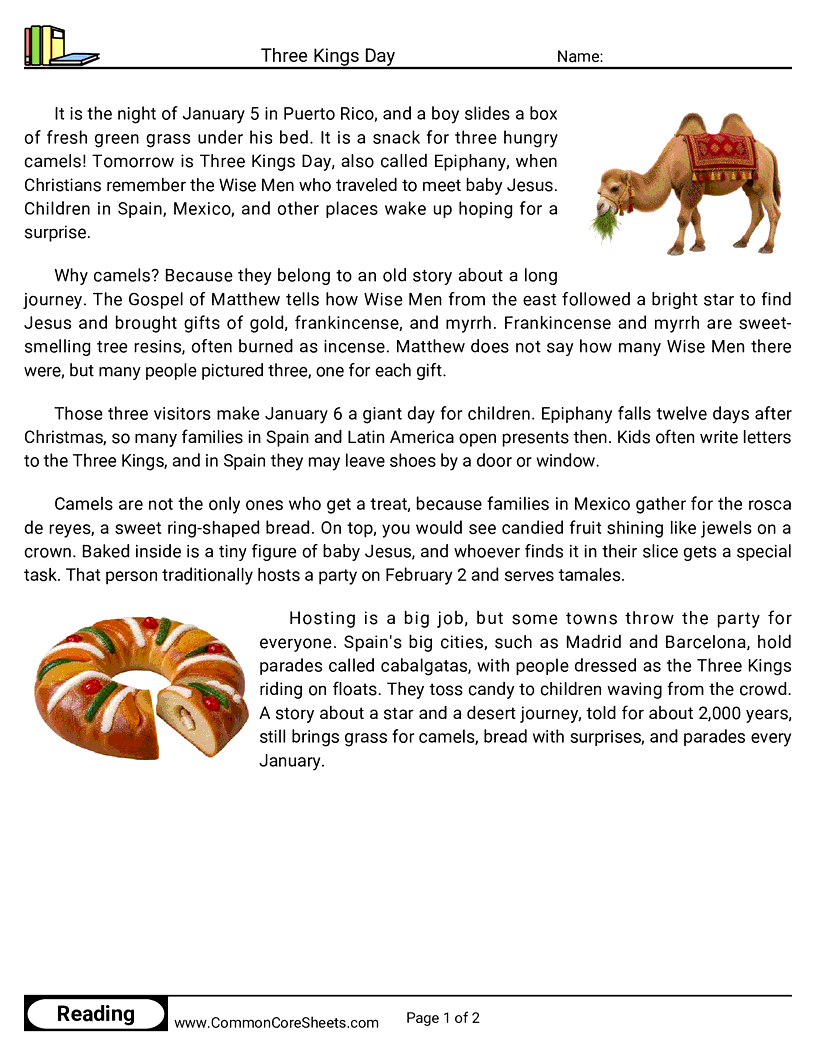
It is the night of January 5 in Puerto Rico, and a boy slides a box of fresh green grass under his bed. It is a snack for three hungry camels! Tomorrow is Three Kings Day, also called Epiphany, when Christians remember the Wise Men who traveled to meet baby Jesus. Children in Spain, Mexico, and other places wake up hoping for a surprise.
Why camels? Because they belong to an old story about a long journey. The Gospel of Matthew tells how Wise Men from the east followed a bright star to find Jesus and brought gifts of gold, frankincense, and myrrh. Frankincense and myrrh are sweet-smelling tree resins, often burned as incense. Matthew does not say how many Wise Men there were, but many people pictured three, one for each gift.
Those three visitors make January 6 a giant day for children. Epiphany falls twelve days after Christmas, so many families in Spain and Latin America open presents then. Kids often write letters to the Three Kings, and in Spain they may leave shoes by a door or window.
Camels are not the only ones who get a treat, because families in Mexico gather for the rosca de reyes, a sweet ring-shaped bread. On top, you would see candied fruit shining like jewels on a crown. Baked inside is a tiny figure of baby Jesus, and whoever finds it in their slice gets a special task. That person traditionally hosts a party on February 2 and serves tamales.
Hosting is a big job, but some towns throw the party for everyone. Spain's big cities, such as Madrid and Barcelona, hold parades called cabalgatas, with people dressed as the Three Kings riding on floats. They toss candy to children waving from the crowd. A story about a star and a desert journey, told for about 2,000 years, still brings grass for camels, bread with surprises, and parades every January.
Why would children in Spain, Mexico, and Puerto Rico fill their shoes with fresh grass on the night of January 5? The answer hides in a very old story and in a sweet bread with a surprise baked inside. Picture a ring-shaped loaf big enough for a whole family, sparkling with candied fruit like jewels on a crown. Add drums, glowing floats, and crowds of cheering kids, and you have Three Kings Day, also called Epiphany, on January 6.
To see why January 6 matters, follow the grass back to the Gospel of Matthew, where Christians read about wise men from the east. They followed a bright star to find the young Jesus and gave him gold, frankincense, and myrrh. Christians remember that visit on Epiphany, a word from Greek meaning "appearance" or "revealing." Here's a twist: the Bible never says how many wise men came or calls them kings, but three gifts led storytellers to picture three royal travelers, later named Melchior, Caspar, and Balthazar.
Once people pictured three kings crossing deserts, they naturally thought of the camels, too. That's where the grass comes in: children leave grass or hay for the camels, plus shoes or boxes for gifts. By morning, the kings are said to have swapped the snack for small presents, echoing the gifts in the story. Since these gifts come at the end of the twelve days of Christmas, many children in Spain open their biggest presents on January 6 instead of December 25.
After the presents, families share a treat shaped like a crown: the rosca de reyes, or "kings' ring." Bakers curve the sweet bread into a circle or oval and top it with shiny strips of candied fruit. Hidden inside is a tiny figure, often a baby Jesus, and whoever bites into it gets a surprise. In Mexico, that lucky person traditionally hosts a party on February 2, often serving tamales, so one slice can plan the next celebration.
A party planned by a slice of bread is fun, but the biggest celebrations happen outdoors the night before. In Spain, the Cabalgata de Reyes rolls through towns and cities on the evening of January 5, with people dressed as the three kings waving from floats. Children hold out bags to catch candy tossed from the floats. Think of it: travelers whose number the Bible never even gives now inspire grass in shoes, rings of bread, and parades in many countries.
Think Christmas is over the moment the wrapping paper hits the recycling bin? For millions of people in Spain, Mexico, Puerto Rico, and many other places, the biggest party is still ahead! On January 6, called Three Kings Day or Epiphany, streets fill with parades, kitchens smell of orange peel and sugar, and children set out shoes stuffed with grass. The day remembers the Wise Men in the Christmas story, who followed a star to find the child Jesus. Many Christians see it as the moment Jesus was revealed to the wider world, which is what the Greek word epiphany means: an appearance.
Those star-following travelers, however, may not be quite who you picture. The Gospel of Matthew calls them magi, a word for scholars who studied the sky, and says they brought three gifts: gold, frankincense, and myrrh. It never says how many travelers there were, and it does not call them kings. Over the centuries, storytellers and artists filled in the details, and the travelers became three kings named Melchior, Caspar, and Balthazar. Nothing about that was a mistake; it is a perfect example of how a tradition grows, one retelling at a time.
Traditions can travel, too, and this one crossed the Atlantic Ocean with Spanish families and blended with local customs in Mexico and Puerto Rico. Today, children in many Spanish-speaking homes set out shoes the night before, and in Puerto Rico they often gather grass or hay in a box and slide it under the bed. The grass is a snack for the kings' camels, and you can picture a tired camel munching it at midnight! By morning, the grass is gone and small gifts are waiting in its place.
Hungry camels aren't the only ones who get a treat, because the humans have rosca de reyes. This sweet, ring-shaped bread is decorated with candied fruit that glitters like jewels on a crown, and in Spain a similar bread is called roscón de reyes. Here is the twist: a tiny figure of the baby Jesus is baked inside. In Mexico, whoever finds the figure in a slice traditionally hosts a party with tamales on February 2. Imagine taking a bite of dessert and finding a tiny surprise hiding there!
That party is proof that the fun of January 6 spills out of the house, and nowhere does it spill farther than the parades. In Spain, cities and towns hold a cabalgata de Reyes, where people dressed as the three kings ride on floats and often toss candy to the crowds. Lively celebrations happen in Mexico and Puerto Rico, too, and in Latino communities across the United States. I think that is why the day still matters: it gives families a reason to gather, share food, and pass stories from grandparents to grandchildren. Not bad for a story that begins with a star, three gifts, and travelers whose number nobody wrote down!
Most people pack away Christmas by the end of December, but in Spain, Mexico, Puerto Rico, and many other places, a major gift day is still twelve days away! On January 6, families celebrate Three Kings Day, also called Epiphany, which remembers the Wise Men who followed a star to find the child Jesus in the Christmas story. Picture a street packed with paper crowns, floats tossing candy into the crowd, and a table set with a sweet, ring-shaped bread. The night before, children set out their shoes, and some even gather grass for the kings' camels. It is a holiday built from one very short story and hundreds of years of people adding their own touches.
That short story appears in the Gospel of Matthew, where Christians read about wise men from the East who saw a special star. Matthew tells the whole visit in about a dozen verses, and he never says how many travelers there were or calls them kings. Because the visitors brought three gifts, gold, frankincense, and myrrh, many people came to picture three visitors, and later traditions named them Melchior, Caspar, and Balthazar. Artists and writers also began to imagine them as kings, partly because their treasures seemed fit for royalty. See how a tradition grows: a few lines of scripture slowly became a full cast of characters.
Once those characters had names and crowns, they needed a grand entrance, and Spain gave them one. On the evening of January 5, cities and towns across Spain hold parades called cabalgatas, where costumed kings ride floats and toss candy to the crowd. Children write letters to the kings in the weeks before, then leave their shoes out for gifts to appear overnight. Some families even set out a snack for the kings and water for their camels, since those animals have traveled a long way.
Shoes and camel snacks were not the only things to sail west, because Spanish settlers carried Three Kings Day across the Atlantic in the 1500s. In Mexico, children still leave shoes out for the kings, while in Puerto Rico they traditionally gather fresh grass or hay in a box under the bed. As the custom took root, each place blended it with its own foods, music, and family habits, so no two celebrations look exactly alike. That is why one holiday can feel like a street festival in one town and a quiet dinner in another.
Grass keeps the camels happy, but people get the bread, a sweet ring called rosca de reyes in Mexico and roscón de reyes in Spain. Bakers decorate it with strips of candied fruit that shine like jewels on a crown, and they hide a tiny figure inside the dough. The figure usually stands for the baby Jesus, and hiding it recalls how the child was kept safe from danger. Hiding a surprise in a cake is an old European habit; in France, bakers have long tucked a bean into the Epiphany cake, though today's bakers often use tiny figures of porcelain or plastic.
Finding that figure is exciting, but it comes with a catch: in Mexico, the lucky person traditionally hosts a party on February 2, almost four weeks later. That day is called Candlemas, and hosts often serve tamales. Meanwhile, parades keep the kings in the spotlight, from Madrid to San Juan to East Harlem in New York City, home of an annual parade by El Museo del Barrio. Not bad for a story Matthew told in about a dozen verses, which now fills streets, kitchens, and doorsteps on both sides of the Atlantic.
Picture a palace in Jerusalem, where King Herod is troubled by a question from foreign visitors: "Where is the child who has been born king of the Jews?" That scene, told in the Gospel of Matthew, is the seed of Three Kings Day, celebrated each January 6 in Spain, Mexico, Puerto Rico, and many other places. Today the holiday brings glittering parade floats, thumping marching bands, and costumed kings tossing candy to crowds. At home, children set out shoes stuffed with grass, and families gather around a sweet bread topped with candied fruit that glitters like jewels. Yet the most intriguing part may be the gap between a very short story and the enormous traditions built around it.
That gap begins in the Gospel of Matthew itself, where the entire visit takes up only about a dozen verses (Matthew 2:1-12). Matthew calls the travelers "magi" from the East, a term for scholars who studied the stars, and says they followed a star to find the child. He lists three gifts: gold, frankincense, and myrrh, the last two being fragrant tree resins. What he never does is state how many travelers there were, supply their names, or call them kings, and camels appear nowhere in the passage. So how did the familiar picture of three crowned kings on camels come to exist?
Storytellers filled in the blanks over many centuries, beginning with those three gifts, which made a group of three seem natural. Some early Christian writers also linked the magi to a Psalm about kings who bring gifts, which may explain how scholars became monarchs. By the early Middle Ages, the travelers had the names Caspar, Melchior, and Balthasar, and artists often showed them at different ages. The holiday's other name, Epiphany, comes from a Greek word meaning "appearance" or "manifestation," and refers to Jesus being revealed to the world. Western Christian churches link January 6 mainly with the magi, while many Eastern Orthodox churches emphasize the baptism of Jesus instead.
Once the travelers became kings, it was only a matter of time before they earned a parade. On the evening of January 5, Spanish cities such as Madrid hold a Cabalgata de Reyes, where people portraying Melchior, Caspar, and Balthasar ride floats and toss candy to the crowd. Before bed, children in many Spanish-speaking homes leave shoes by a door or window, and in Puerto Rico they traditionally gather grass in boxes and slide them under their beds. The grass is meant for the kings' camels, so the animals Matthew never mentions get a snack, and by morning, the custom says, gifts have appeared. For many families, January 6 is a main day for presents, while others exchange gifts on both December 25 and January 6.
The camels get grass, but the rest of the family gets cake. The rosca de reyes is a ring-shaped or oval sweet bread decorated with strips of candied fruit that resemble jewels on a royal crown. Baked inside is a tiny figurine, often of a baby, and whoever finds it in a slice traditionally hosts a party, which in Mexico means serving tamales on February 2, known as Candlemas. Hiding a small charm in a festive cake is a custom in several European countries; in France, the galette des rois hides a charm called the fève, French for "bean." Some writers connect such customs to ancient Roman winter festivals that chose a make-believe king for a day, but other historians caution that the evidence linking them is thin.
Whatever the cake's ancient roots, its journey across the Atlantic is much easier to trace. Spanish settlers carried Epiphany customs to the Americas beginning in the 1500s, and each region added its own touches, such as Puerto Rico's boxes of grass or Mexico's tamale party. Today, January 6 is a public holiday in both Spain and Puerto Rico, and bakeries in many U.S. cities sell roscas in early January. For Christians, the day remembers Jesus being honored by visitors from far away, and for many families it is also a celebration of food, heritage, and togetherness. Matthew never says how many visitors came, never gives their names, and never mentions a camel, yet children from Madrid to San Juan set out grass for three kings and their camels.
About this worksheet
Students read a nonfiction passage about Three Kings Day (Epiphany), written at 8 reading levels (1st grade to 8th grade), and answer multiple-choice questions about it.
A reading comprehension worksheet about Three Kings Day (Epiphany) with a different article for each reading level, 1st grade to 8th grade, each with its own multiple-choice questions aligned to the Common Core Reading: Informational Text standards. Printable with an answer key, and available as an online assignment at any level.
Student objectives
- Read a passage about Three Kings Day and find details about how it is celebrated.
- Explain why many families open presents on January 6.
- Find the meaning of frankincense and myrrh from clues in the text.
- Explain the main idea of the passage using key details.
Everyday practice
- Look at a calendar and count the days from December 25 to January 6 to see how long the gap is.
- Ask a family member or friend if they know a holiday food that has a hidden surprise inside.
- Find Spain, Mexico, and Puerto Rico on a map and notice how far each is from where you live.