Tarantulas Worksheet Download
Free reading worksheets on Tarantulas. Each worksheet has 20 problems with an answer key and are ideal for teachers and homeschooling. You can download the PDF, create a set of flash cards or set it up for online learning.
Select a Different Activity
>


Sheet Information >
Available at 2nd grade, 3rd grade, 4th grade, 5th grade and 6th grade reading levels.
Read the passage
Hey there, kids! Let\'s learn about the amazing world of tarantulas, those big, hairy spiders that might seem scary but are actually fascinating creatures. Tarantulas come in many different colors and sizes, but they all have eight legs and two body parts: the cephalothorax and the abdomen. Did you know that tarantulas can grow up to 12 inches in length? That\'s about the size of a dinner plate!
Now let\'s talk about where tarantulas live and what they eat. These incredible spiders can be found in many places around the world, like deserts, rainforests, and grasslands. Tarantulas are carnivores, which means they eat other animals, such as insects, small lizards, and even birds! When they catch their prey, they inject it with venom to paralyze it before enjoying their meal.
Lastly, let\'s explore tarantulas' relationship with humans and other insects, as well as their defenses and unique features. While some people might be afraid of tarantulas, they are usually not dangerous to humans and would rather run away than bite. In the wild, tarantulas help keep insect populations under control, which is good for the environment. Their main defense is their ability to flick tiny hairs from their abdomen at predators, which can be irritating if they get in their eyes or nose. There are over 900 species of tarantulas, each with their own special characteristics, making them an incredibly diverse and interesting group of creatures. Remember, even though tarantulas might look scary, they play an important role in nature and have many fascinating features that make them unique. So the next time you see a tarantula, take a moment to appreciate these amazing creatures!
Hey there, friends! Let's talk about the fascinating world of tarantulas. These furry, eight-legged creatures are a type of spider that come in many sizes and colors. You can find them living in various places around the world, such as deserts, forests, and even in the ground! They like to munch on insects, small lizards, and sometimes even small birds.
Now let's learn about the life cycle of a tarantula. These amazing creatures start as tiny eggs, which then hatch into spiderlings. Over time, they molt and grow into adult tarantulas, which can live up to 25 years! That's a really long time for a spider, isn't it?
Lastly, let's explore how tarantulas interact with humans and other insects. Though they might look a bit scary, tarantulas are usually harmless to humans and are even kept as pets! To protect themselves, tarantulas can release their tiny, irritating hairs or bite, but they mostly prefer to avoid confrontation. When it comes to other insects, tarantulas are important predators that help keep the insect population in check.
Isn\'t it amazing how much there is to learn about tarantulas? Keep exploring and discovering new things about the world around you!
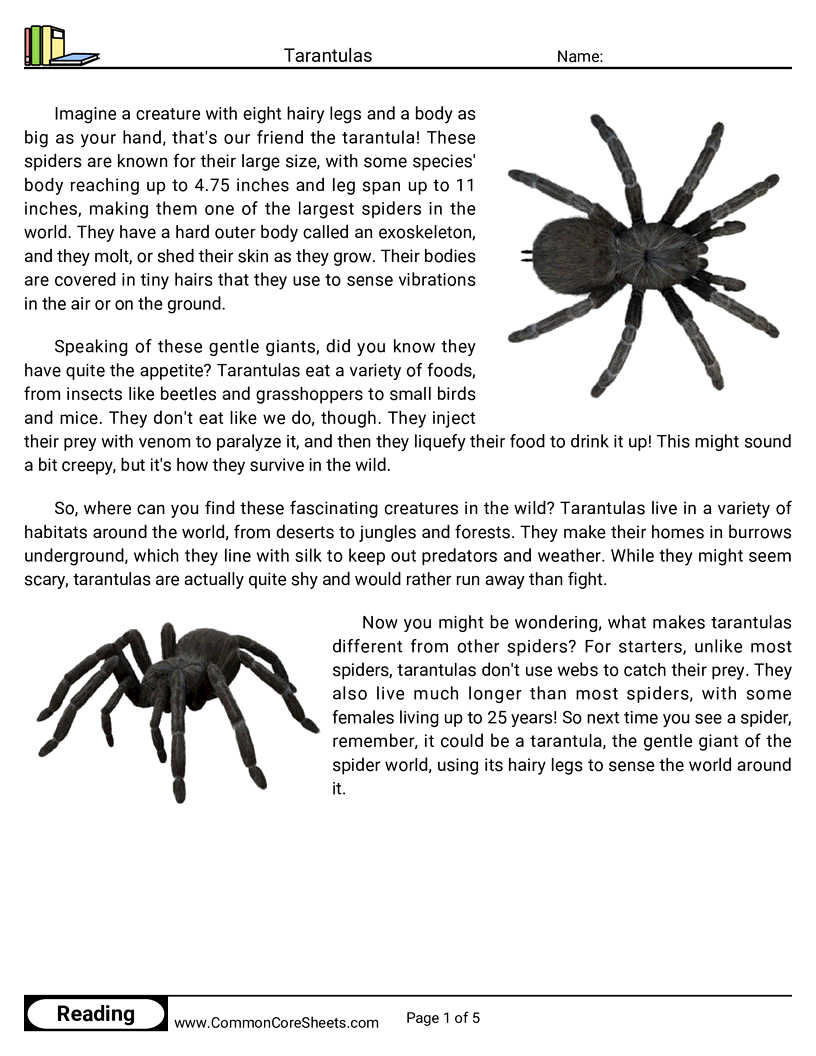
Imagine a creature with eight hairy legs and a body as big as your hand, that's our friend the tarantula! These spiders are known for their large size, with some species' body reaching up to 4.75 inches and leg span up to 11 inches, making them one of the largest spiders in the world. They have a hard outer body called an exoskeleton, and they molt, or shed their skin as they grow. Their bodies are covered in tiny hairs that they use to sense vibrations in the air or on the ground.
Speaking of these gentle giants, did you know they have quite the appetite? Tarantulas eat a variety of foods, from insects like beetles and grasshoppers to small birds and mice. They don't eat like we do, though. They inject their prey with venom to paralyze it, and then they liquefy their food to drink it up! This might sound a bit creepy, but it's how they survive in the wild.
So, where can you find these fascinating creatures in the wild? Tarantulas live in a variety of habitats around the world, from deserts to jungles and forests. They make their homes in burrows underground, which they line with silk to keep out predators and weather. While they might seem scary, tarantulas are actually quite shy and would rather run away than fight.
Now you might be wondering, what makes tarantulas different from other spiders? For starters, unlike most spiders, tarantulas don't use webs to catch their prey. They also live much longer than most spiders, with some females living up to 25 years! So next time you see a spider, remember, it could be a tarantula, the gentle giant of the spider world, using its hairy legs to sense the world around it.
Have you ever wondered about tarantulas, those big, hairy spiders that some people find fascinating and others find scary? Tarantulas are a group of large spiders belonging to the family Theraphosidae, and there are around 1,000 different species. They can come in various colors like brown, black, or even vibrant blue, and some can have a leg span of up to 12 inches! Let\'s dive into the world of tarantulas and learn about their diet, habitat, and other interesting facts.
First, let\'s talk about what tarantulas eat and their role in the ecosystem. Like most spiders, tarantulas are carnivores, meaning they eat other animals, mainly insects like crickets, grasshoppers, and beetles. Sometimes, they even eat small mammals, reptiles, or birds! Tarantulas play an important role in controlling insect populations and are also prey for larger animals like birds, reptiles, and mammals.
Now let\'s explore where tarantulas live and their life cycle. Tarantulas can be found in various habitats like deserts, rainforests, and grasslands, but they mostly prefer warm climates. Their life cycle includes four stages: egg, spiderling, juvenile, and adult, with some tarantulas living up to 25 years! Female tarantulas lay hundreds of eggs in a silk cocoon, and after a few weeks, tiny spiderlings hatch and eventually grow into adults.
You might be curious about how tarantulas interact with humans and other insects. While some people keep tarantulas as pets, it\'s important to remember that they are wild animals and should be handled with care. Tarantulas are not aggressive towards humans unless they feel threatened, and their bites are usually not dangerous, although some species have more potent venom. As for other insects, tarantulas are predators that help maintain a balance in nature by eating various insects.
Lastly, let\'s learn about tarantulas' defenses and differences between species. Tarantulas have two main defense mechanisms: biting with their fangs and releasing tiny, irritating hairs called urticating hairs. Different species of tarantulas can vary in size, color, and behavior, with some being more active at night and others during the day. Some species even have unique features, like the Gooty Sapphire tarantula, which has stunning blue coloration.
In conclusion, tarantulas are fascinating creatures that play a crucial role in their ecosystems, and learning about them helps us understand and appreciate the diversity of life on our planet.
Hey there, young explorer! Let\'s talk about the fascinating world of tarantulas. These eight-legged creatures are part of the spider family and are known for their large size and hairy appearance. There are about 900 species of tarantulas, and they can be found in various regions around the world. These captivating creatures can live in different habitats, such as deserts, rainforests, and grasslands. Some of them even make their homes in trees or on the ground, depending on the species.
Now that we know a bit about tarantulas, let\'s dive into their life cycle. Most tarantulas begin their journey as eggs, which are laid by the female in a silk cocoon. After a few weeks, these eggs hatch into tiny spiderlings that eventually grow into adult tarantulas by molting their exoskeletons. This process of shedding their old skin can happen several times throughout their lives, which can last anywhere from 5 to 20 years, depending on the species. Some female tarantulas even live up to 25 years, making them one of the longest-living spider species!
You must be curious about what these giant spiders eat, right? Well, tarantulas are carnivorous creatures, which means they primarily eat other insects and small animals. Their diet mainly consists of crickets, grasshoppers, beetles, and other small insects, but they can also eat small lizards, mice, and even birds! They catch their prey by ambushing them and injecting venom through their fangs to paralyze or kill them. Once immobilized, the tarantula will then consume its meal by liquefying the insides of the prey and sucking it up like a spider smoothie.
Tarantulas aren\'t only fascinating creatures, but they also have an interesting relationship with humans and other insects. Although most people are afraid of these large spiders, tarantulas are generally harmless to humans and their venom is less dangerous than a bee sting. In fact, some people even keep tarantulas as pets, as they are low maintenance and can be intriguing to observe. As for their relationship with other insects, tarantulas play a critical role in controlling insect populations in their environment. Although, they do have some natural predators like birds, lizards, and even a special type of wasp called the tarantula hawk!
Finally, let\'s explore some more interesting facts about tarantulas that make them unique among other spider species. Unlike many spiders, tarantulas don\'t spin webs to catch their prey; instead, they use their silk to line their burrows or make a cozy hideout in trees. Furthermore, these spiders have two unique defense mechanisms: releasing irritating hairs from their body and displaying a threat posture to ward off potential predators. When it comes to differences between tarantula species, some can be quite colorful, while others are more camouflaged to blend in with their surroundings. Overall, tarantulas are fascinating creatures that are often misunderstood, but they play an essential role in our world\'s ecosystems.
About this worksheet
Students read a passage about tarantulas and answer questions to show their understanding of the text.
This worksheet is designed to bolster reading comprehension using subject matter focused on tarantulas. Featuring 20 diverse questions about tarantula anatomy, behavior, and habitats, it aims to spark curiosity and deep exploration in young readers. This tool provides flexibility for customization and can be adapted into flashcards or integrated into distance learning platforms, fostering engaging, flexible, and effective learning experiences for kids.
Student objectives
- Read a nonfiction passage about tarantulas and understand the main ideas
- Find specific facts and details mentioned in the text
- Answer questions using evidence from the reading
- Learn new vocabulary related to spiders and their habits
Everyday practice
- Read facts about an animal at the zoo and explain them to someone
- Look up information about a spider you found outside
- Share interesting details about tarantulas from a nature book with a friend
- Answer questions after reading an article about wildlife