Swan Worksheet Download
Free reading worksheets on Swan. Each worksheet has 20 problems with an answer key and are ideal for teachers and homeschooling. You can download the PDF, create a set of flash cards or set it up for online learning.
Select a Different Activity
>


Sheet Information >
Available at 2nd grade, 3rd grade, 4th grade, 5th grade and 6th grade reading levels.
Read the passage
Swans are beautiful, large birds that are known for their elegant, long necks. They are generally white, but some swans can be black or grey, which makes them quite unique compared to other birds. Swans are different from ducks and geese, two birds they're often confused with, because they're bigger and have a hump on their beak.
Swans enjoy different habitats such as lakes, ponds, and rivers and they eat a variety of foods including plants, insects, and small fish. In terms of their life cycle, swans hatch from eggs, then turn into little babies called cygnets who grow up into adult swans. Swans are protective of their families and use their strong wings as a defense against animals that might harm them.
Humans and swans have a special relationship; we love to feed them and watch them in parks, and swans have even been featured in many of our stories and ballets. Did you know that swans usually mate for life? That's right, once they choose a partner, they stick with them forever! In conclusion, swans are fascinating creatures with a beauty and elegance that really makes them stand out in the bird world.
"Swans are fascinating creatures, aren't they?" Known for their elegance and beauty, swans are large birds that are part of the waterfowl family, which also includes geese and ducks. Unlike their relatives, swans have a long neck that they usually hold curved in an 'S' shape, and they have the ability to fly at high speeds up to 60 miles per hour! Swans can be found all over the world except for Africa, and they prefer to live in places with fresh water like ponds, lakes and rivers.
"Let's talk about what swans eat and their life cycle." Swans are not picky eaters and they enjoy a diet of aquatic plants, seeds, insects, and even small fish. In terms of their life cycle, swans start as eggs which are hatched after 35-42 days, and by 4-5 months, the young swans, or cygnets, are ready to fly. Swans live a long life for birds, often reaching 20 years or more!
"Swans also have interesting relationships and defenses." Swans are generally peaceful, but they can be fierce if they feel threatened or if they're protecting their babies, using their strong wings to fend off predators. Humans have appreciated swans for their beauty and grace for centuries, and in many cultures, swans are symbols of love and fidelity because they often stay with the same partner for life. So, aren't swans just amazing with their beauty, strength, and interesting life habits?
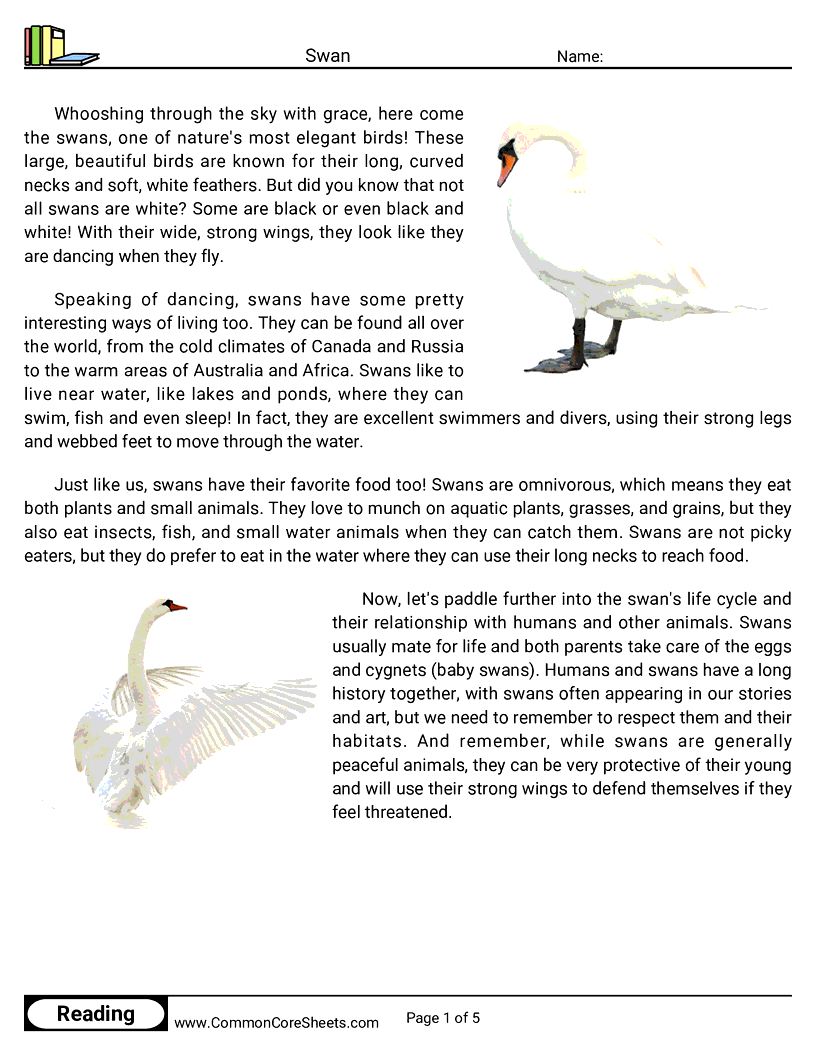
Whooshing through the sky with grace, here come the swans, one of nature's most elegant birds! These large, beautiful birds are known for their long, curved necks and soft, white feathers. But did you know that not all swans are white? Some are black or even black and white! With their wide, strong wings, they look like they are dancing when they fly.
Speaking of dancing, swans have some pretty interesting ways of living too. They can be found all over the world, from the cold climates of Canada and Russia to the warm areas of Australia and Africa. Swans like to live near water, like lakes and ponds, where they can swim, fish and even sleep! In fact, they are excellent swimmers and divers, using their strong legs and webbed feet to move through the water.
Just like us, swans have their favorite food too! Swans are omnivorous, which means they eat both plants and small animals. They love to munch on aquatic plants, grasses, and grains, but they also eat insects, fish, and small water animals when they can catch them. Swans are not picky eaters, but they do prefer to eat in the water where they can use their long necks to reach food.
Now, let's paddle further into the swan's life cycle and their relationship with humans and other animals. Swans usually mate for life and both parents take care of the eggs and cygnets (baby swans). Humans and swans have a long history together, with swans often appearing in our stories and art, but we need to remember to respect them and their habitats. And remember, while swans are generally peaceful animals, they can be very protective of their young and will use their strong wings to defend themselves if they feel threatened.
Let's dive into the fascinating world of swans, shall we? These elegant birds, known for their long necks and pure white or black feathers, are a sight to behold. Swans belong to the Anatidae family, which also includes ducks and geese. Interestingly, swans are among the largest flying birds, with some species having a wingspan of over 3 meters!
Swans have an interesting diet that keeps them healthy and strong. On the menu for swans are aquatic plants, seeds, small fish, and even insects. They usually dip their long necks into the water to scoop up their food, isn't that fun? Sometimes, they even eat on land, munching on grass, grains or berries.
Swans can be found all over the world, in both cool and warm climates. They love water and live near ponds, lakes or rivers where they can swim around. Swan nests, usually built by the female, are large and made from sticks and plants. These nests are usually built close to water and are used year after year!
One of the most fascinating things about swans is their life cycle. After mating, female swans lay up to ten eggs which they keep warm by sitting on them. The eggs hatch after about a month, and the baby swans, called cygnets, stay with their parents for about a year. Swans are known for their lifelong pair bonds, where they stay together for life.
Swans have a unique relationship with humans and other animals. People often feed swans at parks or lakes, but it's important to remember that bread is not healthy for them. Swans can be defensive if they feel their nests are threatened, so it's always good to admire them from a distance. So next time you see a swan, remember these fun facts and appreciate their beauty and elegance.
"Hey there, have you ever been mesmerized by the graceful movements of swans on a serene lake?" Swans are one of the most magnificent and elegant water birds known to mankind. They are known for their elongated necks, which they hold high and curved in a distinctive manner. Swans are usually white, but did you know that there are also black swans? They're native to Australia! Swans are also the largest members of the duck family, which includes other birds like geese and ducks.
"Now, let's dive into what swans like to eat." Swans are not very fussy when it comes to food, they eat a variety of things like aquatic plants, algae, insects, and small fish. They also love to nibble on grass, grains and occasionally, they might snack on small amphibians and mollusks. Did you know that swans are known to 'upend' in water? This means they tip their bodies upside down, tails up, to reach deeper food in the water. But remember, if you ever want to feed a swan, bread isn't the best choice as it can harm their health.
"Curious about where these beautiful creatures live?" Swans are found across the globe in temperate environments, though they prefer areas with fresh water like ponds, rivers and marshes. They build their nests near water, using twigs and leaves and lining them with feathers. Swans are also known for their loyalty to their homes, often returning to their birthplace after migration. In winter, they migrate to warmer areas but always come back to their original homes when spring returns.
"Swans have a fascinating life cycle and relationship with humans and other animals." Swans mate for life, which means they choose a partner and stay together for a lifetime - how romantic! Their eggs, called cygnets, hatch after about a month, and both parents take care of the babies until they can swim and fly on their own. Humans have a long history with swans, keeping them for their beauty, their feathers or as a symbol of love. While swans are generally peaceful, they can be protective of their young and may hiss or even attack if they feel threatened.
"Finally, let's explore some fun facts and defenses that swans have." Swans have a whopping wingspan of up to 10 feet - that's taller than most people! They can fly as fast as 60 miles per hour, using their strong muscles and large wings. Did you know that the 'swan song' is a myth that says swans only sing before they die? But in reality, swans make a variety of sounds throughout their life. Swans are truly fascinating creatures, aren't they? Their beauty and elegance continue to captivate humans and animals alike, making them one of the most loved birds in the world.
About this worksheet
Students read a short passage about swans and answer comprehension questions about the details and facts they learned.
This worksheet is designed to engage children in reading comprehension through a series of fun, informative questions about swans. Through 20 customizable problems, young learners explore topics such as swan habitats, traits, behaviors, and more. This versatile resource can be converted into flashcards or easily adapted for distance learning, offering a flexible tool to enhance a child's interest and knowledge in nature and wildlife.
Student objectives
- Read a short informational passage carefully
- Find and recall specific facts stated in the text
- Answer questions using details from what was read
- Learn new facts about swans and their habits
Everyday practice
- Read an animal fact card at the zoo and remember what it said
- Answer a friend's question about something you just read
- Pull out the important details when reading a story about animals
- Explain to a family member what you learned about swans