Spotted Owl Worksheet Download
Free reading worksheets on Spotted Owl. Each worksheet has 20 problems with an answer key and are ideal for teachers and homeschooling. You can download the PDF, create a set of flash cards or set it up for online learning.
Select a Different Activity
>


Sheet Information >
Available at 2nd grade, 3rd grade, 4th grade, 5th grade and 6th grade reading levels.
Read the passage
"Have you ever seen a spotted owl?" These owls are medium-sized with brown bodies and white spots, and they have a round face with dark eyes in the middle, which makes them different from most other owl species. Spotted owls live in old forests where they find trees with holes to use as their homes.
"Did you know that spotted owls have a special diet?" They like to eat small animals, especially flying squirrels and woodrats, but sometimes they also eat insects, birds, and reptiles. Spotted owls are nocturnal, which means they hunt for food at night when other animals are sleeping.
"Let's talk about the life cycle of a spotted owl and its relationship with humans and other animals." Spotted owls lay 2-4 eggs once a year and both parents take care of the eggs and the baby owls when they hatch. Spotted owls are important to humans because they help to control the population of rodents and insects, but they need our help to protect their forest homes from being destroyed.
"Hey there, have you ever heard about spotted owls?" "Spotted owls are medium-sized owls with chocolate-brown bodies covered in white spots!" "They are quite different from other owl species because they prefer old-growth forests and have a unique circular facial disk, which makes them easy to identify." "Their large eyes are perfect for spotting prey during their nighttime hunts."
"Now, let's learn about where these owls live and what they eat." "Spotted owls make their homes in dense, old-growth forests across North America, from Canada to Mexico." "They love to feast on small animals, like rodents, birds, and insects." "Sometimes, they will even eat reptiles and amphibians!"
"Alright, let's talk about the life cycle of spotted owls and how they interact with humans and other animals." "Their life cycle begins when they hatch from eggs, and then they grow into juveniles and finally into adults, living for about 16 to 17 years." "Humans have a big impact on spotted owls, often causing harm to their habitats through activities like logging and urban development." "But still, these owls try their best to adapt, using their sharp beaks and talons as defense mechanisms against predators."
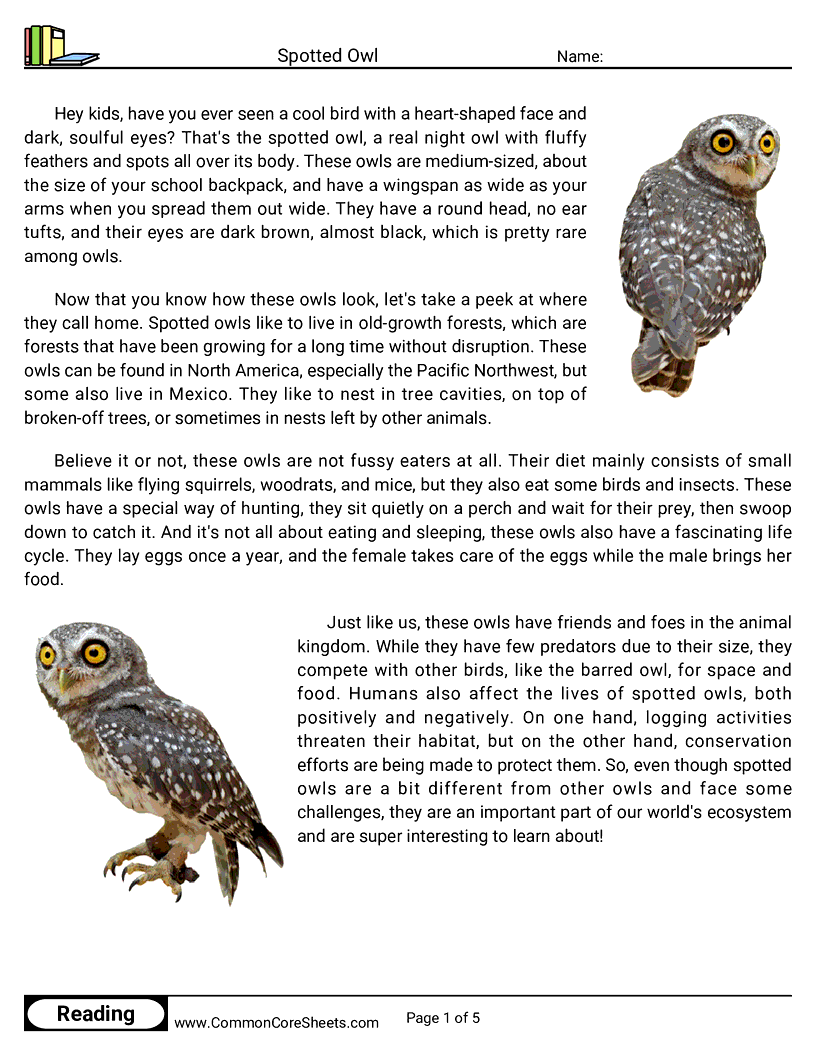
Hey kids, have you ever seen a cool bird with a heart-shaped face and dark, soulful eyes? That's the spotted owl, a real night owl with fluffy feathers and spots all over its body. These owls are medium-sized, about the size of your school backpack, and have a wingspan as wide as your arms when you spread them out wide. They have a round head, no ear tufts, and their eyes are dark brown, almost black, which is pretty rare among owls.
Now that you know how these owls look, let's take a peek at where they call home. Spotted owls like to live in old-growth forests, which are forests that have been growing for a long time without disruption. These owls can be found in North America, especially the Pacific Northwest, but some also live in Mexico. They like to nest in tree cavities, on top of broken-off trees, or sometimes in nests left by other animals.
Believe it or not, these owls are not fussy eaters at all. Their diet mainly consists of small mammals like flying squirrels, woodrats, and mice, but they also eat some birds and insects. These owls have a special way of hunting, they sit quietly on a perch and wait for their prey, then swoop down to catch it. And it's not all about eating and sleeping, these owls also have a fascinating life cycle. They lay eggs once a year, and the female takes care of the eggs while the male brings her food.
Just like us, these owls have friends and foes in the animal kingdom. While they have few predators due to their size, they compete with other birds, like the barred owl, for space and food. Humans also affect the lives of spotted owls, both positively and negatively. On one hand, logging activities threaten their habitat, but on the other hand, conservation efforts are being made to protect them. So, even though spotted owls are a bit different from other owls and face some challenges, they are an important part of our world's ecosystem and are super interesting to learn about!
"Did you know that spotted owls are one of the most interesting species of owls?" "These fascinating birds have unique brown bodies scattered with white spots, thus earning their name, spotted owls." "They have a wingspan of about 45 inches, and they're known for their dark, round, soulful eyes surrounded by a face that appears almost mask-like." "Their intriguing appearance makes them a captivating species to learn about."
"Spotted owls are known for being nocturnal hunters, but what do they eat?" "Their diet mainly consists of small mammals like mice, rabbits, and squirrels, but they also sometimes eat birds and insects." "They hunt at night, using their excellent hearing and night vision to locate their prey." "Despite being hunters, they also play a key role in controlling the population of these small creatures in their habitat."
"So, where can we find these amazing owls you might ask?" "Spotted owls inhabit the old-growth forests in the western part of North America, from Canada to Mexico." "They prefer forests with lots of big, old trees, as they provide lots of places to hide and nest." "Unfortunately, these habitats are disappearing due to logging and wildfires, which is a major threat to the spotted owl population."
"Now, let's dive into the life cycle of these majestic birds." "After mating, the female lays 2-4 eggs, which she incubates for about a month while the male brings her food." "The owlets, or baby owls, leave the nest after about 5 weeks, but their parents continue to look after them for several months." "By the time they're a year old, they're ready to establish their own territories and start families of their own."
"Finally, let's discuss the relationship between spotted owls, humans, and other animals." "As for other animals, the spotted owl is a predator, but also prey for larger species like bobcats or bigger owls." "When it comes to humans, the spotted owl's relationship is a bit complicated. Due to deforestation and urbanization, their population has been declining, creating a need for human intervention and conservation efforts." "In conclusion, spotted owls are not just another bird species, but a fascinating creature with unique characteristics and an integral role in our ecosystem."
Have you ever seen a spotted owl? These medium-sized owls are known for their dark brown bodies, covered in white spots! They have a round face with dark eyes surrounded by bold, white eyebrows and a beak that is yellowish and almost covered by feathers. Their wings and tails have white bars, while their underparts are pale with dark spots. Interesting, right? Let's learn more about them!
So, where can these fascinating creatures be found? Spotted owls live in old-growth forests, where they nest in cavities or platforms in large, mature trees. They are native to North America and can be found from British Columbia in Canada, down to Mexico. They prefer dense forest habitats with a mix of trees of different ages and sizes. Now you know where to find them, but what do they eat?
Spotted owls are quite the hunters! They mainly eat small mammals, especially rodents such as mice, rats, and squirrels. They also sometimes snack on smaller birds, insects, and even bats. They hunt at night, using their excellent hearing and night vision to locate their prey. With such a varied diet, they have a complex relationship with other animals in the forest.
Spotted owls play a key role in the ecosystem and have a surprising relationship with humans and other animals. They help control the population of rodents, which benefits both the forest ecosystem and humans. However, they are often in competition with other bird species, like the Barred Owl, for food and nesting sites. Humans also affect spotted owls through deforestation and urbanization, which reduces their habitat. Despite these challenges, they have some neat defenses to protect themselves!
When it comes to defending themselves, spotted owls have a few tricks up their sleeves! They use their camouflage to blend in with the tree trunks and hide from predators during the day. If threatened, they will puff up their feathers to appear larger and more intimidating. Unlike other owl species, spotted owls have dark eyes, which helps them blend into their environment. So, that's the spotted owl for you - a fascinating and integral part of our natural world!
About this worksheet
Students read an informational passage about the spotted owl and answer comprehension questions about its habitat, diet, and threats.
This worksheet is designed to enhance children's reading skills and knowledge about spotted owls. It features 20 interactive questions covering their habitat, diet, reproduction, and human impact. It's adaptable for customization, can be converted into flashcards, and is suitable for distance learning, engaging students in intuitive and creative ways while learning about this intriguing nocturnal bird.
Student objectives
- Read a nonfiction passage and understand the main ideas
- Recall key facts about the spotted owl's habitat and diet
- Answer questions using details from the text
- Learn new vocabulary related to owls and forests
- Understand why the spotted owl is threatened
Everyday practice
- Read a sign or exhibit label about animals at a zoo or nature center
- Explain facts about an animal to a friend or family member
- Look up information about a wild animal you saw outside
- Talk about why some animals are endangered when watching a nature show
- Point out details you remember from something you just read