4.N.3.8 Worksheets
Numbers & Operations (N)
4.N.3 Represent and compare fractions and decimals in real-world and mathematical situations; use place value to understand decimal quantities.
4.N.3.8Compare and order decimals and whole numbers using place value and various models including but not limited to grids, number lines, and base 10 blocks.
4.N.3.8
4nbt2


×
Description:
This worksheet is designed to educate children on the conversion of expanded form to numeric form up to 1 million in a fun, easily digestible way. Promising 20 interactive math problems, it can be customized to fit individual learning styles, converted into engaging flash cards, or be effectively used for distance learning. Perfect for exploring and mastering numerical concepts at their pace.

×
Student Goals:
4nbt2
×
Description:
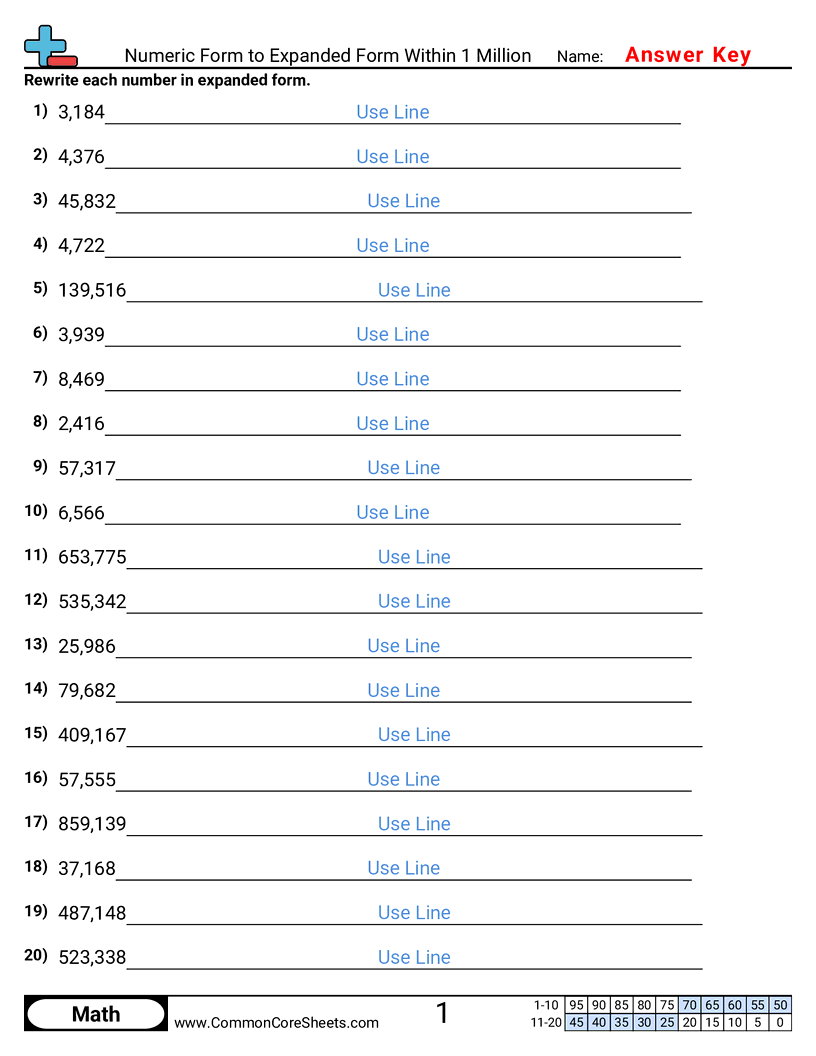
"This worksheet is designed to reinforce understanding of numeric to expanded forms within 1 million in math. Featuring 20 customized problems that can be converted into flash cards, it presents numbers like 10,288 in their expanded form to aid mental arithmetic. Its adaptability makes it ideal for distance learning, helping learners break down and comprehend larger numbers easily."
×
Student Goals:
Critical ThinkingBy completing this worksheet, students should be able to improve their critical thinking and problem-solving skills. This numeric form to expanded form exercise drills into students the ability to decompose numbers and understand the value of each digit in large numbers up to a million. As a result, their comprehension of number relationships and magnitude is enhanced, forming an essential aspect of their reasoning ability.Number SenseStudents will develop a strong number sense. They will be proficient in identifying and understanding the place value of each digit in numbers up to 1 million, from units to hundreds of thousands. This skill is fundamental to their numerical fluency, contributing to more advanced mathematical concepts along with their learning journey.Mathematical LanguageThis exercise aids students in developing their mathematical language and communication skills. They learn the terminology and symbology associated with expanded form, enabling them to accurately describe and record their mathematical ideas and understanding. This capacity is crucial for collaboration, oral and written mathematical communication in future learning settings.ConfidenceStudents should gain confidence in their mathematics abilities. By repeatedly practicing the breakdown of numbers into expanded forms, students will become comfortable and assured in working with large numbers. This confidence will enhance their approach to new mathematical challenges and reinforce a growth mindset in learning mathematics.Preparation for Advanced TopicsBy successfully accomplishing the worksheet, students will be well prepared for more complex math topics. Understanding expanded form is a key prerequisite for knowledge like adding, subtracting, and multiplying large numbers. Therefore, accomplishing this worksheet sets a strong foundation for their mathematical learning progression.Accuracy & SpeedStudents should achieve improved accuracy and speed. Regular practice with conversion of numeric forms to expanded forms can significantly improve the speed and precision with which students perform this process. This increased efficiency will be transferrable to other mathematical tasks, enhancing their overall academic productivity.


4nbt2
×
Description:
"This worksheet is designed to enhance children's math skills, specifically in writing numbers as words. It features 20 engaging problems that require students to transform numerical representation into verbal one. For instance, 6,434 becomes 'six thousand, four hundred thirty-four'. Flexibility is key, with options for customization, conversion into flash cards, and suitability for distance learning. A perfect tool to make math fun and accessible for all kids."
×
Student Goals:
Understanding Numbers and Their Written FormsAfter completing this worksheet, students should have a firmer understanding of how to translate numerical representations into their corresponding written forms. This is a critical skill for numerical comprehension, as it deepens their understanding of our numeration system. It will aid in their ability to recognize and utilize numbers in diverse ways and contexts.Enhancement in Mental ArithmeticWith the consistent practice provided by this fascinating worksheet, children will undeniably improve their mental arithmetic skills. This enhancement comes from internalizing the structural relationships between numbers as they translate them into words. This cognitive strengthening facilitates faster and more accurate mental calculations.Strengthened Problem-Solving AbilitiesThis worksheet supports the development of students' problem-solving capabilities. Children learn to examine and comprehend the systematic processes which are crucial for decoding the numerical problems. These abilities are not only advantageous in mathematics but also application in various disciplines and real-world situations.Improved Reading and Writing SkillsThis math worksheet indirectly allows students to strengthen their literacy skills. By translating numbers into words, students boost their vocabulary, improve their spelling, and enhance their understanding of grammatical rules. This exercise offers an interdisciplinary approach, mixing arithmetic with language arts, revealing the intertwined nature of knowledge.Build Confidence and Proficiency in MathCompleting the worksheet enhances students' confidence and proficiency in mathematics. It encourages children to retain and apply the basic concepts they have learned, promoting autonomy. As children work through the problems and successfully translate numbers into words, they will experience a sense of accomplishment that encourages continued learning and growth in mathematical proficiency.

4nbt2
×
Description:
"This worksheet is designed to enhance children's number writing skills up to 1 million. It includes 20 math problems that task learners to translate verbal descriptions of numbers into their numerical counterparts. This functional tool is versatile, enabling customization, conversion into flashcards, or use in distance learning contexts, fitting various learning strategies and environments for effective mathematical literacy development."
×
Student Goals:
Numeracy ProficiencyBy the conclusion of the worksheet, students are expected to gain a strong proficiency in understanding and writing numbers up to one million. This exercise will aid them to readily recognize and interpret large numbers in their numerical form, a vital skill in the mathematical field.Number ComprehensionAs they decipher the presented problems in verbal format and write them numerically, pupils will enhance their comprehension of the number system. This strengthens the foundations upon which more complex mathematical concepts and problem-solving skills will be built on in future lessons.Precision and AccuracyAccuracy is a key takeaway that students can obtain from such exercises. By learning to carefully write large numbers, they will enhance their sense of precision in conducting math-related tasks. This forms a crucial part of mastering the science of mathematics, where even a minor mistake can significantly alter the resultant answers.Conceptual UnderstandingStudents will gain a deeper conceptual understanding of numbers and their structure. By focusing on the place value system present within large numbers, learners will be able to visualize, understand, and illustrate the value of each digit in its respective position. This abstract understanding is a crucial step for higher-level arithmetic.Confidence BuildingDealing with large numbers can often intimidate or overwhelm students, especially beginners. However, after successfully reckoning these problems, they will develop a greater confidence and comfort in tackling similarly overwhelming number-related tasks in mathematics. This newfound confidence builds motivation and the courage to face challenging problems head-on.Application and Real-World ConnectionThe worksheet also encourages students to perceive the application of large numbers in the real world. Whether it's dealing with population numbers, monetary figures, measurement data, etc., their ability to understand and navigate such large numbers will equip them for real-world experiences.
4nf7
×
Description:
"This worksheet is designed to help children enhance their understanding of comparing decimals up to the hundredths place. With 20 customizable problems, it explores the concept of equality and inequality among decimal numbers. Examples are provided in table format for clear comprehension. This tool can easily be converted into flash cards or utilized for distance learning, allowing flexible and engaging Math lessons."
×
Student Goals:
4nf7
×
Description:
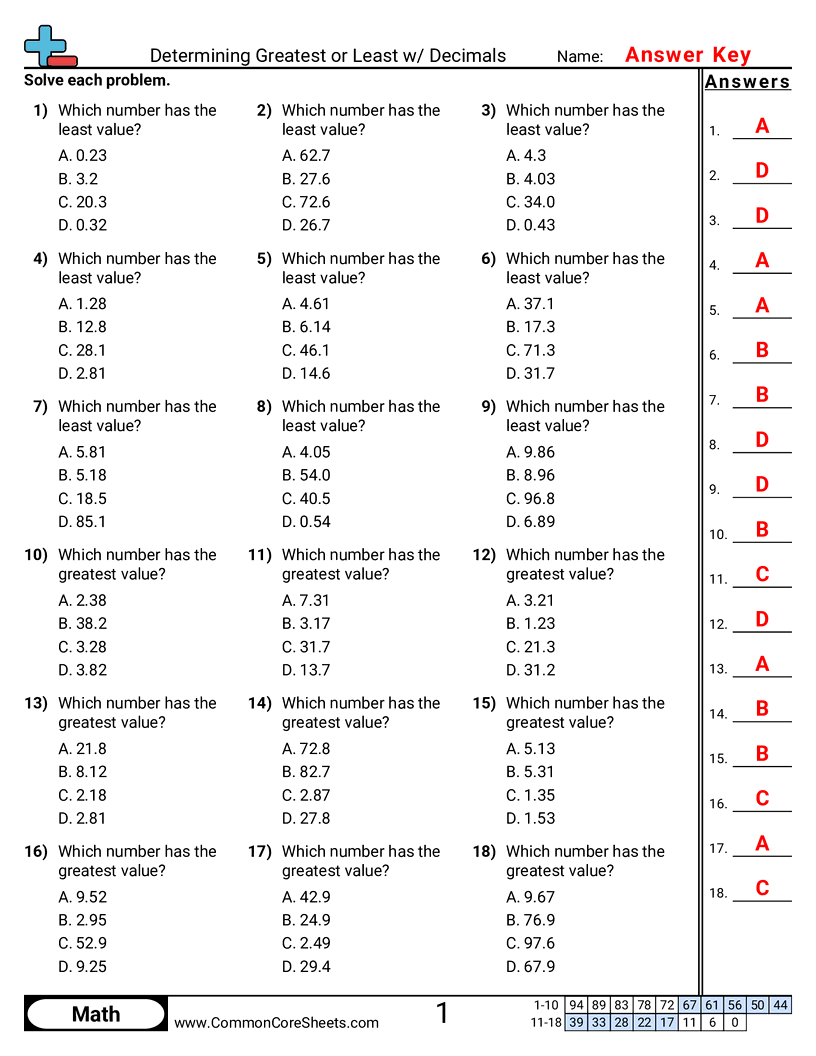
This worksheet is designed to help children enhance their understanding of decimal values in mathematics. With 18 interactive problems, children are encouraged to determine which number has the greatest or least value, providing an engaging way to practice decimal comparisons. Further, this resource can be customized to suit individual learning styles, converted into flashcards for quick revision, or integrated into distance learning for remote education. Efficiently planned, this worksheet aims to make learning fun and effective.
×
Student Goals:
4nf7
×
Description:
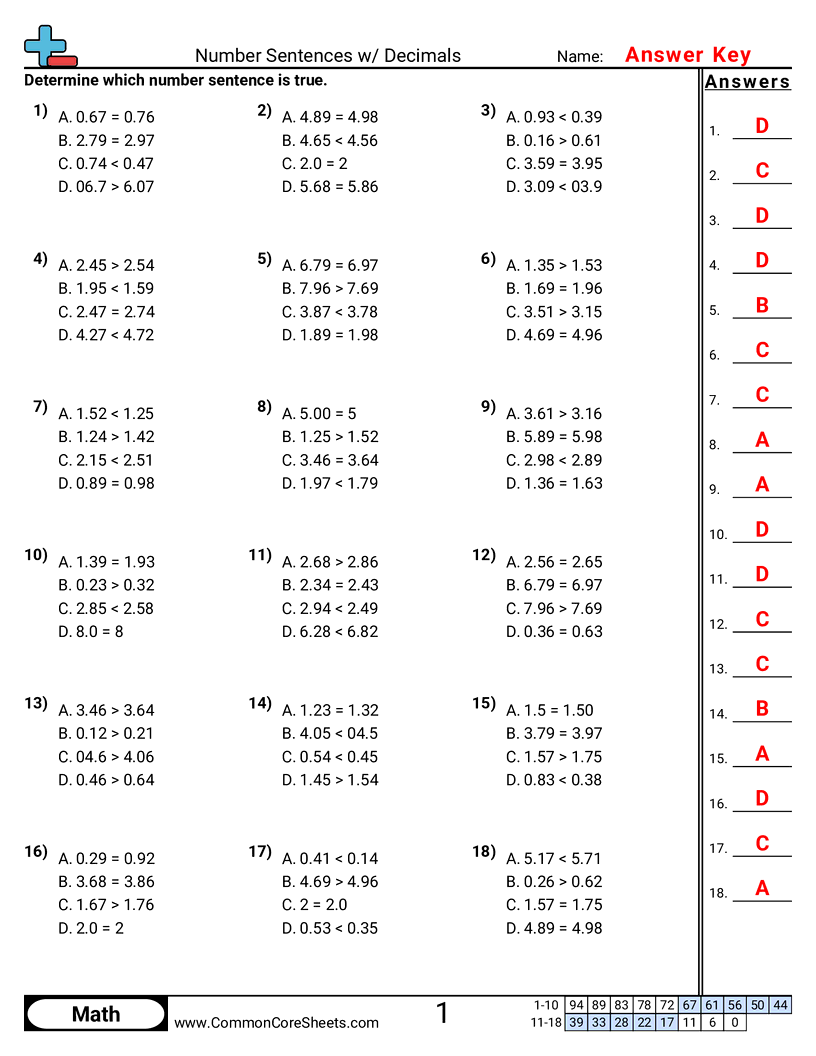
"This worksheet is designed to facilitate understanding of decimal number sentences in mathematics. Comprising 18 problems, learners have the opportunity to explore decimal comparisons across a variety of contexts. A unique feature of this resource is its flexibility; it can be tailored to individual needs, transformed into flashcards for interactive learning, or effectively applied in distance learning environments. It allows students to foster their mathematical proficiency in an engaging, adaptable format".
×
Student Goals:
Understanding of Decimal NumbersAfter completing the worksheet, students will gain a strong understanding of decimal numbers. They will be familiar with the place value and significance of each digit in decimal numbers and comprehend that the place value of a digit changes based on its position in relation to the decimal point.Comparing Decimal NumbersStudents will develop the proficiency to compare decimal numbers. They'll be adept at identifying whether one decimal is larger, smaller, or equal to another. They will understand that comparing decimals is similar to comparing whole numbers and will apply this knowledge to solve higher order numerical problems in the future.Manipulation of Decimal NumbersThis worksheet will assist students in learning how to manipulate decimal numbers in a numerical sentence properly. It paves the path towards more complex manipulations seen in later grades such as decimal addition, subtraction, multiplication, and division.Number Sense DevelopmentBuilding a robust number sense is an indispensable skill. Through this worksheet, students will improve their number sense, particularly with regards to decimals. This involves recognizing patterns and using logical thinking to solve problems. They will be able to figure out whether the value of the particular decimal is reasonable in a given context or not.Evaluation of Mathematical StatementsBy determining whether given number sentences are true or not, students enhance their ability to evaluate boolean mathematical statements. This will arm them with an analytical approach to interpret and solve problems.Mathematical VocabularyEmerging with a broadened mathematical vocabulary, students can precisely describe mathematical situations. Their familiarity with signs such as greater than '>', less than '<', and equal '=' significantly enhances their communicative skill set.Problem Solving and Reasoning SkillsThe worksheet will allow students to enhance their problem-solving and reasoning skills. These skills become particularly integral as they advance in grades and the complexity of problems increases.Preparation for Advanced TopicsBy attaining a solid foundation in handling decimal numbers and comprehending their properties, students are well-prepared for more advanced topics. This includes fractions, percentages, ratios, and different units of measurement which employ decimals.

4nf7
×
Description:
"This worksheet is designed to enhance children's understanding of ordering decimals in mathematics. Comprising of 10 unique problems, children will be tasked to arrange the given decimal numbers from smallest to largest and vice versa. Its flexibility allows for customization, and it can be transformed into interactive flash cards or leveraged for distance learning. A valuable tool in mastering this vital math skill."
×
Student Goals:
Understanding DecimalsAfter completing this worksheet, students should have a strong foundation in understanding decimals. This includes recognizing decimals numbers, understanding their significance, and their position relative to the whole number part.Ordering DecimalsStudents should be able to accurately order decimal numbers. They should be able to order them from smallest to largest and vice versa. Understanding the hierarchy of these numbers contributes to their arithmetic skills, especially in operations involving decimals.Comparison AbilitiesStudents should be able to compare different decimal numbers. They should understand the concept of greater than, less than, and equal to in the context of decimals. This is an essential skill, not just in math but in daily life situations, like comparing prices, measurements, and more.Accuracy in Solving ProblemsThe completed worksheet would give students the ability to solve similar math problems with more accuracy. With continuous practice, their ability to calculate and order decimal numbers swiftly and accurately should increase.Boosting ConfidenceCompleting the worksheet successfully would boost the students' confidence in handling decimal numbers. Their fear or apprehensions related to decimals would decrease, improving their overall interest in math.Logical ReasoningStudents will get to improve their logical reasoning abilities. Deciding the order of decimal numbers requires an understanding of the decimal system and logical thinking to correctly determine which number is bigger or smaller.Application in Real-Life ContextWith the completion of this worksheet, students should be able to comprehend the real-life application of decimals. They will realize that decimals are widely used in various fields such as finance, measurements, and data. Understanding decimals greatly contributes to their analytic and problem-solving abilities.Preparation for Advanced TopicsThe skills gained from this exercise will help prepare students for more complex arithmetic topics in the future. Ascending and descending order of decimal numbers is a fundamental skill required in algebra, calculus, and other advanced topics in mathematics.

4nf7
×
Description:
"This worksheet is designed to enhance children's understanding of decimal numbers in math. It primarily focuses on the concept of organizing decimal numbers, bringing in a set of 20 problem-solving sessions, such as ordering sequences of 13.41, 13, 13.9, 13.11, etc. The customizable worksheet is versatile for remote teaching, converting into flashcards, and can seamlessly integrate into any distance learning environment."
×
Student Goals:
Understanding of Decimal NumbersAfter completing the worksheet, students are expected to have enhanced understanding and better knowledge of decimal numbers. They should be able to easily identify decimal numbers, recognize the importance of the decimal point, and the value it adds to the overall number. Furthermore, they would acquire skills of interpreting decimal numbers in context of their position and place value.Ordering Decimal NumbersPupils would build up proficiency in the crucial concept of ordering decimal numbers. Through regular practice, they will be able to comfortably arrange decimal numbers in both ascending and descending order, acknowledging the influence each decimal place has on the numerical sequence.Problem-solving and Analytical SkillsThe exercises in the worksheet will also implicitly cultivate problem-solving and analytical skills in children. They will learn to approach mathematical problems systematically, dissect a problem to understand its components, draw upon their previous knowledge, and apply appropriate strategies for solution.Number Sense and Numerical FluencyThis worksheet would significantly enhance child's number sense and numerical fluency. It would foster an intuitive grasp of numbers, their value, and their relationships. Students will be able to perform mathematical operations more quickly and accurately, enhancing their overall mathematical efficiency and competence.Confidence and IndependenceThrough the accomplishment of problems in this worksheet, students will grow in confidence and independence. The instilled sense of achievement from accurate problem-solving will motivate them to take on more complex math problems and study new topics with less assistance. As a result, they will become self-reliant learners with a positive attitude towards mathematics.
4nf7
×
Description:
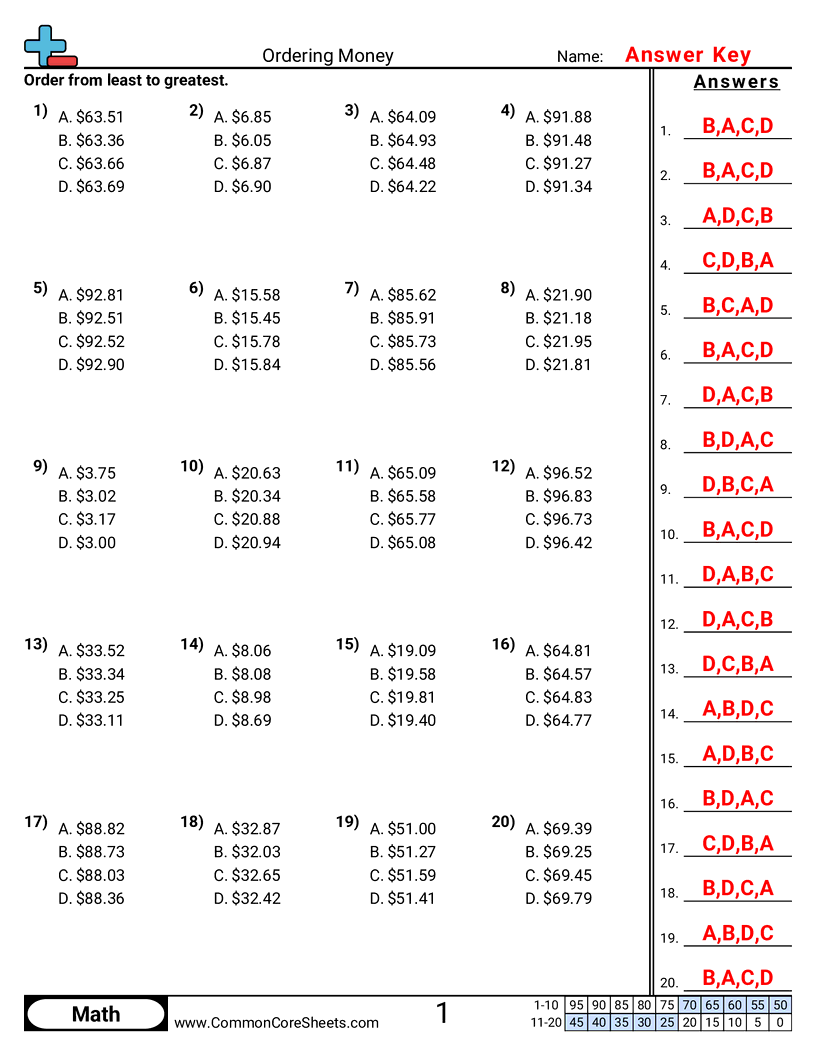
"This worksheet is designed to teach children the concept of ordering money values in ascending or descending order. With a total of 20 mathematical problems, it can be customized to suit each child's ability. It's a flexible tool that can be converted into flash cards for in-person exercises or integrated into distance learning programs for an interactive educational experience."
×
Student Goals:
Improved Numerical SkillsUpon completion of the worksheet, students should demonstrate enhanced numerical abilities. They should be confident in identifying sums of money, differentiating between various values, and comparing amounts. This will be especially useful in real-world contexts such as managing personal finances, shopping, and budgeting.Developed Critical Thinking SkillsChildren should be able to exhibit improved critical thinking skills as the worksheet promotes logical reasoning. Through comparing and ordering different amounts of money, students learn to make logical decisions, understand relationships between numbers, and grasp the concept of sequencing. These problem-solving abilities are instrumental not only in mathematical subjects, but across all areas of learning.Enhanced Concentration LevelWorking through the problems in this worksheet can significantly increase students' focus and attention span. The process of evaluating different monetary amounts and determining their correct order requires diligence, precision, and concentration, all of which are important skills for academic success and beyond.Promotion of Independent LearningThe worksheet aids in fostering a learner's independence. As they navigate resolving the problems independently or via minor guidance, they learn to rely more on their judgment, which contributes to their self-efficacy and academic independence. This is a crucial step in becoming lifelong learners.Understanding Mathematics in Daily LifeBy completing the worksheet, students should gain a deeper appreciation of the practical applications of mathematics. They will perceive how math is not a mere abstract concept, but a tool used in daily life scenarios, especially when it comes to dealing with money. This understanding provides essential context to their learning and makes the subject matter more relatable.Incremental LearningLastly, students reinforcing knowledge of smaller amounts of money will be better equipped to handle larger sums in the future, making this not only an exercise in immediate learning, but in gradual skills development as well. Small incremental advancements lead to mastery in a skill, and this worksheet provides just the right platform for said progression.

4nf7
×
Description:
"This worksheet is designed to enhance children's math skills in dealing with monetary values. Featuring 20 practical exercises about ordering money, the worksheet provides real-world problems to reinforce comprehension. Users can customize it to fit various learning styles, convert it into flashcards for interactive training, or utilize it for distance learning. An effective tool for honing numeracy abilities while understanding money's value."
×
Student Goals:
Understanding the Concept of MoneyBy completing the worksheet, students will gain a deeper understanding of the concept of money. This involves recognizing the different denominations and their respective values. They will become familiar with the symbols used for currency and understand the idea of decimal values in money.Ability to Compare AmountsStudents will learn to compare different amounts of money. They will identify which amount is more or less when given multiple choices. This skill is not only necessary for mathematical development but also vital in real-life applications like shopping and budgeting, helping them become more financially literate from an early age.Ordering and Sorting Money ValuesThe worksheet develops students' skills in arranging money values in ascending or descending order. They will learn to efficiently organize numbers and values, improving their numerical understanding and making complex calculations easier in the future.Critical Thinking ImprovementBy finding the correct answer among multiple options, students will improve their critical thinking skills. The process involves analyzing each option, comparing values, and reasoning before reaching a decision. This exercise thus aids in honing critical cognitive competencies, which are beneficial not only in mathematics but across other subject areas.Enhancing Attention to DetailWorking on the worksheet encourages students to be attentive to details. Their proficiency to spot differences among seemingly similar numbers is improved. This is a valuable skill that assists students in spotting errors and correcting them, thereby refining their precision not just in mathematics, but also in day-to-day activities.Boosting Confidence in Handling MoneyUpon successful completion of the worksheet, students will gain confidence in their ability to handle and manage money. Their fear and anxiety related to handling money may decrease, and they might feel more comfortable participating in activities involving monetary transactions, such as school events or personal savings activities.
4nbt2
×
Description:
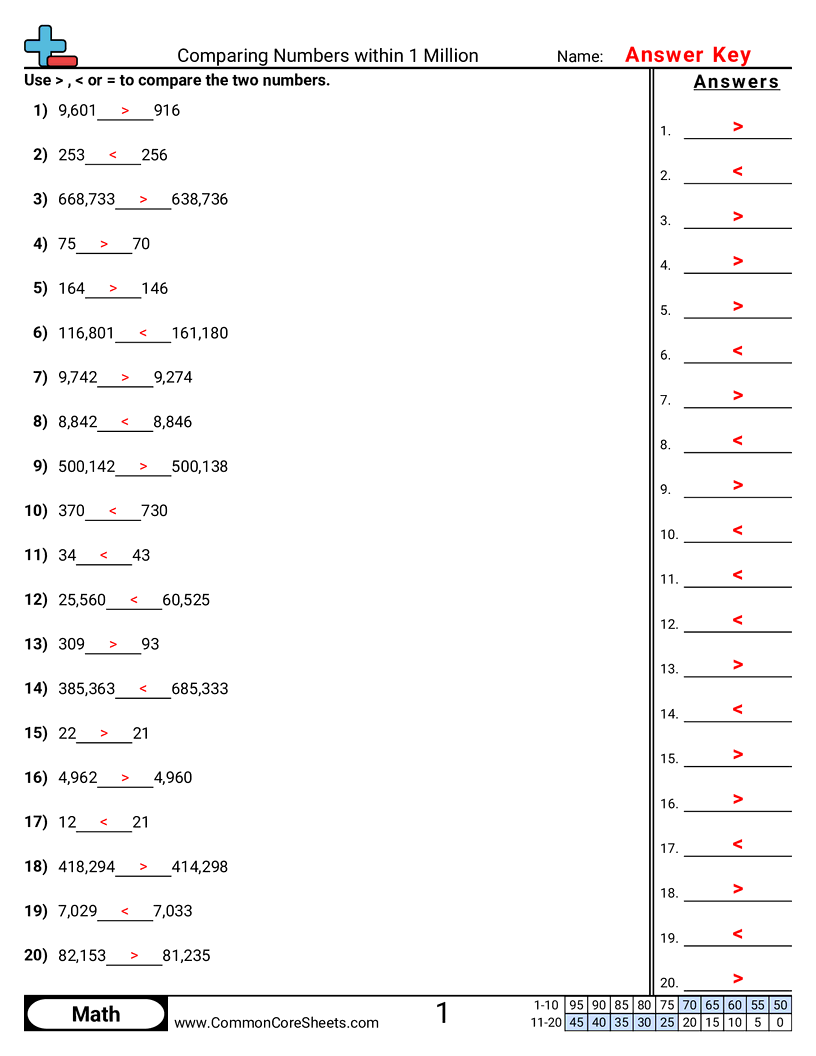
"This worksheet is designed to enhance children's understanding of number comparison up to 1 million. With 20 math problems involving greater, less than, or equal concepts, it encourages numerical literacy. The worksheet is customizable, adaptable to flashcards, and suitable for distance learning, ensuring a versatile tool for nurturing mathematical skills."
×
Student Goals:
Understand the Concept of Comparing NumbersAfter completing the worksheet, students should have a firm grasp on the concept of comparing numbers. They should understand the use and significance of the comparison symbols '>', '<', and '='. Students will be able to identify which number is greater than, less than, or equal to another, thereby developing practical math skills essential for tackling complex problems.Develop number senseThis worksheet will introduce students to numbers within 1 million, thereby building strong number sense. They will be comfortable dealing with large numbers, understand their structure, and the order of their magnitude. The student's ability to visualize different numbers and their values compared to each other will be significantly strengthened.Enhance Problem-Solving SkillsWorking through 20 problems in such a detailed way also encourages the development of problem-solving skills. Students will learn the process of deducing the relation between two numbers based on their values. This act of identifying relevant information, setting up strategy, and solving, fosters critical thinking and logic.Growth in Mathematical ConfidenceAs their understanding grows, students will likely improve their confidence in dealing with large numbers. This self-assuredness can in turn increase participatory behavior in class discussions and provide an overall boost to their performance.Accuracy and Speed in MathematicsPractice makes perfect. By completing this worksheet, students will get plenty of practice comparing large numbers. This frequent practice will help them complete comparisons quickly and accurately, fostering efficiency in math classrooms and exams.Application of Skills to Real-life SituationsAfter mastering the skill of comparing numbers, students will be able to apply this knowledge to real-world situations. Whether comparing prices, distances, measurements or statistics, they'll be able to discern the larger, smaller, or equivalent values effectively.