Snowy Owl Worksheet Download
Free reading worksheets on Snowy Owl. Each worksheet has 20 problems with an answer key and are ideal for teachers and homeschooling. You can download the PDF, create a set of flash cards or set it up for online learning.
Select a Different Activity
>
Sheet Information >
Available at 2nd grade, 3rd grade, 4th grade, 5th grade and 6th grade reading levels.
Read the passage
Let's dive into the fascinating world of snowy owls, shall we? These stunning birds have a pure white color, sometimes speckled with black spots, and can be as tall as 2 feet with a wingspan of 4.2 to 4.8 feet. Snowy owls live in the cold Arctic regions of North America and Eurasia, and when it gets too cold there, they fly to warmer places like Canada and the northern United States.
Now, let's talk about what snowy owls eat and their life cycle. Snowy owls are carnivores, which means they eat meat - their favorite meals are lemmings and other small mammals, but they also eat fish and birds. They lay their eggs in May or June, and by the time it's September, the little owlets are ready to live on their own.
Finally, let's discuss how snowy owls relate to humans and other animals, and some fun facts about them. While snowy owls don't pose a threat to humans and are known to be quite peaceful, they are very protective of their nests and will defend them if they feel threatened. An interesting fact about snowy owls is that unlike most owl species, both male and female snowy owls hunt.
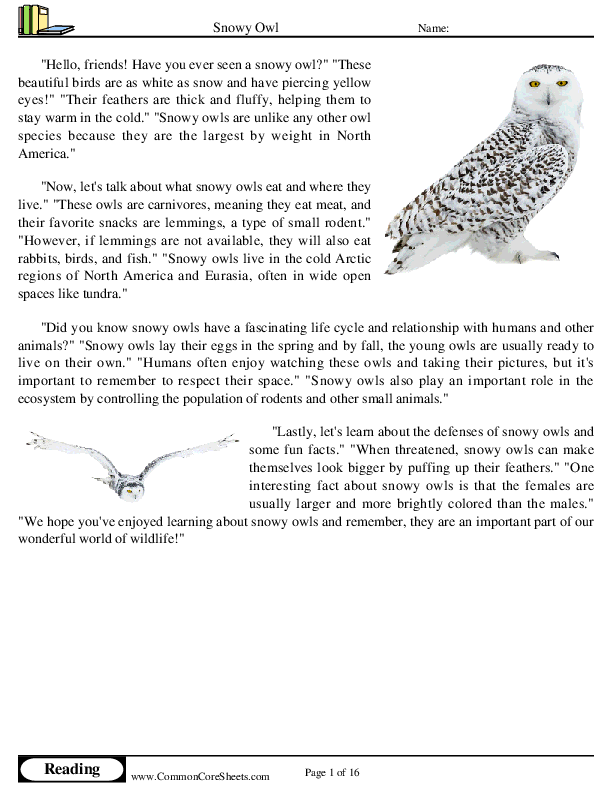
"Hey there, kiddos! Let's chat about the majestic snowy owl." "These beautiful birds are white, like a fresh snowfall, and they have amazing yellow eyes that can spot a mouse from way high up." "Unlike some other owls, snowy owls are active during the day, especially when they're hunting." "And speaking of hunting, did you know that these owls love to eat small mammals like lemmings, rabbits, and even other birds?"
"Now let's talk about where the snowy owl lives." "These owls are true northerners, living in the icy Arctic tundra in North America and Eurasia." "In the wild, snowy owls live for about 10 years, and during that time, they can have lots of babies, called owlets." "Mommy owls lay up to 11 eggs at a time and stay on the nest to keep them warm while daddy owls bring food."
"Finally, let's explore snowy owls' relationship with humans and other animals." "Snowy owls can be a little scared of humans, but they're not usually harmful unless they feel threatened." "As for other animals, well, snowy owls are at the top of the food chain in their Arctic home, which means they don't have many enemies." "So, whether you're admiring a snowy owl from a distance or learning about them from a book, remember: these remarkable birds are a special part of our wonderful world."
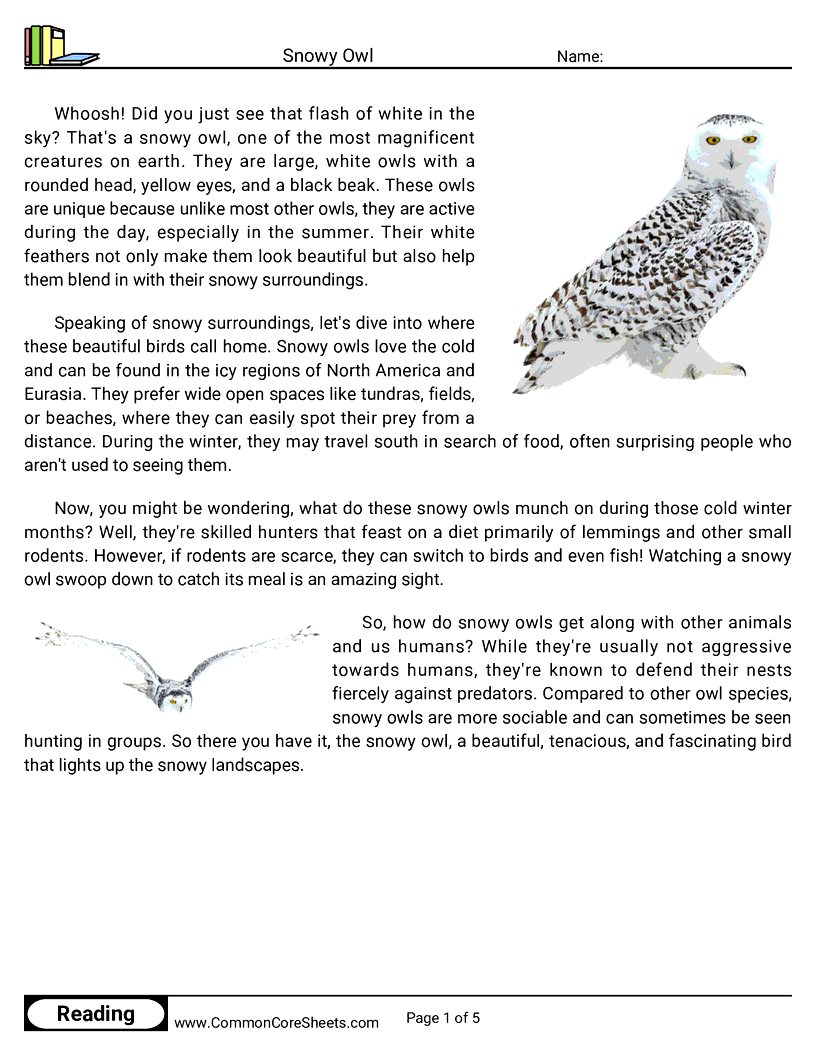
Whoosh! Did you just see that flash of white in the sky? That's a snowy owl, one of the most magnificent creatures on earth. They are large, white owls with a rounded head, yellow eyes, and a black beak. These owls are unique because unlike most other owls, they are active during the day, especially in the summer. Their white feathers not only make them look beautiful but also help them blend in with their snowy surroundings.
Speaking of snowy surroundings, let's dive into where these beautiful birds call home. Snowy owls love the cold and can be found in the icy regions of North America and Eurasia. They prefer wide open spaces like tundras, fields, or beaches, where they can easily spot their prey from a distance. During the winter, they may travel south in search of food, often surprising people who aren't used to seeing them.
Now, you might be wondering, what do these snowy owls munch on during those cold winter months? Well, they're skilled hunters that feast on a diet primarily of lemmings and other small rodents. However, if rodents are scarce, they can switch to birds and even fish! Watching a snowy owl swoop down to catch its meal is an amazing sight.
So, how do snowy owls get along with other animals and us humans? While they're usually not aggressive towards humans, they're known to defend their nests fiercely against predators. Compared to other owl species, snowy owls are more sociable and can sometimes be seen hunting in groups. So there you have it, the snowy owl, a beautiful, tenacious, and fascinating bird that lights up the snowy landscapes.
"Let's dive into the world of Snowy Owls, fascinating creatures of the wild!" Known for their dazzling white feathers, they are one of the largest species of owl and love to stay in the coldest parts of the world. Unlike most owls, which are nocturnal, snowy owls are active during the daytime, especially in the summer. These beautiful birds have a wingspan of about 5 feet and can weigh up to 6 pounds!
"Now, let's find out about where Snowy Owls call home." These incredible birds usually live in the Arctic regions of North America and Eurasia, but sometimes, they travel south in the winter. Snowy owls prefer open spaces like tundra, fields, or beaches, where they can spot their prey from a distance. When it comes to nesting, they like to choose high points like hillocks, dunes or even hay bales!
"So what do Snowy Owls like to eat?" Snowy owls are carnivores and their favorite meal is lemmings, a kind of small rodent. When lemmings are not available, they can also eat other small mammals, birds, and even fish! They use their excellent eyesight and hearing to hunt, even in the dim light of the Arctic.
"Let's explore the life cycle of a Snowy Owl." After hatching from eggs, baby snowy owls, called owlets, stay in the nest for about six weeks before they start to fly. Snowy owls grow up fast and by fall, they're already ready to leave their parents and start their own life. Did you know? Snowy Owls can live for more than 10 years in the wild!
"Finally, let's talk about Snowy Owls’ relationship with humans and other animals." Snowy owls generally avoid humans, but they've been known to attack if they feel their nest is threatened. In terms of other animals, they're at the top of the food chain with few natural predators, thanks to their size and powerful defences. So, as we close our snowy owl adventure, remember that just like all wildlife, it's important to respect these magnificent birds and their habitats."
"Have you ever wondered about the majestic Snowy Owl?" "Snowy owls, or Bubo scandiacus as scientists call them, are large birds that are often associated with wisdom in many cultures." "Their striking white feathers make them stand out in their native habitats, but did you know that only male snowy owls are completely white?" "Females and young owls have some dark markings, which help them blend into their surroundings." "Their big, round yellow eyes are perfect for spotting prey even in the dim light."
"Now let's explore where these amazing creatures live." "Snowy owls are native to Arctic regions in North America and Eurasia, with their range extending as far south as the northern United States during the winter months." "They prefer open landscapes like tundra, but can also be found in fields and airports." "Their nests are simple scrapes in the ground, often on top of a mound or boulder." "In these cold environments, their thick feathers act as perfect insulation."
"What do snowy owls eat, you might ask?" "These birds are carnivorous and their diet mainly consists of small mammals, especially lemmings." "But they also eat rabbits, rodents, birds, and even fish." "They have excellent hunting skills, swooping down silently to catch their prey unawares." "A single owl can eat more than 1,600 lemmings in a year!"
"Snowy owls have an interesting life cycle." "They start life as eggs, laid in a clutch of 3 to 11." "After about a month, the chicks hatch and are looked after by both parents." "In a few months, they learn to fly and hunt, and by the next winter, they're ready to live on their own." "Snowy owls can live up to 10 years in the wild."
"Finally, let's talk about the relationship between snowy owls and humans." "Historically, snowy owls have been respected and revered in many cultures." "Today, they are protected in many areas, and efforts are being made to conserve their habitats." "Unfortunately, they sometimes pose a risk to aircraft, leading to conflicts." "But overall, humans and snowy owls can coexist peacefully, especially if we make efforts to protect their habitats and respect their needs."
About this worksheet
Students read a short informational passage about the snowy owl and answer comprehension questions about its habitat, diet, and features.
This worksheet is designed to educate children about the Snowy Owl through engaging reading problems. It covers 20 concept questions on the animal's characteristics, diet, behavior, and habitat. Ideal for distance learning, it can be customized for varying learning techniques or converted into flash cards. A handy tool to instigate independent research and improve reading comprehension skills.
Student objectives
- Read a nonfiction passage about snowy owls
- Find facts and details in what you read
- Answer questions using information from the text
- Learn new words related to birds and their habitats
- Understand how snowy owls survive in cold places
Everyday practice
- Recognize a snowy owl when you see one in a book or at the zoo
- Share facts about snowy owls with friends or family
- Understand animal facts in a nature documentary
- Look up information about an animal you're curious about