Snow Fleas Worksheet Download
Free reading worksheets on Snow Fleas. Each worksheet has 20 problems with an answer key and are ideal for teachers and homeschooling. You can download the PDF, create a set of flash cards or set it up for online learning.


Sheet Information >
Available at 2nd grade, 3rd grade, 4th grade, 5th grade and 6th grade reading levels.
Read the passage
Let's learn about snow fleas, tiny insects that love the cold weather! Snow fleas, also known as springtails, are very small, and they are dark blue or purple in color. You can find them hopping around on the snow during winter, especially on warm, sunny days.
Snow fleas have a fascinating life cycle and eating habits. They like to eat decaying plants and fungi, which helps to break down organic matter and recycle nutrients in the soil. Snow fleas go through several stages of development, starting as eggs, then growing into tiny nymphs, and finally becoming adults.
Now, let's explore how snow fleas interact with humans and other insects. Snow fleas are harmless to humans, and they are even helpful because they help with the decomposition process in the environment. These tiny creatures have a special protein in their bodies that helps them survive freezing temperatures, which makes them quite unique among insects.
So there you have it, snow fleas are fascinating little insects that play an important role in our ecosystem. Next time you're out in the snow, keep an eye out for these tiny creatures hopping around and remember the amazing things they do!
Let's learn about the fascinating world of snow fleas! These tiny insects, also known as springtails, can be found hopping around on the snow during the winter months. They have a special protein in their bodies that helps them stay active in cold temperatures and not freeze. Snow fleas live in the soil and leaf litter, where they eat decaying plant material, fungi, and bacteria.
Now, let's dive into the life cycle and relationships of snow fleas. These little critters go through a series of molts, shedding their outer layer as they grow from eggs to adults. Snow fleas are harmless to humans and are actually beneficial to the environment as they help break down organic matter. They're also a great source of food for other insects and small animals, making them an important part of the ecosystem.
Last, let's explore the unique features and interesting facts about snow fleas. Unlike other insects, snow fleas don't have wings or jump with their legs, but instead use a special fork-like structure called a furcula to leap into the air. They're also different from other flea species because they don't bite or feed on blood. An interesting fact is that snow fleas can jump up to 100 times their body length, which is quite impressive for such a tiny creature!
In this friendly article for 9-year-olds, snow fleas are introduced, and their habitats, diets, life cycles, and relationships to humans and other insects are discussed. Unique features, differences between species, and interesting facts are also presented.
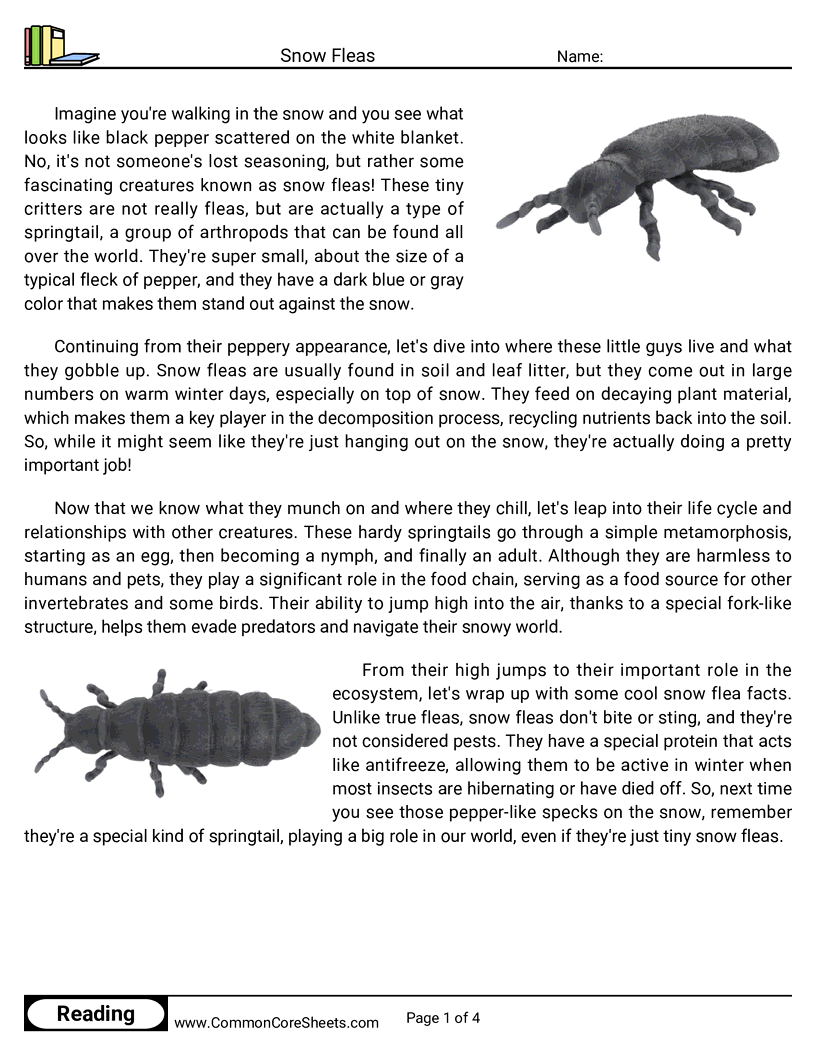
Imagine you're walking in the snow and you see what looks like black pepper scattered on the white blanket. No, it's not someone's lost seasoning, but rather some fascinating creatures known as snow fleas! These tiny critters are not really fleas, but are actually a type of springtail, a group of arthropods that can be found all over the world. They're super small, about the size of a typical fleck of pepper, and they have a dark blue or gray color that makes them stand out against the snow.
Continuing from their peppery appearance, let's dive into where these little guys live and what they gobble up. Snow fleas are usually found in soil and leaf litter, but they come out in large numbers on warm winter days, especially on top of snow. They feed on decaying plant material, which makes them a key player in the decomposition process, recycling nutrients back into the soil. So, while it might seem like they're just hanging out on the snow, they're actually doing a pretty important job!
Now that we know what they munch on and where they chill, let's leap into their life cycle and relationships with other creatures. These hardy springtails go through a simple metamorphosis, starting as an egg, then becoming a nymph, and finally an adult. Although they are harmless to humans and pets, they play a significant role in the food chain, serving as a food source for other invertebrates and some birds. Their ability to jump high into the air, thanks to a special fork-like structure, helps them evade predators and navigate their snowy world.
From their high jumps to their important role in the ecosystem, let's wrap up with some cool snow flea facts. Unlike true fleas, snow fleas don't bite or sting, and they're not considered pests. They have a special protein that acts like antifreeze, allowing them to be active in winter when most insects are hibernating or have died off. So, next time you see those pepper-like specks on the snow, remember they're a special kind of springtail, playing a big role in our world, even if they're just tiny snow fleas.
Have you ever heard of snow fleas? These fascinating little creatures are also known as springtails and are not actually fleas at all! These tiny insects are usually dark blue or black and measure only about 1 millimeter in length. You can find them bouncing around on the surface of the snow during the winter months, which is how they got their name. Now, let's dive into their fascinating world and learn more about their diet, habitat, and lifecycle.
So, what do snow fleas eat? These little insects feed on decaying organic matter, such as dead leaves and plants. Their diet also consists of fungi, bacteria, and algae, which they find in the soil. Snow fleas have a unique way of eating: they secrete digestive enzymes onto their food, which breaks it down into smaller particles that they can then easily consume. This process is essential for the ecosystem, as they help recycle nutrients back into the soil.
Now, let's explore the life cycle of snow fleas. Their life begins as an egg, which is laid by the female in the soil. Once the eggs hatch, the young snow fleas, called nymphs, go through several stages of growth called instars, shedding their exoskeleton each time they grow. Eventually, they reach adulthood and are ready to reproduce and lay eggs of their own.
Snow fleas have a unique relationship with both humans and other insects. While they pose no harm to humans and are not considered pests, they can be beneficial to gardeners by helping to aerate the soil and break down organic matter. In fact, many other insects and organisms rely on snow fleas as a food source, such as spiders, mites, and small birds. This makes them an essential part of the food chain and overall ecosystem.
Lastly, let's learn some interesting facts about snow fleas. One key difference between snow fleas and other species is their ability to survive in cold temperatures, thanks to a special protein in their bodies that prevents them from freezing. They also have a unique defense mechanism called a furcula, which is a forked appendage on their abdomen that allows them to jump up to 100 times their body length to escape predators. It's incredible to think that such tiny creatures can have such fascinating abilities and play such a crucial role in our ecosystem.
Have you ever heard of snow fleas? These tiny, fascinating creatures are not actually fleas at all, but rather a type of springtail called Hypogastrura nivicola. Although they are called snow fleas, they do not bite or cause harm to people or animals. Instead, they are a special kind of insect that can survive in cold temperatures and even live on top of snow during the winter months. Let's explore more about these amazing creatures and their unique characteristics.
Snow fleas thrive in a variety of habitats, such as forests, gardens, and even your backyard. They live in the soil and leaf litter, where they feed on decaying organic matter like dead leaves and plants, as well as fungi and bacteria. During the winter months, you can sometimes spot them on the surface of the snow, where they appear as tiny, dark specks. Snow fleas are able to move around by using a special, forked tail called a furcula, which allows them to jump great distances relative to their size. This jumping ability helps them avoid predators and find food sources.
The life cycle of snow fleas is quite fascinating. They go through several stages, beginning as eggs, then developing into larvae, and ultimately becoming adults. Snow fleas reproduce by laying their eggs in the soil, where they hatch into tiny larvae that grow and molt several times before reaching adulthood. These resilient insects can live for up to one year, and some can even survive freezing temperatures due to a special protein in their bodies called antifreeze protein. This protein helps prevent ice crystals from forming inside their bodies, allowing them to stay active even in the coldest conditions.
Humans and snow fleas share a unique, beneficial relationship. While snow fleas pose no threat to humans, they actually play a crucial role in maintaining the health of the soil and ecosystems around us. By feeding on decaying organic matter, they help break it down and recycle nutrients back into the soil. This process is essential for maintaining fertile, healthy soil that supports plant growth and other life forms. Additionally, snow fleas serve as an important food source for many other insects and small animals.
What sets snow fleas apart from other insects? One major difference is their ability to survive in cold temperatures, thanks to the antifreeze protein mentioned earlier. Another unique characteristic is their jumping ability, which is not common among other insects of their size. Unlike true fleas, snow fleas do not bite or feed on blood, making them harmless to humans and pets. These interesting insects remind us that even the smallest creatures can have a big impact on our world and its ecosystems.
About this worksheet
Students read a short informational passage about snow fleas and answer questions about the key details and main ideas.
This worksheet is designed to enhance children's reading skills through engaging content about snow fleas. It explores the unique traits and habitat of these creatures, debunking myths and sparking curiosity. The 20-problem format can be customized, converted into flashcards, or used in distance learning environments, providing flexibility and adaptability in education. It's an enlightening blend of literacy and science study.
Student objectives
- Read a nonfiction passage and understand what it says about snow fleas
- Find specific facts and details in the text to answer questions
- Figure out the main idea of what you read
- Understand new words using clues from the passage
Everyday practice
- Understand a nature article about an interesting insect you spotted outside
- Answer questions after reading a science book about bugs
- Explain to someone what you learned from a short article
- Look up facts about an animal and pull out the important details