Skink Worksheet Download
Free reading worksheets on Skink. Each worksheet has 20 problems with an answer key and are ideal for teachers and homeschooling. You can download the PDF, create a set of flash cards or set it up for online learning.
Select a Different Activity
>


Sheet Information >
Available at 2nd grade, 3rd grade, 4th grade, 5th grade and 6th grade reading levels.
Read the passage
Skinks are fascinating little creatures that can be found all around the world. These scaly lizards come in many different colors and sizes, with some being as small as your finger, while others can grow to be as long as your arm. You can find skinks living in a variety of environments, such as forests, grasslands, and even in your backyard.
When it comes to their diet, skinks are not picky eaters at all. They love to munch on insects like crickets, beetles, and caterpillars, but they also eat fruits, plants, and sometimes even small animals like mice. As for their life cycle, skinks lay eggs, and after a few weeks, baby skinks hatch and begin their journey into the world.
Skinks are pretty good at keeping themselves safe from predators. One of their coolest tricks is their ability to lose their tails when in danger, which can grow back later. While skinks might not be the best pets for everyone, they do help control insect populations and can be interesting little friends to observe in their natural habitats.
Skinks are fascinating little reptiles that can be found all around the world. These scaly creatures come in various colors and sizes, but most are small and have long, slender bodies with short legs. They usually live in forests, grasslands, and even deserts, making their homes in burrows or hiding under rocks and logs. Skinks are pretty adaptable, which allows them to live in many different environments.
Skinks are primarily insectivores, which means they love munching on insects like crickets, beetles, and caterpillars. However, some skinks also eat fruits, vegetables, and even small animals like other lizards or baby rodents. Since skinks have many predators like birds, snakes, and larger mammals, they have developed some unique ways to protect themselves. One cool defense mechanism is their ability to shed their tail when they feel threatened, which can distract a predator and give the skink a chance to escape.
Skinks are not only interesting to learn about, but they also play an important role in their ecosystems. By eating insects, they help control bug populations, which can be beneficial to humans and other animals. Even though skinks are not typically dangerous to humans, it\'s always a good idea to leave them alone and observe from a distance. So next time you spot a skink, remember that they are fascinating creatures with unique features and an important job in their habitats.
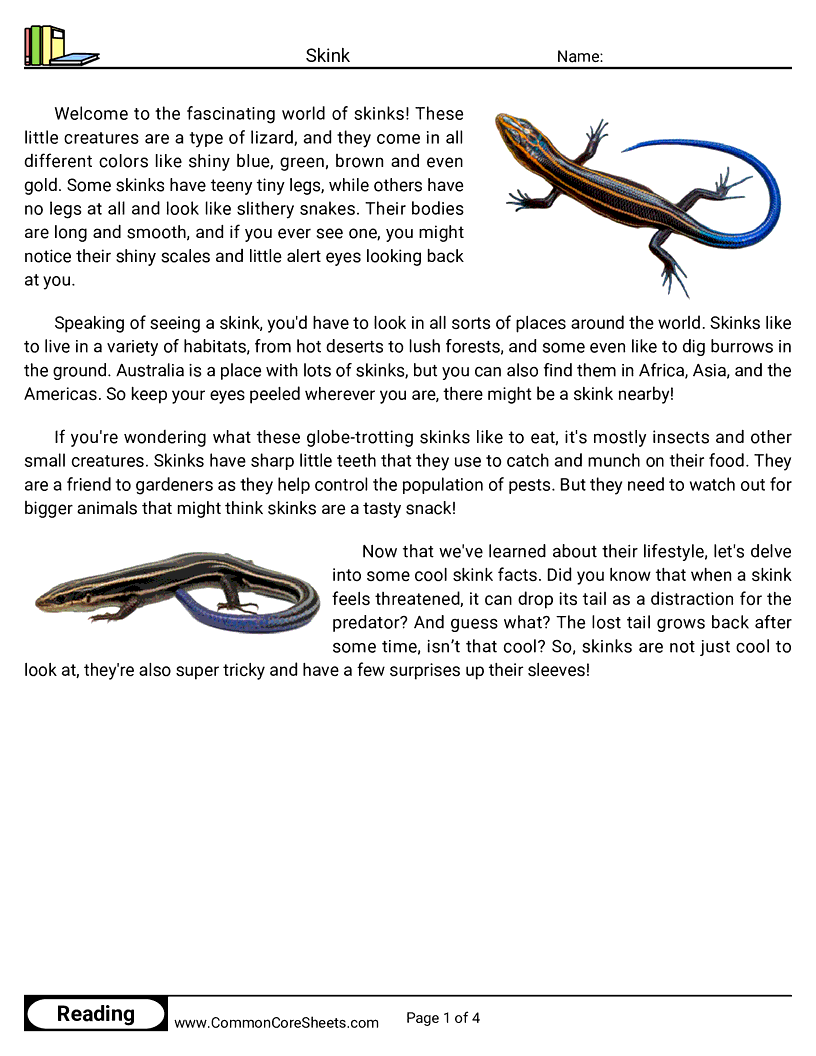
Welcome to the fascinating world of skinks! These little creatures are a type of lizard, and they come in all different colors like shiny blue, green, brown and even gold. Some skinks have teeny tiny legs, while others have no legs at all and look like slithery snakes. Their bodies are long and smooth, and if you ever see one, you might notice their shiny scales and little alert eyes looking back at you.
Speaking of seeing a skink, you'd have to look in all sorts of places around the world. Skinks like to live in a variety of habitats, from hot deserts to lush forests, and some even like to dig burrows in the ground. Australia is a place with lots of skinks, but you can also find them in Africa, Asia, and the Americas. So keep your eyes peeled wherever you are, there might be a skink nearby!
If you're wondering what these globe-trotting skinks like to eat, it's mostly insects and other small creatures. Skinks have sharp little teeth that they use to catch and munch on their food. They are a friend to gardeners as they help control the population of pests. But they need to watch out for bigger animals that might think skinks are a tasty snack!
Now that we've learned about their lifestyle, let's delve into some cool skink facts. Did you know that when a skink feels threatened, it can drop its tail as a distraction for the predator? And guess what? The lost tail grows back after some time, isn’t that cool? So, skinks are not just cool to look at, they're also super tricky and have a few surprises up their sleeves!
Hey there, have you ever heard of skinks? Skinks are fascinating reptiles that come in many shapes, colors, and sizes. They belong to the lizard family and can be found all around the world. Let\'s dive into the world of skinks and learn more about these amazing creatures.
First off, let\'s talk about what skinks eat and where they live. Skinks are mostly omnivores, which means they eat both plants and small insects like beetles, caterpillars, and ants. These adaptable reptiles can be found in a variety of habitats, including forests, grasslands, and even your backyard! Skinks like to hide under rocks, logs, and leaves to stay safe from predators.
Now let\'s look at the life cycle of a skink. Skinks typically lay eggs, but some species give birth to live young! After hatching or being born, baby skinks grow up quickly, reaching maturity in just a few years. These incredible creatures can live for several years, with some species living up to 20 years or more!
Skinks have some interesting relationships with humans and other animals. In some cultures, skinks are considered good luck and are even kept as pets. Skinks can also help control insect populations, making them helpful to have around your home. However, they also need to watch out for predators like birds, snakes, and larger mammals that see them as a tasty snack.
Lastly, let\'s explore some cool facts and differences between skink species. Did you know that there are over 1,500 different species of skinks? Some skinks have no legs, while others have short legs or even brightly colored tails. One unique skink, the blue-tongued skink, uses its bright blue tongue to scare away predators. Isn\'t it amazing how diverse and fascinating these creatures are?
Skinks are fascinating creatures that can be found all around the world. These reptiles belong to the family Scincidae, which is one of the most diverse families of lizards. Skinks come in a variety of shapes, sizes, and colors. Some are small and slim with smooth scales, while others are larger with rough, keeled scales. They can be found in almost every habitat, from forests to deserts and even in your own backyard!
When it comes to food, skinks are not picky eaters. Most skinks are omnivores, which means they eat both plants and insects. Their diet mainly consists of insects like crickets, beetles, and caterpillars, but they also enjoy fruits and vegetables. Larger skinks may even eat small vertebrates like rodents or other reptiles. They have strong jaws and sharp teeth to help them catch and chew their food.
The life cycle of a skink is quite interesting and varies among species. Many skinks lay eggs, while others give birth to live young. Eggs are usually laid in a hidden spot, such as under a log or in a crevice. Once hatched, baby skinks are independent and must fend for themselves. Skinks can live anywhere from a few years to over a decade, depending on the species.
Skinks have unique relationships with both humans and other animals. Many people enjoy keeping skinks as pets, due to their friendly and curious nature. In the wild, skinks often share their habitat with other reptiles, birds, and mammals. They can sometimes be prey for larger animals, but they also help control insect populations. Some species, like the blue-tongued skink, have developed bright colors to warn predators of their potential danger.
There are some fascinating differences between skink species and other reptiles. One unique feature is that some skinks have the ability to lose and regrow their tail as a defense mechanism. This is called 'autotomy' and helps the skink escape from predators by distracting them with the wiggling tail. Skinks also have smooth, shiny scales, which can make them appear more snake-like than other lizards. Finally, many skinks have short limbs or even no limbs at all, which helps them move quickly and efficiently through their environment.
With so many diverse species and fascinating adaptations, skinks are truly remarkable creatures that can teach us a lot about the natural world.
About this worksheet
Students read a passage about skinks and answer comprehension questions to show understanding of key details and facts.
This worksheet is designed to educate children about skinks - unique types of lizards. It covers various aspects such as their physical attributes, habitat, diet, and unique abilities. The 20-question worksheet can be customized to meet individual needs, including conversion into flashcards, making it an ideal resource for both classroom and distance learning. It's an engaging and interactive tool to make learning about Skinks fun and informative.
Student objectives
- Read a nonfiction passage about skinks and understand the main idea
- Find specific facts and details in the text to answer questions
- Learn new vocabulary related to lizards and reptiles
- Practice explaining answers using evidence from the reading
Everyday practice
- Read a fact sheet at a zoo or nature center about lizards
- Look up information about a pet reptile before caring for it
- Answer questions about an animal article you read for fun
- Share interesting facts about skinks with family or friends