4nf2×Description:
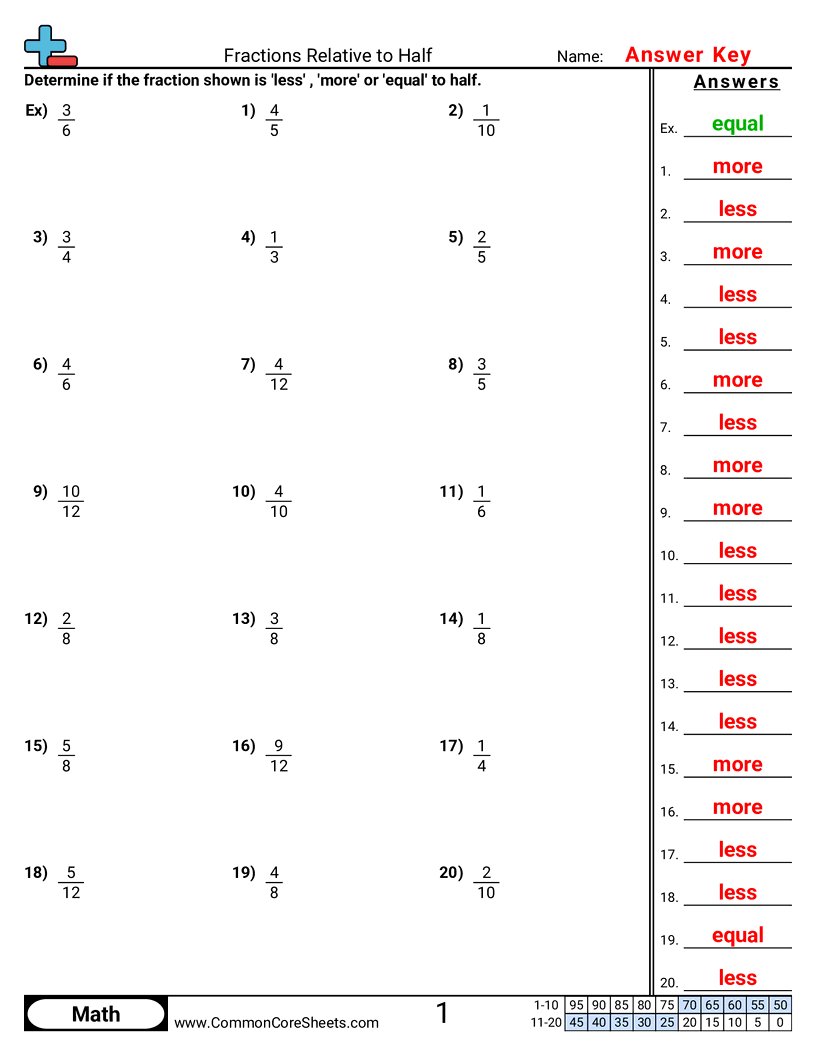
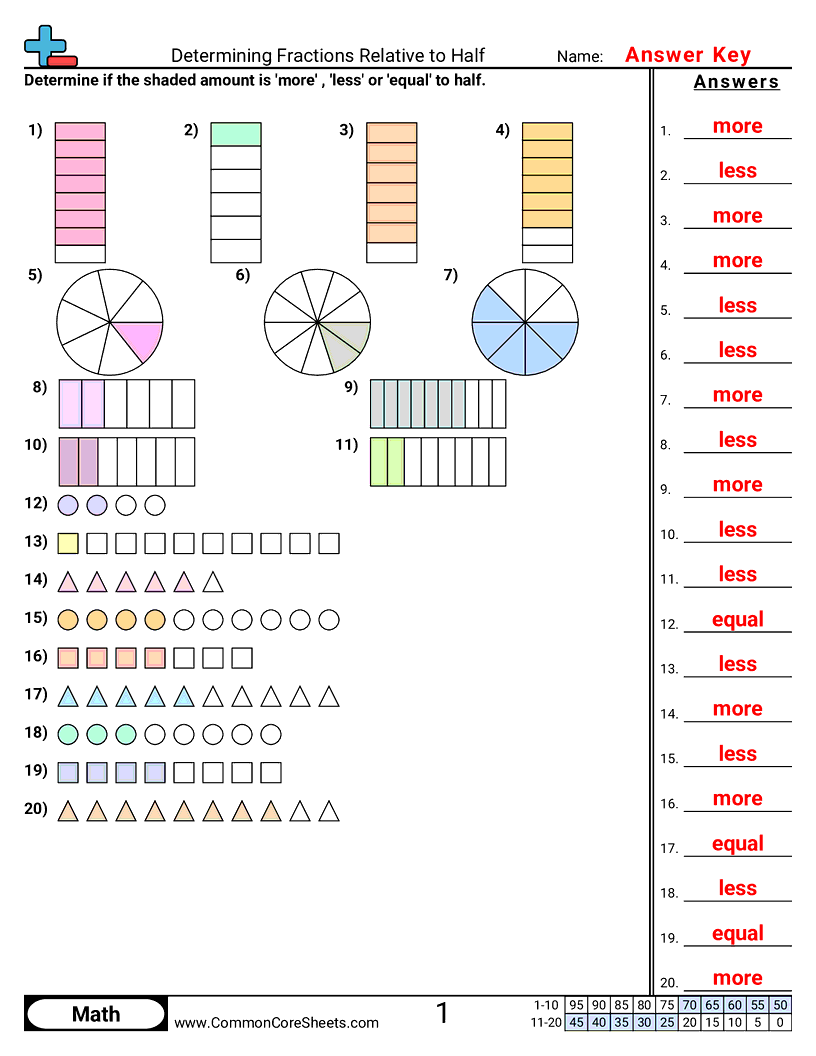
"This worksheet is designed to educate children on the concept of fractions relative to half in a math context. It encompasses 20 distinctive problems, ranging from basics such as 3/6 to more challenging instances like 5/8. Perfect for distance learning, the worksheet is flexible, allowing for user customization and a seamless conversion into flashcards to enhance comprehension and memory retention. Ideal for instilling a strong foundation in fractions."
×Student Goals: Understanding of FractionsAfter completing the worksheet, students should have a deeper understanding of fractions. They should be able to identify numerators and denominators and what they represent in the context of a whole. They should understand how fractions are used to represent portions of a whole, and how different fractions can express the same value.Conversion SkillsStudents should be able to convert fractions to their simplest form. For example, they should know that 2/4 is the same as 1/2. They should also be able to convert improper fractions to mixed numbers, and vice versa. Their ability to compare and order fractions should also be enhanced.Relating Fractions to HalfAn important learning outcome is for students to understand fractions relative to the value of one half. They should appreciate how different fractions are smaller or larger than one half. They should be able to make estimations about the value of fractions based on their relation to one half.Problem Solving SkillsCompletion of the worksheet should also bolster students' problem-solving skills. Not only will students answer specific problems, but they will also apply concepts and strategies learned to solve new, unfamiliar fractional problems. This applies their understanding in a practical and meaningful way.Math Language and TermsThe worksheet should arm students with the correct mathematical language and terms. They should be able to use the proper terminology and symbols when representing and discussing fractions. This helps them to effectively communicate their mathematical thoughts and understandings.Confidence in MathematicsLastly, successfully working out fraction problems can boost students' confidence in their math abilities. They should feel encouraged to further explore and learn more complex fraction concepts and other areas of mathematics. Overall, the enhanced confidence could foster a positive attitude towards learning mathematics.